I. The Elaborate Machinery of Small People
Here’s what most people miss about workplace mobbing: it isn’t random. It isn’t a bad week that got out of hand, or a personality clash. It’s engineering. There’s a designed output—specifically, that the target comes to believe the low valuation being assigned to her. The goal isn’t just to hurt her. The goal is to get her to agree that she deserved it. Get her to react to justify what they’re doing.
The coordination is the tell, and the coordination is damning. We’re talking about multiple people—adults with mortgages and opinions about ethics—each individually suppressing their moral hesitation, simultaneously, in secret. That’s not a crowd. That’s a conspiracy. And the fact that it has to be secret is itself a confession. Everyone involved already knows the verdict on their own behavior. That’s precisely why they’re hiding it. The concealment isn’t strategic. It’s reflexive. It’s what guilt looks like when it refuses to become accountability.
Vera noticed the architecture early. The campaign never happened anywhere it could be named. It lived in margins, in deniable exchanges, in looks traded across rooms, in bizarre but deniable actions aimed at her. The cowardice had a blueprint. That’s not incidental—that’s the point. When cruelty is this deliberately invisible, you’re not dealing with people who lost their tempers. You’re dealing with people who planned ahead.
Now hold two things in the same frame, because this is where it gets almost philosophically interesting: the scale of the operation versus the scale of the people running it. They organized. They recruited. They coordinated and sustained it over time. This was a project. And the entire project existed to hurt one person’s feelings. That’s the return on investment. That’s what all that effort purchased.
These are not interesting villains. They don’t have the grandeur their behavior implies. They’re frightened people who made a choice—not the hard choice of looking inward and asking why someone else’s existence disturbs them, but the easy choice of becoming worse. The grandiosity of the operation and the smallness of the soul behind it deserve to be held together, unflinchingly, in the same light. Because once you see it, you can’t unsee it. And they were counting on you never seeing it at all.
II. The Verdict Requires a Court
Humiliation is, epistemologically, a verdict. And verdicts require jurisdiction. That’s not a semantic escape hatch—it’s the actual structure of how this works. For the campaign to land, for the target to absorb the low valuation being collectively assigned, she has to first grant the aggressors the authority to evaluate her. She has to, on some level, recognize them as a legitimate court.
Their entire operation rests on that assumption. It presupposes, without ever saying so, that belonging with them is worth wanting. That their approval is a currency worth having. That exclusion from their particular circle constitutes a loss. The campaign doesn’t work otherwise. Remove that one unstated premise and the whole architecture collapses.
What almost no one does—because the social noise is too loud, because exclusion triggers something ancient and panicked in the nervous system—is audit the offered belonging before accepting its terms. Stop. Actually look at what’s being withheld. Ask: do I want this? Do these people’s opinions of me carry weight I’d rationally assign them? Is membership in this group something I’d choose on a clear day, without the pressure of being denied it?
If that audit returns a negative result, the exclusion stops being a wound. It becomes, almost against everyone’s intentions, a gift. An inadvertent one, but a gift nonetheless. They meant to take something. They accidentally handed you your own freedom from needing them.
Vera didn’t give them the reaction they’d designed the campaign to produce—and not as a performance of composure. Not as a clenched-jaw act of dignity. She didn’t give it to them because giving it would’ve been a lie. She could see what they were doing. She could see what they wanted. And people who organize covert cruelty do not get to also receive a sincere emotional confirmation that it worked. They are owed nothing—least of all the satisfaction.
Her contempt made the whole transaction impossible. Not contempt as a pose, but contempt as a logical conclusion. You look at small people banding together, doing harm in secret because they’re too cowardly to either compete or confront directly, and there’s really only one honest response. It isn’t devastation. It isn’t grief. It’s the specific, clarifying recognition of exactly how unserious these people are. Pathetic is the word. It fits, and it doesn’t require any additional explanation.
III. Why Moral Contempt Is the Only Response That Holds
Not all contempt is created equal, and the distinction matters more than it might seem. Status contempt—the sense that you’re simply better, more accomplished, higher-ranking—is destabilizable. So is competence contempt. Both of those are tethered to social reality, which is precisely the terrain the campaign is designed to manipulate. If they can make enough people agree with the low valuation, if they can erode enough of your external footing, those forms of contempt start to wobble. They need a stable external reference point, and the whole operation is aimed at destroying your stable external reference points. It’s a reasonable strategy, as far as it goes.
Moral contempt for the acts themselves operates differently. It doesn’t require you to be better than the aggressors in any dimension except this one: the ability to perceive what’s actually happening. That’s it. That’s the whole requirement. And it’s self-confirming in a way that status and competence contempt simply aren’t—each escalation, every new move in the campaign, generates further evidence for the original reading rather than posing a challenge to it. They believe that increased pressure will eventually produce the wound they’re after. What they’re actually doing is making their own behavior more legible. Every additional move is another data point. They are, without knowing it, building the case against themselves.
Here’s the requirement that keeps this honest, though, because it has to be said: the contempt has to be true. This isn’t a license for defensive contempt—the reflexive decision that anyone who hurts you must be contemptible. That’s a distortion. It seals off legitimate feedback, insulates you from correction, and will make you worse over time in ways you won’t be able to see because you’ve pre-emptively discredited anyone who might tell you. That’s its own trap, and it’s worth naming clearly.
What’s described here is different. It tracks observable, structural features: the coordination, the concealment, the recruitment, the sustained intentionality over time. Not interpretations. Not emotional reactions dressed up as analysis. The architecture is visible, and what it reveals about the people running it is simply what it reveals. The contempt follows from the perception of facts.
And this—crucially—is not ressentiment. The aggressor doesn’t become an ongoing reference point. There’s no obsessive return to the wound, no identity built around opposition to them. Ressentiment keeps the other person at the center of your psychic life while pretending to dismiss them. This is something else entirely. The contempt is a completed act of perception. You see what they are. You register it. You render them permanently ineligible as evaluators—not as a defensive maneuver, but as a logical conclusion—and then it’s done. They don’t get to live in your head in the aftermath. They’re simply no longer relevant. That’s the difference between contempt that frees you and contempt that traps you in a mirror facing another mirror. One is a door. The other is a cell.
IV. The Spectacular Confusion of People Who Expected a Wound
Aggressors watch for return signals. They need them. The whole operation is designed around receiving confirmation that the weapon landed—visible distress, bids for reconciliation, the angry outburst, the public unraveling. Any of these will do. What they’re watching for is proof that the valuation they’ve been collectively assigning has been accepted. That she agrees. That the verdict took.
When those signals don’t come, small people have a limited menu of explanations available to them, and the most available one is: she must not know. She hasn’t understood what we’re doing. We haven’t been clear enough. So they escalate. They make it more obvious. They turn up the volume on something that was already, from the other side, perfectly audible.
This is where it tips into something almost comedic, if you can hold the distance for it. From inside the contempt—the real kind, the completed-act-of-perception kind described in the last section—each escalation isn’t experienced as increasing pressure. It’s experienced as increasing legibility. They’re not tightening the vise. They’re filing better evidence. Every new move makes it easier, not harder, to hold the original assessment honestly. They are, with great effort and coordination, making themselves clearer.
The correct read—the one that would actually serve them—would require acknowledging that the entire operation produced nothing except a sharper record of their own moral ugliness. That they ran a sustained, coordinated campaign and the yield was: a tighter case against themselves, handed directly to the person they were trying to damage, refilled every time they escalated. That’s the return. That’s what all that organizing bought them.
They almost never take that read. It would require a quality of self-perception that people who organize covert cruelty have typically already opted out of.
Vera ran her assessment. She looked at the architecture, tallied the evidence, took the full measure of what she was dealing with—and then made the least dramatic choice available to her. She left. Not screaming. Not crying. Not delivering the confrontation they might have secretly hoped for, which would’ve been its own kind of gift to them. She just...left. Walked out of a work/social environment where she’d never have been allowed to flourish or be seen clearly, and never went back. No ceremony. No final statement.
That’s not a small thing. That’s clarity in action. The wound they spent all that time and coordination trying to deliver? It didn’t exist. What existed instead was a verdict—hers, about them—and a door she quietly walked through on her way to somewhere worth being.
V. For Anyone Currently In It
First thing: audit the offered belonging before you do anything else. Before you defend yourself. Before you seek reconciliation. Before you spend one more calorie figuring out how to fix it. Ask the prior question—do I actually want what they’re threatening to withhold? Are these morally respectable human beings? Are they worth it? Because if the answer is no, the weapon is disarmed before it’s even raised. They’ve been holding a gun that only fires if you care about them. You’re allowed to notice that.
Second: name what you’re watching. Precisely. Without softening it, at least to yourself. “These cowardly people have organized to harm me and are concealing it because they know it’s ugly.” That’s not a harsh interpretation. That’s an accurate description of a mobbing campaign. Hold it accurately. The softening—the well, maybe they don’t realize, the I’m sure it’s not that coordinated—that’s what they’re counting on. The softening is the first step toward accepting the verdict. Don’t do it. They don’t deserve the benefit of the doubt once the campaign becomes clear to you.
Third, and this one matters: know the difference between cost and wound. This practice doesn’t make the experience free. The isolation is real. The energy drain is real. The external damage—professional, social, logistical—is real and shouldn’t be minimized or spiritually bypassed. What moral contempt removes is not the cost. It’s the wound: the internalized shame, the corroded self-regard, the self-doubt they were specifically engineering. You are not leaving unscathed. You are leaving unmarked in the place they were aiming. That’s not the same thing, and the difference is everything.
And the long game, for anyone who needs to hear it framed this way: people who build this machinery are making a significant investment. They’re organizing, recruiting, coordinating, sustaining—and what do they get? At best, another person’s distress. That’s the product. That’s what all of it builds toward. Meanwhile, the person who comes through it with her moral perception intact and her self-regard undamaged has something the aggressors will never have—not because they lost and she won, but because the capacity to see clearly and remain whole is simply not available to people who’ve chosen to become that morally ugly. It’s not a consolation prize. It’s not a reframe to make yourself feel better. It’s the whole game.
They were never playing the one that mattered.
Stay lucid out there—and remember: they showed you exactly what they are. The least you can do is believe them.
—M.
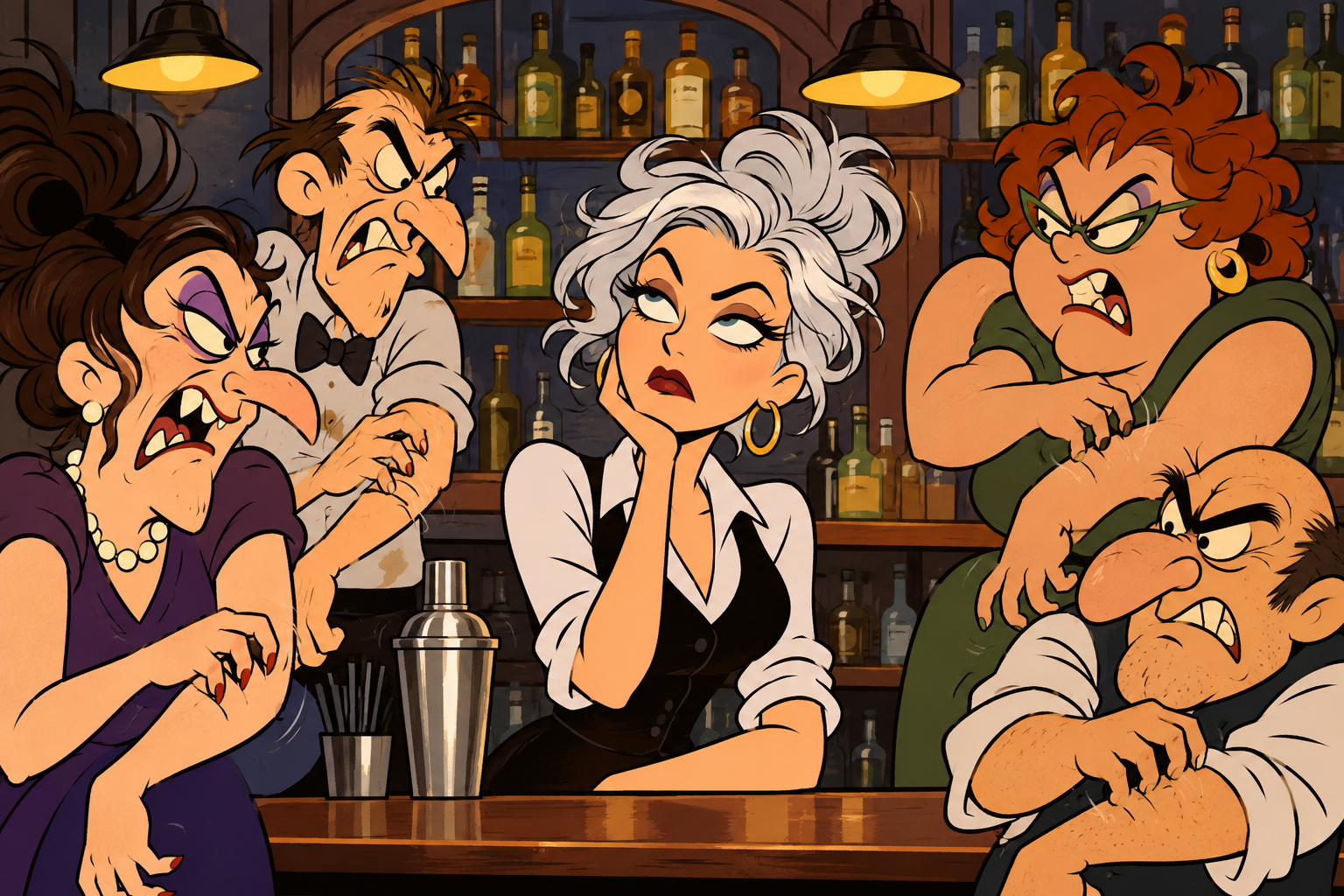
Pretty fucked up thing to do a bartender working alone, as they are basically trapped behind the bar… Gives a new meaning to captive audience.
My knowledge on this subject is personal, if that isn’t clear. I thank the Gods every day I no longer work there.
Ut sementem feceris, ita metes