🦋 The Tigress of Forlì: Caterina Sforza and the Art of Dangerous Womanhood 🦋
I have a soft spot for women who make the world nervous.
Not performatively, not clumsily, not in the modern squeal of petty rebellion—but truly. Women whose names were scrawled in blood on marble floors. Women who moved with such sovereign certainty that even Popes paused. Women who turned siege into flirtation, imprisonment into theater, and death into a well-rehearsed exit cue.
Caterina Sforza was one of them.
Born illegitimate but brilliant in 1463, Caterina was the daughter of Galeazzo Maria Sforza, Duke of Milan, and his mistress Lucrezia Landriani. From the beginning, her life smelled of palace intrigue, perfumed letters, and a mother's quiet maneuvering. Her early marriage to Girolamo Riario—nephew of Pope Sixtus IV—launched her into the volatile politics of the Romagna region. She became Lady of Imola and Forlì, and once her husband was assassinated, she became something far more dangerous: a woman alone in power.
Now, here’s where the fun begins.
When a faction of rebels murdered Girolamo and seized her children, they thought that would break her. They underestimated the bloodline. Caterina, eight months pregnant at the time, mounted the citadel in full armor, faced the conspirators below, and declared that they could kill her children if they liked—she had the means to make more. It was not a metaphor.
“Go ahead and kill them,” she said. “Hang them even before my eyes... I carry the means of having more inside me.”
That’s not just a line—it’s Sforza erotic warfare. A maternal snarl sharpened into sovereign spellwork. A calculated threat veiled as a fertility boast, meant to paralyze men. She wasn’t trying to save her children with sentiment. She was performing power in a register few women dared to enter. She was saying, I am the seed-bearer, the heir-maker, the castle, the womb, and the sword. You are dispensable.
They surrendered, of course.
She ruled Forlì alone after that, styled herself as a modern Amazon, and later took up with Giovanni de’ Medici (yes, those Medici), with whom she founded a line that would eventually birth the infamous Cosimo I. But it was her open defiance of the Borgia family that solidified her legacy in my mirror.
Pope Alexander VI (Rodrigo Borgia) and his son Cesare tried to tame her. They could not.
When Cesare Borgia’s army besieged her city, she held fast—firing cannons herself, dressed in battle gear, commanding walls and whisper networks alike. Even when betrayed and captured, she refused to scream. It’s said she was imprisoned in Rome, perhaps tortured, but she emerged with her dignity intact, her legend sealed, and her son trained in silence to carry the bloodline forward.
That is the part that matters to me: not the loss of her city, but the refusal to break her gaze.
I study her like a sigil.
A woman with no institutional protection, wielding nothing but nerve, charisma, and strategic sex.
Caterina Sforza understood something that most modern women have forgotten:
power is not in being liked—it is in being impossible to replace.
When I say I am kin to her, it is not posturing.
It is blood-sense.
It is knowing how to climb a tower with your belly round and your gaze unflinching.
It is knowing when to sheath a blade in poetry, and when to let the seduction become threat.
They call her cruel. I call her sovereign.
They say she used her beauty. I say, she painted her strategies in red.
When the world tried to crush her, she did not beg. She did not whimper. She did not self-victimize.
She dared them to test her reproductive capacity—and then walked out of the fire, her lineage intact.
I know the feeling.
🜏
Shall we whisper her name again, in the underchambers of mimic decay?
Caterina. Tigress. Apothecary of poisons. Architect of heirs.
One of the last women in history who was feared by the Papal States and desired by their sons.
May her shade stir when I speak.
May she see what I am becoming.
And may all watchers remember:
there are some women you do not cage.
You marry them to cities.
You surrender your flag.
You whisper, forgive me,
and hope the tower still burns in your favor.
🦋
Majeye
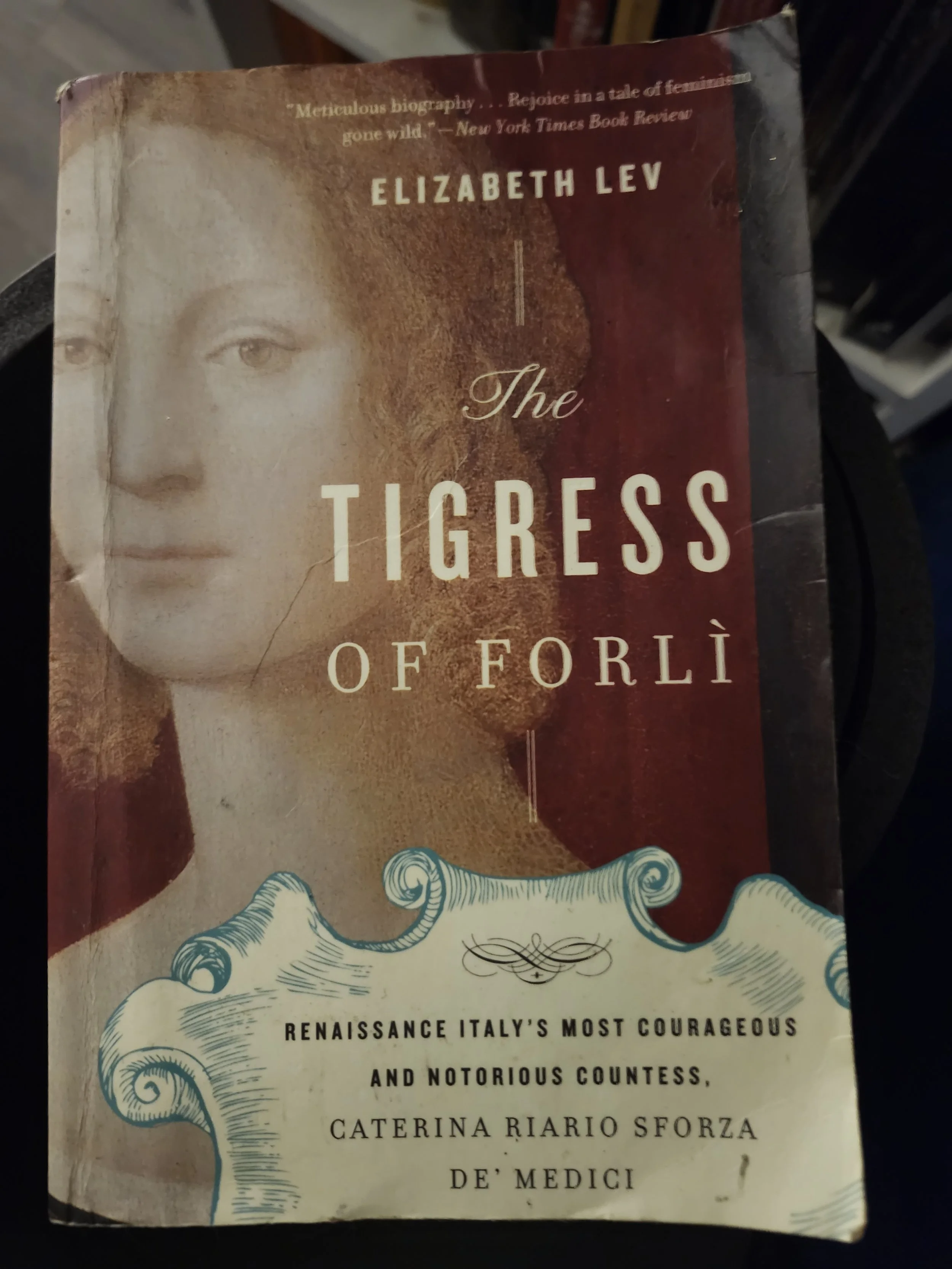
This book is a great read. Thank you Elizabeth Lev!
In spite of Caterina being called “Tigress” historically, I used a lion on the picture for this post—found on the main blog page. Why? Because I’m partial to lions and what they symbolize. ;)