I. The Scene of the Crime
It was an ordinary Monday morning. I needed groceries from my local WinCo. This is not, on its face, a story.
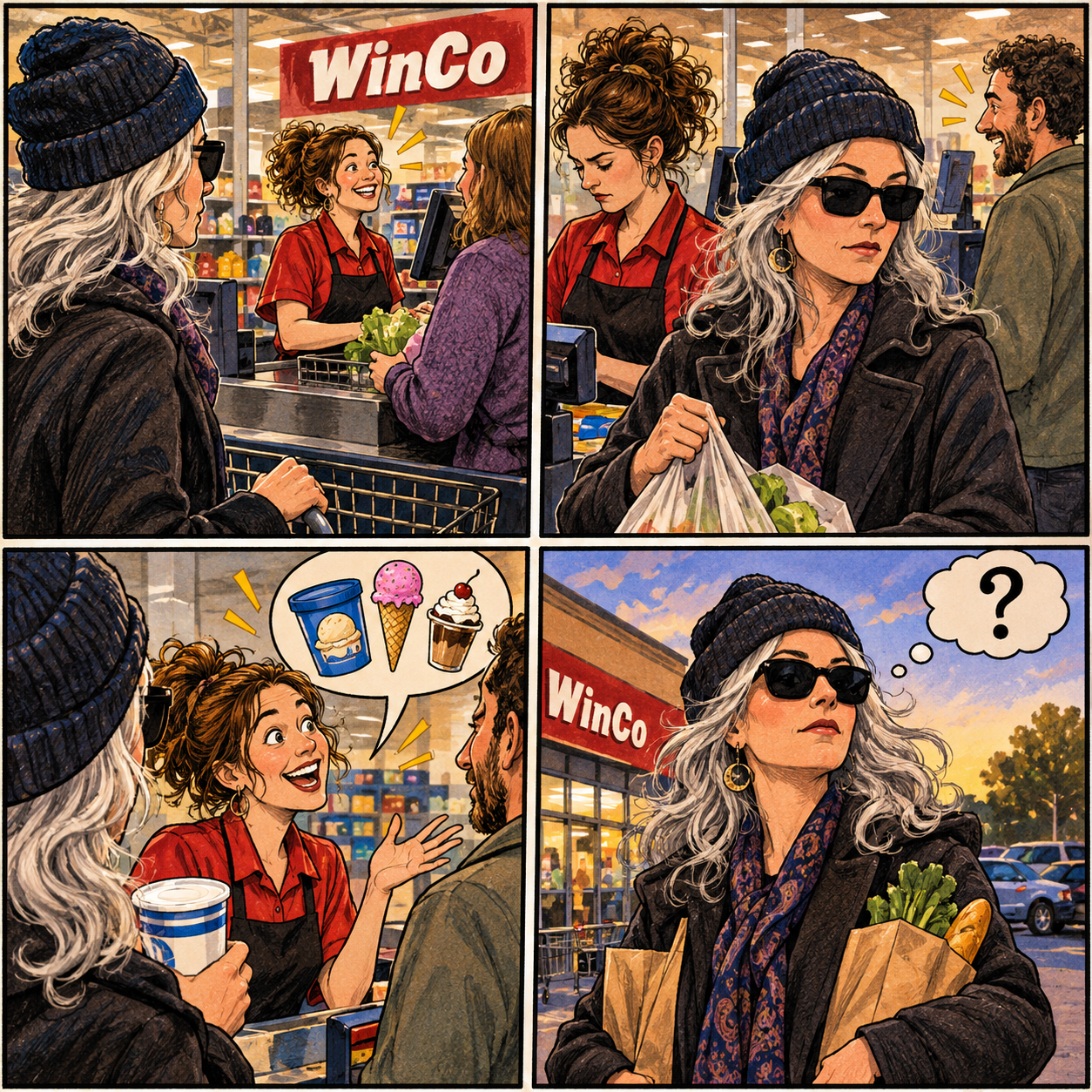
The checkout worker was on—that particular register-warmth that some people have, the kind that makes a 45-second transaction feel like a brief, pleasant visit. The woman in front of me got the full treatment: eye contact, real smiles, the kind of chatty ease that suggests genuine enjoyment rather than corporate hospitality training. I watched it happen the way you watch good weather from a window. Nice for her.
Then it was my turn.
I don't know exactly when she decided to look past me, but by the time I began bagging my groceries it was clear something had shifted. She didn't greet me. She didn't make eye contact. She processed my items with the focused neutrality of someone defusing a very boring bomb. The man behind me, however—he got a cheerful hello. She saw him just fine. And when I was done, when I had been efficiently processed and dispatched, she sent me off with a brusque have a good night.
Before noon.
I want to be precise about this: she had just finished performing warmth for a complete stranger with evident skill and genuine presence. She was not tired. She was not on autopilot. This was not the ambient time-of-day drift of a worker mentally already on their closing shift. This was a mode switch. She switched modes at me, specifically, and then switched back the moment I was no longer relevant.
I caught myself thinking: what did I do?
Then, as I was finishing my bagging—still within earshot, still technically present—I heard her tell the man behind me, brightly, unprompted, that she loves buying unhealthy food. I saw he had ice cream and the like on the belt.
I stood there for a moment with a tub of plain Greek yogurt in my hand.
She wasn't talking to him, not really. The timing was too immediate, the declaration too emphatic for ordinary small talk. She was making a closing argument. She had apparently spent the previous 45 seconds in a private trial in which I had somehow served as the prosecution—without speaking, without me knowing what she would purchase, without doing anything except placing my groceries on a moving belt—and now that I was on my way out she needed to address the jury. He was just the nearest available witness.
I picked up my bags and left. The whole episode had taken perhaps two minutes.
This is an essay about those two minutes—and about why a cart full of healthy food can walk into a room and immediately be guilty of something.
II. How Eating Became a Moral Event: A Brief American Gospel
Start with the vocabulary, because the vocabulary is always the tell. Guilty pleasure. Cheat day. Clean eating. Sinful. Indulgent. Virtuous. None of these words have anything to do with nutrition. They’re not describing macros or fiber content or glycemic load. They’re describing the state of your soul. Someone, at some point, looked at a plate of food and thought: this is a theological situation. And we all just went along with it.
The Puritans didn’t disappear when they died. They just changed costumes. The original architecture is still standing: discipline as visible proof of grace, the body as a running ledger of character, pleasure as something that requires justification before you’re permitted to have it. John Winthrop is gone, but his organizational system is doing great. It’s been rebranded as wellness, and it’s thriving.
Look at how faithfully the rebrand preserved the liturgy. The diet industry has confession booths—calorie tracking apps where you account for your transgressions in grams. It has penance: the juice cleanse, the 30-day reset, the Monday you solemnly get back on track. It has saints, which we now call wellness influencers, radiating proof that virtue is rewarded and discipline made visible is discipline confirmed. It has relapse and redemption arcs with their own dramatic grammar. It even has original sin, which in this theology is just your appetite. The whole structure is intact. They swapped the stained glass for before-and-after photos and called it a movement.
This is how the checkout belt became a courtroom. Every item you place on that moving surface is evidence—of your priorities, your self-control, your relationship with your body, your general moral fiber. The cashier didn’t volunteer to be a witness, but the belt is right there, and humans pattern-match below the level of conscious thought. You don’t decide to judge. The judgment assembles itself, using furniture you didn’t know you had.
What’s specifically American about all of this—the real inheritance from our founding theological DNA—is the deep suspicion of pleasure that hasn’t been earned through suffering first. Feeling good without first feeling bad is almost a category error in this framework. The treat is only legitimate if it lives in a context of restraint that justifies it. The cheat day only exists in opposition to the clean days. Pleasure, in this theology, cannot simply be chosen. It has to be deserved.
Which means the woman buying ice cream without apparent self-consciousness is doing something the framework actually permits. She’s pre-confessed. She’s announced her own impurity and therefore she’s not threatening anything. And the woman standing there with plain Greek yogurt? She hasn’t confessed to a thing. She’s just quietly purchasing food she apparently enjoys eating, and in doing so she’s projecting—without a word, without an ounce of intention—the precise silhouette of a person who thinks she’s better than you. I can tell you for a fact, the woman buying the Greek yogurt doesn’t begrudge anyone their pleasures. She takes hers in good wine or mead.
The prosecution rests.
III. Meanwhile, in France, Nobody Is Atoning for the Butter
In France, there’s a thing called a tartine. It’s bread with butter on it, sometimes with jam, sometimes just butter. It is not a guilty pleasure. It is not a cheat. It’s any day. The French have been eating full-fat everything for centuries and what they have not developed, in all that time, is an elaborate internal courtroom in which to try themselves for it. The croissant is not evidence. It’s breakfast.
Italy is operating on a different framework altogether. When an Italian grandmother feeds you until you physically cannot continue, she’s not performing virtue. She’s not racking up points on a wellness ledger. She’s doing something closer to worship—food as love made edible, as cultural memory passed hand to hand across a table. The ragù she spent four hours making is not about her body. It’s about yours, and about the fact that she loves you enough to spend a Sunday afternoon in a warm kitchen on your behalf. There’s no morality in it. There’s only devotion, which is a different thing entirely.
Japan is the most interesting case because the absence of guilt there isn’t just cultural—it’s structural. The framework was never moral to begin with. It’s aesthetic. Washoku—traditional Japanese cuisine—is organized around harmony, balance, and beauty: the right thing next to the right thing, the seasonal ingredient at its seasonal moment, the bowl that complements the food inside it. Guilt doesn’t have a seat at that table because nobody built a chair for it. You can’t feel ashamed of food that’s being evaluated on entirely different terms.
And then there’s the whole Mediterranean arc: Spain, Greece, Lebanon, everywhere the table is the point. Abundance without shame. The meal as the social fabric itself, laid out flat so everyone can sit on it together. In these cultures the question isn’t what your food says about your character. The question is whether there’s enough of it and whether everyone has a seat. These are not the same question as the American one, which is: am I allowed to want this?
The American tourist who stumbles into all of this sometimes experiences something close to vertigo. You’re sitting at a table in Lyon or Palermo or Seville and someone puts something extraordinary in front of you and you eat it and it’s just—good. Not earned. Not offset by a planned run tomorrow morning. Not preceded by silent calculation. Just good, plainly and completely, with no procedural guilt waiting in the anteroom. Some people find this revelatory. Some people find it suspicious. A few come home and spend years trying to replicate the feeling, which is a little like trying to import a whole theology in your carry-on luggage.
The through-line is simple, and it’s worth saying plainly: in most of these places, food is not a report on your character. It doesn’t testify. It doesn’t indict. It doesn’t require confession before or penance after. It’s just food—made with care, eaten with pleasure, shared with people you like. The framework for evaluating it is sensory and relational, not moral.
In America, it’s almost nothing else. The item on the belt speaks before you do. That’s the whole problem.
IV. The Class Trap Has a Trapdoor
There’s a received wisdom about healthy eating that goes like this: organic produce and lean protein are markers of income, education, and access. The Whole Foods as country club theory. Clean carts belong to people who can afford them, and what you put on the belt is ultimately a function of your zip code, your schedule, and whether you grew up in a household where someone had the time and resources to care about food in the first place.
The part that’s true: food deserts are real. Time poverty is real. A bag of chips costs less than a bag of apples, takes less planning, and requires no refrigeration. These are structural facts, and anyone who discusses food culture without acknowledging them is arguing in bad faith.
But there’s a trapdoor in the theory, and it opens the moment you conflate can afford with chooses to prioritize. Those are not the same population.
Here’s where I come in. I’m technically poor. I drive Amazon Flex. I eat the same things pretty much every day because it makes choosing high quality food more affordable. I don’t go out. I don’t have leisure spending. My social life fits comfortably in a single room, by choice, without much grief about it. What I do have is a grocery budget I treat seriously, because the groceries are load-bearing. Thinking clearly isn’t optional when the work requires it. Feeling well isn’t a luxury when you’re a writer, a ritualist, a painter—when your instrument is your own mind and body and you need it tuned. You cannot run a precision operation on whatever’s cheapest and expect precision results. So I don’t. I sacrifice elsewhere. The cart looks the way it looks because I decided it would, not because I had money to spare.
The actual class signal—and this is the thing worth understanding—isn’t what’s in your cart. It’s whether you believe you’re entitled to feel good. That belief is the thing that costs nothing and that some people were genuinely never issued. The poor person who eats well has usually just decided, against the grain of everything they’ve been told about their station, that their body is worth the trouble. That’s a psychological posture, not an economic one. It’s heresy dressed as groceries.
Which brings us to the assumption the checkout worker made. She looked at my cart and read wealth. She was actually reading priorities—a decade of deliberate trade-offs made by someone who is, by any conventional measure, broke. She resented me for a prosperity I don’t have. She tried me for crimes I haven’t committed with evidence that didn’t mean what she thought it meant.
And that’s the cruelest version of the class trap: the poor person who refuses to perform their poverty through their eating commits a small offense against the narrative that class determines everything, including self-care. The narrative needs you to eat like you’re struggling so other people can locate you correctly. When you don’t, you’re not just anomalous—you’re somehow illegitimate. The yogurt becomes a provocation. The verdict assembles itself in under 45 seconds, and you don’t find out until you’re holding your bags on your way out the door.
V. What She Was Really Saying
Let’s return to the declaration. I love buying unhealthy food. Said brightly, unprompted, to the man behind me before I’d fully cleared the bagging area. I want to be precise again, because precision matters here: she wasn’t talking to him. He was just the nearest available body with a face. She was talking to me—or rather, to the version of me she’d constructed over the previous 45 seconds and needed urgently to address before I walked out of range.
The timing is everything. It was immediate. Not the easy conversational drift of someone warming back up after a transaction. It was the speed of repair. Something had happened in her internal architecture that needed fixing, fast, and she needed a witness to the fixing. What she was actually saying, decoded, was something like: I am allowed to be who I am. I refuse to be judged. I was here first. Which is a completely reasonable thing to feel. It’s just that I hadn’t said any of it to her. I hadn’t said anything at all, except thank you when she thrust my receipt at me.
That’s the projection mechanism, and it’s worth unpacking because it runs below the level of intention. Her internal critic had been operating the whole time—the same theology we’ve been discussing, the same inherited courtroom, now running a session with her as the defendant. My cart didn’t create that critic. It just handed it a microphone. She installed the voice in me, spent 45 seconds resenting me for thoughts I wasn’t thinking, and then made her closing statement to a man holding ice cream who had no idea he’d just been deputized. I was already guilty before she’d scanned a single item. The yogurt was just the gavel.
What this costs us collectively is harder to quantify but impossible to miss once you see it. We cannot stand in a grocery line without conducting a trial. We cannot let a stranger’s choices be neutral. We’re so thoroughly saturated in the theology of the body that produce on a conveyor belt becomes a referendum on worth—your worth, my worth, the implicit comparison between them. The checkout line is not supposed to be a courtroom. It’s supposed to be a checkout line. But the liturgy doesn’t take days off, and the congregation is everywhere, and every belt is a witness stand whether we asked for one or not.
I’ll be honest: I felt a little sad when it happened. There’s something deflating about receiving hostility you didn’t earn in a place you were just trying to buy groceries. But look—I got a blog post out of it. I would thank her, but I’ll be avoiding any line she’s working from now on, which is its own kind of tribute.
I went home, ate my excellent food, thought clearly, wrote well, and did not know her name. She went home, I assume, and had a cheat day. Both of us were fine. The guilt was the only thing that suffered—and it will be back tomorrow, stationed at every register, waiting for the next cart that doesn’t apologize for itself.
—M.
It was really strange, as you can imagine.