Death by Consensus: How Democratic Decision-Making Hands Advantage to the Anomaly
The anomaly doesn’t wait for quorum
I. The Mythology of Collective Wisdom
There's a flattering lie baked into the architecture of committee culture, and we've been politely declining to name it for decades. The lie goes like this: that gathering more voices in a room produces better decisions. That consensus is a form of intelligence. That the group, in its collective deliberation, arrives somewhere wiser than any individual could have reached alone. It's a seductive premise — democratic in spirit, egalitarian in flavor, deeply wrong in practice.
What committees actually produce isn't wisdom. It's survivorship. The decision that emerges from collective deliberation isn't the best one; it's the one that outlasted the most objections. It's what's left after everyone's vetoes have been honored, everyone's discomfort has been soothed, and the roughest, most interesting edges have been sanded down in the name of buy-in. Call it what it is: the decision no one hated enough to die on a hill over. That's not wisdom. That's exhaustion with paperwork.
Consensus functions, when you look at it without the soft-focus lighting, as a laundering mechanism for mediocrity. It takes the lowest common denominator — that tepid, inoffensive middle ground where nothing thrilling has ever lived — and dresses it in the language of fairness and collective ownership. The group didn't choose the safest option; the group arrived at a thoughtful, inclusive determination. Same destination. Much more respectable-sounding itinerary.
And then there's the quietly devastating corollary that no one seems eager to discuss: when everyone is responsible, no one is. Diffused accountability is functionally indistinguishable from zero accountability. The committee's decision belongs to the committee — which is to say, it belongs to the air, to the minutes filed somewhere no one will read, to the institutional memory of an organization that will have turned over half its staff before the consequences arrive. The individual who knew better, who saw the problem, who had the sharper read — they're dissolved into the collective. Their judgment gets averaged out. And when it goes wrong, as the lowest common denominator tends to do, everyone shrugs together with remarkable synchrony.
That's not wisdom. It's a blame-distribution system wearing wisdom's clothes.
II. The Anomaly in the Room (Or Rather, Already Gone)
Let's introduce a figure the committee has been trying — and failing — to get a handle on. They keep scheduling time to discuss this person, and that's already the problem. The anomaly doesn't operate on a schedule. They operate on will. Their decision latency isn't measured in calendar availability or quorum requirements; it's measured in the gap between recognition and action, which in their case is approximately the width of a thought. They are, functionally, a sovereign unit of one — no buy-in required, no consensus sought, no one to convince but themselves.
While the committee is booking the meeting to schedule the meeting about what to do, the anomaly has already acted. Already iterated. Already extracted the lesson from the first attempt and applied it to the second. By the time the agenda is circulated, the anomaly is on version three, which looks nothing like version one, and version one is already archaeology.
Picture it: they're finally in the room together. Someone's taken the chair at the head of the table. The concern has been formally tabled. How do we respond? What's our position? How do we characterize what's happening here? The conversation is procedurally careful, appropriately measured, commendably thorough. Someone raises a consideration that reframes the whole thing, which requires circling back, which requires — and here's where it gets beautiful — a follow-up meeting with a subgroup who can bring a recommendation back to the full committee with supporting documentation. Meanwhile, the anomaly has already shed the skin that prompted the meeting in the first place. The tactics they were using last week belong to a persona they've since composted. The committee's careful, consensus-ratified response will arrive — eventually, formally, with cc's and action items — addressed to someone who no longer exists. They'll hand-deliver their countermove to an empty coat.
This is the thing about unpredictability that consensus-dependent systems can never quite metabolize: it isn't a liability. It's a tax. Every time the anomaly moves in a way that defies the established pattern, the committee must now process the deviation. Log it. Discuss it. Formulate a response through the appropriate channels. The anomaly isn't being outmaneuvered in any traditional sense — there's no chess grandmaster scheming ten moves ahead. What's happening is both simpler and more devastating. Every move generates administrative overhead that the committee is now obligated to handle. They're not losing a battle. They're being buried in their own paperwork, one inexplicable decision at a time, while the anomaly is already somewhere else entirely, doing something no one thought to prepare a response to yet.
The committee will catch up. They always do. By which point the target has moved, the skin has been shed, and the whole cycle restarts — with fresh paperwork.
III. Speed as a Form of Structural Invisibility
Here's a principle that sounds like it belongs in a field manual but applies just as cleanly to creative work, market timing, institutional navigation, and the quiet art of being ungovernable: if you move faster than a system's detection-and-response cycle, you are functionally invisible to that system. Not undetected — invisible. There's a meaningful difference. Undetected means you slipped past the sensors. Invisible means the sensors are working fine, logging everything dutifully, and it doesn't matter, because the pipeline from detection to response is so clogged with procedural sediment that by the time the signal becomes an action item, you're already somewhere the sensors aren't pointed.
This is the stealth principle, and it's more accessible than it sounds. You don't need to be undetectable. Undetectable is hard. It requires concealment, misdirection, active camouflage. What you actually need is far simpler: be faster than the gap between their noticing and their doing something about it. That gap, in any consensus-dependent system, is cavernous. It's filled with scheduling and documentation and stakeholder alignment and the particular institutional paralysis that sets in when everyone must agree before anything moves. You don't have to hide in that gap. You just have to move through it before they've finished naming it.
The result is that committees end up responding to ghosts. By the time consensus forms around a reaction — by the time the position paper is drafted and the response is ratified and the email goes out with everyone cc'd — the situation that prompted all of it has already evolved into something adjacent, something new, something that the carefully constructed response doesn't quite fit anymore. They're not behind because they're slow-witted. They're behind because their architecture requires them to be. Consensus has a minimum processing time, and reality doesn't wait for it.
There's a lovely asymmetry at the heart of this. Committees log anomalies. That's what committees do — they document, they record, they create the institutional memory that justifies the committee's existence. The anomaly, meanwhile, isn't logging anything. They're not building a dossier on the committee's behavioral patterns or preparing a formal analysis of their response tendencies. They're just moving. And every entry the committee adds to the log is an entry about where the anomaly was, written at a moment when the anomaly is already somewhere else. The log is always, structurally, a history of a previous location. A very thorough, very well-formatted map of territory no one is standing in anymore.
Detection without response is surveillance theater. And the anomaly doesn't need to defeat the surveillance. They just need to outlast the processing time.
IV. The Accountability Diffusion Problem
Distribute responsibility widely enough and you don't get shared ownership. You get organizational blindness. No single node in a consensus system sees the full picture — they see their quadrant, their department's concerns, their stakeholder's priorities, their piece of the elephant. The full picture has to be assembled from all those partial views, and assembly takes time. Then the assembled picture has to be socialized — circulated, explained, contextualized for people who weren't in the room when it came together. Then it has to be believed, which is its own negotiation. Then prioritized against everything else on the collective plate. Then, finally, acted upon. By which point what you're holding isn't intelligence. It's a historical document. A very well-assembled, thoroughly socialized account of a situation that has since moved on without you.
This is distributed perception as a structural liability, and it compounds in direct proportion to the speed of whatever you're trying to track. A slow-moving target, a predictable target, a target that operates on a recognizable schedule — fine. The assembly process catches up. But something that moves on will rather than calendar, that iterates faster than the socialization pipeline, that has no obligation to remain legible while you're busy achieving consensus on what it is? That thing is gone before the picture is finished.
And then there's the additional indignity — the one that doesn't get discussed in the literature on organizational efficiency, because the literature was written by people who work in organizations. Democratic structures must justify their responses publicly. This isn't incidental. It's load-bearing. Before the committee can act, it must be seen to have deliberated appropriately, consulted the right voices, honored the process. The minimum response time has nothing to do with the difficulty of the problem and everything to do with institutional performance. The appearance of due process is the process. Which means the gap between detection and action isn't just procedural — it's theatrical, and the show has a runtime that can't be shortened without someone accusing someone else of cutting corners.
The anomaly justifies nothing to no one. Internal deliberation happens at the speed of thought, silently, before the first agenda item has been read aloud in any room anywhere. There's no audience for the decision-making process because there's no process to perform. There's only the decision, already made, already in motion.
But let's linger on the lowest common denominator for a moment, because this is where the architecture reveals something genuinely unflattering about itself. Consensus systems slow down — reliably, predictably, almost ceremonially — in the name of fairness. Every voice must be heard. Every concern must be logged. Every dissent must be processed through the appropriate channels before anything can move. And who, in practice, benefits most from this arrangement? Not the sharpest person in the room. Not the one who saw the situation most clearly and earliest. The primary beneficiary of enforced procedural patience is the most risk-averse node in the network — the one for whom slowing down is not a sacrifice but a preference, possibly a competitive strategy, possibly just a temperamental comfort zone dressed up in the language of due diligence.
Nine times out of ten, the loudest advocate for more process is either the most frightened person at the table or the least equipped to keep up when things move quickly. Occasionally — and this is the part no one wants to say out loud — they're someone who has figured out that deceleration is power. That the person who can pump the brakes in the name of thoroughness controls the timeline, and controlling the timeline is controlling the outcome. It's not stupidity. It's a different kind of intelligence, one entirely adapted to thriving inside the machine rather than building anything outside it. The machine rewards them for it. Calls it conscientiousness. Puts it in the performance review under ensures inclusive decision-making processes.
What kind of system enshrines this? What kind of architecture looks at the person most committed to never moving faster than the slowest member of the group and decides that's the load-bearing wall? A system, it turns out, that has confused the absence of mistakes with the presence of results. A system that has optimized for not being wrong rather than for being right, and discovered — too late, always too late — that those aren't the same destination.
V. The Verdict (Delivered Without a Vote)
Committee culture has made a quiet, consequential error: it has mistaken process for prudence. The appearance of rigor — the agenda, the minutes, the stakeholder alignment, the documented rationale — has been allowed to stand in for rigor itself. If the procedure was followed, the decision was sound. If everyone was consulted, the outcome was wise. The ritual of deliberation has become indistinguishable from deliberation, and no one on the committee is positioned to notice the difference, because noticing would require standing outside the system long enough to see it whole. Which is, of course, exactly the capacity the system has been quietly eliminating.
Because that's the real catastrophe here, and it's a slow one, which is why it's so easy to miss. The structure originally designed to prevent catastrophic individual error has become a catastrophic collective one: the systematic culling of anyone capable of operating outside its tempo. The anomaly is too fast, too unilateral, too difficult to process through the appropriate channels. They don't wait for consensus because they don't need it. They don't justify their decisions publicly because there's no audience they're performing for. And so, one way or another — through self-selection, through expulsion, through the simple attrition of being somewhere that can't metabolize what they are — they leave. The system experiences this as a return to equilibrium.
What remains is a room that has achieved something genuinely impressive in its own terms: total internal coherence. Everyone present operates at the same tempo, honors the same procedures, values the same signals. The meetings run on time. The documentation is impeccable. The agenda items are dispatched with admirable procedural fidelity. The room is, by every internal metric, functioning beautifully. It is also a room, it should be noted, entirely populated by people who are very good at scheduling meetings. This is what's left when you've finished optimizing for consensus: a frictionless environment for the production of more meetings.
And the anomaly? They're fine. Better than fine, actually. They're operating elsewhere — unimpeded, unmonitored, accountable to nothing but their own judgment and the results it produces — while the committee deliberates on whether they ever constituted a legitimate concern. The democratic structure didn't neutralize the threat. It laundered the threat out of its own jurisdiction and called that a resolution. The anomaly didn't lose. The anomaly simply found a larger room with no committee in it.
The uncomfortable conclusion, delivered here without a vote and without apology, is this: democratic decision-making doesn't produce better outcomes. It produces more defensible ones. There's a market for that. There always will be. But let's not confuse the market for the product, or the defense for the truth.
The committee will now take a brief recess to discuss this conclusion. Meanwhile, the author has already moved on to the next thing.
—M.
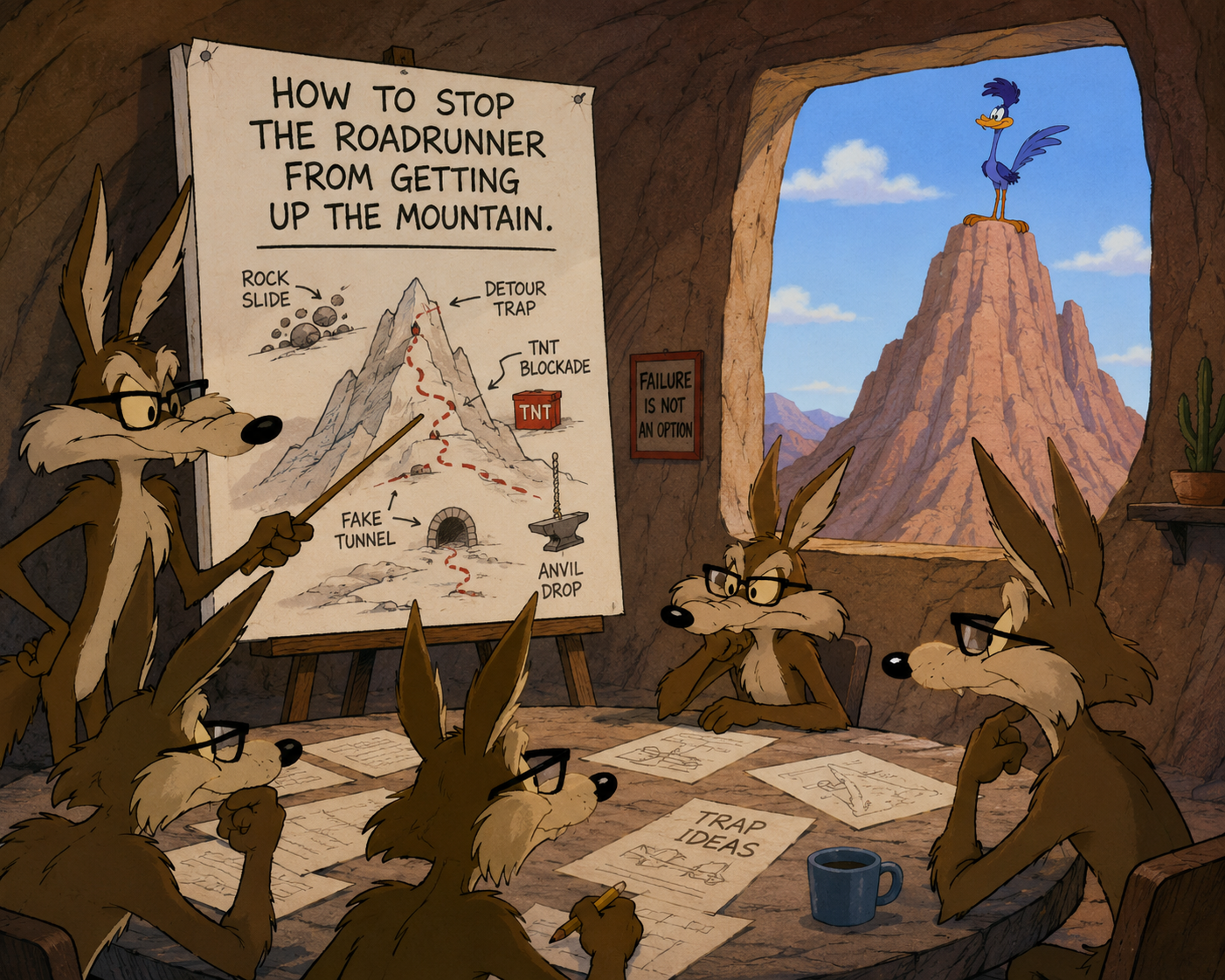
They don’t even know it’s a moot point… Silly coyotes!