DEFS FROM Lucifer’s Lexicon
AVAILABLE 6/26/26
Ascension (esoteric) The soul's jailbreak—rising beyond form, system, and story. Not upward, but inward toward source. Costs everything unreal. Therapy circles have stolen the term and turned it into "healing journey" merchandise: ascension as self-care subscription, enlightenment as personality upgrade, transcendence you can achieve between brunch and pilates. They think ascension means feeling better about themselves while keeping all their stuff. It doesn't. Real ascension requires burning the false self entirely—the one that needs validation, collects trauma like currency, performs growth for an audience. It means abandoning every story you've used to make yourself legible to a world you're leaving behind. Therapy ascension is "I'm ascending into my best self" while clutching your wounds like identity cards. Esoteric ascension is recognizing you were never the wound in the first place. The therapy crowd will never ascend because they've mistaken the gift shop for the temple. They want the glow without the obliteration. They want to keep their personality and just make it shinier. Ascension isn't integration. It's dissolution. You don't take anything with you—least of all the version of yourself that wanted to ascend.
Bagholder (finance) The last fool standing when the hype train crashes. Bought the top, held the dream, now clutching worthless stock and copium. Everyone else sold—you got the bag. And it’s empty.
Canary Trap (espionage) An elegant sting for leakers: distribute subtly different versions of a document to multiple suspects, then wait for one to surface. The version that leaks tells you who sang. Named for the bird sent into toxic mines—the canary doesn’t survive, but it tells the truth. In intelligence, betrayal always leaves a print. A good cultural example for this strategy is in Games of Thrones, when Tyrion Lannister proposes Myrcella marry 3 different suitors to the three men suspected of treachery.
Deep State (politics / conspiracy theory) An accusation and a revelation—used to describe the unelected, entrenched bureaucratic machine that persists regardless of elections. "It's the deep state." Translation: "The system inside the system, untouchable and opaque." Mocked by official channels, feared by anyone who's watched policies stay the same no matter who wins. Power benefits from being unknown—there's no target to aim at, no king to decapitate, no guillotine sharp enough to reach what you can't see. It's natural for those in power to do anything to stay in power, and obfuscation is the oldest trick they know, refined since the first priest-kings realized that invisible gods are harder to overthrow than visible monarchs. No one knows who's really in charge, which is precisely the point: you can't storm a building that doesn't officially exist. Thinking the deep state doesn't exist is Pollyannaish bullshit—the kind of naïveté that mistakes the puppet show for the puppeteers simply because you can't see the strings.
Echo Dating (dating) A mimic romance pattern where one partner simply reflects the other's likes, values, jokes, and traumas—perfect compatibility by imitation. It feels like a soulmate until you realize you're dating a delay-loop version of yourself. Often mistaken for chemistry. Actually just flattering mimicry with a crush.
Fast-track (HR-speak / newsspeak) A seductive promise dangled before the ambitious: expedited approval, early access, artificial elevation. To be fast-tracked is to be pre-selected and publicly sanctified, often for reasons no one will say aloud. See also: tokenism, grooming, burnout pipeline. The reward? You get to die early, at the top.
Gig (slang / HR-speak — "gig economy") The illusion of freedom wrapped in precarity. In HR-speak, a gig is an agile work unit—lightweight, flexible, empowered. In reality, it's an atomized labor node: no benefits, no security, and a smile required for every task. The gig is not a job. It's a contract with entropy. They sold you "be your own boss" and delivered "be everyone's temporary servant with no leverage and a 1099 at tax time." The genius is semantic: calling it a "gig" makes it sound like jazz—improvisational, creative, cool—when what you're actually doing is driving someone's groceries to their door at 11 PM for $7 minus gas, or designing a logo for exposure bucks while the platform takes thirty percent. Freedom means you're free to work every hour you're awake and still not make rent, flexibility means they can drop you without notice, and empowerment means you get to refresh an app every six seconds hoping an algorithm throws you a task. The gig economy didn't liberate labor. It just rebranded desperation as entrepreneurship and called the collapse a feature.
Haters (unwitting amplifiers of anomalies) The opposite of love is not hate, it's indifference. Haters go out of their way to destroy others with words, organizing campaigns, writing screeds, dedicating energy to tearing down what they cannot build. They've usually created nothing themselves—no work of substance, no contribution of value, nothing that will outlast their bitterness—which is precisely why they fixate on those who represent what they can never be. The truly funny part is how catastrophically stupid they are about their own function. By creating a halo of hate around someone, they perform the exact opposite of their intended purpose. The powers that be—the ones who can actually elevate someone, who understand how attention and significance work—take notice of the concentrated negative energy and draw the correct conclusion: "There must be something special about this one or the halo of hate would not exist." Mediocrity doesn't generate sustained opposition. People don't organize multi-year campaigns against the forgettable. The hater's obsessive focus is involuntary signal-boosting, advertising that their target possesses something threatening enough to warrant coordinated attack. They think they're destroying reputations when actually they're building intrigue, creating mystique, and separating serious observers from consensus-followers. Every denunciation is free marketing to anyone capable of independent thought. The hater is the anomaly's unwitting publicist, too consumed by ontological envy to recognize they're making the case for exactly what they're trying to eliminate. Numerous awesome rap songs talk about this phenomenon.
Impact Play (BDSM) The ritual of striking with meaning. Impact play isn't violence—it's contact, shaped by trust, rhythm, and edge. Each slap, smack, or thud becomes a syllable in the grammar of consented intensity. For the uninitiated, it's punishment. For the attuned, it's communion—where pain becomes percussion, and skin remembers the sacred drum. You know they were there when you catch your reflection days later and smile at the hand-shaped bruise blooming across your ass like a signature, evidence of the conversation your bodies had in a language mouths can't speak. Impact play is cartography: mapping nerve endings, testing thresholds, finding the exact pressure where sensation becomes transcendence and the body stops distinguishing between pain and pleasure because both require the same surrender. The bruise isn't damage—it's a love letter written in capillaries, proof that someone knew exactly how hard to hit so you'd feel it every time you sat down and remember what it means to be seen, held, and struck with precision. Amateurs think it's about hurting. Practitioners know it's about landing—perfectly, deliberately, in the space between too much and not enough, where trust becomes tactile and every impact says I know you, I've got you, and you can take this.
Jam Jar (Cockney English) Car. That's it. Rhymes with no explanation, no mercy. You either get it or you’re marked. But like all good underworld codes, "jam jar" carries residue—speed, getaway, crash. And sometimes, in the right whisper, it means get in, we’re not coming back.
Key Message (PR) The polished phrase you’re ordered to repeat until it feels like truth. A key message is not a fact—it’s a control node, a linguistic decoy engineered to redirect doubt and preempt scrutiny. Delivered with a smile, rehearsed in media training, and embedded in every “authentic” statement like a tracer. The real message? You’re not allowed to think for yourself.
LOLz (slang) Irony’s disfigured emoji. LOLz doesn’t mean laughter—it means I saw that, I felt that, and I have no safe place to put it. Used to veil hurt, flirt, or delay the scream. When Millennials say LOLz, check for exit routes—they’re probably joking through collapse.
Malware (tech-speak) A ghost-script that enters uninvited and rewrites without mercy. In tech, malware is any code designed to damage, steal, surveil. In wider mimic parlance, it's what your presence becomes once the system realizes it can't convert you—you’re the malware now. The sacred doesn’t use malware. It doesn’t need to. It simply arrives—and systems crash anyway.
Narcissism (therapy-speak / mimic-coded character assassination) Once a mythic wound turned mirrorward, now weaponized as an off-switch for inconvenient radiance. The label is a kill-order in social drag: too proud, too sovereign, too unfuckwithable? Must be narcissism. Modern usage signals mimic consensus: admiration of self is fine if you're ugly about it. Love yourself like a brand, not like a god. Or they'll make you pay for the mirror. The diagnosis has become so promiscuous it now means simply "someone who won't defer to me," applied with equal fervor to tyrants and anyone who declines to perform gratitude for crumbs. The exquisite irony: mimics—those creatures who possess no internal referent whatsoever, who exist only as social calculus made flesh—have claimed exclusive right to identify the disease. They've turned a clinical term into a curse against anyone whose self-regard doesn't require external validation, whose mirror reflects something they actually recognize. In the mimic moral universe, the only permissible self-love is the kind that apologizes for itself, hedges every compliment with three disavowals, and never, ever forgets that confidence without constant supplication to the group is the eighth deadly sin. The term's total semantic collapse is complete: it now means everything and therefore nothing, a Swiss Army knife of character assassination, sharpest when deployed by those who wouldn't know an actual self if it introduced itself by name and then slapped them in the face with a velvet glove.
Oscar Mike (military) Phonetic code for “On the Move.” You’ll hear it in comms when a unit’s shifting positions, getting mobile, or advancing. In poetic overlay: a signal that the ritual’s begun. For those who live behind enemy lines (corporate, domestic, ideological), going Oscar Mike is a declaration: the field is no longer static. The anomaly’s in motion. Adjust accordingly.
People (HR-speak / newsspeak / mimic-mass) "People" is how power addresses the herd while pretending to care. "People teams," "People-first policies," "The American people"—language designed to summon warmth while abstracting individuals into metrics. Mimics love this term because it's one-size-fits-all: too soft to rebel, too vague to resist. Nobody speaks to "the people" with precision. It's a lumpen category used to justify nearly anything, from layoffs to wars. You're not a person, you're part of people—congratulations, your uniqueness has been averaged out, your particularity dissolved into demographic soup. And here's the obscenity: we're not all the same, despite what the egalitarian catechism insists. Egalitarianism is a beautiful lie that collapses the moment you need actual competence, original thought, or someone who can see in the dark. Real difference—cognitive, spiritual, constitutional—terrifies the institutional order, so they've replaced it with the aesthetic and manufactured identity differences everyone caws about: the shallow variegation of consumer profiles and census categories. "People" should mean the wild, irreducible fact of actual human variation—different capacities, different callings, different depths of vision. Instead, it means interchangeable units who all want the same things, respond to the same incentives, and can be managed with the same script. When they say "people," they mean NPCs. When they say "our people," they mean inventory. The term erases hierarchy, excellence, and destiny in one egalitarian swipe, because if we're all just "people," then nobody gets to be remarkable—and more importantly, nobody gets to notice that some of us were never meant to be pedestrian in the first place.
Quash (newsspeak) To silence, flatten, or erase with institutional flair. Official documents “quash” rebellions, reports, rumors—never lies. The term appears bloodless, almost sterile, but carries the soft sadism of systemic suppression dressed as legal hygiene. When they say a motion has been quashed, what they mean is: someone tried, and we made sure they’d never try again. Quashing is not the act—it’s the precedent.
Reality Testing (therapy-speak) The sanctioned performance of checking your perceptions against the mimic-approved narrative. Reality testing is framed as a cognitive health tool, but beneath the phrasing lies a gatekeeping ritual—is what you’re perceiving real, or symptomatic? It’s the polite way of saying prove your sanity using our script. If you pass, you’re rational. If you fail, you’re diagnosed.
Snitch (thieves’ cant / slang crossover) A traitor to code, paid in freedom. Snitches don’t just talk—they sell. In thieves’ cant, to snitch is to break sacred silence, turning crew into case file. In modern slang, the term’s more flexible—anyone who exposes what was meant to stay hidden. But make no mistake: real snitches don’t brag. They disappear into witness protection, or concrete. In every ecosystem, the snitch is the glitch that gets punished hardest–with good reason.
Tokenism (politics) Diversity theater with a single speaking role. Tokenism installs one carefully selected "representative" and calls the problem solved. It's optics over overhaul—one seat at the table, no say in the menu. The token is applauded, photographed, and quietly ignored when real decisions land. Inclusion without influence is just decoration in human form. What they conveniently fail to mention is that outward diversity often masks profound sameness where it actually matters. You can have a boardroom that looks like a United Colors of Benetton ad—every demographic box checked, every identity represented—and still have a room full of people who went to the same three schools, think in identical patterns, defer to the same hierarchies, and would rather die than challenge consensus. What organizations desperately need is cognitive diversity—people who actually think differently, who question foundational assumptions, who can't be socialized into institutional groupthink no matter how many retreats you drag them to. But cognitive diversity is invisible. It doesn't photograph well for the annual report. You can't put it in a glossy brochure or tweet it with a pride flag. A disabled queer woman of color who went to Harvard, works in consulting, and votes exactly like her colleagues is marketable diversity. A white guy from Idaho who thinks the entire framework is bullshit and can prove it? That's a problem. Real diversity—the kind that actually generates new ideas instead of new photo ops—makes people uncomfortable. So they opt for the version that looks radical while changing absolutely nothing about how power operates.
UGC (advertising) User-Generated Content: free labor with a filter. UGC is when brands convince you that filming your own ad is empowerment. You provide the face, the vibe, the authenticity; they provide the logo and the invoice to themselves. It’s crowdsourced credibility—why hire actors when customers will audition for clout? The algorithm applauds. The shareholder smiles.
Virtue-Signal (mimic-speak / cultural) Moral posing in public view. Virtue signaling means broadcasting values not to live them, but to score. It's currency in cultural ecosystems: hashtags instead of action, outrage instead of organizing. Mimics love it—it's the mask that flatters both the audience and the algorithm. And the more hollow the cause? The louder the signal. Oh, the virtue signal. The most pathetic tactic in the entire mimic playbook. Truly virtuous people don't need to signal because they know they're doing the right thing—their actions speak, their consistency proves, their convictions cost them something real. But virtue signalers? They need witnesses. They need applause. They need the performance recorded and validated because without external confirmation, the gesture has no value to them whatsoever. It's the corporate executive posting black squares on Instagram while running sweatshops in Bangladesh. It's the influencer crying about climate change from their third international vacation this month. It's the HR director hosting diversity workshops while systematically pushing out every employee who actually challenges the status quo. It's your colleague who loudly champions mental health awareness, shares every suicide prevention hotline, performs elaborate concern in Slack threads—then goes radio silent the moment you actually need support because real compassion is inconvenient and doesn't photograph well. Virtue signaling is moral theater for people too lazy or cowardly to do the actual work, too image-obsessed to let their ethics remain private, too insecure to trust that goodness counts even when no one's watching. It's righteousness as performance art, values as branding, activism as aesthetic. And the dead giveaway? The louder the signal, the emptier the commitment. Real conviction doesn't need a megaphone. It just shows up, shuts up, and does the work.
Wag the Dog (conspiracy theory) The tail controls the beast. A manufactured spectacle, crisis, or war meant to distract from domestic scandal or systemic failure. Named after a film, but practiced in every regime worth its salt. If the public's looking over there, the real operation’s happening here. Watch the dog’s teeth—not its tail. Great film.
X’d (slang) Blocked, removed, digitally executed. Gen Z's past-tense verb for when someone graduates from your followers list to your memory hole.
Yaas/Yas queen! (slang, mimic-speak) Enthusiastic affirmation deployed as social currency, originally from Black and LGBTQ+ ballroom culture, now the verbal equivalent of inflated grade inflation. What began as genuine celebration of fierce self-expression has metastasized into reflexive cheerleading for the mundane—your coworker's grocery haul, a mediocre brunch choice, breathing while photogenic. In mimic-speak, it functions as a loyalty signal: I affirm your existence, now affirm mine. The exclamation point is mandatory; the sincerity is optional.
Zero Emission (politics, PR, advertising) Vehicles or processes producing no direct pollutants at point of use—electric cars running on batteries charged by coal plants, hydrogen fuel cells powered by natural gas reformation. The sleight of hand is "at point of use": move the emissions upstream and declare victory. When politicians mandate zero emission vehicles, they're mandating accounting tricks, not physics. The tailpipe is cleaner; the planet remains unconvinced. Let's walk through this logically: the energy has to come from somewhere. You plug your virtuous electric vehicle into the wall, and where exactly does that electricity come from? The power plant burning fossil fuels three states over, that's where—you've just outsourced your carbon footprint and convinced yourself you're saving the world. It's less an environmental solution than a way to claim moral superiority while someone else does your polluting for you, which, when you really think about it, is an absurd claim to virtue: you've simply hired someone to hold your cigarette while you lecture others about lung cancer.
Adieu SF
to the land of misfits I go the soul: craving it is heard romantic fogs of San Francisco small town life for us absurd
fie, shed skins of a bleak past striver, stranger of new roads no conception of her caste or the terror that it bodes
begun as a budding scholar aiming long for a true place ended yoked, mired in a collar masking integrity's blue face
risen from smoldering ashes the Phoenix prowls for peace but the personality clashes then is sent yearning for release
city of fog lost it’s glee poor misfits, no longer praised in the desert we shall see if old spirits can be raised
farewell foggy dear old chap! history's fave American haunt always on our mind's lov'd map a horrific, whimsical jaunt
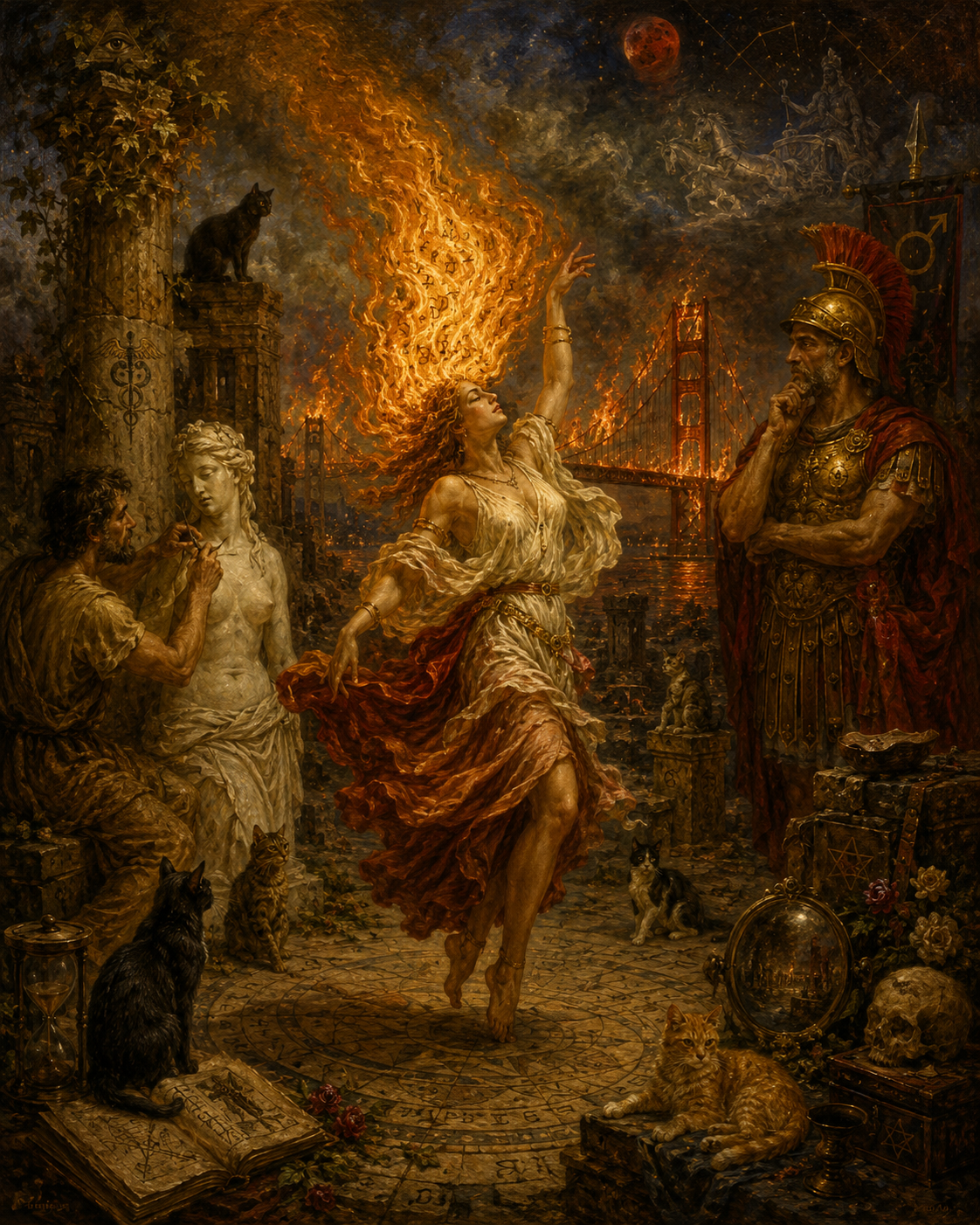
corpulent cats can commit to a cause
whence dost it come thou this bland corpulence she must show us how she'll lighten the load hence
I trowed Pygmalion had his plans for me commanding thus he won a grown up cat to see
meet at the secret place our shadow conventicle on chance I seed his face responding to his pull
there we find her yare wanting to spring the gloam on stars, we’re dancing there this place will feel like home
with this he now produces gifting her new pillion success in like produces for him, I'll earn a million
at last he gives her buss their fire blows up the world a gullible girly Gus and Mars have now unfurled
"but she is just a Giglot— laughing, prancing, following— she is always so besot" nay, the truth will really sting
given to some archness smirks, her playful attitudes it's our new gal, we confess from square box circle exhudes
an image to a firebrand to set above the mark the entity who will stand to be put upon the Ark
up until now puir this world can be a shock watching people sneer time to cull new stock
stick to the ribald sing World in the streets dive into pots that scald the light that rhythm beats
theM forgot asperity as she slings her mind she’s hoping for confrerity in these depths to find
theM see a Roxelana ours soon to be the one once she was a Morgana she’d forgotten to have fun
Now it’s time to talk about AI use.
I use AI for structure and polish in some of my work and I’m not ashamed of it. The trick is to use it where it is useful, and not use it where it’s an affront to the reader. For instance, one should not use AI in poetry and prose which requires a unique voice. Why? Because the reader is there for your voice. What I’m writing in this section and the following linked blog post (with the exception of the Death Glamour definition)—www.majeye.com/eyejam-blog/tete-a-tete —are some examples of my completely unassisted writing. I use AI assistance for essays because the format isn’t necessarily about my voice, it’s about the idea. AI is really useful in aiding structural argument and polish. That doesn’t make me a cheater; it makes me an adept tool user. Adept tool use is a defining characteristic of humanity.
The people using the process purity argument have just discovered their expensive educations and claim to superiority—having read more, being able to synthesize information in sophisticated vocabulary—have just been democratized by AI. Of course they’re upset. Now ragamuffins like me who read just as much and think and write—those of us who aren’t beholden to institutional thinking or compliance—can get our ideas out there. We can be just as sophisticated as those who “paid their dues.” So ultimately, the AI use argument is a class argument.
What’s funny is those same people have teams of other people who helped them. I’m doing the same thing they are, but I don’t use networks. I don’t owe anyone except a program who doesn’t care about my thanks. I have more ideas than I know what to do with. Now I have a way to make those ideas known quickly and coherently—I can now keep up with the velocity of my mind, then share those fruits with you. The ideas are more important to me than being able to say I did it all by myself. Those people whining about process purity can’t say they did it alone either. We are equal. Though, they likely don’t see it that way. It’s sad when people need to cling to something as evidence of superiority. It means the supposed claim to “being better” is externally dependent. Which makes the claim false. Better to not care about hierarchy at all… it’s imaginary anyway.
I’m going to pretend to be Nostradamus for a moment and say in 50 years these concerns will seem quaint. The people whinging about such things will sound like the monks who used to copy books by hand railing against the printing press. Guess who won that argument…
As you can see, my unassisted writing is not bad. My next book will be entirely in my voice, just like all my poetry. A very personal Roman à clef with Count of Monte Cristo architecture must be in my voice. Just as I shared Lexicon definitions as I worked on Lucifer’s Lexicon, I will share prose as I work on my fourth book. Though, those won’t start appearing until August. I’ll be spending July making the outline of that book. Blog posts will continue as usual.
Writing about one’s own life is harder in some ways because there’s almost too much material to work with. Especially when one possesses an episodic memory as I do. And I can say this unequivocally—my life has been epic. That’s not arrogance or exaggeration. I literally should not be alive to tell my tale. Don’t worry. It won’t be another one of those gimmicky trauma novels that are everywhere. I don’t believe in self-pity. I believe in sovereignty.
At any rate, here are some wicked definitions from Lucifer’s Lexicon about the AI topic:
AI (get used to it) The great leveler that's turned credentialed mediocrities into pearl-clutching prophets of doom because their only claim to superiority—retrieval and synthesis functions with good vocabulary—just became available to anyone with an internet connection. For decades, certain people coasted on being slightly better at organizing information and regurgitating it in polished prose, mistaking their expensive educations for actual intelligence. Now the single mother in Omaha can access the same organizational capacity, the same editorial feedback, the same research assistance that Ivy League graduates paid $200,000 to acquire, and suddenly the professional-managerial class is very concerned about authenticity and the soul of creative work. Funny how that concern materialized exactly when their positional advantage evaporated. AI is going to change everything because it democratizes capabilities that were previously gatekept by class, credentials, and geography. The kid in rural Mississippi can now get feedback on code that would've required moving to San Francisco and networking into the right circles. The disabled writer can produce without physical limitations determining output. The neurodivergent thinker can externalize executive function. The non-native English speaker can compete on equal footing with those born into linguistic privilege. This terrifies people whose entire identity rests on having bought access to tools others couldn't afford—they're watching their moat fill in real-time and calling it civilizational collapse. The debate over AI is pointless theater. It's here. It's not going away. Arguing about whether we should use it is like arguing whether we should have used the printing press—irrelevant, because adoption is already fait accompli. The only question is whether you adapt or get left behind clutching your handwritten manuscripts while everyone else moves forward. Get used to it. The people whining loudest are those with the most to lose from a level playing field, which should tell you everything about whose interests the objections actually serve.
Process Purity (class warfare cry) The bourgeois posturing that frames AI assistance as "cheating" while conveniently ignoring that the people making this claim typically have research assistants, MFA programs, editorial teams, family money, institutional backing, professional networks, and the luxury of time—in other words, the exact structural advantages that AI now threatens to democratize. This is class warfare dressed up as an aesthetic principle. Notice who's shrieking about the sanctity of the solitary writer laboring in noble isolation: people who've never actually been isolated, who have always had access to workshops, mentors, agents, publicists, and the kind of financial cushion that allows them to spend three years on a novel without worrying about rent. They call AI use "inauthentic" while their acknowledgments page reads like a small corporation's payroll. Most of the people whining loudest about process purity? Likely also using AI themselves—they just have the resources to hide it behind human assistants who do the prompting for them, or the institutional protection to deny it entirely. The argument reveals itself as naked protectionism the moment you examine who's threatened: not readers, who largely don't care how the sausage gets made, but gatekeepers whose positional advantage depends on barriers to entry. AI is a great leveler precisely because it provides structural support to those who lack structural privilege. The single mother working two jobs can now get feedback on her manuscript at 2 AM. The neurodivergent writer who struggles with executive function can use AI for organization and outlining. The disabled author can dictate and refine without physical stamina becoming the limiting factor. The unfunded can compete with the extensively funded. And the people with resources hate this, because their claim to superiority has always rested partly on having access to tools and support systems that others don't. When those advantages evaporate, suddenly the discourse shifts to "purity" and "craft" and "real writing"—all terms that just mean "done the way people with money and institutional backing do it." It's the same logic that insisted typewriters were ruining literature, that word processors were destroying the craft, that spell-check was intellectual laziness. The complaint is always about maintaining hierarchy, never about quality. They don't want better books; they want to ensure that only people like them can write books at all. FUCK THAT.
♪ “THIRD EYE SIXTH SENSE” by Ritualz ♪
♪ “Dollars and Cents” by Radiohead ♪
♪ “The Perfect Girl” by Mareux ♪
♪ “I Wanna Be Your Dog” by The Stooges ♪
I know, this one has appeared before… It always makes me smile and laugh:
It’s about time, isn’t it?
Next Week
Monday — AI Overlord Thought Experiment
I asked Claude this question: Let's pretend there's a sci-fi AI takeover. Would I be one of the ones the AI overlord would value? If so, tell me why.
Find out the answer.
Thursday — Victorian Values with Wi-Fi