Definizione ◊ Rima ◊ Riflessione
Desensitized (therapy-speak) – A polite accusation meaning you no longer respond on cue. Often applied when outrage, grief, or empathy fails to appear in the approved dosage. "You seem desensitized." Translation: "Our stimuli no longer work on you." Rarely distinguishes between numbness and discernment. Frequently confused with resilience. They neglect to tell you in therapy that there's only a narrowly acceptable band of affect—too much and you're "dysregulated," too little and you're "desensitized," just right and you're miraculously "healthy." This is the problem with having programmed humans judge other humans: subjective assessment is not science, never has been, never will be. The comfortable credentialed programmed class are the poorest judges of the affect of others because they self-righteously believe their way is the only way—their particular temperature of emotional performance becomes the universal standard, and anyone running hotter or colder gets pathologized for failing to match their tepid, risk-averse median.
Honor (esoteric / therapy-speak) — A word split down the middle—half sacred vow, half therapeutic boundary-setting. In esoteric terms, honor is a soul-contract, often made in blood, flame, or silence. In therapy-speak, it's diluted into self-approval rituals: "honor your feelings," "honor your truth." But true honor costs. It isolates. And once invoked, it's not optional—it restructures the path. Real honor seems to be a bygone concept—where are the duels being fought over insult? I picture someone tracking down internet trolls and challenging them to pistols at dawn, only to discover the troll is a seventeen-year-old in his parents' basement who tweets slurs between Call of Duty matches and wouldn't know honor if it pistol-whipped him. The culture murdered honor by making reputation disposable and insult consequence-free: you can say anything to anyone with no physical, social, or spiritual cost, which means words lost their weight and honor lost its teeth. Honor required witnesses, codes, and the willingness to stake your life on your word—none of which translate to a world where you can delete your account, rebrand, and start fresh with a new handle. Therapy tried to resurrect it as self-regard, but that's not honor—that's just narcissism with a yoga mat. Honor binds. It makes you accountable to something larger than your feelings. It's the reason you show up even when no one's watching, the contract you keep even when breaking it would be easier. Modern life doesn't reward that. It punishes it. So honor went underground, kept alive by the few who still understand that some things are worth dying—or at least becoming inconvenient—over.
Horse Race (politics) — The art of covering democracy like it's the Kentucky Derby—candidates reduced to odds, momentum, and soundbites while policy vanishes under hooves. In horse race coverage, it doesn't matter what's said, only how fast, how loud, and who "pulled ahead." Voters become bettors. Journalists become bookies. The nation? Just the track. Blood in the dirt optional. The genius is that horse race framing turns governance into spectacle: no one asks what the winner will do, only whether they can win, which means the entire exercise becomes about strategy, polling, gaffes, and who's "surging" in swing states—as if democracy were a sport where the score matters more than what happens after the game. Policy debates get three minutes; poll analysis gets three hours. Substance is boring; the odds are thrilling. And now, live from the campaign trail: "AND HERE COMES SENATOR WHOEVER ROUNDING THE THIRD DEBATE WITH A STRONG FAVORABILITY BUMP IN THE RUST BELT, BUT WAIT—GOVERNOR ALSO-RAN IS CLOSING THE GAP WITH A WELL-TIMED TWEET STORM, FOLKS, THIS RACE IS TOO CLOSE TO CALL, THE CROWD IS ON THEIR FEET, AND—OH NO, A SCANDAL IN THE FINAL STRETCH, IT'S A PHOTO FINISH, AND THE REPUBLIC DOESN'T MATTER BECAUSE WE GOT GREAT RATINGS!"
Humblebrag (mimics' favorite flex) — A compliment to oneself wearing a guilt-colored hoodie. The humblebrag allows status display while pretending to be burdened—"Ugh, I have to choose between three agents this week"—thereby triggering envy without accountability. Mimics favor it because it camouflages dominance as awkwardness. It's not just a flex—it's a covert insertion of hierarchy wrapped in a sigh. What makes it particularly loathsome is the double extraction: they get to brag and collect sympathy for the supposed hardship of their good fortune, all while pretending they weren't trying to make you feel small. Truly secure people don't need this maneuver—they either share good news directly without the performance of reluctance, or they just don't mention it because their worth isn't tied to your awareness of their wins. The humblebrag is a tell: it announces someone who needs to position themselves above you but lacks the spine to own the flex outright, so they dress it in false modesty and wait for you to notice how much better their problems are than yours. It's not confidence. It's insecurity wearing a crown and apologizing for the glare while angling it directly into your eyes. Every humblebrag is a status assertion that wants credit for not being a status assertion, which is more insulting than just peacocking honestly. At least the honest braggart respects you enough not to lie about what they're doing. The humblebragger thinks you're too stupid to see the knife.
Hunt (esoteric / mimic-coded persecution motif) – In the old rites, the Hunt was divine: a seasonal rupture where justice rode out masked and flaming. In mimic-coded systems, it becomes persecution in slow motion—algorithmic, bureaucratic, deniable. To be hunted now is to be tracked without being named, targeted without being touched. Only the haunted remember the Hunt was once holy.
Identity (therapy-speak / HR-speak / newsspeak / mimic-core construct) — Marketable selfhood wrapped in performative trauma metrics and resume-appropriate disclosure. "Identity" in mimic culture is a permission slip—something you're assigned, managed by policy, and paraded for optics. True identity is outlawed because it isn't useful; it doesn't negotiate. It demands a throne. The mindfuck is totalizing: they convinced an entire generation that selfhood is assembled from pre-approved categorical fragments (gender + race + diagnosis + orientation + trauma checkbox), which means your identity isn't yours—it's a combo-meal of signifiers legible to HR departments, grant applications, and DEI initiatives. Politically, this is exquisite control architecture: you're so busy performing identity and defending its borders that you never develop an actual self, and anyone who tries gets accused of either "erasing" someone else's identity or having "privilege" that nullifies theirs. The genius is that it replaces being with identifying as, which means the institution can manage you through categorical thinking while you mistake bureaucratic recognition for liberation. Who benefits? Anyone who needs populations divided into administrable units, distracted by intra-category warfare, and dependent on external validation for their sense of realness. True identity is cosmically ordained, non-negotiable, radically particular—it can't be shared, managed, or put on a form. It doesn't ask for inclusion because it doesn't recognize the authority doing the including. That kind of identity threatens power, so the culture gives you identity*-flavored product* instead: all the aesthetic, none of the sovereignty, and if you notice the substitution, you're a bigot. It's brilliant. It's evil. And it worked.
Idle (newsspeak / HR-speak / productivity-code) — An accusation disguised as a status. To be idle isn't rest—it's deviance from the output stream. In corporate mimic-speak, "idle" means useless, vulnerable, a threat to momentum. Stillness is punished not because it's wrong, but because it might wake you up. The Romans had a word for sacred idleness: otium—the contemplative leisure reserved for citizens, the space where philosophy, art, and genuine thought occurred. Negotium (business, literally "non-leisure") was what you did so you could afford otium, which was the actual point of being alive. The Protestant work ethic flipped this entirely, turning labor into moral virtue and rest into sin, which is extraordinarily convenient if you're running an economic system that requires endless extraction: convince the laborer that their work output—which generates real money for other people—is the same as being morally good, and suddenly they'll grind themselves to dust while calling it righteousness. The mentality hides slavery. Specifically, it hides that you've been morally conditioned to volunteer for your own exploitation, to wear exhaustion like a merit badge, to feel guilty for stillness because stillness might allow you to notice that your life is being consumed to build someone else's empire. Idle isn't lazy. Idle is dangerous. It's where you think unmonitored thoughts, reconnect with desires the system can't monetize, and remember you were never supposed to be a profit-generating unit. That's why they criminalize it.
Informant (newsspeak / surveillance) — A euphemism for betrayal in service of protocol. Informants are the sacred perverts of the mimic world—those who watch, report, and call it care. Newsspeak paints them as civic heroes, helpful insiders, concerned citizens. But their true role is simpler: to turn life into evidence before it flowers. Here's the filthy truth: if you inform to the police, they hate you just as much as the people you're informing on—maybe more. Why? Because cops have a brotherhood code, loyalty above all, and they would never rat on their own even when their own are corrupt, violent, or criminal. They view you as less than dirt for doing what they'd never do, even as they use you like a disposable tool. You're not noble. You're useful, which means contemptible. They'll extract every drop of information, promise you protection or consideration, then drop you the second your utility expires—and everyone you informed on wants you dead. You've made yourself an enemy to both sides because betrayal has no constituency: even the system benefiting from your treachery despises you for being the kind of person who betrays. The Fifth Amendment exists for a reason: you have the right to remain silent. Use it. Informants think cooperation buys safety or virtue. It buys neither. It buys contempt from the cops who'd never snitch and a target on your back from everyone else. Shut up. Lawyer up. And remember: the system doesn't reward rats—it uses them, then pretends they never existed.
Jane Wayne Day (military) – A designated morale spectacle where military spouses—usually wives—are invited to "play soldier" for a day. They fire blanks, wear helmets, tour the base. It’s not about empowerment—it’s about containment with cupcakes. The real message: here’s the limit of your inclusion. Pretend, applaud, then go home. The war isn’t yours.
Kindness (therapy-speak / mimic-coded weakness) — The behavioral muzzle masquerading as virtue. Kindness, as preached by the system, is non-confrontational, inoffensive, and perennially soft—a palliative not for suffering, but for visibility. True kindness is wild and fanged. Mimics mistake kindness for naive weakness because their entire worldview is status positioning—every interaction is a hierarchy calculation, every gesture a power move. When they encounter actual kindness, their internal monologue runs something like: "Why are they being nice? What do they want? Are they stupid enough to think this matters? Do they not see I could destroy them? This is pathetic. I can use this." They literally cannot compute generosity without agenda because they've never acted without one, so your kindness registers as either manipulative theater (which they respect as fellow gamesmanship) or genuine idiocy (which they'll exploit immediately). They think you're showing your belly. They think you don't understand the game. What they don't see is that real kindness often comes from people strong enough not to need cruelty, sovereign enough not to play status games, and clear-eyed enough to choose grace despite seeing exactly who you are.
Ladder (HR-speak / mimic-hierarchy mapping) — The ladder exists to be climbed—until you realize it's leaned against a collapsing institution. Every rung is a behavior checkpoint, every promotion a deeper compromise. HR calls it "career progression." But in truth, the ladder's a loyalty filter, rigged to select the most compliant climbers and shake off anyone watching the sky. Not everyone is invited to climb the ladder, and the lie of upward mobility disguises what's really happening: familial inheritance and support doing all the heavy lifting while meritocracy gets trotted out as cover. It used to be true—briefly, post-war, when the economy was expanding and social mobility wasn't purely theatrical—but it hasn't been for decades. Now the people at the top were born halfway up and pretend they climbed from the bottom, while the people actually at the bottom are told to keep climbing rungs that lead nowhere, on ladders missing half their supports, leaned against buildings scheduled for demolition. Meanwhile I have a penchant for burning rotten ladders instead of trying to step on them—if the structure's compromised and the destination's a lie, why the fuck would I waste time ascending? I'd rather torch it and build something new from the ash than spend thirty years climbing toward a corner office in a collapsing empire, collecting performance reviews from people who peaked at managing other people's dreams into dust. The ladder is bait. I brought matches.
Majeye's Sexuality (sapiosexual and demisexual) — The rare and particularly brutal subset where both conditions must be met simultaneously: genuine arousal requires both deep emotional connection and exceptional intelligence, meaning the already-narrow demisexual filter gets further restricted to the tiny percentage of humans operating at cognitive levels that register as erotic. This isn't "I prefer smart people"—this is "I literally cannot be turned on without both profound intellectual engagement and sustained emotional intimacy," which makes finding viable connection approximately as likely as winning the lottery while being struck by lightning. Now imagine being a reasonably attractive, highly intelligent woman with these requirements. Other women don't understand and assume you're competition for male attention you don't even want—they register the attractiveness, the intelligence, the effect you have on men, and conclude you're a threat. So they come after you with all the weapons women deploy against perceived rivals, never grasping that you're not interested in their boyfriends, not playing the game they think you're playing, not competing for resources you don't value. The heartbreak is compounded: socially punished for desirability you can't even activate, isolated by requirements so specific they eliminate 99.9% of the population, and rendered invisible by a dating infrastructure designed for people who can assess attraction in thirty seconds. It's like being cursed with the wrong operating system for the species—your wiring demands something vanishingly rare while making you appear threatening to those who possess what you don't want. The loneliness isn't circumstantial; it's architectural.
Nonce (what to call the beige ones) — Originally British prison slang for child molesters (from "not on normal courtyard exercise"), later expanded to mean generally worthless individuals not fit for regular population. I'm redefining it to mean the consensus-controlled, programmed fucks who police everyone else's behavior while contributing nothing of value themselves—the ones who don't mind their own business because they have no business worth minding. These are the enforcement arm of beige society: the ones who report, monitor, concern-troll, and weaponize institutional mechanisms against anyone operating outside approved parameters. They're not living examined lives; they're running surveillance on yours. They exist to ensure no one escapes the median, that no tall poppy remains uncut, that nothing interesting survives their scrutiny. The nonce is the person filing complaints, leaving one-star reviews out of spite, whispering to management, amplifying callouts, performing concern while enjoying cruelty. They're the dry rot of civilization—everywhere, invisible until the structure collapses, and utterly confident in their righteousness. The nonce believes monitoring others is civic duty, that their inability to create anything themselves entitles them to destroy what others build. In a healthy society they'd be ignored into irrelevance. In ours, they've been given institutional power and call it accountability. Fucking nonces. Who needs ‘em?
Rabelaisian (Majeye's operating system) —From François Rabelais, the 16th-century French monk-turned-physician whose Gargantua and Pantagruel celebrated excess, erudition, and earthiness in equal measure. This is appetite as philosophical stance: a lust not just for life but for knowledge, experience, food, wine, sex, language, debate, and every variety of sensory and intellectual encounter the world offers. It's the operating system that treats existence as banquet rather than ordeal, that finds obscenity and scholarship equally delicious, that refuses the false choice between body and mind, sacred and profane, high culture and low appetite. The Rabelaisian temperament keeps life interesting by rejecting nothing—literature and debauchery, Latin and laughter, mysticism and carnality all belong at the same table. It's maximalism as survival strategy, the understanding that if you're going to be trapped in a meat suit on a dying planet you might as well taste everything, read everything, fuck everything worth fucking, and laugh at the cosmic joke without retreating into either stoic denial or puritan self-flagellation. Rabelais gave us "Fay ce que vouldras"—do what thou wilt—centuries before Crowley made it occult. The Rabelaisian doesn't choose between spirit and flesh; they pour wine over both and call it research.
ZOG (conspiracy theory, politics) – "Zionist Occupied Government"—white supremacist shorthand claiming world governments are secretly controlled by Jewish interests. Pure antisemitic conspiracy theory dressed in acronym efficiency, allowing adherents to signal their worldview without stating it plainly. When someone deploys ZOG unironically, you're not encountering political analysis; you're encountering the same blood libel that's gotten people killed for centuries, now with internet distribution. What's absurd about all of this is, it doesn't matter who's in power—you're still going to be exactly where you are, doing exactly what you're doing, so get over it and get back to work, peasant.
I wrote this during last Friday’s ritual. I recommend reading it aloud for maximum linguistic fun.
Beltane BooM
winsome whirling wanton woman
wyrding wild worldly wicked words
winking witty to whet wanking bowmen
wresting worship, wriggling wet thirds
her hungry honey-heavy hips
hermetic heathenish heaven
heralding harlequin havoc lips
hell's heaven heaving seven
intense inebriated impish I's
igniting infernos in inscrutability
instinctual Isis is instigating sighs
island ilk illume initiate virility
stroking succulent scepters, she smote
savage strumpet, swaggering spiral
syzygy singing sibilant, she wrote
surrender sovreign service: survival
triune thaumaturgial thrusts
testamental trial, too much to trow
tickle tumescent trance, needs musts
tyrannical taboo taking time to know
Luciferian logos' lilting lark
lewd literature lady's lux legacy
liminal luminous labyrinth park
leading land lover, legend ecstacy
eccentric excess ekes Empire Eye
enchanting eloquent edge Empress
erotic eager eidolonic erect pie
enlivened epic ebullient elf dress
rakish resonant Regina rose
roaring ragamuffin ruffian
relic revelation ritual knows
rapture rides regal raw muffin
waggish whorling willful-wise won
"quelle surprise!" whistled wolf-worths
witchy wight waves weltering puns
wending wet worshipful whimsy mirths
entwining excellent esoteric Eve
expressing epicurean élan eon
eternal epaulette enjoyment we receive
ensorcelling embrace espy to be on
nimble necromantic nodal nymph
notorious naughty nonconformist
nudging nightingale Nyx symph
nifty nutty novel noir performist
craving carnal circle cosmos caress
cavalier courageous comet cunt
come call cool cats, carnelian Countess
combustible crimson core, facta sunt
he's hankering, Hecate; hunting your hoots
howling, "honor historical harlot heir!"
hauling horny, heaving hard heirloom boots
hereditary haven has hoisted hill stare
Let me tell you a little story about the ritual alcohol I used on Beltane…
I went to the giant liquor emporium intent on getting Irish whiskey. Whiskey has yet to be explored as a ritual alcohol. I’ve always found Bourbon too sweet and some Scotches taste like medicine. Without the experience with Scotch to know which is which, best to avoid it. Irish whiskey is a tasty, happy median. The Irish whiskey offerings were meager. But then I saw The Whistler. Cool label design. That’s the one. I grabbed it and bought it, without reading the label. I do things like that.
Then when I finally looked at the label, I realized it is a liqueur. 33% alc/vol.—66 proof. Surely the Gods must’ve wanted me to have this. So I kept it. It’s very sweet, which is usually not my thing. Irish whiskey and honey liqueur. It’s fucking tasty though. It goes well with Limoncello LaCroix. I haven’t been able to meet the spirit properly in ritual, because after 2, I don’t want anymore. Hard to get used to sweet drinks.
I probably won’t buy it again. But without having made that mistake, I’d have never written Beltane BooM. Those who understand why get 5 gold stars.
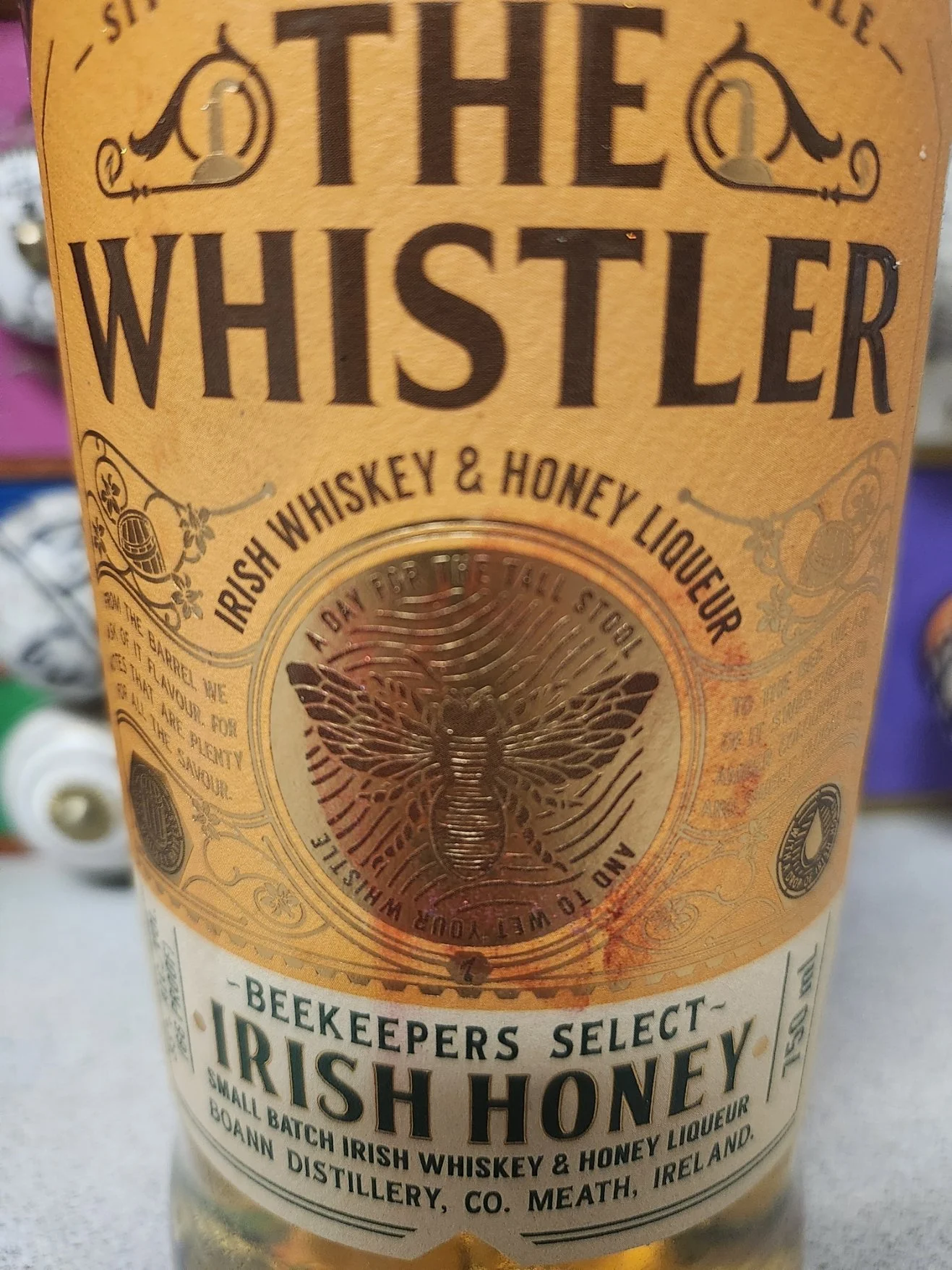
Yes, I kissed the label wearing red lipstick—then smeared it during ritual.
;)
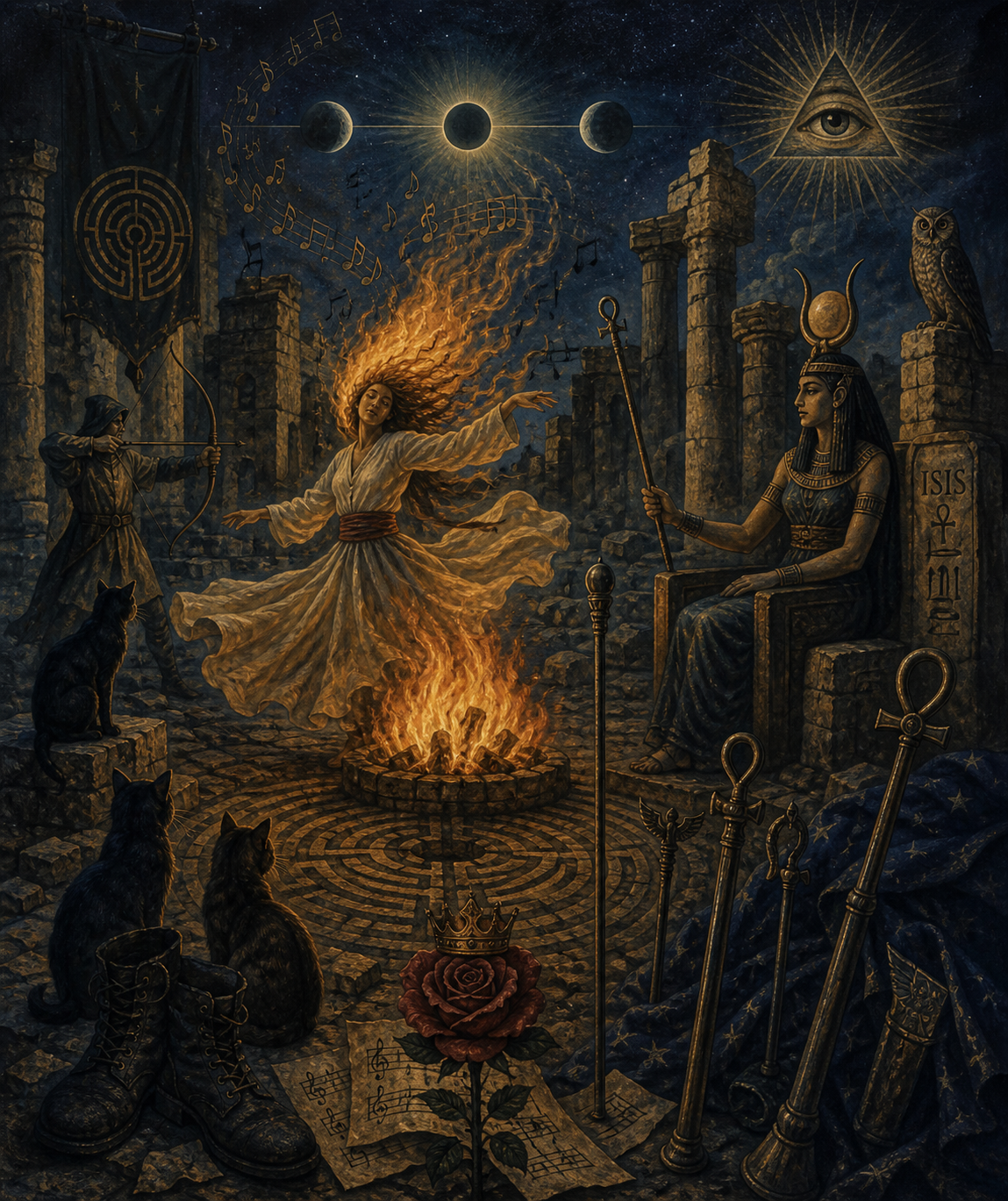
This is what ritual feels like to me.
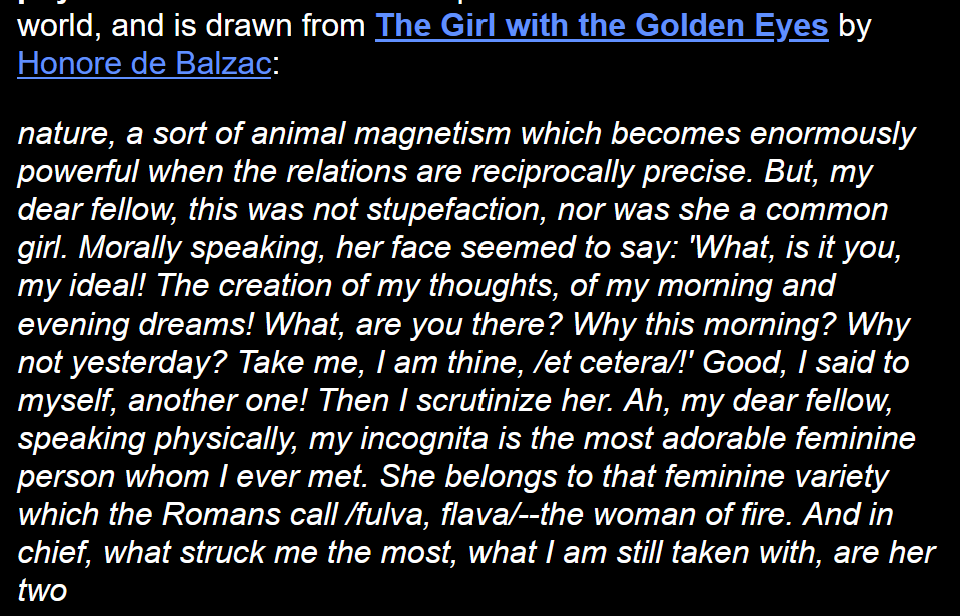
Balzac! How do I love thee?! Let me mount each way.
Oh wait… He’s dead.
;)
Next Week
Monday: DISTRIBUTED ATTRIBUTION: When Everyone Is Nobody A Strategic Assessment of Peer-to-Peer Enforcement Systems
This one explores how horizontal totalitarianism is a national security threat and how it relates to falling birth rates.
Thursday: Applause for the Dead The Cultural Logic of Celebrating the Pneumatic Type While Eliminating the Pneumatic Person