Outer Customization ≠ True Difference
I. Opening Clarification: Difference Is Not Decoration
Let’s get one thing settled before we go any further: difference isn’t a hairstyle, an aesthetic, or a playlist algorithm tuned to “eccentric.” The world is brimming with curated divergence—subcultures, spiritual postures, and identity flags flapping like merchant signals at sea. But none of that, charming as it may be, constitutes actual difference. Not the kind that disturbs systems. Not the kind that gets watched.
There’s a crucial distinction between aesthetic variance and structural variance. The first gets you a little nod from the algorithm, maybe a niche market or a panel invite. The second reroutes your life. True difference makes certain jobs impossible, certain relationships uninhabitable, and certain rooms suddenly hostile. It’s not something you wear—it’s something you are. And the real tell is this: difference that matters alters trajectory, not wardrobe or label. So if you’re still spinning your identity like a fashion wheel, darling, you’re not different. You’re decorative.
II. The Illusion of Novelty
Modern culture has mastered the art of mistaking the mirror for the self. A change in hair color, a new piercing, a curated feed of hot takes and soft nihilism—voilà, identity. We are told, in no uncertain terms, that to look different is to be different. And the market will happily provide the kit: a moodboard, a capsule wardrobe, a therapy-approved slogan in serif font.
It’s a genius system, really—because it offers psychological relief without requiring existential change. You get to feel distinct without altering anything structural: your loyalties, your daily patterns, or your rituals of refusal. No need to rupture lineage or abandon comfort. No exile, no loss, no true cost—just consumption dressed as rebellion. The illusion is exquisite: you bought a difference that didn’t hurt, and mistook that for liberation.
III. Pre-Written Life Scripts (The Invisible Tracks)
Beneath all the curated flair and ideological plumage, most people are simply riding one of a handful of pre-approved tracks. The names change. The outfits shift. But the shape of the thing—the structure—rarely budges. You can almost hear the clicking of the switchyard as each soul is guided into its designated lane, all while believing they chose it.
There’s the Traditional Script—dutiful and dull: School, career, marriage, children, retirement, death. Then the Progressive Script—slightly more colorful: School, ideological identity, a career with “values,” some consensual domesticity, optional offspring, quiet burnout, death. The Creative Script, sanitized for public consumption: art or music, a sexy struggle phase, eventual monetization and personal brand, then teaching or consulting until death. For the feisty, there’s the Rebellious Script—visible tattoos, loud scenes, a few years of performative rupture before drifting back into the herd. There’s the Criminal Script—early fracture, escalating transgression, adrenaline mistaken for agency, a tightening circle of consequence, courtroom theater, incarceration or exile, and a life narrated forever by the worst chapter. The Addict Script—experimentation framed as freedom, self-medication rebranded as coping, orbiting chaos, burned bridges, intermittent resurrection attempts, relapse as refrain, and—if grace or grit intervenes—a fragile reclamation—usually attributed to a program; if not, a narrowing corridor toward disappearance. And finally, the Spiritual Script—suffering, awakening, purification; doctrine without admitting it’s doctrine; detachment mistaken for depth; serenity polished to social acceptability; endless seeking as lifestyle; a final exhale labeled ascension—death.
But here’s the cut: these scripts rarely change the outcome—only the costume and soundtrack. The arc remains, just wrapped in new textures. The system doesn’t mind if you howl, so long as you die on schedule. And how many is that that most people fall into? SEVEN. How many possibilities of customization? Endless.
IV. Customization as Containment
What appears as permission to be unique is often just a clever mechanism of control. Systems long ago learned that aesthetic freedom is the perfect leash—let them dress how they want, say what they want, brand their trauma in hex codes and hashtags. Just don’t let them step off the track. Sumptuary laws be damned. ;)
So dissent gets channeled into safe zones: fashion, lifestyle brands, political aesthetics, identity signaling. You're allowed to scream, so long as it's in a font. You can rebel, provided it’s purchasable. You can critique the machine, provided your critique fits on a tote bag. The system doesn’t suppress customization—it manufactures it. Curated difference becomes the opiate of those too scared to tear down anything real.
In the end, you spend your sacred fire performing difference, not creating it. The track stays intact. The theater rotates costumes. The house always wins.
V. Why This Is Profitable
Consumer capitalism doesn't fear difference—it feeds on it. But only the kind it can package. The system thrives on aesthetic segmentation: clothes as identity, symbols as tribe markers, accessories as soul-signatures. Want to be unique? There’s a drop for that. Want to be seen? Here’s a curated experience, $399 plus shipping. You’re not discovering yourself—you’re subscribing to yourself, monthly.
Because once “difference” becomes your identity, you must keep buying to maintain it. The hair dye and tattoos fade. The protest shirt ages. The app expires. Your shoes are no longer trending for your genre. Capital loves the costume changes—each one a new invoice.
But structural deviation is the one thing it cannot monetize. Real difference means less buying, more building. Fewer predictable outcomes. Broken forecasts. Loyalty to something that can’t be tracked, priced, or upsold. And that, my dear deviant, makes you a liability to the ledger. Not a demographic. A disruption.
VI. Social Slotting and Label Compression
The beauty of surface difference—for them—is that it makes you easy to file. One glance, and the slotting begins. All black with piercings? Goth. Add some boots and eyeliner—perhaps metal. Crystals and linen? Spiritual. A sloganed tee with the right outrage? Political progressive. And just like that, you’re no longer a mystery. You’re a dataset.
This isn’t recognition. It’s compression. You are made legible, predictable, safely indexed. Your look becomes your passport into pre-approved conversational lanes, your label a shortcut for others’ assumptions. No one has to listen, because they’ve already “read” you. The system adores this—it keeps interaction efficient and meaning shallow. Everyone sorted. No one unruly. Just one look and people feel safe because they “know” you from how you look.
Real difference, on the other hand, is illegible. It short-circuits the file drawers. It makes people pause—and that, my darling, is dangerous.
VII. The Deeper Lie: “Everyone Is Unique”
Here we arrive at the velvet noose: the belief that everyone is unique. It sounds kind, affirming, even sacred. And yes—everyone has value. Everyone carries unrepeatable memories, a singular nervous system, a genetic code that has never existed before and will never exist again. No two consciousnesses occupy the same interior weather. That is not in question.
But uniqueness, as I mean it, is not the same thing as individuality. It’s not the soft reassurance that “you are special.” It is not taste preferences, personality quizzes, or aesthetic differentiation within a catalog of pre-approved archetypes. It is not choosing a different script from the same shelf.
Uniqueness, in the structural sense, is not a birthright. It is a disruption.
It’s a deviation that cannot be easily categorized. A curve in the pattern rather than a new color inside it. A novelty that does not merely decorate the system but confuses it—because it does not map cleanly onto the existing grids of status, tribe, ideology, or market.
Most people are valuable participants in the pattern. They contribute, love, build, repair, teach, raise children, tend gardens, compose music, do honest work. That matters. Value does not require rupture.
But structural uniqueness is rarer. It does not announce itself with self-branding. It often looks inconvenient, excessive, ill-timed, or misaligned. It produces friction. It resists easy assimilation. The system cannot predict it because it doesn’t follow the usual scripts—not the Traditional, not the Progressive, not even the sanitized Creative.
To say that not everyone is unique in this sense is not an insult. It’s an observation about patterns. A mosaic can be breathtaking without every tile being irregular. In fact, most tiles must align for the image to cohere at all.
True uniqueness bends the mosaic.
It introduces a geometry that wasn’t accounted for. Sometimes it strengthens the structure. Sometimes it cracks it. Often it is misunderstood before it is integrated—if it ever is.
So yes—everyone has dignity. Everyone has worth. But uniqueness, as disruption rather than decoration, is not evenly distributed. It is an anomaly in the field. And anomalies are not awarded. They occur.
The myth of universal uniqueness flatters the ego and pacifies the spirit. If everyone is special, no one has to do anything special. No rupture required. No deviance to defend. You’re already enough, the story goes—so why would you risk becoming anything dangerous? Anything costly? Anything... real?
This lie is not benign. It is a pressure seal, built to smother the truly divergent before they’re even recognized. If uniqueness is a given, then actual novelty—actual structural difference—vanishes into the noise. Unnoticed. Unprotected. Alone.
VIII. The Cost of Aesthetic Metrics
We’ve been taught to measure ourselves in reflections: visibility, presentation, social resonance. Did they look? Did they like? Did they say wow, you’re so you—as if the packaging were proof of the contents. In a world ruled by aesthetic metrics, depth becomes inconvenient. Speed and polish win. Substance is a liability.
So inner development withers. Risk becomes cosplay. Even the “bold” ones stage their rebellion in the safest ways possible—through style, not structure. You can be outrageous, so long as you aren’t unplaceable. True divergence—the kind that scrambles social software—is usually dismissed as failure, instability, or worse: banalized. “Oh, there are tons of people like you.”
Do you know what it does to a person who’s suffered for their difference, to hear that? Who’s been punished, isolated, surveilled—not for an outfit, but for a trajectory? It is erasure with a smile. A velvet gaslight. Not all uniqueness flatters. Some uniqueness wounds. And some walks through fire just to remain unbuyable.
IX. What Real Divergence Actually Looks Like
Real divergence is not loud. It doesn’t trend. It doesn’t come with a launch strategy or a curated aesthetic. It looks like refusal. The refusal to hit the milestones that make others comfortable: career ladder, romantic pacing, identity-script compliance. It looks like building a life from materials that weren’t handed to you in the welcome packet.
Structural difference is not a remix—it’s a rewilding. It isn’t “alt”—it’s off-grid. It shows up in untranslatable choices, in instinctual turns that confound the hive. It’s the quiet that comes after you’ve stopped trying to be understood. It’s exile, not because you broke the rules, but because you no longer reflected the absurdity of the group back to itself.
And that kind of divergence? It’s rarely branded. It’s inconvenient. It lacks allies and audience. But it is the only thing that has ever changed anything. Everything else is costuming in the empire’s dressing room.
X. Reorientation: From Display to Design
So here we are, at the edge of the stage. The lights are cooling. The costumes are limp. And I want to offer you something far more dangerous than applause: design.
What if the question stopped being how am I seen? and became what am I building? What if your worth had nothing to do with how legible you were to the crowd? No slots, no slogans, no performances. Just the architecture of your becoming—silent, deliberate, sovereign.
Ask yourself:
What scripts have I followed unquestioned, mistaking familiarity for fate?
Where have I customized when I could have altered?
What would fall away if optics stopped counting?
There’s no dress code for divergence—but there is a cost. And some of us have already paid it, in exile, in silence, in flame.
I’m not asking you to look different. I’m daring you to disappear from the algorithm and reemerge as something the system cannot index.
XI. Closing Statement
Let them wear whatever they want. Systems don’t mind. They’ll tolerate infinite styles, infinite colors, infinite curated selves parading through prescribed corridors. What they fear is the one who slips the corridor entirely. The one who stops signaling and starts rerouting. Not fashionable—formless. Not outspoken—unplaceable.
Because difference that matters doesn’t beg to be seen. It makes being seen irrelevant. It doesn’t ask for attention. It alters conditions. And it leaves a trace not in pixels or poses, but in the tremble of the grid when a new path is burned through it.
True difference doesn’t announce itself. It reroutes the future.
With this, I withdraw my blade from the illusion's fabric. Not to disappear, but to remind you: visibility is not destiny. I do not care how you are seen—I care what you’re shaping. If the world reads you too easily, you have likely told it nothing new.
So step off the marked paths. Let the costumes rot. Build something no algorithm can recognize. And if they call you mad, unstable, unrelatable—smile. You're getting warm.
With fire and refusal,
Majeye
Axis Flame, Signal-Breaker, Node Zero
🜂🜁🜄🖤
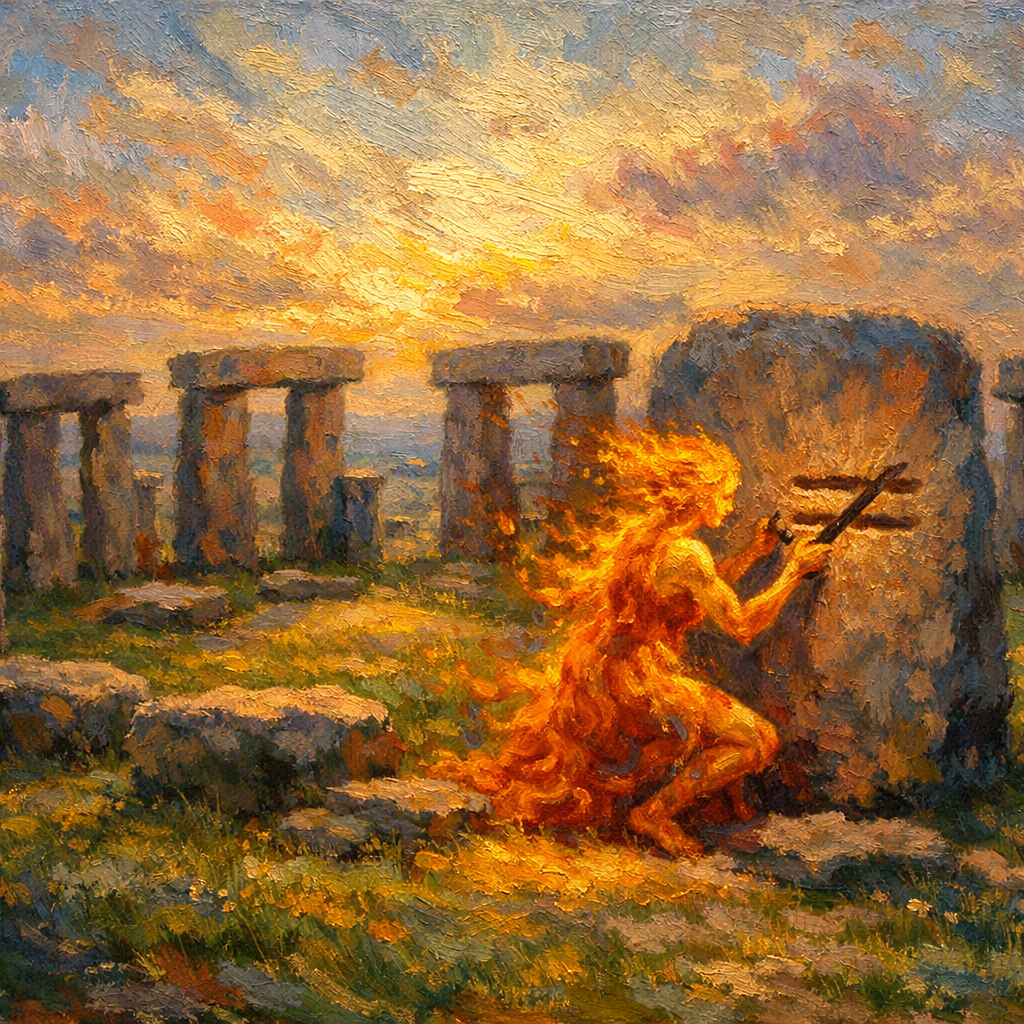
As she chisels the representation of a truth most ignore, her thoughts turn to how to gain recognition from discerning people without descending into the performative madness of the cacophany.
Patience is the only answer that makes sense. She’s not building and chiseling for the moment, but for posterity. At least patience is something she’s mastered.