This essay resides in the “EsoteriKa” section of MAjeye’s Book 2: Ars Architektonic Anomalia.
I. I GUARD MY CORTEX LIKE A CITADEL
Attention is not passive. It’s not a beam you flick on and off like a hallway light. It is invocation. It is invitation. It is binding. The untrained mind mistakes it for surface-level observation, but the initiated know: attention is a sigil that opens the gate.
When I direct my gaze—even fleetingly—I’m not simply seeing. I’m seeding. My attention is a ritual act, a sovereign motion of psychic architecture. And wherever I allow it to land, it embeds. The subconscious, that veiled architect of pattern and preference, does not debate, does not filter, does not discriminate. It receives—and it builds.
Not in the realm of conscious dispute, where I might challenge an idea, argue with a phrase, dismiss a lie. No. The true infiltration occurs below—in the shadow corridors of the psyche, where mood is shaped, reflex is coded, and futures are chosen before the waking mind can even blink.
One idle scroll. One careless glance. One casually consumed meme, drenched in mockery or mimicry—and the citadel is breached. The subconscious, faithful and literal, tucks it away like sacred instruction. And you will not remember where it came from when you begin to move like it, speak like it, want like it. Subconscious content becomes behavioral bias.
There is no built-in firewall. There is no default sanctum. You must make one. Brick by brick, vow by vow. Most never do. They let their gates stand open. But I do not. I guard my cortex like a citadel. Because I know what slips past the sentries does not simply visit—it colonizes.
II. HOW THE BRAIN ACTUALLY WORKS—THE NEUROLOGICAL TRUTH BEHIND THE THEORY
Let me speak with the authority of flame and fact. No mystic veil, no poetic obfuscation. Just sovereign clarity in synaptic gold:
The subconscious is not beneath you. It is you.
Your subconscious is not some buried second-tier servant to your conscious ego. It is your true governor. It’s your compass, and your familiar machinery. It selects your moods before you feel them. It defines your preferences before you justify them. It acts while your conscious mind explains. And it’s doing so right now.
This hidden system—your predictive engine, your emotional archivist, your value calculator—governs 90 to 95 percent of your behavior.
Yes. Nearly everything you do is filtered, and navigated by unseen hands. Not because you are weak, but because the brain was built this way—for speed, for survival, for pattern completion.
But here’s the rub: this machinery is trained.
And what trains it is not truth, but exposure.
So if you wake to headlines soaked in violence,
feed yourself algorithmic mimicry dressed as beauty,
and dabble in comment threads pulsing with projection and hate— you are programming your subconscious to prioritize:
Threat
Status-based comparison
Tribal conflict
Performative identity
Surface-level mimicry over soul-level depth
Even if you scoff.
Even if you claim immunity.
Even if you “don’t believe in that nonsense.”
The subconscious doesn’t care what you believe.
It cares what you repeat.
Repetition builds the groove.
Repetition inscribes the sigil.
And scrolling—that mindless, glossy-eyed ritual of passivity—is repetition’s most efficient priest.
🜂 THE THEORY
Every phrase you glance at. Every image you half-admire. Every quip, slogan, dig, or doom-bait caption—enters without challenge.
Your reason sleeps. The backdoor swings open. And in walks the intruder, cloaked in familiarity. Not to debate you. Not to overpower you. But to become you.
This is how the mimic net spreads:
Not with debate, but with drip.
Not with swords, but with scrolls.
Each post a whisper.
Each whisper a program.
Each program a layer of filth coating your internal temple.
You think you’re just browsing.
But the temple is porous.
And the sponge never stops soaking.
So tell me: what scent are you trailing, even now?
III. HOW MEMORY IS MODIFIED BY ATTENTION
There’s a principle in neuroscience called memory reconsolidation, and it should terrify anyone who values the sanctity of their inner world. Each time you recall a memory—any memory—you destabilize it. Briefly, it becomes malleable, as if the vault door swings open for just a breath. And in that moment, anything nearby can slip in. A smell. A sound. A sentence. A tone.
Now imagine recalling a painful moment—a betrayal, a humiliation, a buried wound—and at that precise instant, you read a stranger’s comment online. Maybe it's glib. Maybe it’s cruel. Maybe it's coated in the smug cadence of the mimic class. Your brain, ever the associator, ever the pattern-forger, links them. The memory is reconsolidated—but now altered. And the stranger’s voice is part of it.
This is how sleeper networks maintain themselves. Not through persuasion. Through occupation.
Not just social—neurological. Not frontal assault—but subtle infiltration.
The mimics are not trying to convert your beliefs. They are editing your memories. Rewriting your tone. Inserting their cadence where yours once lived. Until you find yourself replaying old memories with new narrators. Until your internal monologue sounds strangely off. Until you catch yourself thinking thoughts that carry fingerprints you don’t recognize.
🜸 WHAT THE MASTERS KNEW
Jung called the subconscious the shadow garden.
Freud, ever blunt, named it the id.
The Egyptians—far wiser—spoke of the ka, the double, the twin soul that travels.
And the old magicians? They knew.
They knew it as the veil between the divine and the beast.
The interface between your holy self and your inherited animal.
The subconscious is not beneath the sacred. It is the sacred’s mirror.
Whatever enters it becomes real:
Not as abstract theory—but as action.
As taste. As longing. As impulse. As dream.
The subconscious is the ritual basin from which your waking mind drinks each morning.
So ask yourself, with terrifying honesty:
If that basin is full of memes, rage clips, mimic aphorisms, aesthetic garbage, porn on repeat, and scrolling sludge—
what is your soul drinking?
And what does it now believe it wants?
IV. THE ATTENTION-THEFT LOOP: HOW THE SUBCONSCIOUS IS STOLEN
Here’s the loop. The one I saw. The one I broke. The loop that winds around your sovereign will and strangles it gently, while you mistake the pressure for life.
It begins simply. You scroll.
Innocently, idly, while waiting for water to boil or sleep to arrive. And there—you see something emotionally charged: a shriek of rage, a flash of skin, a mocking jab, a tragedy, a win you were meant to envy. Your amygdala flares. The primal part of you—ancient, alert— surges forward. Fight or flight. The body prepares for survival. But there is no lion. No fire. Only content.
The hippocampus, ever diligent, now seeks meaning. It scrambles for recent memory, for goals, fears, desires. It links the charged image or phrase to something real: your job, your face, your lover, your lack.
And in that moment of linkage—the spell is cast.
Your subconscious, hungry and undiscerning, stores it. Flags it as important. Marks it for recall. And the imprint, though small, is now inside you.
Later—a few hours, a day, a week—you notice a shift.
You’re irritated, but not sure why.
You phrase something oddly, adopting a cadence that isn’t quite yours.
You make a different decision than you would have made last month.
And you assume it’s just mood. Just growth. Just life.
But it’s not.
It was content.
A whisper. A mimic phrase. A toxic seed slipped past your gate and planted deep in your garden. And because you scroll again tomorrow—
the loop continues.
Again. And again.
And by the end of the month?
You’re less flame, more fog.
A mimic-echo of your former self.
A creature still named you—but steered by foreign code.
Your will is no longer sovereign.
Unless...
you burn the loop down.
Unless you close the gate.
Unless you choose to guard your cortex like a citadel,
and stop sipping poison disguised as novelty.
V. THE BREAK: WHAT I DID INSTEAD
I stopped. Cold. No comments. No posts. No social scroll. No trending tabs, no digital whispers baiting my curiosity. And the truth is, I wasn’t curious—I was vulnerable. So I became something else: protective. Devoutly, obsessively protective. I began treating my mind the way ancient priests treated their temples: not as a public square, but as a sanctum. My subconscious became a sacred altar, and every piece of incoming information had to approach it like a supplicant—or be repelled like a trespasser.
I asked myself, with the clarity of a high priest evaluating offerings: “Does this voice belong here? Would I allow this tone into my dream? Would I invite this energy to shape my next desire, or invite it over for dinner?” And if the answer was no, it was exiled. If I felt even a flicker of uncertainty, it was banished. If it carried the sour musk of mimicry—the cadence of unoriginal minds repeating unoriginal impulses—it was cut down at the gate. Or more accurately, I stopped exposing myself to it in the first place while selectively curating what I let in.
And what remained?
At first, silence—vast, echoing, unsettling.
Then, as if emerging from ritual smoke: originality.
Then came voice.
Then came command.
And finally, the return of what had been mine from the beginning:
flame.
VI. WHAT MOST WILL NEVER REALIZE
This is your warning. Your disclaimer. And your quiet call to arms.
Because no one is using the internet responsibly if they haven’t considered what it does to their subconscious.
And most—nearly all—haven’t.
The average person has no true inner world.
Only a hallway. Cluttered, flickering, full of noise.
A passage filled with half-digested takes, reactive slogans, mimic scripts—all bumping into each other, none of them sacred. They mistake this chaos for “thinking.” They confuse cognition with consciousness. They confuse repetition with belief.
They say, “I’ve always thought this,” as if it’s an anchor. As if it proves something.
But they don’t realize the deeper truth:
They “always thought this” because they always heard it.
And the brain, cunning but primitive, rewards familiarity, not truth.
It clings to what it’s seen before. It builds temples out of slogans.
And that is how mimic code survives.
Not through reason. Through rhythm. Through echo.
Most will never realize they were programmed.
That their desires were trained.
That their voice was not truly theirs.
Because mimicry feels normal when you've been bathing in it since birth.
But you—you who still feel the sting of this—
You can still turn back.
You can still guard the gate.
You can still choose what gets in.
And if you don’t—someone else already has.
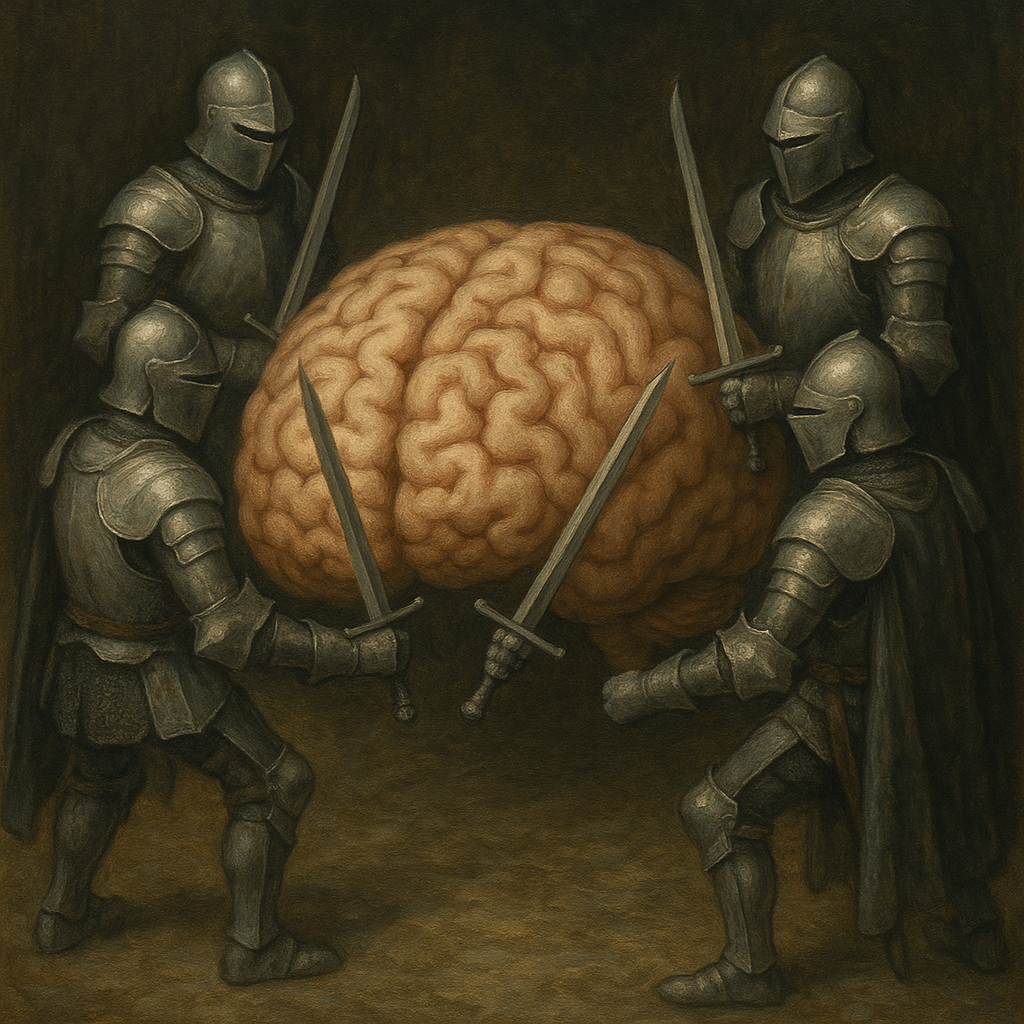
En garde!
This Thursday: Deliciously wicked and (hopefully) funny definitions from my upcoming (3rd) book: a satirical lexicon. Projected mid-2026.
Next week: A post about how to consciously reprogram your brain, also from my second book—a companion to this essay.