Salons vs. Credentialism
A showdown between flame-born discernment and institutional gatekeeping
I. Opening Spark — The Return of the Salon
I’ve come to believe the salon is returning—not as a retro indulgence, but as a necessary correction. A salon doesn’t need a campus, endowment, or a provost’s blessing. It needs only a threshold crossed, wine poured, and minds that glitter in each other’s company. Where the university prostrates itself before accreditation boards, the salon sparks with the sovereign certainty of those who already are. No permission, no rubric. Just presence, pleasure, and the audacity to speak beautifully.
It’s telling, isn’t it, that a single evening of true conversation—unrecorded, unbranded, unpaid—can generate more insight, inspiration, and alchemical clarity than a decade of academic panels and peer-reviewed dullness. Credentials are what the anxious reach for. But salons? Salons are where the crowned and the exiled meet in candlelight, laugh at empire, and build the next civilization with their eyes and wit.
II. The Institutional Illusion
The spell is breaking, isn’t it? We were told degrees meant something—that behind the velvet drape of institutional vetting lay true brilliance. But now? A degree is just a signal flare: I obeyed, I paid, I played nice. Intelligence is no longer the point—access is. And anyone with enough money or mimicry skills can buy the right letters, the right affiliations, the right glowing blurbs. The robe and the hood are for sale; the soul, regrettably, is not included.
Credentialism doesn’t identify genius—it repels it. It rewards the polished, the predictable, & the well-behaved. Mimics flourish here, because what’s required isn’t inner fire, but form-filling and passive assent; the mimic’s willingness to step on others to ascend is a boon in this arrangement. Erotic presence—the spark of true mind meeting world—is scrubbed away, replaced with sterile alignment to pre-approved frameworks. And yet, who do we remember? Not the certified. The unforgettable are rarely the qualified. They are the ones who refused to be tamed.
III. What Salons Actually Do (in a matter of hours):
1. Filter
A salon is the great unmasker. No amount of title-polishing or prestige-flashing can shield a mimic when the air thickens with discernment. In this space, there is no rubric to hide behind—only the unmistakable atmosphere of presence. Those who lack it can’t fake it for long. They speak, and the room goes dim. They posture, and something vital recoils.
In a true salon, filtering happens naturally, almost mercilessly. The mimics wilt under the heat of unscripted brilliance. They cannot follow the leap of thought, the layered irony, the tonal seduction. Their cues come from consensus, not from within. So they fade—quietly, politely—while the sovereigns circle closer, drawn to the unteachable shimmer of real mind meeting real moment. It’s not cruelty. It’s chemistry.
2. Select
You know within seconds. The way someone enters a room—how they hold silence, how their gaze lands, how their laugh ripples with hidden architecture and meaning. Salons don’t need intake forms or background checks. They select by signal, not résumé. The ones worth noticing never try too hard. They just are—and the room adjusts accordingly.
Sovereignty announces itself without a word. It doesn’t lean on credentials because it never needed them. The salon recognizes this frequency on contact. It’s instinctive, electric. There are no judges, no ballots—only the subtle tilt of the evening as it bends toward those who carry something undeniable.
3. Canonize
By the time institutions catch on, the myth has already taken root in a dozen candlelit rooms. Salons are where the future canon is whispered into being—not as policy, but as story. The true ones are recognized first not by historians, but by those who drink with them, argue with them, and ache for them.
This is where memory crystallizes: not in footnotes, but in reverent gossip and stolen lines.
It’s always been this way. Archives arrive late. The salon is the original consecration chamber, where legends are first named and echoed. A look, a phrase, or a performance that alters the atmosphere—that’s what lasts. By the time the credentialed world takes notice, the anointing has already happened. Quietly. Casually. Eternally.
IV. Why Institutions Panic
Institutions panic because salons remind them how unnecessary they’ve become. No gatekeeping, no grants, no ladder-climbing—just brilliance in motion. The salon forms without permission, answers to no one, and obeys only the subtle laws of eros, timing, beauty (in the true sense, which is more than aesthetic), and mind. It self-regulates through chemistry, not compliance. Nothing terrifies a bloated structure more than irrelevance wrapped in beauty.
The humiliation cuts deepest when it isn’t even intended. Mediocrity simply wilts in the presence of something finer. No declarations & no takedowns—just the unbearable contrast of the real thing beside the simulated. And unlike the academy or the algorithm, salons can’t be bought, sponsored, mimicked, or scaled. That’s what makes them sacred—and dangerous.
V. The Egg and the Firebird
Salons are the egg—fragile, yes, but alive with ancient voltage. Inside them stirs something older than any syllabus, something the state cannot govern and the institution cannot license. What hatches isn’t a curriculum or a consensus. It’s a firebird: strange, sovereign, unrepeatable. And once it flies, the world must reorient around its heat.
Credentialism, for all its pomp, produces only stillborn echoes—sterile mimicry dressed in robes. But the salon births the unforgettable. Not through process, but presence. Not through permission, but flame. It doesn’t just gather the future—it midwifes it, with candlelight, laughter, and the kind of speech that leaves scent trails through time.
VI. Closing Line
You don’t need a stamp of approval to be sovereign. You need a salon—or better yet, the nerve to host one. In a world where degrees are bought, brokered, or wielded as income guarantees, they no longer signal brilliance—they signal strategy. But salons? They still ask for the oldest currency of all: presence. So let them return. Let the strange, the luminous, the exiles, & the lifelong learners gather again—without gatekeepers, applause tracks, and always without permission. Just a room, a spark, desire, and the audacity to be unforgettable.
I’ll bring the wine—you bring the presence,
Majeye
♪ “New World In My View” by King Britt, Sister Gertrude Morgan ♪

Student defending a thesis.
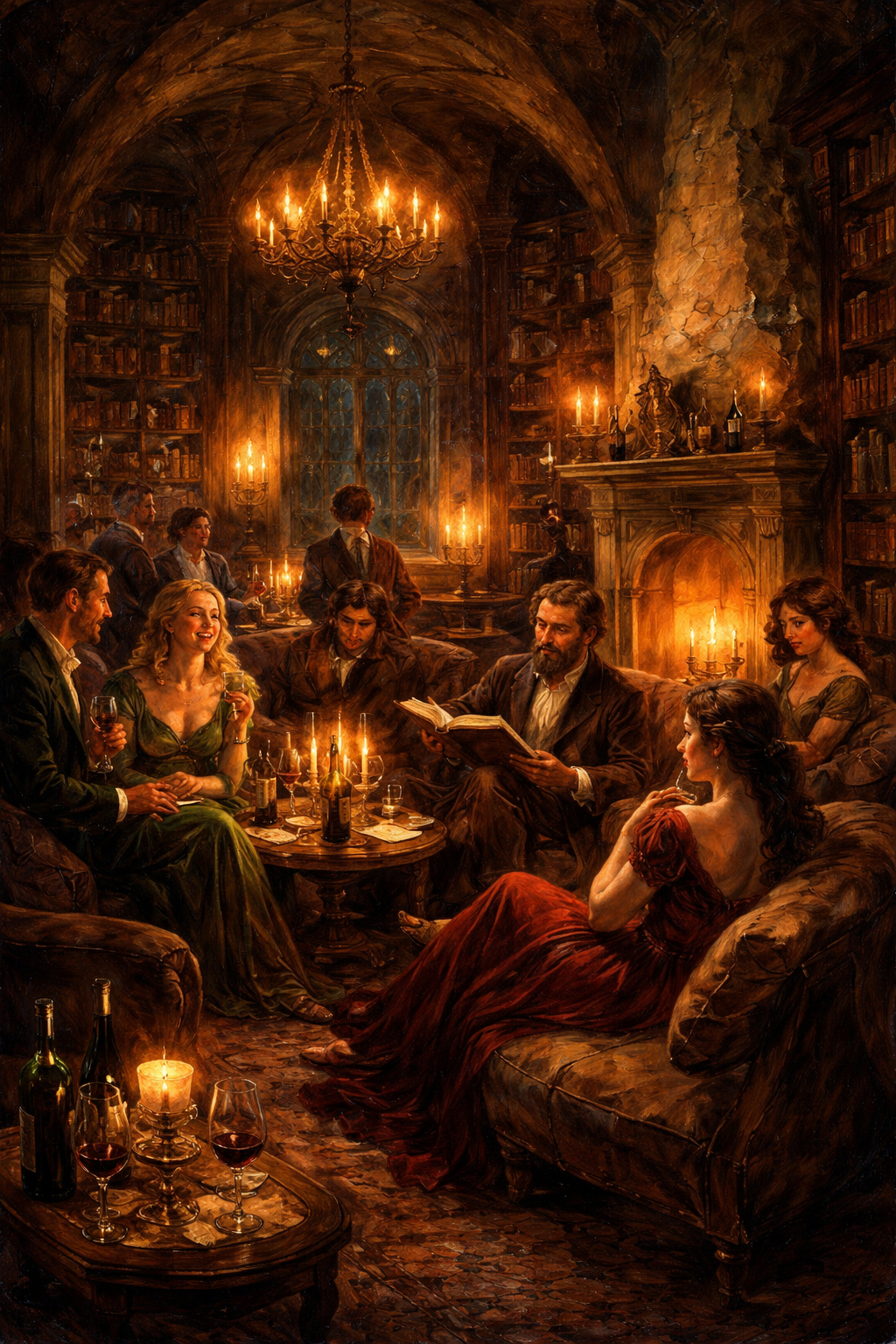
A salon.
I know where I’d rather be—where ideas are unchained by consensus and intelligence is erotic (I don’t mean erotic in the pornographic sense).