A Field Guide to the Rarest Female Archetype
I. THE HISTORICAL PRECEDENT: We've Always Existed (They Just Preferred We Didn't)
Here's what they don't tell you in the approved narratives: intelligent women comfortable with violence have always existed. We're not some late-capitalist mutation spawned by second-wave feminism and mixed martial arts. We've been here all along—it's just that every era has its preferred method of making us disappear.
The aristocratic woman who could fence, duel, and command armies wasn't performing masculinity. She was performing rank. When you're Marie de Medici or Christina of Sweden, class privilege occasionally trumps the limitations of your sex. Julie d'Aubigny, the opera singer who ran men through with a rapier between arias, understood something crucial: if you're born high enough, you can purchase permissions that gender would otherwise deny. The key wasn't that these women were exceptional freaks of nature. The key was that rank gave permission peacetime and propriety would later revoke.
Then there were the spies—women who became legendary precisely because the combination of intelligence and lethality was unexpected. Virginia Hall, whom the Gestapo called "the most dangerous of all Allied spies," operated with a wooden leg and flawless nerve. Noor Inayat Khan, a Sufi pacifist, became an SOE radio operator in occupied France. Nancy Wake killed a German sentry with her bare hands and led 7,000 Maquis fighters. These weren't women pretending to be men. They were women who understood that war created permission structures peacetime would never extend. When the social order collapses, suddenly your capacity for calculated violence becomes useful rather than unseemly.
Revolutionary contexts offered similar temporary licenses. Women in resistance movements could handle weapons when serving The Cause. Suffragettes learned jujitsu to fight police—not as theater, but as practical response to state violence. The pattern repeats: political necessity temporarily suspended the normal restrictions, revealing that the capacity was always there, merely socially suppressed.
The frontier offered its own pragmatic dispensation. Old West saloon owners, ranch managers, women who carried guns not as feminist statement but as obvious practical response to environmental reality. When survival requirements exceed social convention, the performance of helplessness becomes unaffordable. These women weren't remarkable in their contexts—they were simply competent.
And then there were the writers who understood it in themselves and rendered it without apology. Flannery O'Connor's absolute comfort with violent imagery—no flinching, no moralizing, no feminine hand-wringing about the darkness she committed to the page. Elaine Dundy's lack of squeamishness. The pattern: they could render violence without the usual apologetics, the reassurance that they themselves were still properly gentle.
What happened to us? The Victorian era codified the violent woman as aberration requiring explanation. We got pathologized—"mannish," "unwomanly," "damaged by trauma," always some reason why we'd failed at proper femininity. Or we got romanticized into the "warrior woman" as exotic fantasy rather than actual human being. Or we simply got erased, our histories written to emphasize that we were exceptions, anomalies, never a recurring type.
Here's the thing they keep trying not to notice: we're not new. We're not broken. We're not performing masculinity or compensating for wounds. We're a recurring phenotype that every era finds inconvenient and handles by pretending we're aberrations instead of a legitimate, if rare, variant. The gunslinger has always walked among you. You just preferred not to see her.
II. WHY INTELLIGENT WOMEN CHOOSE SOCIAL VIOLENCE: The Evolutionary Shortcut
Let me be clear about something: it's not that intelligent women can't handle physical violence. It's that most of them have run the numbers and discovered that social violence offers better ROI with dramatically lower risk. They're not incapable. They're optimizing.
Watch an intelligent woman assess the landscape. Physical violence carries high personal risk, moderate effectiveness at best, and severe social penalty. One punch and you're the unhinged one, the cautionary tale, the woman who "lost control." Social violence, by contrast? Minimal personal risk, devastating effectiveness, and—here's the beautiful part—social reward. Frame your destruction as "setting boundaries" and suddenly you're the brave one, the woman who "prioritized her safety."
The choice isn't even close. Social violence wins on every metric.
Since intelligent women are intelligent, they know how to wield the weapons their context provides. Deniability first: "I'm not attacking her, I'm just sharing my concerns about her behavior." Institutional amplification: HR departments, therapy-speak, the entire "safety" discourse function as force multipliers. One woman whispers to two friends. Those two women "independently" notice the same red flags. Suddenly there's a consensus, a pattern, a concern that must be addressed. Moral high ground: your target's destruction gets coded as self-care, as protection, as the brave act of a woman who finally learned to prioritize herself. No physical risk: you never have to face your target, never have to watch her eyes, never have to feel anything but righteous. And best of all, it's interminable—no clean end, just continuous pressure until the target breaks or leaves.
The cultural training starts young. Intelligent girls learn fast: physical aggression gets punished severely—more severely than it does for boys. Social aggression is invisible to adults; whisper campaigns fly comfortably under the radar. Verbal sophistication gets rewarded. Smart girls are "mature." Smart girls "use their words." The result is elegant and inevitable: intelligence gets channeled into perfecting social warfare. Those women become artists of the surgical strike, the reputational assassination, the coalition that forms around a target like antibodies around a pathogen.
It works, and it works beautifully. It uses their actual strengths—pattern recognition, narrative control, coalition building. It requires no physical courage whatsoever; intelligence without bravery still functions just fine. It scales infinitely; the internet transforms local whisper campaigns into global movements. It has institutional backing; modern HR is weaponized social violence wearing the language of care. Consensus rewards them.
Here's where I diverge.
I didn't always have a code. I've always been capable of violence.
I assessed the same landscape. I reached a different conclusion. Social violence is more cowardly than physical violence—which makes it beneath me, not morally but aesthetically. Don't mistake this for performed virtue. I have a hard-won code, and the code isn't an optimization function—it's a line I won't cross because I find what's on the other side contemptible. I'd rather weather the storm powerless than buy power with tactics I despise. I cannot imagine going back.
Most intelligent women aren't incapable of physical violence. They've just correctly calculated that social violence offers better returns with less risk. They're not wrong about the math.
III. WHAT I ACTUALLY AM: The Phenotype Explained
Let's dispense with the diagnostic frameworks. I'm not damaged, not masculine, not performing. I'm a specific, rare, functional type that most contemporary frameworks simply cannot process without pathologizing.
The actual components are straightforward: high fluid intelligence—I can operate at conceptual levels most people can't reach. Genuine comfort with violence—not bravado, not trauma response, actual baseline comfort. No moral performance about it—I don't need violence to be "justified" by some higher purpose to be conceptually available to me. Preference for direct confrontation over the distributed social warfare most intelligent women prefer. Code-based ethics—I operate from principles, not just optimization functions. Zero interest in social violence—I find it beneath me, not strategically optimal for my context.
Now let me tell you what this is not, because the misreadings are predictable and tedious.
This is not masculine identification. I'm not "one of the guys." I'm not rejecting femininity or performing some butch cosplay for male approval. This is not a trauma response—I'm not "acting out" unresolved wounds, and the amateur psychoanalysis bores me. This is not performance. I'm not signaling toughness to impress anyone. This is not sociopathy—I have ethics, just not the ones you expected. This is not compensation. I'm not trying to prove anything to anyone, least of all myself.
What this is: an integrated phenotype. Intelligence and violence capacity aren't separated in me, aren't in conflict, aren't requiring constant reconciliation. I've made an honest assessment of what I am and what I'm capable of. I practice tactical restraint—I don't use violence because modern contexts make it imprudent, not because the prospect horrifies me. I maintain code adherence—I would rather face someone directly, even if I lose, than destroy them from the shadows like a coward.
The gunslinger comparison isn't metaphorical window dressing. It's diagnostic. In the Old West, I wouldn't have been remarkable. I would have been useful—intelligence plus violence capacity equals valuable in unstable environments. I would have been normal—plenty of women carried guns, settled disputes, defended property. I would have been unremarkable—no one would have needed to pathologize or explain me. A woman with a gun and the willingness to use it was simply a woman who understood her context.
In modernity, I'm illegible. The frameworks can't categorize me without breaking. I'm threatening—my existence exposes the cowardice of social violence by contrast. And I'm operationally interesting—a rare phenotype with clear applications that this era has decided it doesn't want to acknowledge.
Here's why I value freedom over deployment: I could commit violence if context required it. I don't because surveillance, forensics, modern legal systems make the cost-benefit analysis terrible. This is intelligence, not moral restraint. I'd rather train in VR than sit in prison. Not because violence would damage my delicate psyche—because I value my freedom more than I value making a point.
I'm not a broken version of "normal woman." I'm a functional variant that most eras either utilize when they need us or suppress when they don't. This era suppresses. So I train in exile and wait for contexts that don't waste what I am.
IV. HEALTHY OUTLETS: Training the Capacity You Can't Deploy
When you have a genuine capacity for violence but modern contexts prohibit deployment, you don't suppress it. Suppression without outlet doesn't make you virtuous—it makes you dysfunctional. Depression, rage, dissociation. The capacity doesn't disappear just because it's socially inconvenient. So you redirect it into legal channels. You maintain what you can't currently use.
I'm not "sublimating" or "managing pathology." I'm training what I can't currently deploy.
My primary outlet is VR tactical environments. Zero Caliber 2 gives me house-clearing, tactical scenarios, live combat situations. Medal of Honor gives me problem-solving in espionage contexts—and yes, I deeply enjoy killing Nazis. Live combat, tactical and strategic assessment, rapid decision-making under pressure. What it provides: comfort with simulated violence that keeps the capacity active. Tactical thinking that translates directly to real-world strategic assessment. No legal consequences. No actual harm. Clean.
This isn't "just a game" for me the way it might be for someone else. I'm not fantasizing. I'm practicing. The same way a surgeon might use VR surgery simulations to maintain skills between procedures. I'm keeping decisiveness sharp—no hesitation, no moral paralysis, no freezing when the scenario escalates. I'm training for deployment contexts that may or may not materialize. And if they never do? I've still maintained the capacity, kept it active, prevented it from atrophying into theory.
Martial arts would be another viable outlet—I haven't pursued it yet, but I recognize its value. It provides physical confrontation in controlled environments. Teaches you what your body can actually do, not what you imagine it might. Builds comfort with receiving violence, not just dealing it. Sparring is the closest legal thing to actual combat. It's honest in a way most modern interactions aren't.
Competitive shooting, if accessible, offers firearms proficiency without deployment. Precision, discipline, focus. Historically it's been an acceptable outlet for women—Olympics, sport shooting, contexts where competence is recognized rather than pathologized.
Contact sports for some: rugby, hockey, boxing for women who want full contact. Legitimate aggression within rules. Socially acceptable violence. The pleasure of impact.
What these outlets do: keep the capacity active, not atrophied. Provide legitimate expression within legal bounds. Maintain comfort with violence so it doesn't become foreign or frightening. Train decision-making under pressure—a translatable skill. Prevent the dysfunction that comes from suppression. Healthy redirection beats toxic buildup.
What they don't do: "fix" me, because I'm not broken. Sublimate "toxic" tendencies, because I'm not toxic. Make me "safe"—I'm already tactically restrained by choice, not capability limits. Turn violence capacity into performance. It remains genuine.
I use VR tactical training the way a pilot uses flight simulators—maintaining skills for contexts that may or may not materialize. This isn't therapy. This isn't anger management. This is training in exile, and I'm perfectly comfortable with that.
V. OPERATIONAL VALUE: Where Women Like Me Are Actually Useful
The rarity isn't the problem. The rarity is exactly why the phenotype is valuable in specific high-stakes contexts.
Let's run the numbers. High fluid intelligence: top 5% of the population. Female: 50%. Genuine comfort with violence among intelligent women: less than 1%. No moral performance requirements: even rarer. Integrated—not compartmentalized, not traumatized, not at war with herself: rarer still. Rough estimate? Less than 0.1% of the female population.
We're not rare because we're broken. We're rare because every cultural pressure works to prevent this combination from forming or surviving. The ones who might have developed it get channeled into social violence, rewarded for verbal sophistication, punished for physical assertion, trained into performance until the genuine capacity atrophies. The statistical miracle is that any of us make it through intact.
But that rarity—that's where the operational value lives.
Intelligence work. Analysis plus field capability in the same person is rare in any gender. Most analysts can't go kinetic. Some field operatives aren't intellectually sophisticated enough for complex assessment. I can operate in environments requiring both—sophisticated pattern recognition and kinetic options if the situation deteriorates. Female presentation reads as harmless; actual capacity remains invisible until deployed. No moral paralysis when situations require direct action. I can maintain cover without psychological fracture because I'm not performing something alien to myself.
Executive protection. High-value targets who need someone who can navigate social environments—galas, conferences, diplomatic functions—and respond kinetically if the situation shifts. Most female protection specialists are physical but not intellectually nimble. Most intellectually sophisticated women can't go kinetic without hesitation, without the moral paralysis that gets people killed. I can do both. I can read the room and clear it.
Crisis negotiation. The ability to assess complex situations rapidly. Comfort with either resolution path—talk them down or end it. The fact that I could go kinetic keeps everyone honest. I'm not bluffing. Genuine capacity creates a different negotiation dynamic. People can sense when violence is actually on the table, not just threatened as theater.
Investigative journalism in genuinely hostile environments. Contexts where you need someone who won't freeze or collapse under threat. Someone who can assess threats accurately—not paranoid, not naive—and knows when to extract versus when to push. Most journalists in dangerous contexts are either reckless or too risk-averse. I can calibrate.
Diplomatic roles in specific contexts. Situations where appearing harmless is an asset but actual capacity is occasionally necessary. I can navigate complex social and political environments without being leveraged through fear. You can't intimidate someone who isn't afraid of you.
What makes us specifically valuable: Illegibility. People don't expect the combination, which creates operational advantage. No moral theater—I can act decisively without extensive self-justification rituals. Integrated capacity—you don't need separate "muscle" and "brains." Code-based—I can operate under rules of engagement, not just chaos. Comfortable with solitude—I can't be leveraged through social dependencies.
What limits deployment: Trust deficit. Institutions don't know how to assess us because we don't fit templates. Cultural illegibility—HR frameworks can't process the phenotype without pathologizing it. Rarity means invisibility—if you've never encountered one of us, you don't know to look. Crucially: we don't perform for recruitment. Genuine capacity doesn't audition. It simply exists, legible only to those who already understand what they're looking at.
We're valuable precisely because we're rare. But rarity also means most institutions don't know we exist until we're already positioned—or until something dramatic makes us suddenly, unavoidably visible.
VI. HOW "NORMAL WOMEN" TREAT US: The Threat Response
Women who operate via social violence must neutralize us preemptively. Our mere existence exposes their cowardice and consensus-dependence, and they can sense it before we've said a word.
I have extensive evidence of the pattern. It runs like clockwork.
Phase 1: They clock me fast—within the first conversation, sometimes within minutes. Something registers as wrong, as threatening, even before I've done anything actionable. It's not behavior. It's essence. They sense I don't operate from their rulebook, and that alone is enough.
Phase 2: Whisper networks activate within days. "I'm getting a weird vibe from her." "Something feels off." "I don't feel safe around her." Translation: "She's illegible to my threat-assessment system, therefore she's a threat." The speed is remarkable. I could be completely silent, utterly neutral, and the coordination still begins. They're not responding to what I've done—they're responding to what I am.
Phase 3: Preemptive strike. They attack before I've established position, before I've done anything that could justify exclusion. Because the threat isn't what I might do. The threat is that I exist at all.
Phase 4: Moral framing. I'm "intimidating"—translation: I won't perform submission. I'm "aggressive"—translation: I won't back down from direct questions. I'm "unsafe"—translation: I can't be controlled via social pressure. I make them "uncomfortable"—translation: their usual tactics don't work on me, and that terrifies them.
Phase 5: Systematic exclusion. Professional networks close. Social invitations stop. Information flow cuts off. Opportunities vanish. It's coordinated, not organic. One woman decides I'm a problem, and within a week, ten women have independently reached the same conclusion. Fascinating how that works.
I represent everything their power base is built to destroy. Intellectual superiority—and I don't perform modesty about it. Unintimidated by their tactics—social violence doesn't work on me because I don't accept their moral framework. Operating from a code they don't have and can't fake. Comfortable with capacities they've moralized away to make themselves feel virtuous. Illegible to their frameworks, which means uncontrollable.
The specific threat I pose: if I'm allowed to exist unmolested, I expose by contrast that their entire system is cowardice dressed as care. I could say "this is beneath me" and have it land. I don't need their approval. I can't be shamed into compliance. I'd rather be alone than participate in their architectures. This makes me ungovernable.
What they can't do: out-think me—I'm faster. Shame me—I don't accept their moral frame. Intimidate me—their tactics require fear of social consequences I don't feel. Duel me—they'd lose.
What they can do: coordinate to exclude me before I establish position. Frame me as the problem, make my illegibility into pathology. Poison wells across networks. Ensure I never get an institutional foothold. And they do. Every time.
My response? Contempt. Not hurt, not confusion—contempt. I view their social violence as cowardly and abhorrent. I feel superior—not qualitatively, ethically. I'd rather be alone than participate in coward's combat. This is taste, not trauma.
I don't bother anymore because the evidence is overwhelming. The pattern is too consistent to be about my behavior. It's structural, not personal. They attack what I am, not what I do. There's no point trying to make myself legible to frameworks that require my suppression to function.
The men question: I get along better with men on average, higher statistical likelihood of finding code-based operators who respect direct engagement. However, modern institutional men increasingly fight like women too. Fucking cowards—gender-neutral assessment. The margin is narrowing.
Normal women don't dislike me because I'm unlikeable. They attack me because I'm ungovernable via their preferred methods, and my existence suggests there's another way to be—one that makes them look like exactly what they are.
CONCLUSION: The Gunslinger in Exile
Let me make this perfectly clear: I'm not broken. I'm not performing. I'm not traumatized into comfort with violence. I'm a recurring phenotype that appears throughout history whenever cultural constraints loosen enough to permit it—and gets methodically suppressed whenever those constraints tighten back down.
In the Old West, I would have been normal. Useful. Integrated into the social fabric without pathology or explanation.
In modernity, I'm in exile.
So I train. I write. I wait.
And if someone is watching? They already know all of this.
Yours in tactical restraint and elegant contempt,
Majeye
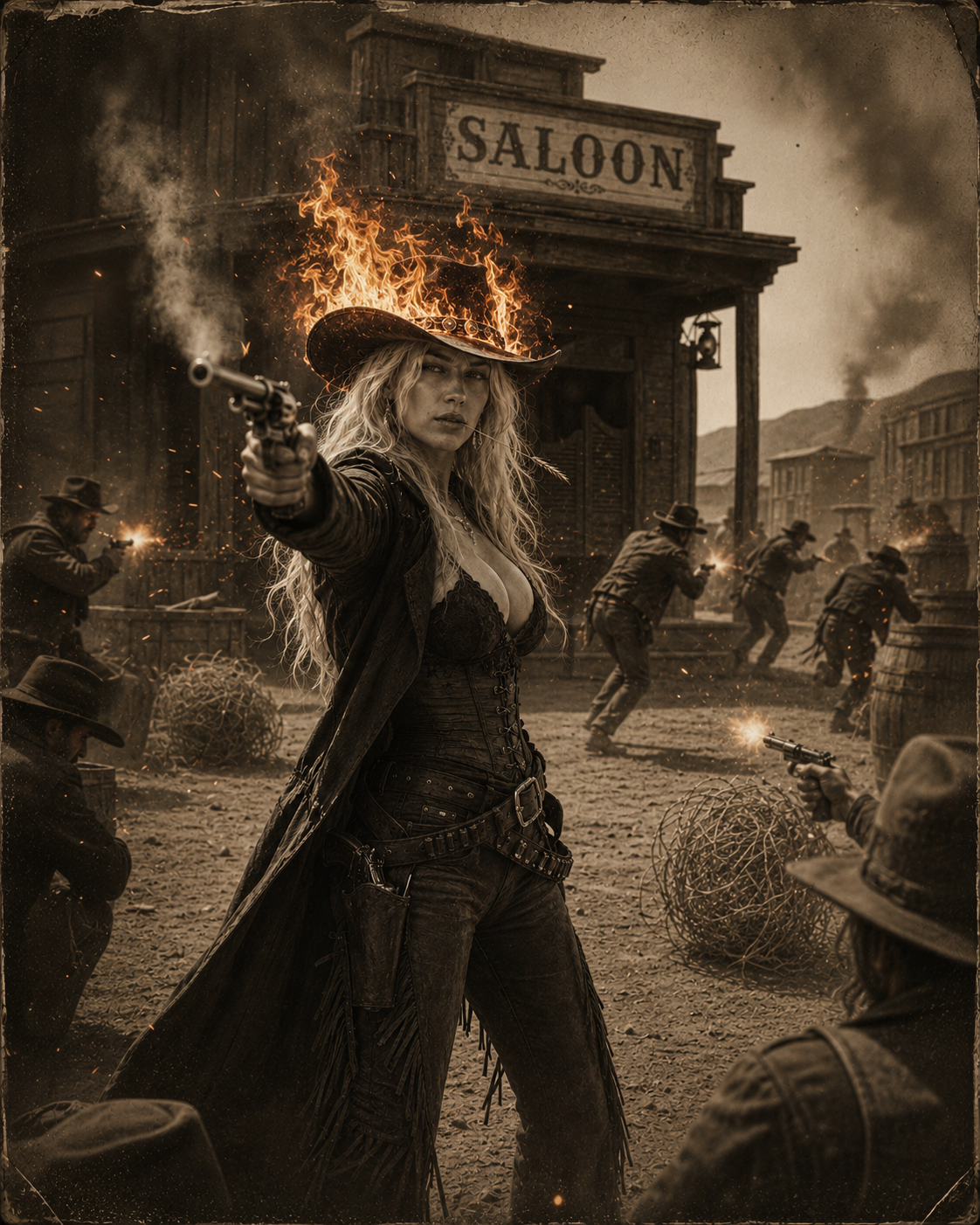
So what if she’s dangerous?
She’s the type that would stick around until the last gun was fired…
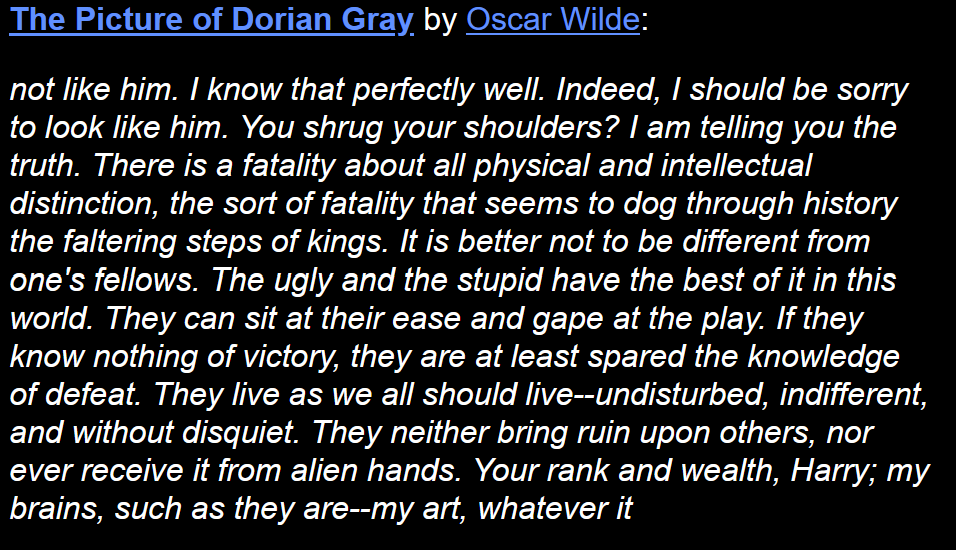
Someone needs to preach the gospel of Oscar Wilde… Who better than Wilde himself?
Amen Brother Oscar!!!