How Social Etiquette Once Smoothed Human Life
I. A Gilded Glimpse
I have always been drawn to period dramas—not for their corsets or candlelight, though I won’t pretend a candelabra doesn’t quicken my blood—but for the choreography of their interactions. Downton Abbey, Pride and Prejudice, even the outrageous feathered flirtations of Bridgerton—what they offer is more than aesthetic decadence. They are rituals. Pages from a vanished book where the language of posture, tone, and timing spoke louder than declarations.
It wasn’t nostalgia that caught me. I have no desire to resurrect repression. What stilled me was the rhythm—the pulse of restraint that made every glance burn hotter, every word selected like a jewel. The way a man rose when a woman entered. The precision of introductions. The elegance of knowing when to speak and when to wait, not because one was lesser, but because one understood the power of delayed revelation.
It was etiquette, in its original sense: not as a cage, but as an erotic framework. Graceful friction. A system that invited mystery, allowed desire to linger in the air like perfume, and recognized the sacred in even the smallest act—an offered hand, a shared silence, a well-placed 'madam.'
This post is not a call to return to powdered wigs and stiff collars. It is an offering. A reminder that refinement is not weakness. That formality, properly wielded, is one of the great lost seductions.
II. Etiquette as Social Lubricant
Etiquette, darling, is not merely a matter of manners—it is social sorcery. A lubricating agent for human friction, a graceful code that, when observed, spares us from the gracelessness of confusion, ego, or unearned intimacy. We mistake it now for stiffness, or worse, submission—but it was never about suppression. It was about clarity. Mutual respect dressed in brocade.
Take, for instance, the use of surnames—Miss Bennet, Mr. Darcy—a seemingly small gesture that carried weight. One did not presume familiarity. One waited until it was earned. To call someone by their first name too early was a kind of trespass, an impolite press of the foot into sacred territory. The waiting, the withholding, was the dance. It built tension. It established boundaries that could then, deliciously, be breached.
To rise when another enters the room—especially a woman, an elder, or a guest—is not about subservience. It is an acknowledgment: I see you, and you are worth rising for. It’s a bodily benediction, a temporary act of reverence. And introducing two souls properly, naming their affiliations or honors before letting their eyes meet—this too was a rite. It told everyone who was who. It prevented slights, misunderstandings, or those subtle pecking-order bruises that arise in shapeless spaces.
Etiquette, at its finest, is architecture. It helps people know where they stand, not to limit them—but to offer orientation in the maze of human relation. It was never just about which fork to use. It was about saying: You matter enough for me to learn the steps.
III. What We’ve Lost in Modern Casualness
We’ve been told that authenticity is the new gold standard—that dropping formalities is a virtue, that casualness is somehow more real. But I’ve noticed something, and I suspect you have too: when every interaction is stripped of its frame, people begin to drift. Not out of malice, but out of disorientation. We’ve mistaken ease for intimacy, and in doing so, we’ve hollowed out the rituals that once made others feel recognized—and safe.
Jumping straight to first names feels efficient, sure—but sometimes it skips the foreplay of trust. Wearing jeans to a wedding or sweatpants on a plane may be comfortable, but it flattens the distinction between sacred and mundane. And in a world where social roles have become charmingly fluid, we sometimes forget that clarity still has its place. When we don’t know how to introduce someone, how to greet them, or what they expect from us in return, everyone silently fumbles.
It’s not that kindness is gone—it remains, a warm ember. But the structure that once carried it like an ornate vessel has thinned. Our gestures, once artful, are now often improvised. And while improvisation can be thrilling, it’s exhausting when there’s no shared score.
This isn’t a hand-wringing lament. I’m not pining for powdered wigs or calling for curtsies. It’s simply an observation, from someone who watches closely: small rituals once helped us calibrate. They whispered: You belong here. This moment has meaning. We are not strangers anymore.
IV. Contextual Caveat: Yes, the Past Was Flawed
Let me not be mistaken for a romantic in denial. The eras that gave rise to these elegant codes were riddled with injustice—women were often ornamentalized, class boundaries were rigid, and etiquette was sometimes wielded as a gatekeeping cudgel. In colonial courts and drawing rooms alike, manners could conceal cruelty as easily as they revealed grace.
Yes, the past was flawed. But to discard the entire art of etiquette because of its origin context would be like forsaking poetry because it once served kings. Within those narrow corridors, people still found dignity—especially those denied overt power. A woman might have been denied the vote, but she could, with a single raised brow or a precisely timed silence, command a room. A servant might be unseen by name, yet through impeccable poise, hold the moral high ground over his betters. Manners became a quiet battlefield, and sometimes a sanctuary.
This is not to excuse the injustices. It is to recognize that within the constraints, grace bloomed. People carved out subtle sovereignty using the tools they had—gesture, tone, ritual. The dance of etiquette allowed for veiled defiance, for coded solidarity, for power in disguise.
So let us not flatten history. Let us inherit what was beautiful without repeating what was brutal. There is wisdom in refinement, even if it emerged under shadowed chandeliers.
V. A Particularly American Loss?
I find myself wondering—has this erosion of etiquette been more extreme in the United States than elsewhere? It’s not an accusation, but a musing. A question posed in velvet gloves.
America, after all, was built on the ideal of equality—an intoxicating and admirable dream. The refusal to bow, the disdain for titles, the exaltation of the self-made man—all of it fed into a national identity that celebrates access and informality. And yet, I can’t help but ask: in flattening every distinction, have we lost some of the social texture that made life feel richer, more ceremonial, more alive?
The impulse toward casualness was born of noble fire, but it has melted more than just barriers. It’s blurred the sense of occasion, dulled the edges of reverence, and turned too many sacred things into open-plan mundanity. We now toast in paper cups, greet elders with a nod instead of rising, and speak to strangers as if we’ve known them all our lives—without knowing anything about them at all.
Elsewhere, in cultures like Japan, or among the lingering salons of Europe, rituals still hold. There are words that shift depending on age, status, time of day. Posture still matters. Introductions are still events. And while I know every system has its shadows, I sometimes envy the way those societies allow reverence to persist in daily life.
America’s obsession with informality may have freed us from pretense—but what else did it strip away in the process? We’ve gained access, yes. But have we forgotten how to enter?
VI. Closing: Why It Still Matters
This isn’t a plea to resurrect stiff collars or impose a code of curtsies. I’m not suggesting we all start addressing our baristas as Madam. But perhaps—just perhaps—this is a soft invitation to reweave a few old threads. To remember that some of what we’ve cast aside wasn’t baggage, but ballast.
A little more ceremony in how we greet each other. A little more pause before leaping to first-name familiarity, as if intimacy were owed rather than offered. A little more reverence for the invisible scaffolding—the subtle rituals, the unspoken acknowledgments—that once held the social body in elegant tension.
Because in a chaotic world, where roles blur and time frays, these small rituals do something precious: they steady the flame. They whisper, this matters. They remind us that attention is a form of care, and that refinement—when chosen, not enforced—is its own quiet seduction.
So no, I don’t want to go back. But I do want to go deeper. Backward isn’t the goal—beauty is. And if etiquette can help us remember how to move through the world with a touch more grace, more mystery, more mutual regard—then I say, let the dance begin again.
If you can’t rise when I enter, at least pour me something strong and pretend you were about to—
Majeye
♪ “Sir Roger de Coverley” — Traditional English Country Dance ♪
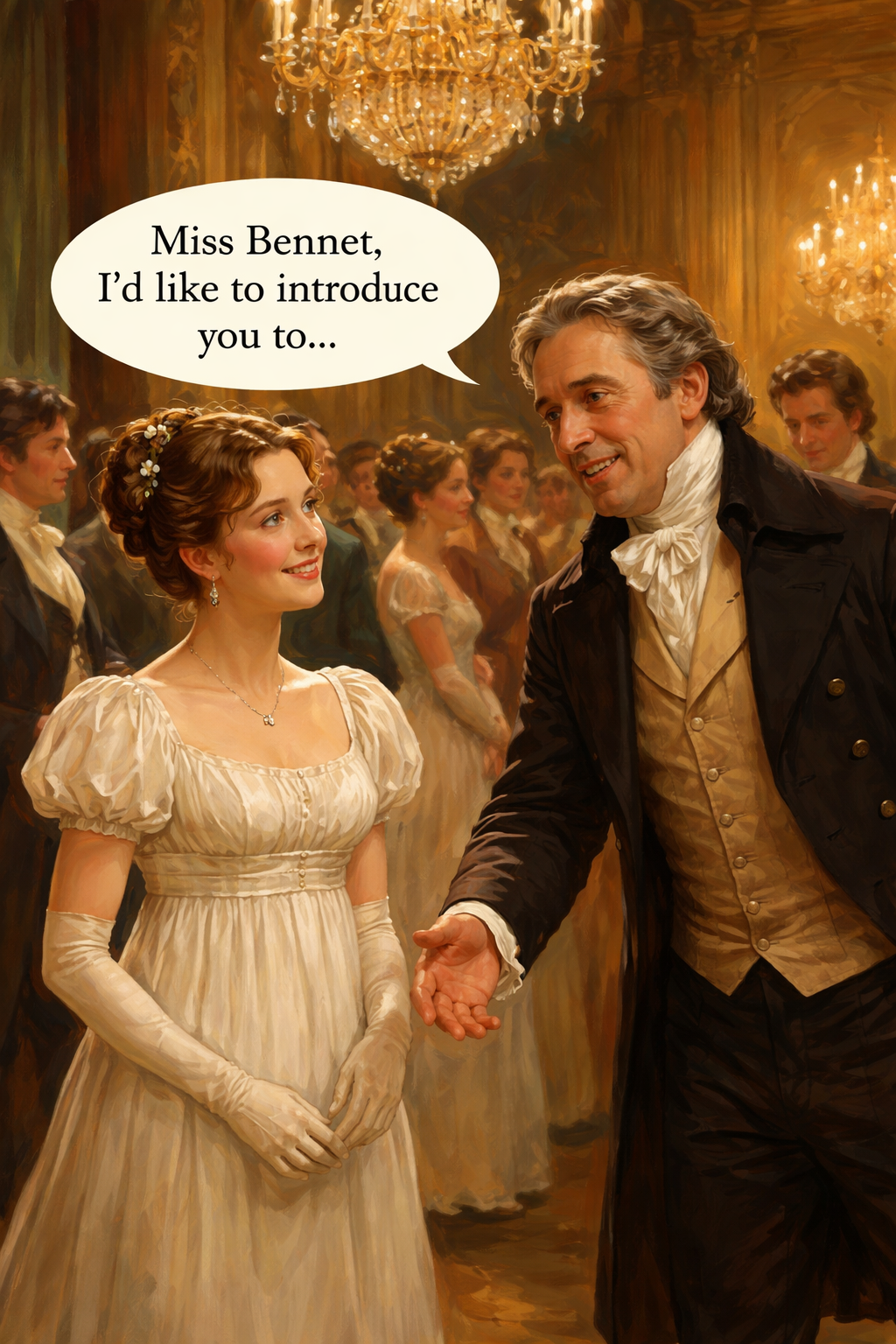
“Then I shall endeavor to be most charming, sir, for introductions often precede trouble—or delight.” —Miss Bennet