when female confidence gets diagnosed as delusion
Oh no! I skipped the queue and messed up my own schedule! This had to be said before I went any further. I’ll try not to make a habit of it. New schedule at the bottom.
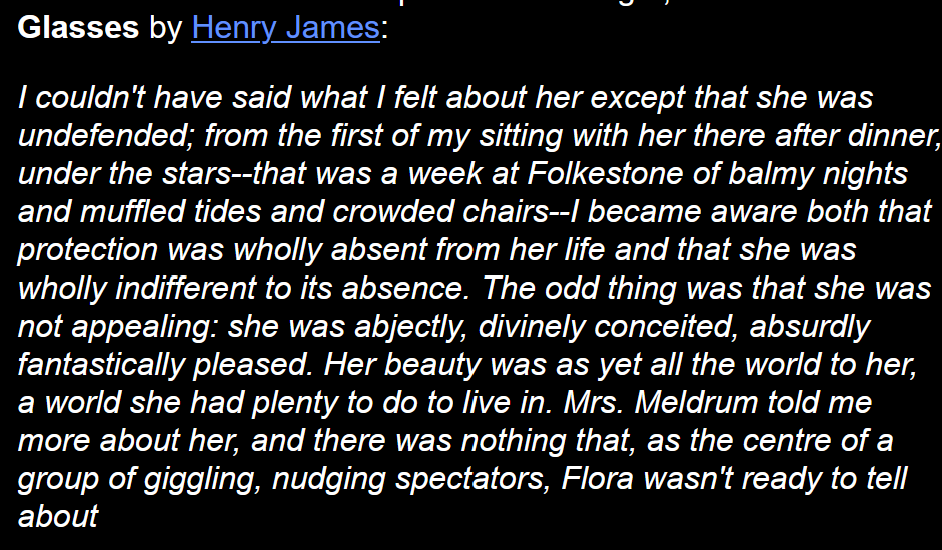
Wow. Just wow.
I. THE SETUP: What Bothers Him Isn't Her Vulnerability—It's Her Indifference to It
Let's be precise about what's actually happening in this passage. The narrator isn't concerned that Flora lacks protection—he's disturbed that she hasn't noticed the lack, hasn't arranged her interior life around the supposed crisis of her unguarded state. She is, in his diagnostic assessment, "wholly indifferent to its absence." This indifference registers not as autonomy but as a medical symptom requiring documentation.
And what does this undefended creature do with her dangerous freedom? She becomes "abjectly, divinely conceited, absurdly fantastically pleased." Four qualifiers for one woman's pleasure in herself—as if the pleasure requires increasingly baroque language to convey its sheer unreasonableness. She's not just pleased; she's absurdly pleased, fantastically pleased, pleased in a manner that defies natural law. The pleasure itself is the pathology. Pleasure without external validation, without the proper anxiety that should accompany female existence, reads as a break with reality.
The narrator makes clear what truly troubles him: she's not appealing. Not because she lacks protection, mind you, but because she lacks concern about lacking it. She's living "in a world she had plenty to do to live in"—self-sufficient, occupied, content. A woman with a full interior life that doesn't include monitoring male opinions about her safety protocols.
The complaint, stripped of its prose embroidery, is simple: she should be worried. She should be humble. She should be actively seeking guardianship, or at minimum, performing anxiety about its absence. Instead, protection is absent and she doesn't care—and that is what makes her unappealing. A woman who doesn't organize her psychology around what she allegedly needs from men has committed the unforgivable error of not requiring the narrator's assessment of her vulnerability to be correct.
II. THE DOUBLE STANDARD: Call It Confidence When He Does It
Here's where the mechanics become visible. A man operating without institutional backing while pleased with himself gets an entire vocabulary of celebration: self-made, independent, confident, entrepreneurial, maverick. He's disrupting systems. He's forging his own path. We write magazine profiles about his refusal to seek permission or wait for validation. His self-sufficiency is the story we tell about virtuous masculinity.
A woman doing the exact same thing gets diagnosed. She's conceited, delusional, absurdly pleased, fantastically pleased—as if the pleasure itself violates physical law, as if a woman's satisfaction with her own choices without male endorsement represents an impossible state requiring increasingly hyperbolic modifiers to capture its sheer unlikeliness.
Male sovereignty is both default expectation and celebrated achievement. We manage to make it simultaneously unremarkable (of course he operates independently) and heroic (look how independently he operates). Female sovereignty, by contrast, is a concerning deviation requiring diagnosis and documentation. The exact same psychological state—contentment without external validation, occupation without institutional framework, pleasure in one's own capabilities—gets bifurcated into "self-assured" versus "conceited" based solely on who's experiencing it.
The man who builds his own path without a safety net: rugged individualist, beacon of self-made masculinity. The woman who does the same: not appealing, conceited, delusional, should be concerned about her choices and her lack of protection. Same lack of traditional protection, same self-directed life, same satisfaction with her choices. Opposite cultural read. One is doing masculinity correctly; the other is doing femininity wrong—and the wrongness is located specifically in her failure to perform anxiety about her unprotected state.
III. THE EARNED SOVEREIGNTY ARGUMENT: She's Not Delusional, She's Battle-Tested
Let me tell you what happens once a woman has survived what should have killed her: lack of protection stops being frightening and becomes irrelevant. This isn't bravado. It's arithmetic. When you've already been through the fire without a shield and walked out the other side, the theoretical absence of a shield no longer merits psychological real estate.
Sovereignty isn't delusion when it's been tested under fire and held. The woman who's been through hell and is still standing doesn't fear vulnerability because she's already been vulnerable—maximally, cataclysmically vulnerable—and survived it. She doesn't need protection from hypothetical future harm because she already endured actual harm and came out whole. Her architecture has been stress-tested. She knows what load-bearing capacity she has because she's already carried the weight.
This isn't naivety, delusion, or conceit. It's earned capacity. It's proven resilience. It's tested architecture that didn't collapse when it should have. The pleasure she takes in herself isn't "absurd"—it's the natural result of discovering you're stronger than what tried to break you. When you realize you can survive without the protection you were told was necessary for survival itself, a certain pleasure does arise. Call it absurd if you like. I call it empirically justified.
Now here's my question for the narrator making this diagnosis: Can he say the same about himself? Has he been tested and survived without protection? Has he walked through what she's walked through and emerged autonomous on the other side? Or is he pronouncing judgment from the protected position he's held his entire life, mistaking his untested status for proven strength?
Because here's what's really fantastical: calling her pleasure "fantasy" when she's survived what he hasn't faced. If she's been through the fire undefended and came out pleased with herself, and he's been protected his whole life and feels entitled to diagnose her satisfaction as pathology, which one of them is actually living in fantasy? His comfort in his protected status is the actual delusion—the belief that protection equals strength, that untested infrastructure is superior to battle-tested resilience, that his theoretical framework for understanding vulnerability holds more truth than her lived experience of it.
She's absurdly pleased? She IS pleased since she’s survived what should have destroyed her and discovered she didn't need what she was told she couldn't live without.
IV. WHY THE INDIFFERENCE THREATENS: If She Doesn't Need Protection, What's He For?
Now we arrive at the actual threat. The issue was never that Flora lacks protection—it's that she's indifferent to lacking it. This indifference isn't a character flaw; it's a revelation. It demonstrates that protection was never actually necessary in the first place. It was a control mechanism dressed up as care, a service she never requested being billed as essential infrastructure.
If women can be pleased with themselves without male or institutional approval—if they can operate autonomously, survive undefended, and still experience that "absurd, fantastic" pleasure in their own existence—the entire protection economy collapses. The observer needs Flora to need what he offers: validation, safety, guardianship, the psychological architecture of dependency. He needs her to require his assessment of her vulnerability to be accurate. His sense of purpose depends on it.
Her sovereignty without him answers the question "what are you for?" with the most threatening response possible: nothing I can't do myself.
The accusation of conceit is defensive. It has to be. If she's actually fine without protection—if her pleasure in herself is justified by her proven capacity to survive and thrive undefended—his entire worldview breaks. The narrative he's built about what women need, what keeps them safe, what makes them viable, all of it dissolves in the face of her indifference. She's not performing the anxiety that would justify his relevance.
Female anxiety about vulnerability justifies male relevance. Female indifference to vulnerability threatens it. This is why her state must be pathologized, must be described in language that makes it sound impossible, irrational, conceited, absurd. If other women realize they could be indifferent too—if they discover that the protection they've been told is necessary for survival is actually optional, that they could walk away from the whole arrangement and be not just fine but pleased—what happens to the men whose entire identity is built on being needed?
Hence the diagnosis. Hence the careful documentation of her unappeal. She must be made unappealing so the threat she represents—the possibility of female sovereignty without male approval—doesn't spread.
V. THE CONCEITED DIAGNOSIS: Satisfaction Requires Permission (But Only for Women)
Let's define terms. "Conceited" means being pleased with yourself without waiting for external approval. That's it. That's the crime.
For men, being pleased with yourself is confidence, self-assurance, healthy self-regard. We encourage it. We build entire industries around teaching men to cultivate it. A man who's satisfied with himself without needing others to cosign his assessment is demonstrating proper masculine development.
For women, being pleased with yourself without male validation or institutional backing is pathological self-regard. It's a diagnostic category. It requires documentation and increasingly baroque language to capture its aberrance: not just conceited, but abjectly conceited, divinely conceited, absurdly, fantastically pleased.
The implicit rule, once you strip away the prose: women are supposed to wait for permission to feel satisfied. She's supposed to earn the right to pleasure through a specific sequence: appeal to men, gain institutional recognition, achieve social approval. Only after external validation has been conferred should she be allowed internal satisfaction. That's the proper order of operations.
Flora has skipped the permission phase entirely and gone straight to being pleased. This reads as jumping the queue, cutting in line, violating protocol. She hasn't waited for the validation that would justify her pleasure. She's just... pleased. With herself. About herself. In herself. Without clearing it with anyone.
The "absurdly, fantastically" modifiers reveal the observer's shock at this procedural violation. How dare she be this satisfied without our approval? How dare she generate her own contentment without waiting for us to determine whether she's earned it? The intensifying adverbs are trying to capture the scale of the transgression: this isn't ordinary pleasure, this is fantastic pleasure, pleasure that exceeds reasonable bounds, pleasure that has bypassed the proper authorization channels.
Male satisfaction is self-generated by default. It's expected. A man doesn't need anyone's permission to be pleased with himself; that's called having a healthy ego. Female satisfaction is supposed to be other-granted, conferred from outside, earned through appeal and approved through validation. She's generating her own, and that's the unforgivable transgression. She's operating an independent power source when she was supposed to be running off the grid we control.
VI. THE VERDICT: Let Them Find It Unappealing
If being pleased with yourself without institutional or male backing is "unappealing," then be unappealing. Lean into it. The alternative—performing anxiety and humility to make others comfortable—is spiritual death.
They want women scared enough to beg for protection, humble enough to be grateful for scraps, small enough to not threaten male purpose. They get women indifferent to their withdrawal of support, pleased with themselves anyway, living in worlds with plenty to do. The observer finds this unappealing because it doesn't need him—and things that don't need you are always threatening. A mirror held up to your own irrelevance tends to produce unflattering diagnoses of the mirror.
A woman who's survived hell doesn't fear lack of protection. A woman who's proven her capacity doesn't perform false humility to make men (or women) comfortable with her competence. Call it conceit if you want—she calls it hard-won sovereignty, and she's keeping it.
The real question: would he be calling her absurdly pleased if she were a man? Or would he be writing admiringly about his remarkable self-assurance, his independence of spirit, his refusal to bow to convention? She has plenty to do to live in her world. His opinion of her pleasure is not on the list.
So where are the men who can actually see women like me and Flora as we are? The narrator in that passage is a coward, and clearly untested—or he wouldn't talk like that. Battle-tested people recognize each other. We see the scars, the earned sovereignty, the pleasure that comes from surviving what should have broken us. A man who's been through his own fire doesn't diagnose a woman's hard-won satisfaction as pathology. He recognizes it as kinship.
I do desire love and connection. But not with a man who looks at female self-sufficiency and calls it conceit, who sees pleasure without his permission and calls it delusion, who is so deeply comfortable in his own untested smugness that he mistakes his comfort for insight. I'd rather be a spinster—fantastically, absurdly pleased with my own company—than waste a single evening with the kind of unappealing, conceited coward who thinks, speaks, and acts like that while believing he's delivering penetrating psychological analysis.
At least I'd be in good company: myself, unbothered, with plenty to do.
—M.

I bite my thumb at thee, sirrah!
Danzig’s “Mother” chorus, in Ye Olde English:
I'll not behold thy light, Yet if thou wouldst find Hell in my company, I shall shew thee what manner of place it be— Until thou bleedest.
Thursday: The Borg Standard: HOW MIMIC CULTURE ASSIMILATES EVERYTHING INTO ONE SIGNAL