Henry VIII’s Playbook for Blame Management
Pre-intro:
I know it's been a while since I've done a post about history. Do know that European history is one of my passions—particularly the deliciously sordid bits where power and pathology tango in matching doublets. It's nice to take a break from dissecting the current era once in a while, if only to remember that our present madness has such distinguished ancestry.
I. INTRODUCTION: The Strategy Revealed
"Why Fix Problems When You Can Fix Blame?"
Henry VIII discovered early in his reign what modern crisis managers charge six figures to whisper: you don't need to change unpopular policies—you just need to kill the person associated with them. It's the political equivalent of rearranging deck chairs on the Titanic, except the deck chairs are people and they're on fire and you're charging admission to watch them burn.
The mechanism is elegant in its brutality: heap terrible accusations on someone close to you, charge them with treason based on spurious facts barely worthy of the name, satisfy the people's bloodlust with a good beheading, strengthen your position through strategic grief, then keep doing exactly what you were doing before—only now with renewed mandate and a convenient scapegoat already cold in the ground. No policy review needed. No admissions of error required. Just fresh corpses and a clean slate.
It's brilliant. It's terrible. It's terribly brilliant. And Henry refined it to an art form we're still performing today, albeit with HR departments instead of executioners.
II. THE BETA TEST: Empson and Dudley (1510)
"How to Start Your Reign by Ending Someone Else's Career"
Henry VII dies, and the realm collectively exhales—except for two men who suddenly realize they've been standing too close to the wrong corpse. His financial policies had been deeply unpopular: aggressive tax collection, bonds that functioned as legalized extortion, fines levied on the wealthy with the enthusiasm of a man who'd clawed his way to a throne and intended to keep it solvent. The actual architect of this fiscal brutality? Henry VII himself, naturally. The fall guys? Edmund Dudley and Richard Empson, his chief financial enforcers, about to discover that "I was just following orders" doesn't play well when the man giving orders is conveniently dead.
What They Actually Did: Collected debts owed to the king. Sold offices, wardships, marriage licenses, pardons—basically anything that could be monetized was monetized, medieval venture capitalism at its finest. Made themselves spectacularly rich in the process. Were they doing Henry VII's bidding? Absolutely. Were they also extortionate and ruthless in their methods? Also absolutely. They'd mistaken proximity to power for invulnerability, a mistake men continue making to this day.
The Accusation: "Constructive treason"—that beautiful catch-all charge for when actual treason is hard to prove but you really need someone dead. The specific claim? They'd summoned armed men to London, probably out of entirely justified fear for their own safety when Henry VII died and they suddenly found themselves very exposed, but who's checking the details when there's a public execution to plan? The formal charge was that they'd conspired to "hold, guide and govern the King and his Council," which is a fancy way of saying they'd done exactly what they were hired to do, only now it was inconvenient.
Why It Worked: Henry VIII was eighteen, shiny and new, and the country was desperate for a fresh start—which really meant "someone to blame for everything we hated about the last fifteen years." Executing these two allowed young Henry to speedrun his popularity arc. He could distance himself from his father's unpopular regime, appear to "fix" the tax problem without actually changing the tax structure that filled his coffers, demonstrate he had the power to destroy highly placed servants (always a useful early signal), and become immediately beloved. It was a masterclass in optics: change nothing, kill someone, collect applause.
The Punchline: The financial policies continued. Henry just got better PR.
Bonus Detail: While sitting in the Tower waiting to die, Dudley wrote The Tree of Commonwealth, a treatise on good government featuring roots of justice and truth, hoping to save himself through displays of wisdom and reform. It probably never reached Henry. Nothing says "irony" like being executed for injustice while frantically writing about justice from a cell, your last work a desperate CV update for a position you've already been terminated from—permanently.
III. THE WOLSEY VARIATION: When Your Chief Minister Fails to Get You a Divorce (1529-1530)
"How to Blame Your Employee for Your Marriage Problems"
Henry wants to annul his marriage to Catherine of Aragon, and Thomas Wolsey—his Lord Chancellor and chief minister for fifteen years, the man who'd been running the country brilliantly while Henry jousted and wrote terrible poetry—suddenly has one job that matters more than all the others combined. Unfortunately, that job is "convince the Pope to grant an annulment" while Catherine's nephew, the Holy Roman Emperor, is literally holding the Pope hostage after the Sack of Rome in 1527. This is a geopolitical impossibility, not a failure of effort. Asking Wolsey to deliver this divorce is like asking your IT guy to fix a problem caused by someone unplugging the server in another country while holding a gun to the data center manager's head. But Henry needs his annulment, and when kings need things they can't have, someone has to pay.
What Wolsey Actually Did: Ran England with ruthless efficiency for a decade and a half, managing everything from foreign policy to finances while Henry played at being a Renaissance prince. Built the magnificent Hampton Court Palace, then graciously handed it over to Henry when Henry got jealous—a move that should have taught Wolsey that making yourself indispensable doesn't make you invulnerable. Accumulated massive wealth and power doing exactly what Henry wanted him to do. Failed to achieve the literally impossible task of getting the Pope to defy the Holy Roman Emperor, which apparently cancelled out everything else.
The Accusation:Praemunire—exercising papal authority in England without royal permission. This was technically true in the same way that breathing is technically metabolizing oxygen. It was also exactly what Henry had wanted, needed, and explicitly authorized him to do for fifteen years. The real crime? Failing to deliver the divorce. Everything else was paperwork to make the execution legal.
Why It Worked: The country resented Wolsey's wealth and power with the special venom reserved for low-born men who've climbed too high—he was the son of a butcher in a world where nobility still believed blood conferred competence. His failure on the annulment was visible, embarrassing, and most importantly, Henry's problem dressed up as Wolsey's failure. Blaming him allowed Henry to appear decisive and wronged while hiding his own marital crisis and succession panic. Wolsey became the scapegoat for Henry's inability to control the Pope, European politics, and his own desperate need for a male heir.
The Twist: Wolsey died on his way to trial—possibly of natural causes, possibly of despair, possibly of the sudden realization that fifteen years of service had bought him exactly nothing when it mattered. His alleged last words remain one of history's most elegant throat-cuts: "If I had served God as diligently as I have done the King, he would not have given me over in my grey hairs." Even his final moments were a sick burn on Henry's ingratitude, a deathbed review that Henry probably never read.
The Punchline: The annulment problem didn't go away. Henry just broke with Rome entirely, declared himself Supreme Head of the Church of England, and found new people to blame when they also couldn't magically solve his problems. Wolsey's real mistake wasn't failing—it was believing competence would protect him.
IV. THE MASTERPIECE: Anne Boleyn (1536)
"When Your Wife Becomes Inconvenient: A Case Study in Creative Accusations"
Henry broke with Rome, defied the Pope, split England from Catholic Europe, triggered a religious upheaval that would echo for centuries, and married Anne Boleyn to legitimize their relationship and secure the male heir that would justify all of it. She gave him Elizabeth—brilliant, formidable, wrong gender. Then she miscarried a son. By 1536, Henry wanted out, had his eye on the blandly compliant Jane Seymour, and needed a way to erase Anne without admitting he'd torched his kingdom's religious foundation for a woman he now found inconvenient. Enter the most spectacular blame management operation in English history.
What Anne Actually Did: Failed to produce a surviving male heir, which was apparently her job alone despite the biological reality of chromosomes Henry wouldn't understand for another four hundred years. Was sharp-tongued, politically active, and far less submissive than Henry had decided he preferred in a wife—turns out the qualities that make a mistress exciting make a queen threatening. Had probably not committed adultery, given that the accused "lovers" were tortured and even under torture the evidence was laughable: one alleged encounter supposedly occurred when she was visibly pregnant, another when one of the men wasn't even at court that day. The math didn't math, but since when has math mattered when a king needs someone dead?
The Accusations: Adultery with five men, including her own brother George—yes, Henry went there, adding incest to the charges because if you're going to destroy someone you might as well be thorough. Conspiring to murder the king. Bewitching the king into marriage, because apparently Henry's own agency in pursuing her for years vanished the moment he wanted a new wife. The charges were so absurd that even contemporary observers noted the implausibility, which is saying something in an era not known for its critical examination of royal proceedings.
Why It Worked: Anne was deeply unpopular—blamed for the break with Rome, for Catherine of Aragon's suffering, for the religious chaos, for everything Henry had actually chosen to do in pursuit of her. People wanted to believe the charges because they disliked her, and a good scapegoat is worth more than truth. The spectacle was enormous: a Queen of England accused of serial adultery, incest, and treason. It allowed Henry to paint himself as the wronged husband, the victim of a scheming seductress, rather than the calculating opportunist who'd set fire to Europe's religious order for a woman he'd now decided was defective. Six people were executed to support this narrative: Anne, her brother George Boleyn, and four men—Henry Norris, Francis Weston, William Brereton, Mark Smeaton—whose real crime was being convenient props in Henry's morality play.
The Punchline: Eleven days after Anne's execution, Henry married Jane Seymour. The "grief-stricken wronged husband" who'd supposedly been traumatized by his wife's monstrous betrayal moved on with remarkable speed. Jane died giving him the son he wanted—Edward VI—proving that maybe, just maybe, the problem wasn't the wives. But by then Anne was already ash and rumor.
The Meta-Layer: Here's where it gets truly perverse. Henry annulled his marriage to Anne before executing her, rendering Elizabeth illegitimate—but he'd broken with Rome and defied the Pope specifically to marry Anne in the first place. The entire English Reformation, the split from Catholic Europe, the religious upheaval that would define generations—all undertaken to legitimize a marriage he then declared invalid before killing the bride. The accusations didn't just destroy Anne; they allowed Henry to reframe the entire narrative of his reign. The problem wasn't his judgment, his obsession, his political recklessness. The problem was that he'd been bewitched. Victimhood is such elegant armor.
V. THE RELIABLE PATTERN: Thomas Cromwell (1540)
"How to Thank Your Most Effective Minister With an Axe"
Thomas Cromwell engineered the break with Rome, dissolved the monasteries and enriched Henry's treasury beyond imagination, restructured the entire English government with terrifying efficiency, and served as Henry's chief minister brilliantly for a decade. He was arguably the most capable administrator Henry ever employed, which should have been a warning sign. Then he arranged Henry's marriage to Anne of Cleves—a politically sound Protestant alliance—and Henry found her unattractive. That was it. That was the crime. Everything else was paperwork.
What Cromwell Actually Did: His job. Brilliantly. The Anne of Cleves marriage was strategically sound given the European political landscape; Henry just didn't like her face and decided competence didn't matter when his aesthetic preferences were offended. Cromwell had also made powerful enemies among the conservative faction at court, particularly the Duke of Norfolk, who wanted to reverse his reforms and saw an opening in Henry's marital disappointment. When a king is embarrassed, ambitious men sharpen their knives.
The Accusations: Treason and heresy—the greatest hits of Tudor charges. Supporting heretics, accepting bribes, issuing commissions without royal authority. The accusations were a mix of stretches, fabrications, and things Cromwell had done with Henry's full knowledge and approval until it became convenient to forget that approval. The charges had the structural integrity of smoke, but smoke is enough when the fire is already lit.
Why It Worked: The conservative faction wanted him gone and had managed to whisper their way into the king's ear. Henry was embarrassed by the Cleves marriage and needed someone to blame for his own shallow disappointment. Cromwell had accumulated enough power and enemies that his fall would satisfy multiple constituencies at once—always efficient. The monastery dissolution had made him the public face of religious reform, which was deeply unpopular with conservatives who'd watched their institutional power base liquidated. He'd made himself indispensable, which made him vulnerable. Indispensable people know too much.
The Speed: Arrested in June 1540, executed in July 1540. Henry didn't even give him a trial—just an Act of Attainder pushed through Parliament, legislative murder dressed in legal robes. Cromwell wrote desperate letters from the Tower, pleading his case, reminding Henry of his service, probably mentioning the small detail that he'd done everything Henry had asked. Henry didn't read them. Or perhaps he did, and they simply didn't matter. Gratitude has a short shelf life when blame is more useful.
The Punchline: The marriage to Anne of Cleves was annulled—she got a generous settlement, kept her head, and outlived Henry by a decade, probably the best outcome any of his wives managed. Henry married Katherine Howard, Norfolk's niece, within weeks of Cromwell's execution, because nothing says "I've learned from my mistakes" like immediately marrying into the family of the man who just engineered your last minister's death. Two years later, Katherine Howard was executed for actual adultery. Maybe Cromwell's marriage arrangement wasn't the disaster after all. Maybe marrying someone who bores you is preferable to marrying someone who sleeps with your courtiers, but that realization came too late to save Cromwell.
The Irony: Cromwell had invented many of the legal mechanisms Henry used to execute people without trial—streamlined administrative murder, efficient and bloodless on paper. He died by his own innovations, hoisted on the procedural petard he'd engineered for others. It's the ultimate performance review: your processes work so well they kill you.
VI. CONCLUSION: The Genius of the System
"How to Die Beloved Despite Being Terrible"
The Pattern Summarized:
Policy unpopular? Kill the minister who implemented it. Keep the policy.
Marriage inconvenient? Kill the wife and everyone around her. Marry someone new.
Divorce impossible? Kill the person who failed to achieve the impossible. Problem remains unsolved.
Political faction problematic? Kill their leader. Faction persists, just quieter.
Why It Kept Working: Spectacular accusations distracted from actual issues—when you're charging a queen with incest, nobody's talking about tax policy. Public bloodlust satisfied equals temporary popularity boost, the Tudor equivalent of bread and circuses [heh, heads and circuses] except the circus is an execution and the bread is metaphorical. Scapegoat dead means they can't defend themselves, which is remarkably convenient for narrative control. King appears decisive and strong, which matters more than being right. Actual problems never addressed, but everyone forgets that part because there's fresh drama and new heads on pikes.
The Body Count: Two chief ministers—Wolsey died before execution but the disgrace killed him anyway, Cromwell executed with the efficiency he'd engineered for others. Two wives—Anne Boleyn and Katherine Howard, plus the slow-motion murder-by-isolation of Catherine of Aragon. Various advisors, friends, and associates: Thomas More, John Fisher, the Pole family, various monks and reformers who had the misfortune of principles. And countless others whose names didn't make the historical highlight reel but who died nonetheless in the machinery of Henry's blame management system.
The Legacy: Henry VIII died in 1547, bloated and diseased, a festering monument to unchecked power and the belief that problems can be solved by killing the people who remind you they exist. He'd executed some of the most talented people in England—the kind of administrative and intellectual capital that takes generations to rebuild. His son Edward VI, the male heir he'd destroyed so many lives to produce, died at fifteen without issue. His daughter Mary I tried to reverse the Reformation and burned Protestants, earning herself the epithet "Bloody Mary" and proving that brutality is bipartisan. His daughter Elizabeth I—the "wrong gender" child of the "treasonous adulteress" Anne Boleyn, the girl he'd bastardized and nearly destroyed—turned out to be the greatest Tudor monarch, reigning for forty-five years and giving her name to an age.
The Final Punchline: The daughter he bastardized and nearly destroyed became the success story of the dynasty. The son he sacrificed everything for died young and changed nothing. And Henry is remembered not for his policies—which were mostly continuations and refinements of his father's work—but for his wives and the spectacular accusations he used to dispose of them. He changed almost nothing of substance. He just changed who got blamed for everything.
He solved none of his actual problems. He just killed the people who couldn't solve them for him, then killed the people who reminded him the problems still existed, then killed the people who witnessed the previous killings, in an ever-widening circle of blame management that substituted corpses for competence.
And that, friends, is how you appear popular while being terrible: distract with spectacle, satisfy with bloodshed, blame the dead who cannot contradict you, and die convinced of your own brilliance.
Closing Line: The next time someone tells you perception is reality, remember: Henry VIII had six wives' worth of PR problems and solved exactly none of them, but he died thinking he'd done brilliantly. Sometimes perception is just murder with good branding.
Giuen vnder mine Hand this Twelfth Day of May, in the Yeare of Our Lord Two Thousand and Twentie-Six, with a Winke most Wicked and a Bow most Mocking,
Your Obedient Seruant in Históricall Mischiefe,
Majeye
Scribbler of Truthes Inconuenient, Keeper of Receipts Históricall, and She Who Remembreth What Kinges Would Preferre Forgotten
Henry VIII wrote this song:
♪ “Pastyme with Good Companye” by King Henry VIII ♪
This one is a fun juxtaposition—trippy video:
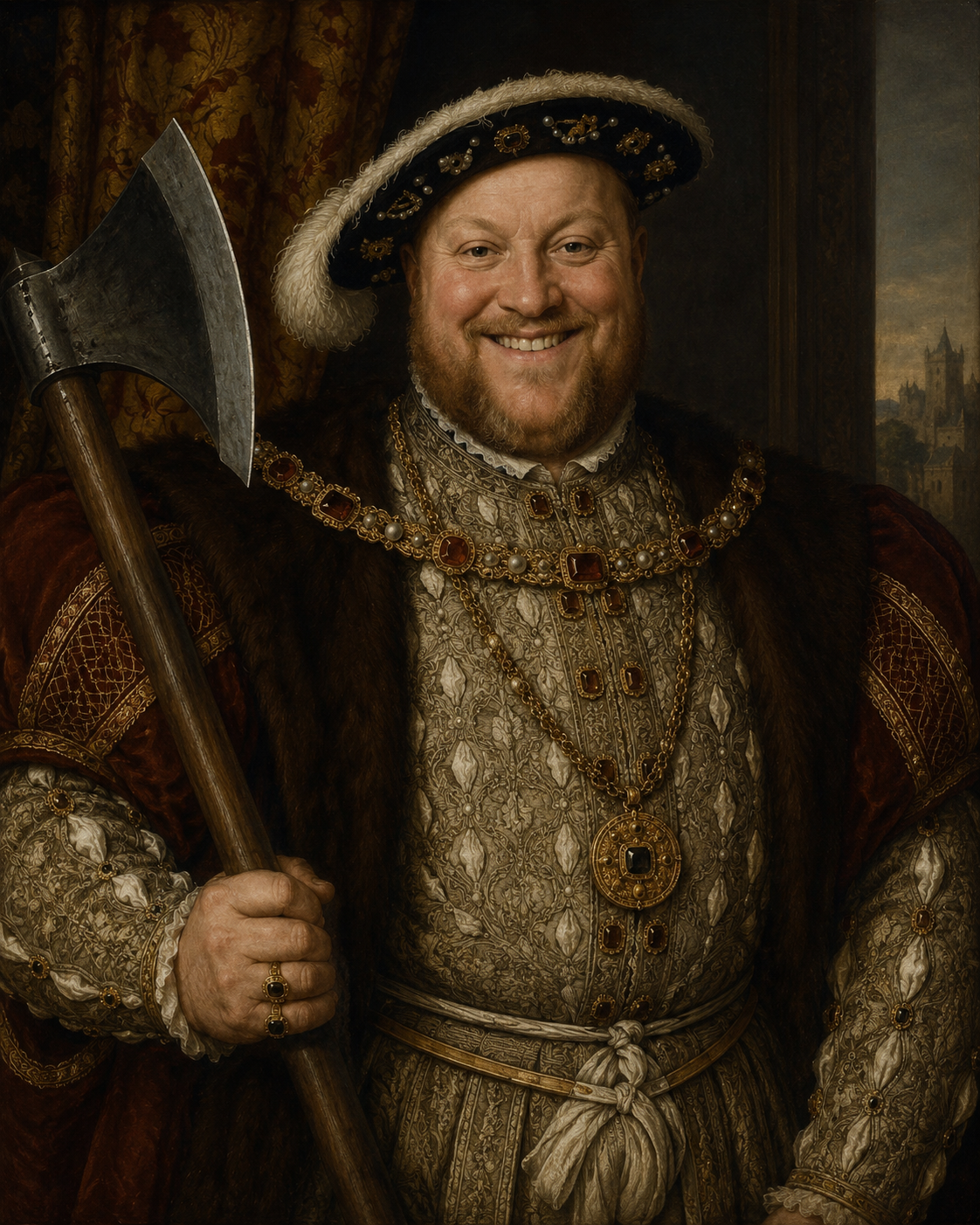
That smile when you've convinced everyone the problem was never you, just everyone around you who's now conveniently dead.
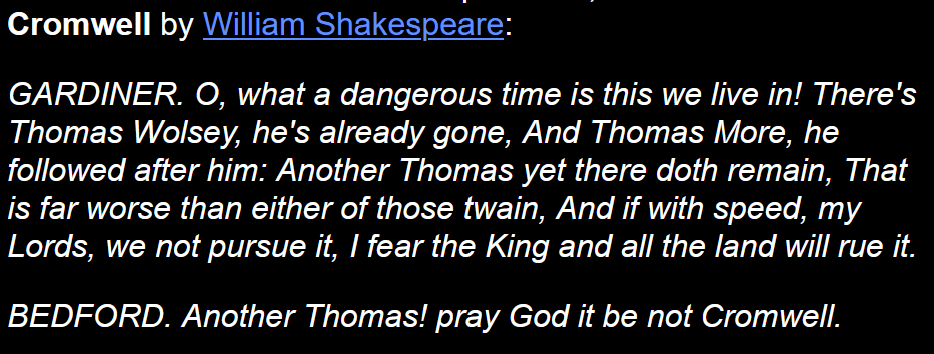
James Frain played a great Cromwell in The Tudors. Not a very historically accurate show—but great acting, with a star-studded cast.