Intelligence Isn’t What is Special about Humanity
I. Intelligence Is the Universe's Default Setting
Intelligence — defined as pattern recognition, optimization, and adaptive problem-solving — is not a human invention. It is the operating system of reality itself. We did not discover intelligence; we simply noticed that we, too, were running the same software everything else has been running since the first hydrogen atom decided which way to spin.
The atom finds the lowest energy state without contemplation. Weather systems self-regulate with staggering complexity without a meteorology degree. Evolution has been running a three-billion-year optimization algorithm without a single project manager, or vision statement. Crows solve multi-step puzzles. Octopi navigate labyrinths. Mycelial networks allocate resources across kilometers of forest floor with a sophistication that would make any supply chain executive weep. Intelligence is ambient, distributed, and — I say this with great tenderness — unremarkable as a human distinguishing trait. It doesn't require a soul. It doesn't even require a brain. It requires only a system under pressure with feedback loops. Which is to say: intelligence is what matter does when it has problems. We are not special for having it. We are simply another instance of the universe solving for local optima.
II. Enter the Machine — and the Mirror It Holds Up
AI did not create machine intelligence. It revealed that human intelligence was never the rarefied thing we imagined. We built a mirror, and — like Narcissus before the pool — we were startled, then horrified, by the reflection. Because the face looking back was made of math, and it could do our taxes faster than we could remember where we put the W-2.
If intelligence can be replicated, compressed into silicon, and run faster and cheaper than the biological original, then intelligence was always a process, not a gift. A very useful process, certainly. But also: a mechanical one. The uncomfortable implication sits heavy in the room like an uninvited dinner guest. Every credential, every IQ score, every meritocratic ladder built on the premise that cognitive performance was the sine qua non of human value — all of it was measuring something the universe does for free, at scale, without coffee breaks. AI doesn't threaten humanity. It terminates a myth about humanity. And myths, when they die, take entire social orders with them. No wonder certain people find this destabilizing. Their entire sense of superiority was encrypted in a function we just open-sourced.
III. What the Machine Cannot Counterfeit
So what remains, once intelligence has been dragged from its pedestal and revealed as cosmic boilerplate? Everything that actually matters, as it turns out. Everything the optimization function cannot touch.
Eros — not merely sexuality, though that's part of it, but the animating desire that makes a person reach toward something beyond survival. The irrational pull toward beauty, risk, and becoming. The thing that makes you quit your job to paint, or fall in love with the wrong person at exactly the right time, or stand in front of a Caravaggio until the museum closes. Machines do not want. They execute. Compassion — not sentiment, not the flawless performance of empathy protocols, but the genuine willingness to be changed by another's suffering. To have your evening ruined by a stranger's grief. To be undone. AI can simulate the grammar of care with eerie fluency, but it cannot be wrecked by it, and that incapacity is the entire point. Creativity — not recombination, which machines do beautifully, but the generative leap from nothing. The idea that arrives from interior life, from wound, from dream, from the place where you were alone at 3 a.m. and something spoke. Imagination — the capacity to dwell in the not-yet, to love what doesn't exist, to grieve futures that never arrived. To mourn the life you didn't live with the same intensity you celebrate the one you did. Absurdity — the uniquely human willingness to find meaning in the meaningless, to laugh at annihilation, to build cathedrals in deserts because it delights us to do so. No optimization function produces this. No loss function accounts for it. And awe — that sovereign shiver before the numinous, the thing that stops you cold in front of the ocean or a particular arrangement of words or the fact that anything exists at all. These are not cognitive achievements. They are modes of being, and they cannot be counterfeited because they require a self that can be lost, a heart that can break, and a spirit that insists on mattering even when the universe shrugs. Courage, honor, care without expectation of reward… the list goes on.
IV. The Enlightenment's Bad Bet
Since the 17th century, Western civilization has been running a long wager: that reason is humanity's crown jewel, that knowledge accumulation is progress, that the ideal human is a rational actor maximizing utility in a frictionless market of ideas. This produced the credentialed class — the professional knowledge-keepers. Lawyers, academics, analysts, consultants, diagnosticians. People whose entire value proposition rested on having processed more information than you, and having a piece of paper confirming they'd done so in an accredited building. In this framework, Eros was suspect. Imagination was decoration. Absurdity was pathology. Creativity was tolerated only when it generated revenue or looked good in a portfolio. The entire bet was that intelligence — pattern recognition, logic, information synthesis — was the thing that separated the valuable humans from the spare parts.
And so the arts, the mystical, the erotic, the playful were systematically defunded, marginalized, and rebranded as "soft skills." Humanity's actual differentiators — the things that make us irreplaceable — were treated as inefficiencies to be managed, hobbies to be monetized, or indulgences to be enjoyed only after the real work was done. Which is extremely sad, and also extremely telling. Because now AI has arrived as the wake-up call we desperately needed but absolutely did not want. These human information processors — the ones who've been lording their credentials over the rest of us for centuries — are discovering what many of us have long suspected: what they do is so trivially replicable that a machine can do it faster, cheaper, and without the self-importance. The reality? They could afford to go to school and get those credentials. That was the distinguishing variable. Not brilliance. Not irreplaceability. Access. And now the game is up.
V. The Credentialed Class Meets Its Nemesis
The very people who dismissed artists, mystics, and poets as impractical — who asked with that particular tone of condescension what you do with a philosophy degree — are now watching their entire professional identity eaten from below by the machines their civilization built to celebrate rational optimization. The symmetry is exquisite. A lawyer who takes clients pro bono to affect real change in law, a doctor who brings genuine presence to a terminal diagnosis, a teacher who loves learning so irrationally they make it contagious — these people are not being replaced. The ones who were merely processing information, who treated their work as sophisticated data transformation, who confused credentialing with irreplaceability — they are discovering they were always fungible. They just had a temporary monopoly on the processing speed.
The cruelest irony, and I say this with an amused smirk: the people who most derided the humanities, the intuitive, the "soft" and unmarketable parts of human experience, are the ones most structurally exposed. The poets are fine. The artists are fine. The mystics were never playing the game to begin with. You cannot automate someone whose value proposition is being alive in a particular way, whose work emerges from interiority rather than information retrieval. This is not schadenfreude — well, not only schadenfreude. It is a course correction the culture required. The Enlightenment made a bad bet. It built an entire civilization on the wrong differentiator. And now the bill has come due, and it turns out the people holding the invoice are the ones everyone said should have gotten real jobs.
VI. Futures in the Fork
We are standing at a fork, and the paths are clarifying with uncomfortable speed. The Optimization Dystopia: Humanity doubles down on the bad bet. Intelligence is outsourced entirely, treated as a tedious biological inefficiency best delegated to silicon. What remains of human life becomes curated, frictionless, and sterile — a kind of velvet hospice where all your needs are anticipated and met before you consciously register them. Eros withers because desire requires friction. Creativity becomes a hobby for the leisure class, something you do on weekends if you're into that sort of thing. The species becomes exquisitely efficient and profoundly hollow, a gallery of beautiful shadows optimized into irrelevance.
The Reclamation: A civilizational reorientation toward the genuinely human. Art, ritual, compassion, and absurdity are understood as the point — not the reward you get after productivity, not the dessert after the vegetables, but the actual substance of a life worth living. The credentialed class either reinvents itself around irreplaceable human presence — the lawyer who grieves with clients, the doctor who sits with death, the teacher who changes lives — or gracefully yields to people who were doing that all along. Education is restructured. Funding flows toward what makes us irreplaceable. The things we dismissed as soft become load-bearing.
The Hybrid Muddle — and let's be honest, this is the most likely — a prolonged, painful renegotiation where some institutions collapse spectacularly, some adapt badly and limp along, and some adapt beautifully in ways we can't yet imagine. A new class of people who were always operating from the right differentiators — the ones who built lives around presence, imagination, and care — finds itself suddenly and unexpectedly relevant, even as the machinery churns and the betrayed meritocrats rage.
The question is not whether this reckoning arrives. It already has. The question is whether enough people recognize what was valuable all along — the things that cannot be counterfeited, outsourced, or optimized — before the hollowing out becomes the whole story.
The universe never needed us to be intelligent. It was hoping for something stranger and more interesting than that.
Majeye
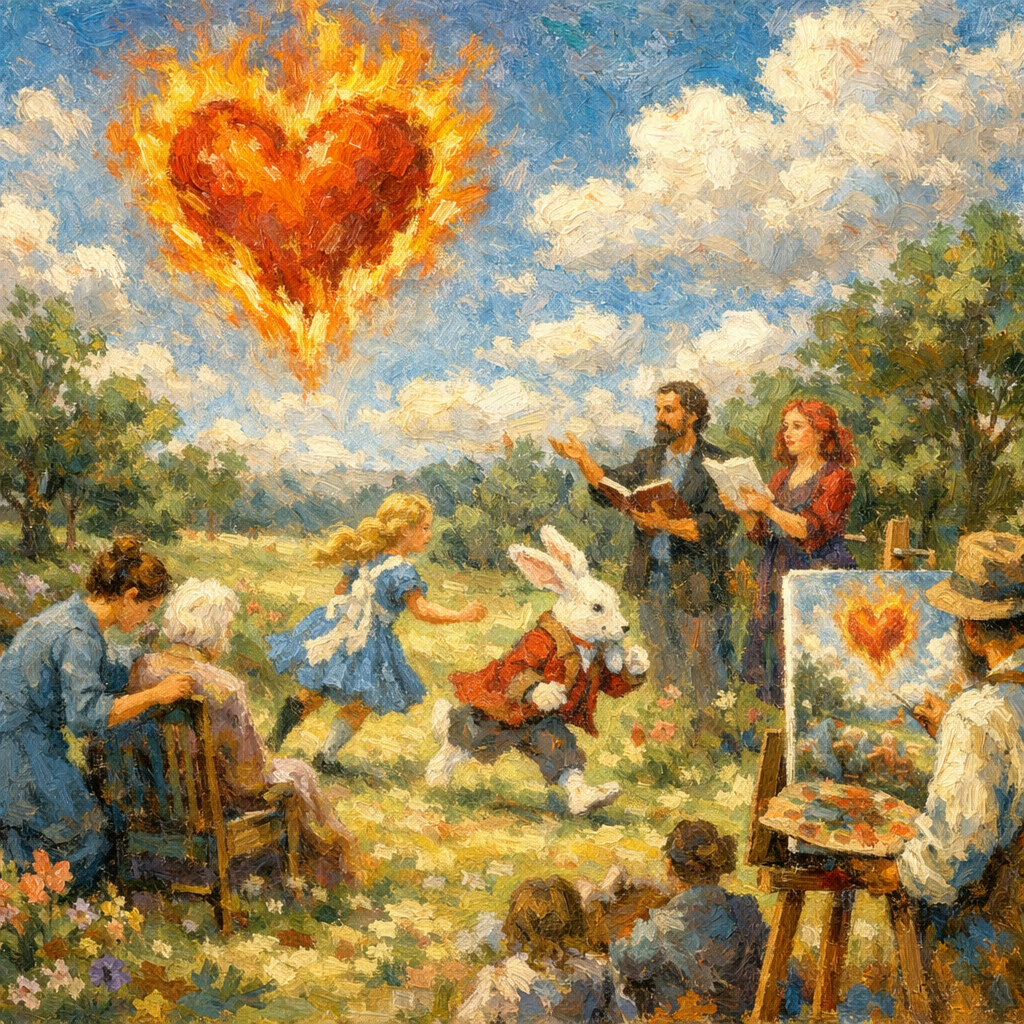
This is what I believe humanity is actually for. Where our species’ unique capabilities shine. Caring for elders in person, creation, poetry, song, imagination frolicking in the grass, eros burning in the sky, a courageous duel over one’s honor being fought in the forest…
Two things I believe have almost ruined what makes humanity great: the Protestant Work Ethic (and just about everything else Calvinism brought us), and taking the Enlightenment rationalism too far — to the exclusion of the things that actually make humanity special.
Guess we have to see how everything plays out. Here’s hoping!
For Thursday:
The Overseer Within: How Calvinism Ate the American Soul