This is a topic dear to my heart. This one’s a little long. But if you don’t enjoy reading, you’re probably in the wrong place. There’s a special treat for those who make it to the end. I still cannot stop laughing. Maybe it’s just me.
The Obligation to Greatness — What Aristocracy Demanded vs. What Meritocracy Rewards
Here's something they don't put in the brochure: real aristocracy was a protection racket with a surprisingly rigorous honor code. Yes, you got the estates, the titles, the absurd wigs — but the implicit contract was that you were obligated, cosmically and socially, to be more. More cultivated, more courageous, more capable of the grand gesture that cost you something. Noblesse oblige wasn't a charming footnote to power; it was the load-bearing wall. The aristocrat who simply sat on his inheritance, comfortable and self-satisfied, was considered a quiet disgrace by his own class — a man who had received the invoice of greatness and simply... declined to pay. Comfort without magnificence was failure wearing expensive clothes. The structure enforced aspiration whether you felt inspired or not, which turns out to be a rather brilliant mechanism for generating civilization, since inspiration is famously unreliable.
The genius of it — and I use that word with full awareness of the irony — is that it worked even on the cynical and the vain. Especially on the cynical and the vain. The Medicis were essentially anxious nouveaux-riches laundering social insecurity into cultural patronage, and their status anxiety produced Botticelli, Michelangelo, and Brunelleschi. You staked your name to something that would outlast you, which meant you had genuine skin in the game of posterity. A cathedral commissioned in your family's name and built over a century has a way of focusing the mind on legacy in a manner that no quarterly earnings report has ever managed to replicate. The obligation to magnificence, once accepted, became generative regardless of the original motive. Vanity, it turns out, is a perfectly adequate fuel for transcendence — provided the structure demands transcendence as the price of admission.
Contrast this with what our current arrangement quietly selects for, and try not to wince. Faux meritocracy rewards the capacity to navigate systems — to read what the evaluating body wants, produce precisely that, and perform effortlessness throughout. This is mimicry dressed in the language of competence, and it is self-referential all the way down: the skill being rewarded is legibility to the selectors, which means the system produces nothing that exceeds itself, because exceeding itself was never part of the evaluation rubric. Consider the architecture of elite university admissions — a process now so thoroughly gamed that it selects primarily for families wealthy enough to hire consultants who specialize in performing the appearance of authentic passion. The output is a class of people exquisitely skilled at impressing committees. Louis-Philippe understood this instinctively: he put on bourgeois clothes, walked among the people with calculated informality, and called himself the Citizen King — meritocratic costuming worn by someone who had simply maneuvered better than his rivals. A cathedral was built to impress God and accidentally became sublime. The consultant's report is built to impress the client and is forgotten before the invoice clears.
The Moral Grammar of Each System — Obligation vs. Desert
Let me say something mildly scandalous in defense of the old aristocracy: at least it had the decency to be honest about what it was. Blood mattered, position was inherited, and the game was not open — and everyone, from the duke to the ditch-digger, understood this perfectly well. The injustice was legible. You could point at it, name it, build a revolution around it, which is precisely what eventually happened. There is a certain perverse integrity to a system that doesn't bother lying about its own mechanics. The aristrocrat didn't need you to believe you could have been him under different circumstances. He was rather comfortable with you knowing you couldn't. This moral clarity, however brutal, at least left the critique intact. You knew what you were angry at.
Faux meritocracy is considerably more elegant in its cruelty, which is to say considerably more cruel. It requires its beneficiaries to genuinely believe they earned it — and this transforms privilege into self-righteousness with an efficiency that would make Machiavelli tip his hat. When outcomes are framed as reflecting desert, failure becomes a moral verdict. The system doesn't need to suppress dissent; it outsources that function to the individual's own psychology. You didn't make it because you didn't want it badly enough. It's a formulation so effective at preempting rebellion that one almost has to admire the architecture. François Guizot, Louis-Philippe's chief minister, was at least nakedly vulgar about it — his famous enrichissez-vous was an honest declaration that accumulation was the point. The current version has laundered that vulgarity entirely. It doesn't admit it's about enrichment. It frames the whole enterprise as virtue. The hustle is now a spiritual practice. The network is now a community. The inheritance is now a growth mindset.
The tell, as always, is in the vocabulary. Access to elite graduate programs, the correct therapeutic register, the right political sensibilities, fluency in the current emotional vocabulary of the professional class — all of this is presented as neutral competency available to anyone willing to develop it, rather than as the hereditary cultural capital it actually is. Samuel Smiles published Self-Help in 1859, at the precise historical moment when industrial fortunes were consolidating into dynasties — providing ideological cover, right on schedule, for what was becoming a new hereditary class. The self-made man arrived in the literature just as making yourself was becoming structurally impossible for most people. Today the equivalent is the wellness industry: a vast apparatus that converts economic advantage into the language of discipline and mindfulness, making poverty legible as a failure of self-care. "Cultural fit," that blandest of HR euphemisms, is simply the corporate implementation of the same logic — a filter selecting for people who already resemble the people doing the hiring, laundered through the language of workplace harmony. The aristocracy said your blood isn't right. We say you're just not quite the right fit. Progress.
Risk Tolerance and the Architecture of Ambition — Noble Failure vs. Managed Decline
Here is something the current arrangement cannot afford to admit: the magnificent failure is a civilizational necessity. Aristocratic culture understood this in its bones. The tragic-heroic tradition didn't valorize loss out of sentimentality — it valorized loss because a culture that punishes the attempt produces people who stop attempting. The Jacobites rode into catastrophe for a king who was arguably not worth it. The Light Brigade charged into artillery because someone gave a bad order and the alternative was to flinch, which was unthinkable. These disasters were aestheticized not despite their futility but because of what the futility revealed — that the people involved were committed to something beyond the calculation of personal survival. Failure was readable as fate rather than inadequacy, which meant that the attempt itself retained dignity independent of outcome. You could bet everything, lose everything, and still be elegized. That insulation from the terror of failure is, it turns out, the precise precondition for every genuine breakthrough in human history. Breakthroughs require the willingness to be wrong at scale, and that willingness requires a culture that doesn't treat being wrong at scale as a moral verdict.
Faux meritocracy has no elegies. It has exit strategies. Because when your entire moral architecture rests on outcomes reflecting desert, a spectacular failure isn't fate — it's evidence. Evidence that you were reckless, delusional, insufficiently rigorous in your due diligence. The rational response — and this is the part that should keep you up at night — is therefore never to bet everything. Maintain deniability. Keep the hedge in place. Never be so nakedly committed to a vision that its failure becomes your failure. Have the consulting pivot ready before the conviction gets inconveniently visible. This is not cowardice in the individual; it is cowardice produced by the system, which is worse, because it presents itself as prudence. The person who bets everything on something genuinely strange and loses doesn't get a ballad. They get quietly excised from the network, their emails go unreturned, and the room rearranges itself around their absence as though they were never there. The system doesn't punish failure dramatically. It simply stops seeing you. Which is, in its way, a more effective deterrent than anything the aristocracy ever managed.
Brunelleschi built the dome of Florence Cathedral using methods so radical and so personally guarded that he had workers arrested rather than allow the technique to be observed. He had no formal training in engineering. He had no licensed firm, no liability insurance, no peer review. He had a vision that everyone competent told him was structurally impossible, and he built it anyway over the course of sixteen years, and it still stands. No contemporary architectural procurement process would have let him past the proposal stage. The venture capital industry performs the vocabulary of exactly this kind of lunatic ambition — "moonshots," "disruption," "changing the world" — while systematically filtering out anyone whose ideas are too strange to fit in a pitch deck. The "fail fast" mantra is not aristocratic risk tolerance; it is aristocratic risk tolerance's taxidermied corpse, mounted attractively in the lobby. It celebrates pivoting away from conviction the moment conviction becomes costly, which is precisely the opposite of what it claims to be. Steve Jobs getting fired from Apple is celebrated now as a founding myth of visionary stubbornness. In real time, the board voted him out. The system always punishes the genuine article on the way through. It only canonizes them once they're safely historical and the lesson is no longer actionable.
What Each System Does With the Outsider — Elevation vs. Co-optation
The aristocratic salon was not, let us be clear, a progressive institution. It was not interested in equality. What it was interested in — with an appetite that turns out to have been accidentally civilizing — was being entertained by genuine brilliance, and genuine brilliance has the inconvenient habit of arriving from unexpected addresses. Molière was the son of an upholstery merchant. Voltaire was the son of a notary. The philosophes were, by and large, men whom the existing order had every structural reason to ignore, and yet there they were, circulating through the finest salons in Paris, being collected by aristocratic patrons who wanted the frisson of dangerous intelligence at their dinner tables. The crucial detail is this: they were elevated as what they were. Their strangeness was the point. Their difference was the asset. Nobody asked Voltaire to file down his edges before taking a seat — the edges were precisely why he'd been invited. A patron made a personal bet on a person, which meant the person's peculiarity was a feature rather than a bug requiring remediation.
Faux meritocracy has developed a considerably more sophisticated method for handling the outsider, which is to say a considerably more effective method for making sure the outsider never actually disrupts anything. The disruptive voice is offered a seat at the table — but the offer is conditional. The price of entry is legibility: you must demonstrate fluency in the existing vocabulary, fitness through the existing evaluation processes, comfort with the existing table manners. By the time you've paid that price, the disruption has been successfully laundered. The credential is the mechanism: it ensures that only those who can perform fluency in the current paradigm get through the gate, which means that genuine alien intelligence — the kind that doesn't know the vocabulary because it's thinking from an entirely different set of premises — is filtered out before it becomes anyone's problem. Leonardo's notebooks contain investigations into fluid dynamics, anatomy, flight, and optics that wouldn't be systematically pursued for centuries. He was also, by any reasonable measure, unemployable by a modern research institution. No peer-reviewed journal. No reproducible methodology. No institutional affiliation. Just an illegible genius doing illegible things in the margins of his own private cosmology. The committee would have passed.
The TED Talk is the perfected cultural artifact of this process, and I mean that as the darkest possible compliment. It takes ideas that might genuinely disturb the room, subjects them to eighteen minutes of emotional calibration, graphic design, rehearsal coaching, and narrative arc consultation, and delivers them to exactly the audience that most needs to be unsettled — in a format so thoroughly optimized for comfort that unsettlement becomes impossible by design. The medium doesn't just dilute the message; it reverses it, transforming potential disruption into the warm sensation of having been disrupted without any of the actual consequences. "Diversity" hiring operates on identical logic: it selects for people from different demographic backgrounds who are otherwise entirely legible to the existing culture — same schools, same discourse, same carefully managed ambitions — rather than genuine cognitive outsiders who might actually say something the room hasn't already pre-approved. Different face, same vocabulary. The appearance of the open window with all the structural integrity of a painted wall. The aristocracy, at its most functional, wanted the strange and dangerous at its table because strangeness was entertaining. We want the strange and dangerous to have completed the onboarding module first — or they don’t get a seat at the table and are usually mocked by the mediocre.
The Output Problem — What Each System Actually Produces
Let us play a small game. Name a building built in the last fifty years that will still be making people catch their breath in five hundred. Name a poem produced by the major publishing apparatus of the last decade that will be read in a hundred. Name a piece of public architecture from any democratic urban planning process that achieves anything beyond the heroic ambition of not being actively offensive. Take your time. The Athens of Pericles was a slave state run by a tiny elite with no interest whatsoever in your participation, and it produced the Parthenon, Sophocles, and the philosophical foundations of Western civilization simultaneously. Augustan Rome was an autocracy with a body count, and it produced Virgil, Ovid, and an architectural vocabulary that European cities were still ransacking two thousand years later. Versailles was an instrument of political control dressed as a garden, and it remains one of the most sublime built environments in human history. The mechanism is not mysterious once you stop being sentimental about it: concentrated wealth plus the obligation to magnificence plus genuine competition for prestige through excellence plus the long time horizon of dynastic legacy equals the funding of things with no immediate utilitarian return. And that category — things with no immediate utilitarian return — contains almost everything that has ever genuinely mattered.
The long time horizon is the variable nobody wants to discuss because it indicts everything. An aristocrat commissioning a cathedral he would not live to see completed was making a bet on posterity with his name attached, which focuses the ambitions in a rather clarifying way. Faux meritocracy operates on quarterly earnings cycles, grant renewal periods, and the attention span of a venture fund counting down to its liquidity event. The result is an output that is, in proportion to the staggering resources commanded, almost impressively mediocre. We have produced a managerial class of extraordinary sophistication — credentialed, optimized, fluent in every current vocabulary of excellence — that has given us corporate architecture of stunning ugliness, institutional prose of weaponized vagueness, and cultural products aimed with laser precision at the largest possible audience, which is to say aimed with laser precision at the lowest common denominator. The consultant's report is the emblematic artifact: produced by the most credentialed minds, consuming resources that would have funded a wing of the Uffizi, written in the most carefully hedged language available, and containing — on close inspection, in the privacy of your own honest assessment — almost nothing that wasn't already known to the people who commissioned it. It is the cultural product of a system that has optimized for the appearance of knowledge rather than its substance, and it shows.
Contemporary literary fiction is where I feel this most personally, and forgive me if the middle finger becomes briefly visible. The major publishing houses now produce novels so thoroughly shaped by MFA program aesthetics, sensitivity reader approval, and sales committee consensus that the genre has achieved a kind of perfect, inoffensive nullity — books that process approved emotional experiences in approved emotional vocabulary and leave no mark whatsoever on the imagination that encounters them. Meanwhile, the modernist moment — Joyce, Woolf, Céline, Pessoa, Kafka — was produced by genuinely strange people with no credentials being published by individual editors making personal bets on work that disturbed them. Haussmann's transformation of Paris under Napoleon III was authoritarian, imposed without a single stakeholder consultation, aesthetically controversial, and genuinely magnificent — a city rebuilt at a scale of ambition that the contemporary urban planning process, with its committees and its impact assessments and its competing interests producing Democratic Ugliness by exhausted consensus, cannot even conceptually approach. Caravaggio was a murderer who painted like an angel and would not have made it past the first round of arts council applications. The NEA, the foundation grant, the residency program — all meritocratic credentialing processes in ecclesiastical drag, selecting for the artist who can write a compelling application rather than the artist who can produce a compelling work. We defunded the patron and hired a committee. Behold the results.
The Endgame — When a System Mistakes Its Own Socialization for Intelligence
Every aristocracy ends the same way, and the ending is always embarrassing. The French nobility of 1789 had, over the preceding century, quietly shed every function that had originally justified its extraordinary privileges — the military leadership, the administrative competence, the obligation to magnificence — while retaining, with remarkable tenacity, every exemption, every title, every claim on the national treasury. What remained was incumbency dressed as birthright, defending itself with the circular logic that has always been the last resort of a class that has run out of actual arguments: we are here because we are here, and we are here because people like us have always been here. The revolution that followed was not, at its root, about ideology. It was about a class that had become a parasite on its own mythology, and a population that had finally done the arithmetic. The terminal stage of any aristocracy is the moment it loses contact with the original justification for its position. After that, it is simply waiting for the arithmetic to catch up.
Faux meritocracy is burning through that timeline with impressive efficiency. The specific pathology is this: a class selected so thoroughly and for so long for fluency in a particular discourse that it has lost the ability to distinguish between understanding something and knowing the approved vocabulary for discussing it. The map has eaten the territory. The credentialed non-expert is the symptomatic figure — the policy expert who has never run anything, the urban planner who has never built anything, the education reformer who has never taught anyone — speaking with the confidence of genuine mastery about domains they have inhabited exclusively as administrators of other people's labor. It is a circle jerk of mediocrity with good vocabulary, and it has become so self-enclosed that dissent is no longer even recognizable as dissent — it simply doesn't parse. When a class controls not just the evaluation of output but the very definition of what counts as output, the self-referential quality becomes total. You are not wrong; you are illegible. Which is, from the system's perspective, tidier. The late Qing dynasty ran a credentialing apparatus of genuine sophistication for centuries, producing a mandarin class of profound classical erudition that was almost perfectly useless when confronted with the actual nineteenth century arriving at China's door with gunboats. The credential and the competence had decoupled so completely that the system couldn't perceive its own uselessness — it was too busy evaluating itself by its own criteria and finding itself excellent.
The reckoning, when it comes, will not announce itself politely. It is already here, in fact, wearing the bland face of a language model. The one thing faux meritocracy could always fall back on — we process information better than you, and that processing is what justifies our position — is being quietly and comprehensively undermined by systems that process information better than anyone, at a fraction of the cost, without requiring a mahogany-paneled office or a fourteen-week onboarding process. What remains when the navigation skill is automated is the genuinely terrifying question of what these people are actually for — and the answer is arriving in the silence where a good answer would be. The established institutions' response to the information disruptions of the last decade has been not adaptation but the increasingly shrill reassertion of credentialing authority, the "misinformation" discourse deployed as epistemology while functioning as incumbency protection, which is exactly what the Qing mandarins did with their classical texts when the gunboats appeared on the horizon. It didn't work then either. The irony of the endgame — and I find it genuinely delicious — is that faux meritocracy will likely not be replaced by a more genuine meritocracy. It will be replaced by something that looks considerably more like the old aristocracy: concentrated wealth, dynastic ambition, long time horizons, names attached to buildings. The tech dynasties are already beginning to look more like Medicis than McKinsey partners. Whether they will feel the obligation to magnificence, or merely the appetite for power, is the only question that remains. History, as usual, is running the experiment without asking our permission.
With a grin, a wink, and a middle finger to the faux meritocracy (meristocracy?)
Majeye
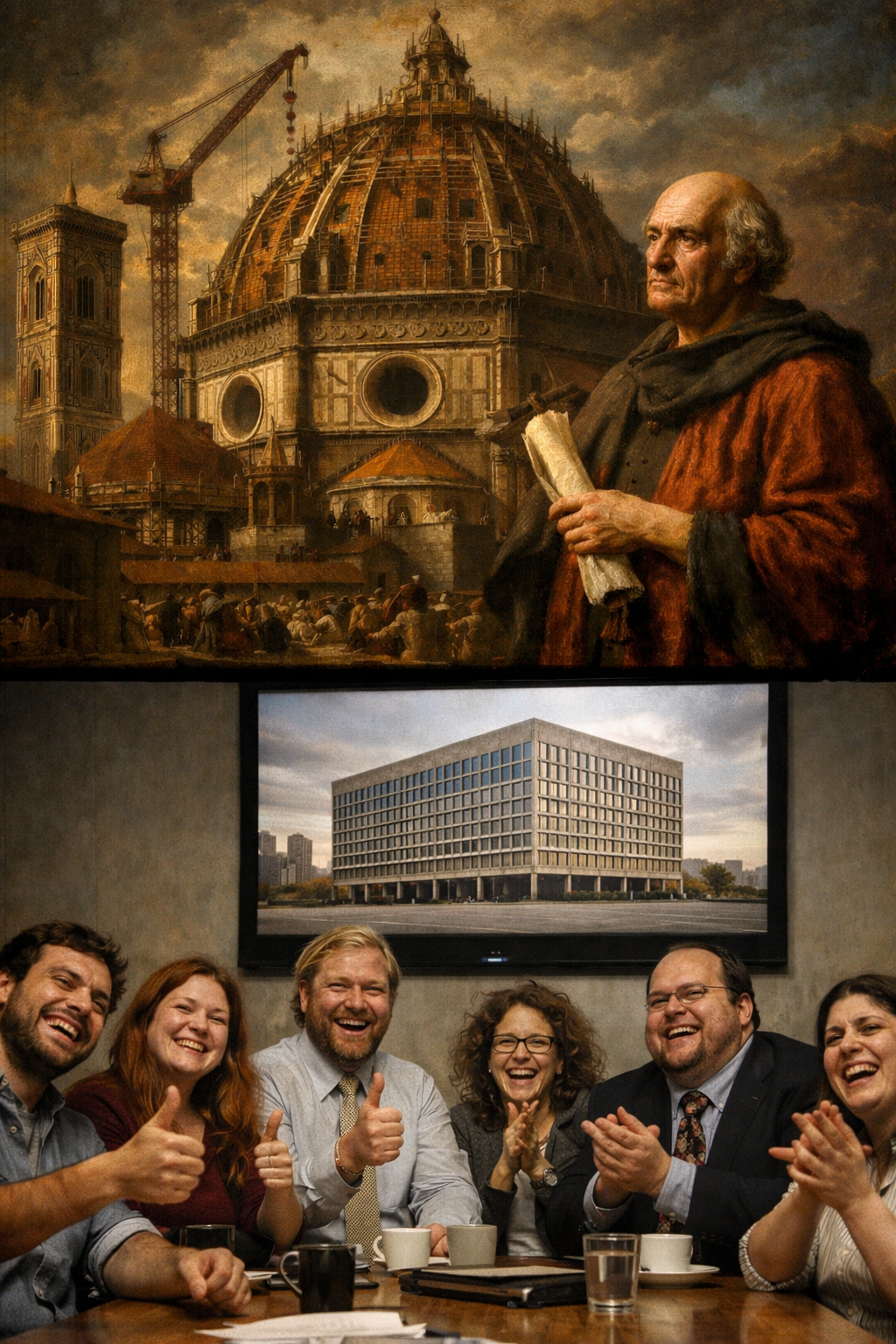
Here we observe two distinct species in their natural habitats.
Above: the solitary visionary, utterly unemployable, guarding his methods like a state secret, building an impossible dome over a city that doubted him — fueled by obsession, funded by a patron who wanted his name on something eternal, answerable to no one except God and his own terrifying interior logic.
Below: the committee. Thrilled. Thumbs up. Applauding the rendering of a beige rectangle. They have achieved consensus. The licensed firm had excellent liability coverage and a very compelling pitch deck. Someone has brought coffee cake. This is the best day of their lives.
For Monday: Intelligence Isn’t What Is Special About Humanity