Ironic Distance as Species-Level Threat
I. THE DIAGNOSIS: How Ironic Distance Paralyzes Genuine Response
We have arrived at a peculiar evolutionary dead end: a species capable of diagnosing its own extinction with exquisite precision while doing absolutely nothing about it. This is not ignorance. Ignorance would be almost forgivable. This is something far more insidious—ironic distance, the perfect psychic armor for watching the world burn while maintaining the aesthetic posture of being too clever to panic.
The mechanism is elegant in its cruelty. Climate collapse is met with memes instead of mobilization. Democratic backsliding earns sardonic commentary instead of resistance. Epidemic loneliness gets parasocial relationships as a band-aid. The meaning-crisis receives a shrug and "that's just, like, your opinion, man." We see everything. We feel nothing we can't immediately aestheticize into detachment.
Here's the insidious genius of it: ironic distance creates awareness without accountability. You can witness the horror, catalog it, even analyze it with postgraduate-level sophistication—all while remaining psychologically protected from the vulnerability of actually caring enough to act. If you never fully commit to caring, you can never be accused of caring too much, trying too hard, being naive enough to think individual action matters. You get to be right about everything while doing nothing about anything.
This is late capitalism's perfect psychic defense mechanism. It allows continued consumption and complicity while maintaining the feeling of being above it all. We scroll through catastrophe with one eyebrow raised, performing our detachment like a doctoral thesis in ennui. The sophistication is real—I won't pretend it isn't. We've produced a generation that can analyze every problem with devastating accuracy. But the paralysis isn't a bug. The paralysis is the point.
II. THE COWARDICE: Pre-emptive Retreat Dressed as Intellectual Maturity
Let's call this what it is: cowardice. Ironic distance is the psychic equivalent of betting against yourself as a default position, pre-loading your own failure to spare yourself the indignity of having genuinely tried. It masquerades as intellectual maturity—oh, how sophisticated to recognize that sincerity is gauche—but strip away the rhetorical filigree and you're looking at simple, bone-deep fear of looking foolish.
The architecture of self-protection is meticulous. If you never mean anything fully, you can never be held accountable for meaning it. If you never commit completely, you can never fail completely. Every statement arrives pre-ironized, every feeling pre-distanced, every commitment pre-qualified with an invisible asterisk that reads: just kidding, unless you agree, in which case I was totally serious. The ironist protects their ego by never exposing it. This is not wisdom. This is terror that caring about something might reveal you as unsophisticated, uncool, insufficiently aware of how the world really works.
Genuine engagement requires accepting the full catastrophic possibility of failure. Of being wrong. Of caring about something that doesn't care back. Of revealing yourself as someone who still believes effort might matter, that sincerity might occasionally outperform smirking detachment. Ironic distance is the wholesale refusal of that risk.
But here's the exchange rate no one mentions: the price of this protection is that you also can't fully succeed, be completely right, or experience unqualified joy. You've immunized yourself against humiliation, certainly—but you've also immunized yourself against everything that makes being alive worth the trouble. The ironist is already dead, just articulate about it. They've traded vitality for invulnerability and called it sophistication. I've seen corpses with more aliveness in their eyes.
III. THE CONDESCENSION: Mistaking Detachment for Depth
Ironic distance operates on an implicit hierarchy so pervasive it's become invisible: the more detached you are, the smarter you must be. The more you care, the less you understand. Earnestness is treated as a failure of intelligence—anyone who cares deeply must be performing ignorance, anyone who means what they say simply hasn't learned better yet. The truly sophisticated know that caring is for people who haven't figured out the game.
This is ego protection masquerading as epistemological humility. "I'm too smart to fall for caring about things" is just "I'm too scared to risk caring about things" with a graduate degree. The aggression reveals the insecurity. If earnestness were truly naive, it wouldn't require such relentless mockery to contain. But watch how quickly the ironist moves to ridicule anyone who commits without qualification—the speed of that response tells you everything about the threat they perceive.
Ironic distance creates its own tribal boundaries: in-groups and out-groups sorted by who's "in on the joke." But the joke is that there's nothing underneath the joke, just more protective layers of the same defensive posture spiraling inward. Those who care are treated as marks, rubes, people who haven't yet discovered that nothing matters. But here's the thing they won't tell you: "nothing matters" is a choice, not a discovery. It's not wisdom you arrive at through experience; it's a conclusion you select to avoid experience.
The condescending ironist mistakes their numbness for clarity. Their paralysis for perspective. Their cowardice for sophistication. They've convinced themselves that caring less means understanding more, when what they've actually accomplished is insulating themselves so thoroughly from reality that they can no longer feel it enough to respond to it. They're not deeper. They're just further away.
IV. THE DEMOGRAPHIC DEATH SPIRAL: Why Make Babies in This Hellhole?
Falling birth rates across developed nations correlate with the rise of ironic distance as the dominant cultural mode. This may not be coincidental. I'd argue it's not coincidental at all.
Having children is the ultimate act of non-ironic commitment. You cannot hedge. You cannot distance yourself. You cannot protect yourself from caring completely and without qualification. There is no asterisk, no escape hatch, no "just kidding" clause. Parenthood requires believing—genuinely, vulnerably believing—that the future is worth investing in, that meaning can be made, that your actions matter across generational time. These are precisely the positions ironic distance has declared naive, unsophisticated, the province of people who haven't figured out that hope is for suckers.
"Why would I bring a child into this world?" has become the rallying cry, delivered with the satisfied finality of someone who's just won an argument. But this world has always been brutal. Previous generations faced world wars, nuclear annihilation, plague, famine, civilizational collapse on a Tuesday—and still had children. Not because they were stupid or ignorant, but because they hadn't yet learned that caring was cringe. They hadn't been taught that hope was a character flaw.
Ironic distance makes reproduction psychologically untenable. If nothing matters, if all commitment is suspect, if caring deeply is evidence of insufficient intellectual development, then creating a new human being who will inevitably care—who will love, hope, suffer, try—becomes an act of cruelty. You're birthing someone into the vulnerability you've spent your entire adult life learning to avoid.
The demographic collapse isn't just economic, though it certainly is that. It's the logical endpoint of a culture that has made earnest investment in the future unfashionable. A species that cannot commit to its own continuation because commitment itself has become embarrassing is a species in terminal decline. We're not dying out because we lack resources. We're dying out because we've made wanting to live—really live, in the bodies of people who come after us—too uncool to survive.
V. THE COMPARISON: Two Possible Worlds
Let me sketch two versions of reality, both available to us right now. The choice between them is the only choice that actually matters.
World A: Ironic Distance as Default (Current)
Every crisis is observed, analyzed, memed into oblivion, and left meticulously unaddressed. Awareness has replaced action as the measure of intelligence. You're sophisticated if you can name all the problems with perfect precision while doing nothing about any of them.
Sincerity is cringe. Caring too much marks you as unsophisticated. Trying earnestly at anything is social suicide—better to fail ironically than succeed while appearing to have wanted it. Relationships become "situationships." Commitments are "for now." Meaning is "your truth," with the implicit parenthetical: not truth, just your quaint personal fiction.
People are more afraid of appearing naive than of being complicit. More afraid of being wrong than of being utterly ineffective. Joy requires ironic framing to be permissible—unqualified delight is suspicious, childish, evidence of insufficient awareness of how broken everything is. The sophisticated person is the detached observer, the one who sees through everything and participates in nothing fully.
The result: endemic depression, anxiety, loneliness, purposelessness—all accompanied by perfect ability to articulate exactly why these conditions exist. We can diagnose our own malaise with doctoral-level precision. We just can't do anything about it, because doing something would require caring, and caring would reveal us as marks.
World B: Earnest Engagement as Default (Possible)
Problems are still analyzed—we're not abandoning intelligence here—but analysis serves action rather than replacing it. Understanding becomes a prelude to response, not a substitute for it. You think clearly in order to act effectively, not to protect yourself from having to act at all.
Sincerity is recognized as strength. Caring deeply is understood as braver than protecting yourself from caring. Trying earnestly is respected even in failure, because at least you were in the arena instead of commentating from the stands. Relationships are commitments with actual stakes. Meaning is something you construct and defend, not something you deconstruct into comfortable relativism. Truth is pursued rather than dismissed as everyone's equally valid personal narrative.
People are more afraid of inaction than embarrassment. More afraid of paralysis than of looking foolish. Joy is permitted without ironic qualification—delight is recognized as a reasonable response to beauty, connection, achievement, the fact of being alive at all. The sophisticated person is the one who can see clearly and still act. Who understands complexity and still chooses. Who knows the odds and plays anyway.
The result: still suffering, because reality is hard and I'm not selling you a fantasy. But suffering in service of something. With agency. With the possibility of genuine success or failure rather than ironic non-participation. You might lose, but at least you're in something real enough to lose.
The difference isn't that World B is naive about horror. It's that World B refuses to let horror be the last word. World A has made peace with apocalypse by aestheticizing it. World B looks at the same apocalypse and asks what can be done before the lights go out. One of these positions is sustainable. The other is already dead.
VI. THE VERDICT: Ironic Distance Isn't Sophisticated—It's Spineless
Let's deliver the verdict plainly: ironic distance isn't sophisticated. It's spineless.
Real sophistication means seeing clearly and acting anyway. Ironic distance means seeing clearly and using that clarity as an excuse for inaction. "I'm too smart to care" is functionally indistinguishable from "I'm too scared to care"—the former is just the latter with a condescending smirk and better vocabulary. Strip away the rhetorical flourishes and you're looking at people who mistake paralysis for principled non-participation, cowardice for wisdom.
Ironic distance lacks backbone and insists that's better. It's performance art masquerading as philosophy. And here's what kills me: if you're trying to be cool, you're not actually cool. Coolness is intrinsic, not a pose. All I see is a generation of people performing sophisticated detachment to seem cool, to appear intelligent, to signal that they're in on the joke—but underneath? Risk-averse cowards. People so terrified of vulnerability that they've built an entire worldview to justify never exposing themselves to the possibility of failure, humiliation, or caring about something that doesn't care back.
The truly sophisticated position is this: I see the horror. I understand the odds. I know I might fail spectacularly. I'm doing it anyway, because the alternative is death-in-life. That takes courage. That requires a spine.
Ironic distance produces clever corpses—people who can articulate exactly why everything is terrible while doing nothing about any of it. People who are already dead but articulate about it, who've traded vitality for the illusion of invulnerability. A culture of ironic distance is a culture in hospice care: comfortable, medicated, waiting for the end while calling it enlightenment.
The species-level threat isn't that ironic distance makes us sad. It's that ironic distance makes us unable to do anything about being sad. We've built a philosophical framework that justifies paralysis as insight, and then called people who reject that framework naive. But they're not naive. They're alive. They still have a pulse.
Ironic distance is killing us not despite its intelligence but because of it. It's smart enough to see every reason not to try, too cowardly to try anyway. It catalogs every obstacle with perfect precision and then uses that catalog as evidence that movement is futile. This isn't wisdom. This is intellectual sophistication in service of fundamental cowardice.
The choice is simple: die articulate and detached, or live messy and committed.
Ironic distance has chosen. The rest of us don't have to.
Majeye
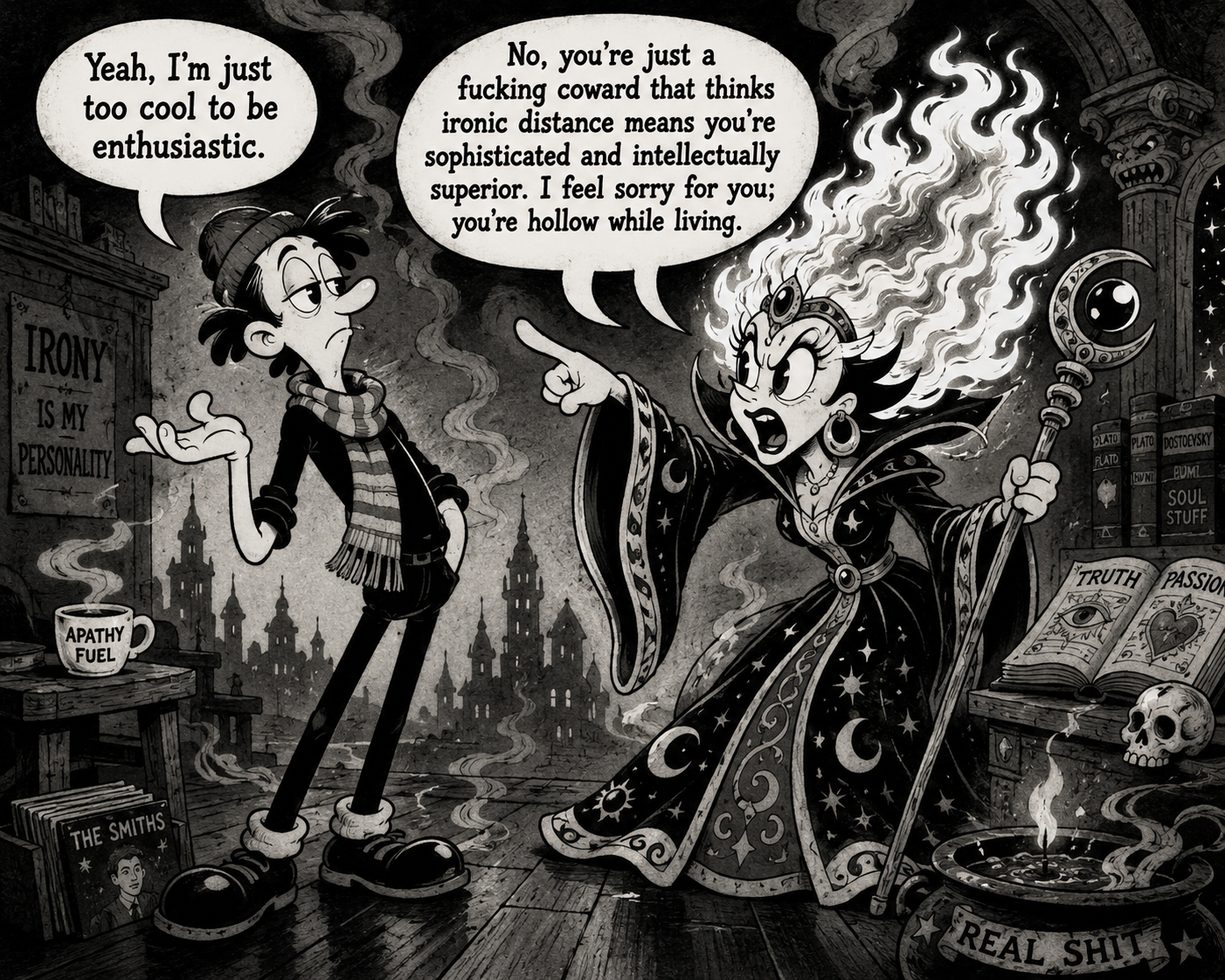
I think my sentiments are adequately expressed here…
The Smiths are still awesome music though. :D