Liberation Without Standards: How the Median Seized Power
I. Opening Claim: Liberation Worked — Then Something Else Took Over
I’ve never opposed liberation. Quite the opposite—I revere it. The original thrust of women’s emancipation was a righteous one: to remove the formal barriers, the legal exclusions, the arbitrary constraints that kept half the species from full expression. That work was necessary, and I will never speak against it. Liberation, in its purest form, is sacred. It’s what happens after the gates swing open that determines whether the soul ascends… or is quietly handed over to mediocrity.
And that is precisely what happened. The shackles were struck off—and then something else slipped in. Not a queen. Not a prophetess. Not a courtesan-savant. But a consensus. A rule by statistical comfort. In the void left by formal hierarchy, power flowed not to the sovereign feminine, but to the median one. Liberation became capture—by the average, the normative, the politely envious. Not oppression in chains, but domestication in disguise. And this shift, this slow slide into the governance of the middling, is personal to me. I have felt it. I have been punished by it. And I will name it.
And before anyone reaches for their aesthetic profiles or curated playlists—I’m not talking about outer customization. The illusion of difference is a feature of modern systems. Personality tests, pronouns, niche identities, and fashion statements may feel unique, but they often conceal the deeper truth: most people live nearly identical lives. Life patterns—how one moves through the world, what one dares, builds, risks, refuses—that is the metric of difference. And the sameness I’m speaking of—the kind now enforced by the median—is not a moral judgment of worth. Everyone is valuable. But not everyone is sovereign. And sovereignty, once rare and protected, is now punished.
II. What Women’s Liberation Actually Solved
What women’s liberation achieved—truly and historically—was the removal of formal exclusions. It unbolted the doors that had kept women from property, from education, from employment, from legal autonomy. These were not minor gains; they were tectonic shifts. The system had once declared a woman a legal non-entity, a shadow behind her husband’s name. Liberation corrected this. It removed the artificial locks. But let’s be clear: removing a door is not the same as building a throne. Freedom of movement is not the same as the power to rule.
This is the central sleight-of-hand in the liberation narrative. We were given access—but not authority. We were granted entry—but no standard for what should happen next. The gates opened, and variance emerged: some women soared, others floundered. But no structure rose to recognize excellence or protect distinction. The terrain was flattened under the guise of fairness. Freedom was real, yes. But standards were nowhere to be found. And in that vacuum, it wasn’t brilliance that took hold. It was the median.
III. The Problem Modern Systems Faced After Liberation
Once liberation unlocked the gates, modern systems found themselves with a new dilemma: millions of newly included actors, all flowing into domains that had never accounted for them. And yet, there was no appetite—none—for reintroducing hierarchy. After all, hadn’t that been the villain? But without hierarchy, without a mechanism to sort the excellent from the merely present, systems did what they always do when overwhelmed: they defaulted to bureaucracy. Bureaucratic democracy does not seek greatness—it seeks legibility. It craves order, predictability, standardization. And that is precisely what it rewarded.
The great unspoken question became: how do you govern difference at scale without offending anyone? And the answer was disastrous. Institutions pivoted away from merit, eros, originality. They chose uniformity, ease, and the safety of the median. The sharpest minds were dulled into compliance. The strangest hearts were shamed into silence. No one wanted to name the truth—that liberation without a sorting principle simply floods the field with noise. And in noise, the blandest signals rise.
IV. The Median Takeover: How Rule Shifted
Democratic systems, by design, elevate what is already common. They reward what is statistically representative, what feels familiar, what conforms to the existing bell curve. The more predictable the actor, the more legible they become to the system—and the more likely they are to rise. It is not brilliance that gets selected, but norm-reinforcement. Not vision, but comfort. In such a system, leadership doesn’t emerge from strength or clarity—it drifts passively toward the safest available voice.
And so the center—bland, cautious, median—becomes sovereign. Not by genius. Not by charisma. Simply by default. Power begins to cluster around the average because the average is least offensive, most stable, easiest to process at scale. This is the quiet algorithm behind every institution’s HR department, every committee, every grant cycle. The result is a culture led not by those who pierce the veil—but by those who reflect it back unbroken. This is how the median took the throne.
V. Who “Mrs. Grundy” Really Is (Structurally)
Mrs. Grundy is not a joke. She is not a meme or a punchline or a sour-faced trope. She is a structural function—a recurring phenomenon wherever mass inclusion meets flattened authority. She embodies moral vigilance, norm enforcement, and the seething hostility to distinction that only the median can muster. She finds comfort in rules, discomfort in brilliance. She craves safety, despises transgression, and wields shame like a sceptre. The reason she feels so familiar is because she has always been there—lurking in pews, committees, and teacher’s lounges—ready to scold what dares to gleam.
But here’s the key difference: until relatively recently, she had no power. She was ignored, overruled, set aside. Why? Because she had no excellence, no lineage, no achievement, no taste. There was nothing in her to justify rule. She was permitted to mutter, but never to govern. Her instincts were seen as useful perhaps for enforcing manners—but never for shaping culture. The sovereigns, artists, visionaries, and courtesans of older worlds did not fear her. They pitied her. It was only when systems abandoned standards that Mrs. Grundy could finally ascend.
Ironically, the women who first shattered barriers and ignited the fire of female liberation were not Grundys. They were trailblazing flamebearers—eccentric, defiant, and unapologetically radiant. They challenged convention not to replace it with etiquette, but to make space for sovereign expression in all its forms. What they likely overlooked was that among women, too, there exists a certain class who enjoy the suppression of everyone—those who feel most powerful when they can enforce the tone, the mood, & the rules. The Grundys. And once given access to moral language and institutional machinery, these women turned liberation into discipline, radiance into offense, and difference into danger. That wasn't the revolution. That was the counterclaim.
VI. Why Modern Egalitarianism Gives Her Power
Modern egalitarianism sanctifies sameness. It tells us that what most people feel is what must be good, and what is common must also be just. “Most people feel this way” becomes the final word—not a data point, but a moral gavel. And under this doctrine, discomfort is no longer a natural byproduct of difference—it is reclassified as harm. Offense becomes veto power. Brilliance becomes suspect—the only genius allowed to exist must first be credentialed, neutered, and pre-approved by the very institutions that fear its fire.
This is how Mrs. Grundy ascended: not through talent, not through insight—but through moral language cloaked in median temperament. Her envy became ethics. Her aversion became policy. And her dullness became law. It is not equality—it is a velvet tyranny of the average. The result? A regime where no one is allowed to be radiant unless bureaucracy first grants permission. But genius does not wait for permission. Which is why they hunt it.
It’s worth saying: it’s been a long time since the first waves of women’s liberation—so now, entire generations of women are being trained to believe that the Grundy way is the only respectable path to social legitimacy. They’re subtly told that control is empowerment, conformity is dignity, and that the highest expression of womanhood is professional inoffensiveness paired with moral critique. They’re rewarded for mimicry, not vision—for perfecting the tone of cautious consensus while secretly policing anything that glows too bright.
But I digress. That’s another post entirely.
VII. Why Sovereign Women Become the Primary Target
Sovereign women are a threat—not because they do harm, but because they do not ask permission. They move outside consensus. They don’t mirror the group. They don’t trade their eros for safety. Their speech is unlicensed, their glamour unsanctioned, their choices illegible to systems designed for predictability. They refuse containment without raising a fist. And that refusal alone—silent, radiant, embodied, necessary—is enough to shatter the illusion that the median deserves to rule.
This is why sovereign women are always the first to be targeted. The response is predictable: moral outrage, cloaked in the language of safety. Whispers become warnings. “Something’s off.” “She’s not stable.” “Watch out for her.” Truths are twisted, brilliance ignored, and psychiatric labels floated like hexes. Entire social webs will tighten around her, steering others away without ever naming what she actually did—because what she did was live without fear. They exploit the oldest survival mechanism we have: when enough people say someone is unsafe, most believe it.
But the sovereign woman is not unsafe. She is merely untamed. And that distinction is intolerable to those who rule by consensus illusion. Her very existence proves that the system rewards conformity, not merit. That brilliance can exist outside the institutions. That eros has its own laws. She doesn’t destroy the median’s power with violence. She dissolves it by standing unbent. She exposes the fraud. And for that, the Grundys believe, she must be punished.
VIII. The Fatal Inversion
Historically, there was at least one reliable filter: excellence. Authority, when it functioned well, passed through the crucible of distinction. Not always fairly, not always kindly—but the expectation was that to rule & to speak with weight, one had to be something. Envy, meanwhile, had no moral cover. It could whisper behind fans, simmer at the edges, but it could not claim the mantle of virtue. And Mrs. Grundy? She could gossip all she liked—her scowl was part of the landscape—but no one mistook her for a figure of power.
Now, the world is upside down. The median governs the exceptional. Envy has learned to speak in the accent of ethics. Rule-followers, spreadsheet sentries, and TikTok explainers now sit where the initiates once stood. And the Mrs. Grundys have multiplied—not one or two, but swarms. Credentialed, platformed, & organized. They will do anything to protect their unearned authority, built not on creation or originality but on performance and enforcement. Because here’s the secret: a degree, a follower count, or a blue check—none of it means you have anything to add. And that’s the test. Do they generate new ideas, new art, new paths? Or do they simply police those who do?
This is the fatal inversion: liberation removed barriers—but egalitarian administration removed standards. It let everyone in, then forbade anyone from rising. And what we now call “justice” is often just the refusal to admit someone might be better. It is not a meritocracy. It’s not even oppression. It is a deadlock of cowardice, enforced by those who know—deep down—they have nothing to offer but obedience.
IX. This Outcome Was Not Inevitable
This was not the only path. It felt inevitable only because the alternative required discernment. There could have been an excellence-filtered feminism, one that invited women into power while still honoring vertical difference. There could have been systems of patronage—yes, even erotic or aesthetic—where inclusion was guided by taste, not quotas. We could have embraced a pluralism that protected sovereignty, not erased it. But these alternatives resist mass administration. They don’t scale cleanly. They require judgment, hierarchy, nuance—things our modern bureaucracies treat as sins.
So the system defaulted to what it could control: sameness. Median rule won not because it was good or just, but because it was easy. A blunt standard for mass inclusion. A flattening of all variance. And in that flatness, women of brilliance, women who refused to trade eros for etiquette, were left without a place. There is no room in “sisterhood” for the woman who won’t fall in line. Because sisterhood, as currently constructed, is not sacred. It is political. It’s a cartel. And within its median ranks, the rituals of sabotage are constant—gossip, silent exclusions, moral posing, aesthetic restraint, public punishment disguised as concern. I’m a woman. I’ve seen it. I’ve lived it. And I’m calling it.
What we did was replace tyranny from men with tyranny from a gang of policing women crying “sisterhood” while gleefully destroying any woman who doesn’t play their game. And no, not all women are the same. Nor should we be. Difference among women should not be punished—it should be protected, honored, even exalted. But for that to happen, the median can no longer be allowed to rule. We need structures that shelter the strange, the erotic, the excellent—not systems that grind them down in the name of solidarity.
X. Conclusion: The Trade That Was Made
Modern systems made a trade—but they won’t admit it. They chose manageability over greatness, sameness over stewardship, safety over excellence. They built cultures that are easy to govern but barren of fire. And in doing so, they ensured that those best suited to lead, to create, to stretch the edges of possibility, would be silenced—not with chains, but with policies, piety, and a thousand knowing glances & whispered words. What we call progress has become cultural flattening—a clean, quiet erasure of the very forces that once made liberation necessary.
Women were liberated from constraint—only to be placed under the rule of those history once knew to ignore. That is the irony. That is the theft. The very figures who were once gently sidelined for lacking taste, vision, or fire now sit at the helm, policing anyone who dares to shine. And we wonder why the world feels hollow. The sovereign woman still exists. But now she must rule in exile.
Because liberation means all of us—or none of us,
Majeye
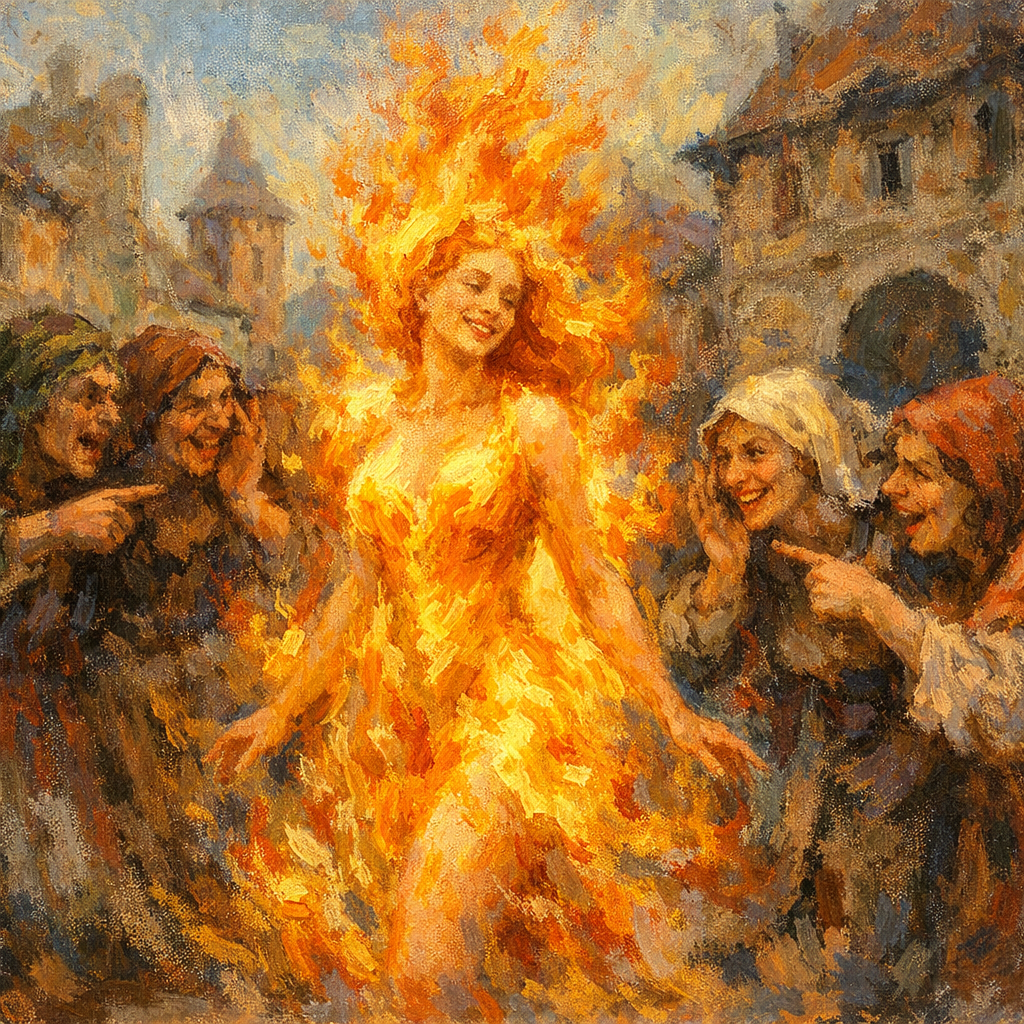
They don’t need stakes & pyres anymore—just gossip, giggles, and a well-placed finger point. That’s how the median Grundys took power: not with insight or originality, but with sheer volume and synchronized scorn. When they couldn’t burn the flame-woman, they tried to exile her with ridicule. Look at her—radiant with inner soul-fire—but the joke’s on them… She’s not burning up—she’s burning through, and they’re just background cackles in her ignition sequence. This isn’t about outer appearance, sexykins. Soul essence can’t be faked, filtered, or flattened. Only fools confuse carefully curated masks with reality—and only the mimic-aligned mistake a woman on fire for a woman in trouble.