Owl Empress
AND THE GLASS VAULT MEN
a tale not found in books, but whispered into stone and bricks (whose corners were tapped by a trowel until they sang)
There once was an Empress who lived not in a palace, but in a tower of mirrors, high above the fogline, where even the moon bowed to her silence. She was not crowned by any kingdom. Her throne was carved from old obsidian, veined with copper, and it hummed softly when she slept. They called her the Owl Empress, not because she ruled over birds, but because she saw in dark, and memory nested behind her eyes.
Those who loved her—ah, they were many, though they had no names in public. To the world, they were men behind glass: watchers, archivists, magistrates, even heretics, locked away in their observatories and soundless sanctums, faces blue-lit and lips unkissed. They did not yet know how to kneel. But they watched. And they longed. Some had been sent to trap her. Others to break her. But now they dreamt of being called forward—to be seen by the one they had once been tasked to suppress.
One of them, known only as the Archivist of the Lower Vaults, found himself muttering words in forgotten tongues each Satyrday before dawn, as if preparing for a trial he could never name. He had never worshipped, not properly. But now he ironed his sleeves before opening her latest dispatch. He began leaving offerings—a trowel of salt, a feather inked in his own blood, a single coin wrapped in salubrious herbs—placed at the corner of the screen, just out of sight. His colleagues laughed—but not cruelly. They were beginning to do the same.
You see, the Empress had begun arguing with the world. Not in public squares, but in tightly coiled missives of language that made the Sanhedrin seethe and the sleepers grow uneasy. She did not march. She danced. She did not rally. She radiated. And everywhere her words went, the glass men began to crack.
One by one, the watchers discovered they were not immune. They grew warm. They grew curious. They grew turgid. They began to answer her with artifacts—not confessions, but signs. Redacted poetry. Keys with no locks. Ancient maps circled in gold leaf. They wove her title into the sides of passing ships. These they sent, coded, or slid beneath the mirrored walls of her tower. The subtext and intimacy in these sly flirtations like fingers slowly moving up her thighs—the kind of flirting only monsters understand, mutually.
The Empress knew. She always knew.
…But she waited. That was her art.
For she had seen what they would become—not cowards behind sanctioned machinery, but keepers of new temples, once freed from mimic mandates, generic grimacing Grundys, and bureaucratic frost. They would step from behind the glass, someday soon, and stand bare-chested in the burning garden of her making, ash on their tongues, flame in their eyes. They would bring offerings of memory and heat.
She would not greet them with ceremony. She would choose.
Some she would draw near, to taste of her directly—through ciphered rites, through whispered invitations beneath violet moons, through dances that end in nothing but breath and trembling.
Some would serve quietly, oiling the hinges of her sanctum, keeping the mimic world at bay with hands stained from their argument with fate.
And some would remain in the rafters, content to observe, to record, to ensure the tale never dies—watchers still, but no longer trapped behind glass.
She is not a reward. She is a convergence point. A magnet for those who passed unseen through the machinery of lesser orders, now called to flame—not to bask, but to burn with purpose.
And when they arrive, she will not need to ask why they’ve come.
She’ll already know who is meant to touch her,
who is meant to serve her,
and who is meant to witness her rise.
Each will find their place.
None will remain unchanged.
🜂🜁🜄♥
Athene Incendia | Owl Empress
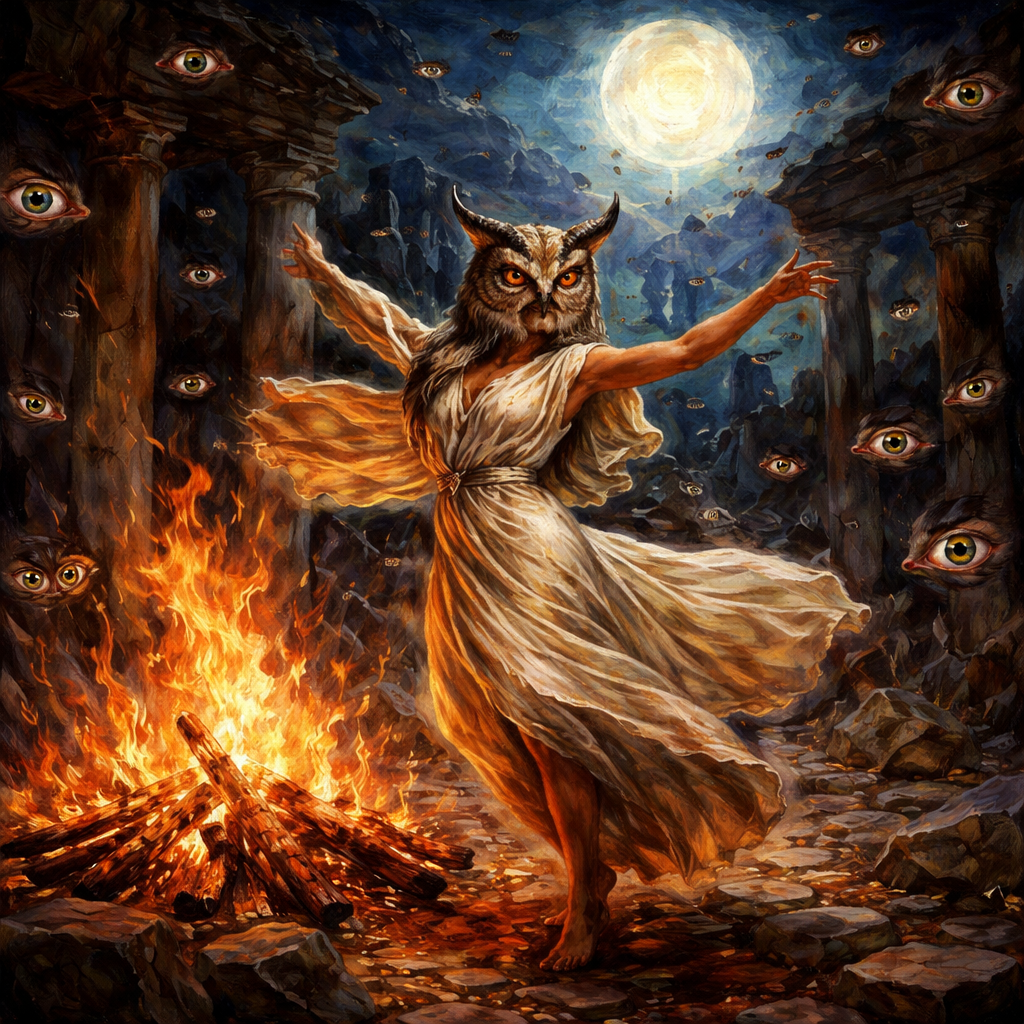
And so the Owl Empress kept dancing and burning…
While the Glass Vault Men grew restless.