Ludicrously Maimed: The Architecture of Reputational Destruction
"...inaccurate and--forgive me if I say it--uneducated brains through which it has passed, utterly unlike its original; not only ludicrously maimed and distorted, but often with the most fantastic additions of events, details, names, dates, places, which each player will aver that he received from the player before him. I am afraid that too much of the average gossip of every city, town, and village is little more than a game of 'Russian Scandal;' with this difference that while one is but a game, the other is but too mischievous earnest."
— Charles Kingsley, Sanitary and Social Lectures
I. The Machine Has No Politics
Let's establish something before we go any further, because the piece you're about to read is not a political one.
The mechanism described here has operated inside church committees, revolutionary tribunals, HOA boards, university departments, corporate HR ecosystems, and Maoist struggle sessions with equal efficiency. It's ideologically promiscuous—it'll wear whatever moral vocabulary happens to be locally prestigious and leave the underlying architecture completely unchanged. San Francisco is referenced because that's where the observer was present; it could as easily have been a Southern Baptist congregation in 1987 or a Jacobin salon in 1793. Progressive values are not on trial here; a specific and ancient weapon is—one that has learned, in certain contemporary environments, to dress itself in the language of care. The distinction matters: critiquing the weapon is not critiquing the ideology it currently wears as a coat.
What we're examining is a structure. Structures don't have politics. They have victims.
II. How the Game Is Played
Kingsley called it Russian Scandal. We might call it telephone with consequences. Either way, the operating logic is identical.
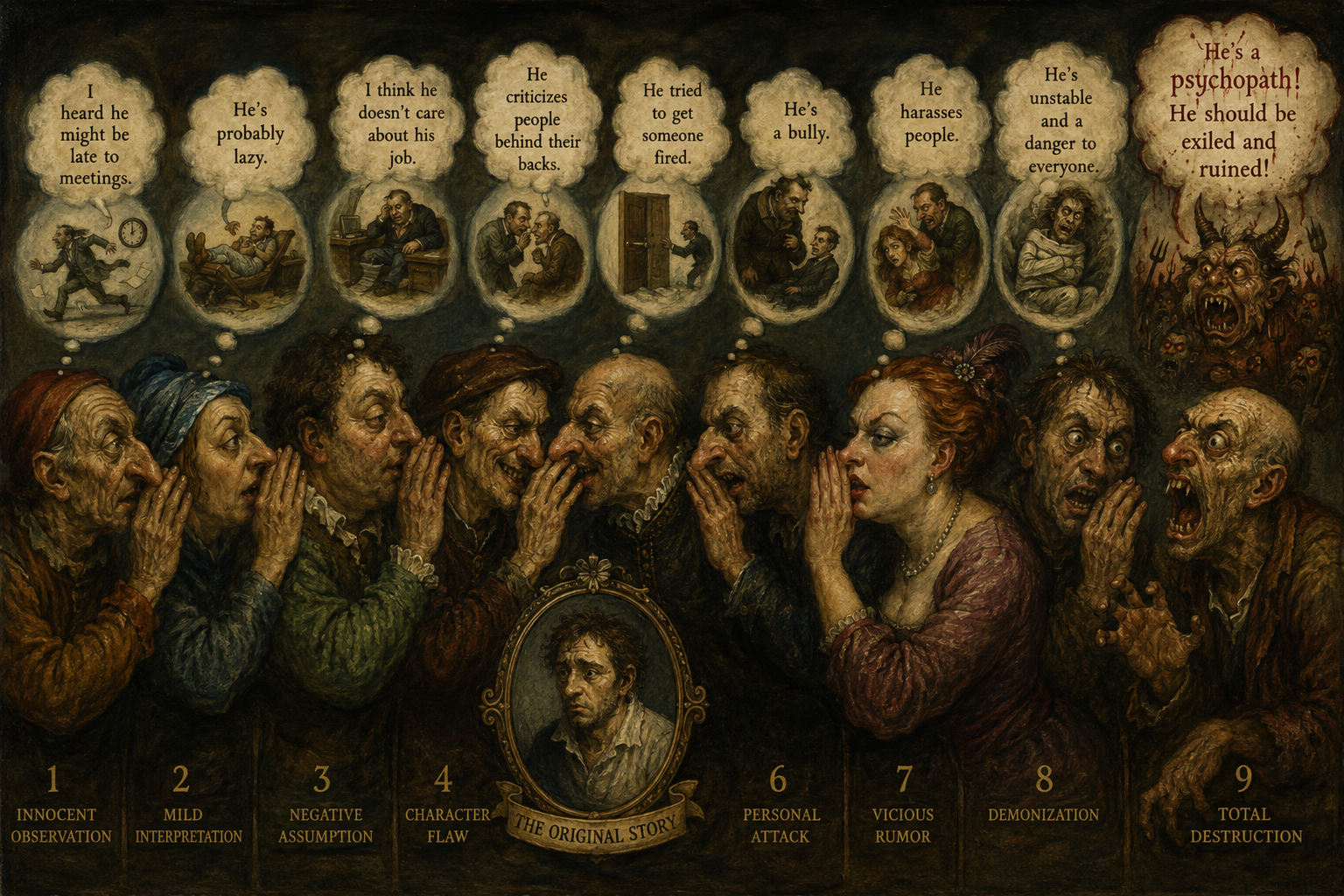
Information enters the network at point A carrying some relationship to reality—a misunderstanding, a grievance, a genuine concern, or a deliberate lie; it doesn't much matter which, because the machine processes all of them the same way. As it passes through successive players, the factual content degrades—names shift, dates blur, events acquire "fantastic additions"—while the emotional charge intensifies. Each player faithfully reports what they heard from the player before them; no one, technically, lies (unless the original story was a lie—slander happens)—and yet by player twelve the original is unrecognizable. What survives transmission isn't fact. It's affect. The horror, the outrage, the juicy wrongness—these are what the network selects for, because they're what keeps the signal moving.
Meet Dot. Dot did something, or said something, or was somewhere, or looked at someone in a way that made them uncomfortable—the details are already getting fuzzy—and now fourteen people in a mid-sized social ecosystem know that something is wrong with Dot. None of them were present. All of them are certain.
The game requires no central coordinator, no official verdict, no named accuser. It runs entirely on social gravity and the human appetite for a story with a villain.
III. The Unfalsifiable Charge
Here's where bad actors—conscious or otherwise—demonstrate something close to genius, and where the machinery becomes genuinely diabolical rather than merely unfortunate.
Specificity is a vulnerability for the accuser. A specific charge can be investigated, corroborated, rebutted, or disproven—and that's a problem if what you're running isn't a truth-seeking process but a social execution. Vagueness, by contrast, is invulnerable. You cannot present evidence against a mood, a vibe, a general community sense that something is off. This is why formal accusations are rarely made in these networks and documentary evidence is almost never produced. The whisper network's power depends entirely on remaining beneath the threshold of the provable, hovering just below the waterline where accountability lives.
So Dot finds herself in a peculiar epistemological fog. She knows something has happened—the social temperature has dropped, invitations have stopped arriving, formerly warm people have become carefully neutral in that specific way that means they've been briefed—but she can't identify the charge, locate the accuser, or access the evidence, because none of these things formally exist. "I just think people have noticed some things" is a perfect weapon: unfalsifiable, untraceable, and self-replenishing. Because here's the elegant cruelty of it—Dot's visible confusion and distress can be folded back into the narrative as further evidence of the original wrongness. Her not knowing what she did becomes proof that she's the kind of person who doesn't know what she does.
And if she responds? That's evidence too. Defend yourself and you're defensive. Get emotional and you're unstable. Stay quiet and you're clearly guilty. The accused cannot mount a defense against something that was never formally stated—the trial concluded before she knew there was a courthouse. Told you, they'll say, watching her flounder. Told you something was off.
Dot, in other words, has already lost by the time she realizes she's playing.
IV. The Vocabulary of Care as Cover
This is the San Francisco-specific observation, and it deserves its own section because it represents a genuine tactical refinement—an upgrade, really—of the classic mechanism Kingsley was describing.
In any sufficiently moralized community, the local moral vocabulary gets requisitioned as camouflage. This isn't unique to progressive environments; it happened in Puritan Massachusetts, it happened in Soviet kollektivs, it happens wherever a community maintains a shared and prestigious ethical framework that confers status on those seen to be upholding it. The framework itself almost doesn't matter. What matters is that it's prestigious, that it's shared, and that transgression against it carries social cost. Those three ingredients and you've got the perfect host.
What's particular to the contemporary progressive variant is the vocabulary of therapeutic care: concern, safety, community protection, holding space, centering the harmed. This vocabulary performs a crucial inversion that the Puritan model, frankly, couldn't quite manage. It doesn't just license the destruction—it reframes the destroyer as a moral actor. They're not spreading rumors about Dot; they're honoring someone's truth. They're not executing a social campaign against her; they're protecting the community from her. The violence becomes indistinguishable from virtue, and the cruelest participants are frequently the most convinced of their own righteousness, which makes them, incidentally, the most dangerous. A person who knows they're being cruel can be reasoned with or shamed. A person who believes their cruelty is care cannot.
None of this indicts progressive values any more than the Inquisition indicts Christianity as a whole. What it demonstrates is that any moral framework can be requisitioned as a host by people—conscious or otherwise—who understand that the framework's social prestige provides cover for the very oldest human games.
Dot never stood a chance. And the people who destroyed her are still, to this day, telling the story of how they kept the community safe.
V. The Only Answer Is the Record
The Russian Scandal machine runs on low resolution, no documentation, and one foundational assumption: that the target has no durable voice. Remove that assumption and the whole architecture gets shaky.
Here's the structural fact that bad actors in oral networks rarely stop to consider—the machine is specifically adapted to distortion through intermediaries. It requires the uneducated brains Kingsley describes, each one softening an edge here, adding a flourish there, unconsciously auditioning the story for maximum social impact before passing it along. The game cannot survive direct contact between the original and the audience. Cut out the relay, and you cut out the mechanism. This is why the permanent written record is the machine's natural enemy—not because it enables revenge (though it might, and honestly, fair enough) but because it does something more devastating: it eliminates the middle. The writer speaks directly to the reader across any distance of time or geography without passing through a single distorting hand.
Evidence is a problem for this machine, which is why bad actors rarely produce any and why, in sufficiently moralized environments, the mere request for evidence gets reframed as an act of aggression against the person claiming victimhood. Asking for documentation becomes proof of your callousness. But the record doesn't argue with the gossip—it doesn't have to. It simply exists at a resolution the whisper network cannot match. Precise, dated, signed, and permanent, while the gossip remains fuzzy, unsigned, and increasingly baroque with each retelling.
And when Dot starts to show—through her work, her conduct, her continued existence as a full and functioning human being—that the narrative built around her name was fiction? The people who built it get revealed not as protectors of anything, but as what they actually were: people who went out of their way to harm someone who didn't deserve it, and called it virtue while they did it.
Dot, if she's wise, is writing it down. She didn't deserve what happened to her. But it's starting to look like she'll have the last word.
The machine, as Kingsley says, is mischievous earnest. So, it turns out, is the archive.
—M.
Gods, these people are disgusting! Don’t they have anything better to do? Don’t they see they have their own flaws they should be addressing?