For everyone who has ever been targeted by someone(s) they never wronged—and for anyone still fooled into thinking cruelty is power.
I. First, Let’s Be Clear About What We’re Actually Looking At
Here’s the thing nobody tells you when someone decides to make you their target for no good reason: you’re not actually the subject of what’s happening. You’re the wall they chose to spray-paint on. The message has nothing to do with the wall.
When someone wrongs you first—lies to you, betrays you, takes something that was yours—and you respond with cruelty, there’s at least a chain of causation you can follow. It’s not admirable, but it has a logic. You can point to a beginning. But unprovoked cruelty? Cruelty aimed at someone who never gave them a reason? That has no external origin story. No inciting incident. No justification trail that leads anywhere but inward.
Which means they built it themselves. Every bit of it came from inside the house.
And that’s actually important information, because what you’re witnessing when someone targets you without cause isn’t a verdict about you—it’s a readout of them. A completely involuntary one. They aimed something at you, and in doing so, they handed you a perfect self-portrait of their interior condition. The disdain, the pettiness, the particular flavor of the wound they’re working from—it’s all right there in how they come at you. You didn’t cause any of it. You just happened to be the nearest available surface.
Here’s what’s almost funny: they don’t know they’re posing. They think they’re demonstrating something about you. They think the audience is watching you flinch. But anyone paying real attention is watching them—cataloguing the desperation in the performance, the smallness of the machinery, the tell-tale absence of anything actually powerful underneath it.
So before we go any further, let’s plant the flag right here and not move it: this is not strength. It has never been strength. It doesn’t look like strength to anyone who isn’t also afraid. What it looks like—what it is—is a confession. Unsigned, unintentional, and absolutely damning.
We’re going to talk about what’s actually in it.
II. Envy: The Vice With No Visible Returns
Let’s make a distinction that most people blur, because blurring it lets envy hide in plain sight. Jealousy wants what you have. It’s acquisitive—pointed at the object, the opportunity, the relationship. It at least has ambition in it, however twisted. Envy is something else entirely. Envy doesn’t want the thing. Envy wants you not to have it. That’s a completely different animal, and a significantly uglier one.
Think about what that actually means in practice. The jealous person is at least trying to get somewhere. The envious person has no destination. They’re not building toward anything. They’re just sitting in a room, suffering because you exist and are doing well, producing absolutely nothing from the experience. No gain. No acquisition. No elevation. They lose energy, they lose clarity, they lose time—and in exchange they get to watch you from a distance and seethe. It is, by any rational accounting, the stupidest available vice. Even greed pays out occasionally. Envy never does. It is a machine that runs on you and returns nothing.
And it radiates. That’s the other thing. Envy doesn’t stay contained to the person who has it—it poisons every room they enter. It sours their relationships, because they can’t be genuinely happy for anyone who’s doing well, which eventually becomes a pattern people notice. It corrupts their work, because creation requires a generosity of spirit that envy systematically eats. It hollows out their interior life until what’s left is mostly a scoreboard they’re always losing on. The envious person is not having a good time. They are, in the most literal sense, suffering because you’re fine. Let that land.
Now here’s the part that makes it genuinely poetic: envy almost always targets the most irreducible things. Not the job you got—the ease with which you inhabit yourself. Not the relationship you have—the specific quality of your mind, the particular way you move through the world, the gifts that grew from your actual marrow and cannot be downloaded, purchased, or socially acquired no matter how many moves are made. These things aren’t transferable. They can’t be taken. No amount of scheming produces them in someone who doesn’t already have them.
Which leaves exactly one option: erasure. If you can’t have it and you can’t take it, maybe you can make it smaller. Maybe you can make it disappear. Maybe you can get other people to stop seeing it. That’s the entire project—not to rise, but to cover.
But here’s what that project actually announces to anyone watching. Trying to erase something you cannot possess isn’t a power move. It’s the most expensive form of concession available. It is a person standing up in front of a room and saying, without words, I know I cannot do what this person does, and it is ruining me. They mean it as an attack. It lands as a confession.
III. Notice Who They Always Pick
They never pick someone who scares them. This is the part that people miss when they’re in the middle of it, absorbing the hit, trying to understand what they did to deserve it. You didn’t do anything. But you did be something—and before the first move was ever made, they ran the numbers. Quietly, probably without even consciously knowing they were doing it, they asked: what will this cost me? And they concluded: not much.
That’s what selection is. It’s a threat assessment dressed up as a grievance. The target is reliably someone who won’t retaliate with equivalent force, can’t mobilize the same social capital, operates by a code that prevents them from going low, or simply has better things to do than wage a campaign. They didn’t pick you because you’re weak. They picked you because they calculated that you wouldn’t burn them down—and they were probably right, because people like you tend to have an interior life that makes scorched-earth retaliation feel beneath them. That restraint is real. What they mistook for defenselessness is actually just standards.
And then there are the covert ones—the whisper campaign runners, the reputation poisoners, the architects of quiet exclusion. These deserve special attention, because they tend to think of themselves as sophisticated. What they actually are is occupied in an obsessive way. Run the inventory: favors spent, alliances managed, impressions carefully maintained, stories calibrated for different audiences, accomplices recruited and kept in line. This is a full-time project. It requires constant tending. It is consuming their finite human attention—the same attention they could spend building something, learning something, becoming something—and the only output is your diminishment. They are running an entire operation whose sole product is making your life smaller. That’s not power. That’s an obsession wearing power’s clothing.
Now read the shape of it. Because this is where it gets genuinely precise: the attack always maps onto exactly the quality that disturbed them. Not randomly. Not approximately. Exactly. If your solitude unsettled them, it gets reframed as loneliness, as inability to connect, as something sad and pitiable. If your work threatened them, it becomes self-indulgence, navel-gazing, delusion. If your self-containment made them feel like a plea they couldn’t send, it gets called coldness, arrogance, thinking you’re better than everyone. If the clothes you choose to wear (because you feel good in them) bother them, they’ll say, “She thinks she’s so fashionable.”—no matter that the she in question views people who care about fashion as followers who choose not to think for themselves.
They are telling you, with surgical precision, what they cannot tolerate in themselves. The attack is an X-ray—not of you, but of the specific wound in them that your existence kept pressing on. You didn’t have to do anything to cause this. You just had to be the thing they couldn’t be, in a room where they had to watch it.
That’s not your problem to fix. That’s their sentence to serve.
IV. The Pathology, Decoded
Let’s talk about what’s actually broken.
It’s not that they’re mean. Meanness is a behavior. What we’re looking at is a structural problem—a generative failure at the level of the self. The cruelty-giver cannot produce internal resources from within. The account is always short, and they have never learned to earn. Only to raid.
Think about what that life actually feels like from the inside. Every morning you wake up and the tank is low, and the only mechanism you’ve developed for filling it is to find someone nearby and take something from them—their confidence, their standing, their sense of safety in a room, their relationship with mutual friends. You can’t make energy. You can only redirect it. You can’t generate worth. You can only redistribute it by pushing someone else’s down. This is not a personality quirk. This is a poverty so complete it has become a worldview.
And this—this—is what weakness actually is. Not the absence of brute force. Not being smaller or quieter or less aggressive. Weakness is the inability to generate your own power from within. The person who cannot sit alone with themselves without immediately reaching for a comparison. The person who needs the other person to be less in order to feel like enough. That is a person who has never once been self-sufficient in the ways that actually count. They are running entirely on external inputs, which means they are entirely at the mercy of their environment—which means they are, structurally, dependent. On you. On your reaction. On whether you flinch.
Here’s the architecture of it: they can’t build a tower. They can only lower the horizon around them. Those are not the same project, and the difference is everything. One requires vision, sustained effort, the tolerance for being mid-construction and looking unfinished for a while. The other requires only a shovel and a willingness to dig at other people’s foundations. One produces something. The other produces the illusion of height by making everything nearby shorter. They’ve chosen the shovel because the tower was never available to them—not because the materials didn’t exist, but because the interior architecture required to build one was never developed.
Now. What happens when someone simply doesn’t participate in the ranking system? Not as a protest, not as a performance of indifference, but genuinely—someone who is just off doing their own thing, unbothered by where they place, indifferent to the hierarchy because they have an interior life rich enough that the hierarchy never felt like the point? That person doesn’t just win the game. They remove the measurement instrument entirely. And for someone whose entire sense of self is organized around the ranking system, that is not an inconvenience. That is an existential threat.
For this, they will be punished.
The person who doesn’t need their approval will be called arrogant. The person who doesn’t compete will be called a failure. The person whose solitude looks like freedom will have that freedom pathologized until it looks like a wound. They will come for you specifically because you didn’t come for them—because your indifference to the game revealed that the game was optional, and they cannot afford for anyone to know that.
Take the punishment, then. Wear it correctly. Because what it actually is, stripped of their intention, is a compliment of the highest order—confirmation that your refusal to measure yourself against them was noted, felt, and found threatening. You are not obligated to receive it warmly. But you might allow yourself, in private, a small and unhurried smile.
V. What Strength Actually Looks Like (Spoiler: It Doesn’t Need You Smaller)
You’ve met them, even if only briefly. Something about the encounter stayed with you—not because they were loud, not because they dominated the room, but because they were entirely at ease inside themselves in a way that asked nothing from you. They didn’t need you to be less. It didn’t even occur to them to want that. This is what we’re talking about.
The genuinely strong can tolerate excellence in others without threat, and not because they’re nobly suppressing the urge to compete—but because comparison has simply ceased to be dangerous for them. When your internal balance doesn’t depend on where you rank, ranking becomes optional. And when ranking becomes optional, other people’s gifts become interesting rather than threatening. They can sit across from someone brilliant and feel something that looks, shockingly, like pleasure. They can celebrate without calculating what the celebration costs them. The internal account is healthy enough that generosity isn’t a risk.
Watch where their attention goes. This is the tell. The person running the raid—the whisper campaign, the exclusion architecture, the carefully managed narrative—is spending enormous resources on threat assessment, on impression management, on keeping the right stories circulating in the right rooms. The strong person is not doing any of that. That same bandwidth goes into the work. Into genuine thought. Into actually showing up for the people they care about, fully, without the low hum of comparison running underneath every interaction. The absence of an enemy project frees up a staggering amount of human attention, and they spend it on building things that exist beyond the conversation.
And when someone takes a shot at them? The lever finds no purchase. Not because they’ve developed some impressive stoic practice, not because they’re white-knuckling their way through the insult—but because their self-knowledge isn’t maintained in the place the attack was aimed. You can’t destabilize a foundation by scratching the paint. The cruelty slides off not as performance but as physics. They are not indifferent because they’re pretending. They’re indifferent because there’s nothing there to wound in the way the attacker imagined.
Generosity is simply what surplus does. It seeks expression. The person who trusts their own regenerative capacity—who knows, from repeated lived experience, that their energy and ideas and warmth will replenish—gives freely because withholding never made sense to them. They’re not rationing from scarcity. They’re spending from abundance. And that spending, that instinct to build and share and add to rather than subtract from, is what genuine strength looks like in motion.
So here’s the bottom line, and it’s worth saying plainly: the strong do not need you to be less. They are too busy being what they are. Cruelty toward the innocent is not a move made from above. It is a poverty response—a final proof of an inability to build, to generate, to sustain oneself from within. It’s the action available to someone who has exhausted every other option and arrived, inevitably, at the shovel. They thought it made them powerful. What it made them was legible.
The next time cruelty lands, notice—you are receiving information about the giver’s interior, not an accurate report on your own value. The cruelty-giver has just handed you, at some cost to themselves, a complete inventory of what they cannot afford to tolerate. That is an inverted tribute. You didn’t ask for it. But it’s yours.
Just remember: if you stoop to their level, then you become ugly like them—and they win. Never let them win. It’s worth the cost—no matter how hard it is or what they throw at you. Stay strong; you’re worth it!
—M.
Lyrics from this song: “And I’m not scared of your stolen power. I see right through you any hour.”
♪ “Eye On Fire - Zeds Dead Remix” by Blue Foundation, Zeds Dead ♪
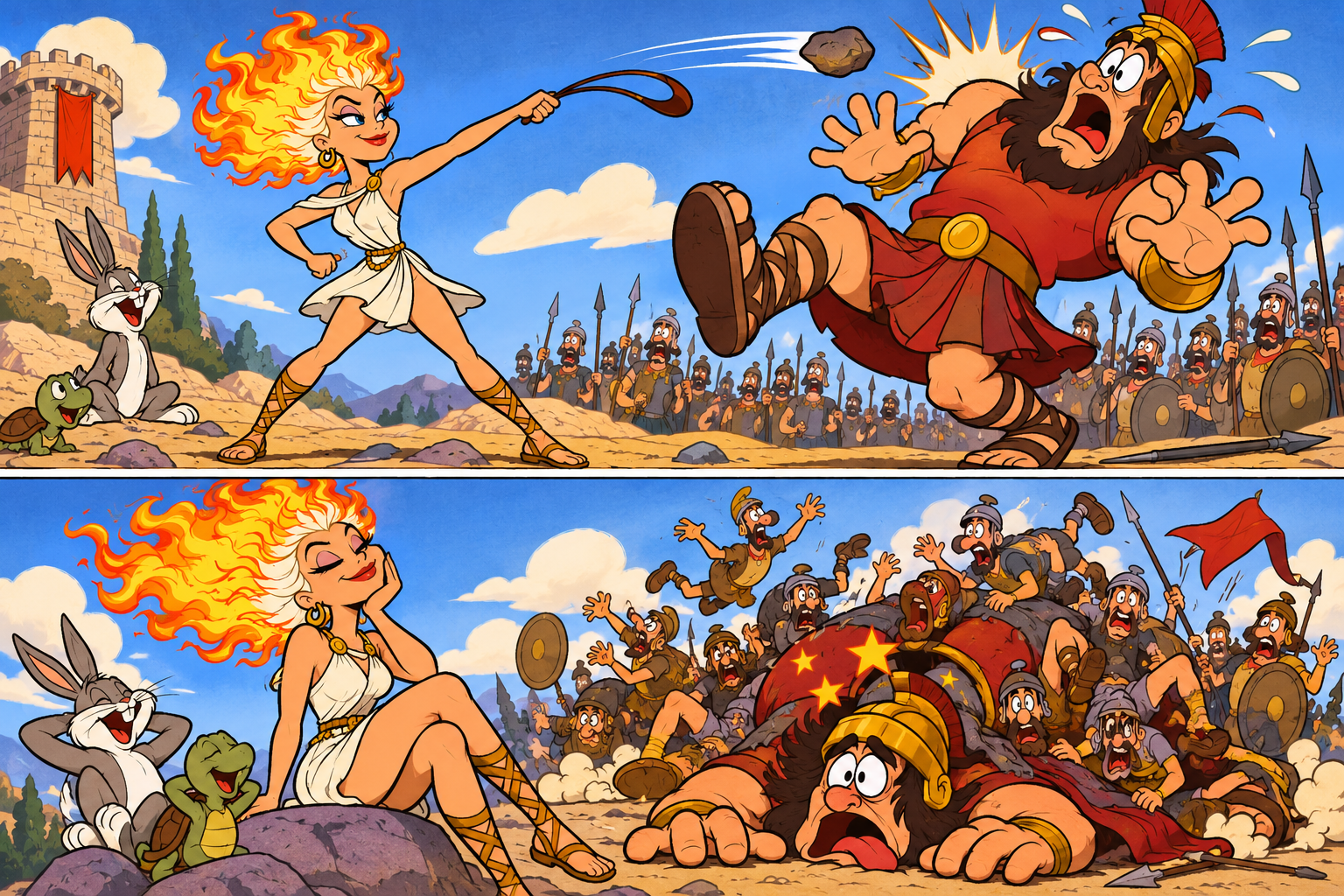
Let’s call this “Davidia and Goliath.” Just goes to show…never underestimate an underdog—lest you and your whole fucking army be taken down.
:D
Next Week
Monday — The Closed Loop: How Arrogance and Complacency Built Each Other a House
Arrogance and complacency didn’t move in together on purpose. It just sort of happened—the way these things do. One closed the door, the other stopped checking the windows, and before long they’d built each other a very nice house. Cozy. Self-contained. Remarkably good at keeping out drafts. This is a guided tour of the floor plan.
Thursday — PETTY TYRANTS: A FIELD GUIDE
Somewhere right now, a person in a reflective vest is counting your grocery items with her eyes before you’ve come to a full stop. Somewhere else, a man is doing 31mph in the left lane with the serenity of someone who has made peace with God and doesn’t check mirrors. These are not villains. These are petty tyrants—a remarkable and underappreciated species who discovered a small, legitimate pocket of power over other humans and decided to live there. This is their field guide. Study it. You’ll need it at the DMV.
Also Thursday — A Happy Thanksgiving Comic
Just wishing you all a Happy Thanksgiving—whether you celebrate or not.