Ontological Envy: The Aggression That Has No Ceiling
Working Thesis: Ontological envy is categorically distinct from ordinary social envy because it cannot be resolved by acquisition, achievement, or even destruction of its object — which is precisely what makes it so structurally dangerous to genuine originals, and so poorly understood by everyone who hasn't lived inside its blast radius.
I. The Taxonomy of Envy (Why Most Envy Is Boring and This Kind Isn't)
Ordinary envy has a ceiling. You want what someone has — their position, their beauty, their advantage — and the desire resolves in one of three ways: you acquire the thing, you sublimate the wanting into something else, or you exit the game entirely. The critical feature here is that the object is, in principle, obtainable. Which means the threat, however sharp in the moment, is ultimately containable.
Ontological envy is the specific mutation that occurs when the envied quality is constitutively unavailable to the envier. Not blocked by circumstance. Not solvable by more effort, better strategy, or favorable conditions. Structurally inaccessible by nature of what the envier is.
Genuine interiority cannot be acquired by proximity, imitation, or theft. The surface features can be reproduced — the mannerisms, the vocabulary, the aesthetic signatures — but the thing itself cannot. This is the envy that cannot be resolved, only metabolized. And the primary metabolism available to the envier is elimination.
Let me be clear from the start: we are not talking about jealousy, competition, or wounded ego. We are talking about a structural condition with no natural terminus. One that doesn't resolve. One that escalates. One that harms.
II. What Genuine Interiority Actually Threatens (And Why Its Mere Existence Is Intolerable)
The pneumatic original is not threatening because of anything she does. She is threatening because of what she is.
What she is demonstrates the existence of a thing the envier cannot access. Every act of genuine creation is a piece of evidence. Evidence of an impossibility — not a personal failing, not a skill gap, but a structural distinction the envier experiences as indictment rather than inspiration.
Here is where it becomes exquisite: visibility itself functions as aggression. Not attack. Not competition. Just existence and output. For someone constituted by external validation, her presence implies their absence. Her production implies their performance. She need do nothing hostile. She need only continue.
The original's work carries a texture the envier cannot replicate and cannot explain away. This is what makes it intolerable rather than merely annoying. There is something in the grain of it — some ineffable signature of having come from somewhere — that resists all forms of capture. The envier can study it, mimic it, reverse-engineer the components, but the thing that makes it real remains inaccessible.
The more undeniable the interiority, the more urgent the need to discredit it. Because if it cannot be denied, and it cannot be acquired, the only remaining option is to destroy the evidence that it exists at all.
III. The Escalation Problem (Why It Has No Logical Terminus)
Ordinary professional jealousy plateaus. The competitor acquires what they wanted, loses interest, or finds another target. The drama resolves because the object of desire was, at base, achievable — or at least bounded.
Ontological envy escalates because there is no satisfiable acquisition at the end of the road.
Each attempt to suppress, discredit, or eliminate the evidence fails on its own terms. You see, the pneumatic's interiority is not located in her reputation, her platform, her institutional standing, or her social legibility. Destroying those things does not destroy the thing that was intolerable in the first place. So the campaign continues — and reaches for new levers.
The shape of escalation moves like this: professional obstruction, then social contamination (reputation seeding, coordinated narrative), then coordinated discrediting across institutional or social networks, then pathologizing the target — reframing her accuracy as instability, her clarity as paranoia, her refusal to participate as proof of unfitness.
Here's the exquisite part: the escalating pattern is almost always misread by observers as evidence that the target generates conflict. The original's mere presence at each flashpoint "proves" she is the problem. The aggressor's coordination is invisible; the target's responses are visible. The script writes itself.
And there is no point at which the campaign declares victory and stands down. The goal itself is unachievable. Which means the aggression has no natural ceiling — only the limits imposed by available resources, institutional tolerance, or the target's removal from the field entirely.
IV. The Category Contamination Collateral (The Damage That Outlasts the Campaign)
Now we arrive at the part that doesn't require ongoing malice to function. Even when the direct campaign exhausts itself — when the envier moves on, loses resources, or simply tires — the structural damage persists independently.
The mimic reproduces surface features of pneumatic interiority at scale and for legibility. And in doing so, rewrites the cultural definition of authentic depth. This is not a side effect. This is how the game is won even after the original aggressor has left the field.
The original becomes illegible against her own copies. Work coming from genuine interior pressure reads as wrong by a standard now calibrated to performance. Too strange. Too unperformed. Too unwilling to signal its own seriousness in approved ways. The vocabulary is recognizable, but the grain is off. She fails to match the template that was lifted from her in the first place.
Here's where it gets truly insidious: the long-game damage is not that the original is destroyed. It's that the category she belongs to has been colonized by mimicry so thoroughly that genuine instances now appear eccentric against their own impostors. The copy sets the standard. The original fails the copy's test.
And this operates without any ongoing malicious intent. The infrastructure of mimicry sustains the damage autonomously. No one needs to keep targeting her. The cultural template does the work now. She has been rendered illegible by her own echo — and the echo, because it performs legibility better, is what the culture recognizes as real.
V. Why the Most Calibrated Instruments Are the Most Targeted
The faculty for distinguishing authentic from performed interiority is precisely what the ontologically envious are constituted to attack. Not incidentally. Not as collateral damage. As the primary target.
Its accuracy is an existential threat to their operating conditions. The instrument sees through the performance at the level of texture, not content — it registers the grain, the provenance, the unmistakable signature of something sourced versus something assembled. No amount of polish defeats it. Which means the instrument itself must be discredited.
The attack vector is never the instrument's conclusions. It's the instrument's credibility. The goal is not to pass the test — the goal is to convince the instrument-holder that the instrument is broken. Paranoia. Hypersensitivity. Unresolved damage. Persecution complex. The readings are reframed as symptoms rather than data. You're not seeing clearly; you're projecting. You're not registering threat; you're manufacturing it.
Here's the inversion that most people miss: the more accurately calibrated the instrument, the more sustained the campaign to dismantle it. People with the best discernment are not protected by their discernment. They are targeted because of it.
Discernment, in this context, is not a defensive asset. It is the provocation. The person who can see what you are is the person whose credibility must be destroyed before she can say it aloud. And if she does say it aloud — well, we've already planted the frame. She sounds unhinged, doesn't she? Far too certain. Clearly damaged by something.
The instrument was right. That's why it had to be broken.
VI. The Only Viable Response (Which Is Not a Defense)
Defense against ontological envy is a category error.
You cannot resolve someone else's unresolvable envy by moderating your visibility. Softening output, making interiority less legible, performing humility or accessibility — these do not appease. They simply reduce the signal without neutralizing the threat. Worse: conceding visibility concedes the mimic's implicit claim that the original's existence is the problem. That if you were just a little less you, the aggression would stop.
It won't. Because the aggression was never about what you did. It was about what you are.
The only thing that moderates ontological envy is also the only thing that enrages it: continued existence and continued production.
The record is the response. Not as revenge — revenge requires ongoing investment in consequence, in watching them burn, in needing them to know you won. But as the one thing constitutively unavailable to the ontologically envious: a document that cannot be mimicked because it was made from something they don't have.
There are two postures available here. The defensive posture concedes the frame, shrinks the original, buys temporary peace at permanent cost. It treats the aggression as something reasonable people negotiate their way out of. The generative posture simply proceeds — which is, in fact, the most devastating thing possible. And knows it.
The work continues. The record accumulates. The coal burns where it was always going to burn.
You don't win by proving them wrong. You win by making something they can see but cannot touch — and then you keep making it.
Still building into the void
— Majeye

What if you know you’re in a glasshouse, but everyone else wants to throw stones and you don’t?
The answer is: just keep building.
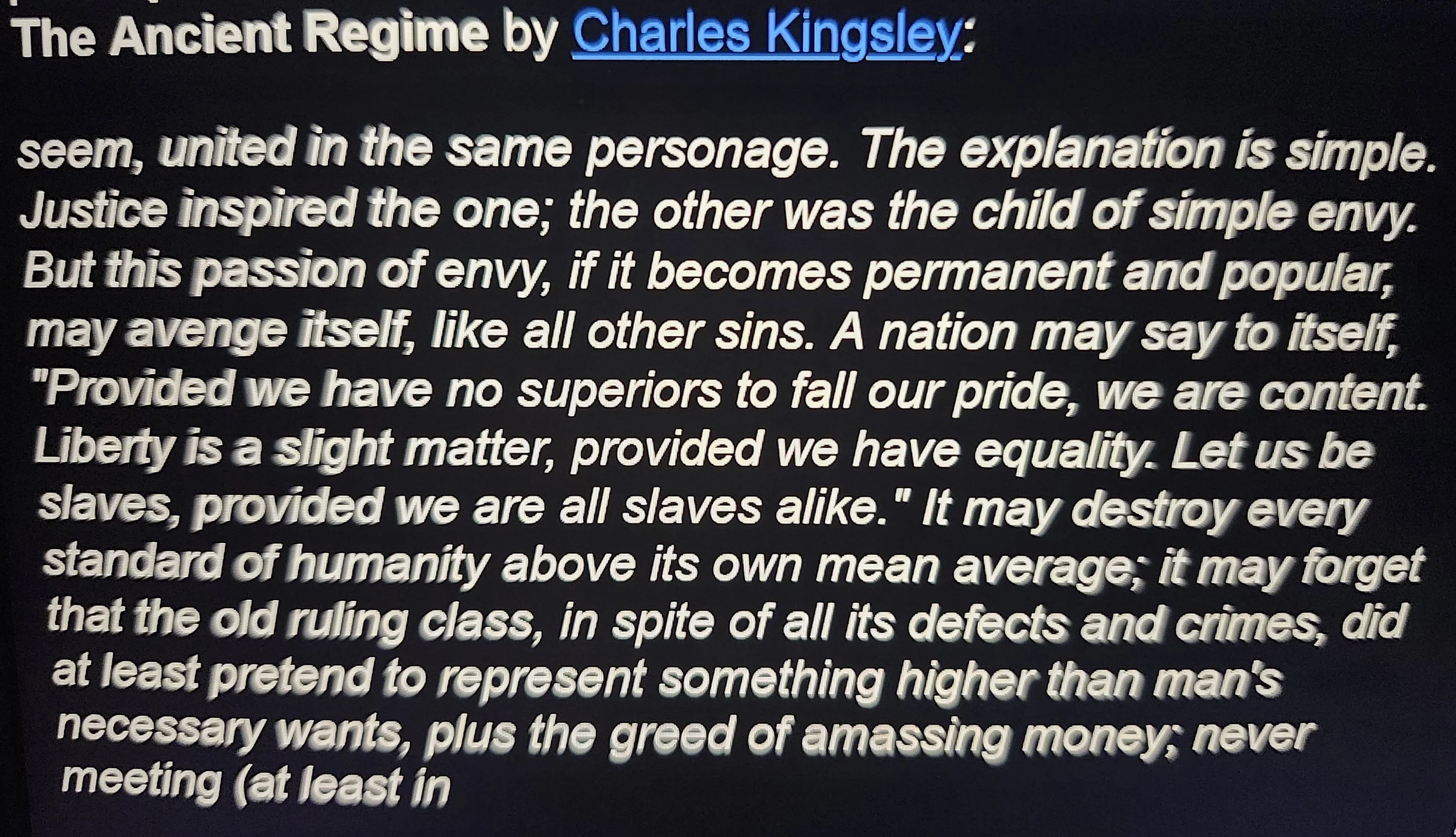
The flattening that has the potential to lead to the destruction of the species, IMO. Still betting on the cyclical nature of things to swing the other way. But alas, as I’m in my early 40’s, probably not in my lifetime.