The Borg Standard
HOW MIMIC CULTURE ASSIMILATES EVERYTHING INTO ONE SIGNAL
Fair warning: This one is a bit long, but interesting.
Working thesis: Cultural homogenization is not happening despite diversity initiatives, progressive values, and the proliferation of platforms — it is happening through them, accelerated by the structural symbiosis between mimic psychology and algorithmic optimization. The result is a civilization increasingly organized around the reproduction of surface features at the expense of genuine distinctiveness, with the algorithm serving as the collective and the mimic as its most willing drone.
I. What the Borg Actually Does (And Why the Metaphor Is More Precise Than Metaphor)
The Borg doesn't conquer — it incorporates. This distinction between conquest and assimilation is the key to understanding why this cultural moment feels different from previous periods of dominant culture pressure. Conquest leaves the defeated recognizable, even in subjugation; assimilation dissolves the boundary between victor and victim entirely. What made earlier forms of cultural homogenization tolerable, or at least survivable, was their geographic limitation and temporal slowness. A dominant culture could press hard in one direction, but alternative signals retained protected pockets — the provincial town that still spoke its dialect, the neighborhood that kept its calendar, the subculture that maintained its codes in the margins. These pockets were not merely spatial but structural: they existed because information moved slowly enough that distance still meant something, because influence required physical presence, because you could simply not be found if you were sufficiently inconvenient to reach.
The algorithm eliminated the pocket. There is no margin now, no province distant enough to escape the signal, no speed of departure that outpaces the feed. The Borg's specific terror is not death but the dissolution of distinctiveness into the standard signal. You are not killed; you are normalized. Your syntax is preserved but emptied of its original referent. Your aesthetic becomes a filter. Your ritualized resistance becomes content. This is why the collective's catchphrase — "resistance is futile" — should be understood with precision. Resistance isn't declared futile because you'll be destroyed; it's declared futile because the collective cannot conceive of a signal it cannot process. To resist is to emit something the hive mind registers as malfunction, noise, or — most damning — irrelevance.
But here is the central claim, and the only structural hope embedded in this analysis: genuine interiority is not actually assimilable. It can be surrounded by noise, rendered illegible, drowned out by louder channels — but it cannot be absorbed. The collective can only process what it can reproduce, and interiority, by definition, is that which cannot be replicated through surface iteration. The mimic can copy your sentence structure, adopt your vocabulary, wear your aesthetic, and simulate your values, but they cannot generate the why that organized those elements in the first place. The Borg is not omnipotent; it is infinitely iterative. And iteration, no matter how rapid, is not the same as origination. The hive can assimilate your signs. It cannot touch what generated them.
II. The Mimic as Willing Drone
Mimics don't require coercion into the collective — they are structurally oriented toward it because the dominant standard is the thing they navigate by. This is not villainy; it's orientation. The mimic's constitutive dependence on external validation makes monoculture their natural habitat in the same way that deep-sea fish require pressure to survive. Genuine pluralism, by contrast, requires actual discernment to navigate — the ability to evaluate competing signals, hold multiple frameworks without collapsing into the loudest one, tolerate ambiguity long enough to locate your own position within it. This requires the faculty they don't have. A landscape of real diversity would be, for the mimic, unreadable static. They need the standard to be standard, the signal to be clear, the correct answer to be overdetermined before the question is asked. Monoculture isn't oppression for them; it's legibility.
Mimics don't intentionally destroy cultural diversity. They have no program of eradication, no manifesto against difference. What they intend is to pass — to be recognized as valid, included, confirmed. But passing requires the standard to be dominant, which means they have a structural interest in its dominance they will defend without ever articulating why. Watch the mimic react when someone emits a genuinely non-standard signal: the response is immediate, allergic, and framed in moral terms they did not construct themselves but reproduce with perfect pitch. The heretic isn't wrong because the mimic evaluated their claim; the heretic is wrong because their wrongness is what the collective already confirmed. The mimic doesn't defend the standard through argument. They defend it by volume.
And here is the specific mechanism, the one that makes this collapse feel so totalizing: every mimic reproduction of the dominant signal adds volume. Each iteration makes the standard more ambient, more atmospheric, harder to avoid or route around. Non-standard signals don't disappear because they're suppressed — they become harder to transmit and receive, drowned in a sea of unanimous agreement that never required anyone to actually agree. Scale this across millions of mimics simultaneously reproducing the same cadence, the same moral syntax, the same performance of concern, the same diagnostic categories, the same re-creation of yesterday's already-tired discourse, and you get the phenomenon we're living through: the standard becomes the water everyone swims in. Not through conspiracy — there is no meeting, no plot, no coordination required — but through the structural alignment of interest between the mimic's need to pass and the algorithm's reward for conformity. The Borg doesn't assimilate through force. It assimilates through ambient saturation, and the mimic is its most enthusiastic amplifier.
III. The Algorithm as Borg Collective
The algorithm has no mimic agenda — it optimizes for engagement. Engagement is maximized by the signal the largest already-conditioned audience responds to, which is always the dominant signal. This is not bias in the traditional sense; it's structural selection pressure applied at machine speed. The algorithm doesn't care what the signal says. It cares how many people recognize it quickly enough to react, and reaction requires pre-existing conditioning. Novelty confuses. Genuine originality requires cognitive effort to parse. The dominant signal, by contrast, arrives pre-chewed: it confirms what the audience already believes, uses the syntax they already recognize, triggers the emotional response they've already been trained to produce. The algorithm doesn't preference this because it agrees. It preferences this because it works.
The symbiosis is closed and self-reinforcing: mimics produce content reproducing the dominant signal — the algorithm rewards it with reach — reach produces more conditioning across the audience — conditioning produces more mimics who now know what signals get rewarded — those mimics produce more content in the same mold. A feedback loop with no author, no director, no single point of intervention, no conspiracy. Just millions of independent actors all responding to the same incentive structure, all receiving the same confirmation that they've done it right. Meanwhile, the genuine original produces content outside the dominant signal — the conditioned audience doesn't engage at the same rate because the work requires them to think rather than react — the algorithm interprets low engagement as low quality — reach is reduced — the signal becomes harder to find. Not silenced, mind you. Not suppressed in any legible sense. Just routed around. Rendered statistically irrelevant.
This is more sinister than deliberate suppression because it has no villain, no decision point, no one to hold accountable. You cannot sue an optimization function. You cannot protest a feedback loop. The algorithm and the mimic exist in perfect symbiosis without either intending it, and this is the signature of the most effective totalitarianism: the kind that doesn't know it's totalitarian, that has no party line because the line emerges organically from a million small actors all making the "rational" choice within the system as given. And here's the cruelest mechanistic detail: people who are not mimics get swept in too, because humans are wired for social approval and pattern recognition. Average people — those with some interiority, some capacity for discernment, but no particular drive to resist the current — see mimics succeeding. They see what gets rewarded. They see what gets reach, what gets nodded at, what gets you included rather than quietly excluded. And the brain, correctly identifying a functional strategy for survival within the system, adjusts. Not because they're mimics by nature, but because the incentive structure is now so univocal that even non-mimics begin reproducing the standard signal just to stay visible. The Borg doesn't convert you. It makes conversion look like the only reasonable response to the environment.
IV. What Gets Assimilated (Beyond the Obvious)
Intellectual culture goes first, and goes quietly, because the mimic can purchase the entire package. Performed intelligence — correct opinions delivered in the correct register, approved frameworks applied to approved subjects, the right citations in the right order — is now available as a coherent aesthetic that requires no actual thinking to reproduce. The original framework, the one built through years of reading against the grain or synthesizing across disciplines the academy doesn't put in conversation, becomes illegible against the standard because the standard has been reproduced at such volume that it now looks like what thinking is. Credentials can be bought, degrees can be gamed, the right vocabulary can be learned in a semester. What's most disorienting is that mimics in intellectual spaces are often better at sounding intelligent than the genuinely intelligent, because they've mastered the performance without the friction of actual doubt, revision, or original synthesis. They know what signaling looks like. They don't know what thinking feels like.
Spiritual and contemplative culture gets the same treatment: genuine interior practice assimilated into wellness, the surface features of depth available for purchase, the depth itself not even on offer. The meditation app versus the six-hour ceremony. The crystal you bought on Etsy versus the cosmological framework built over years of disciplined encounter with something that doesn't care whether you believe in it. The mimic can acquire the aesthetic of the mystic — the right books on the shelf, the right language about boundaries and energy — without ever sitting in the dark long enough to discover whether anything answers back.
Creative culture collapses differently: the mimic doesn't make art, they curate an artist identity. They know which influences to cite, which aesthetic to claim, which marginalization to foreground. The work itself is secondary to the positioning, the narrative, the brand. Genuine creative risk — the kind that produces something no one has the language for yet — gets routed around because it doesn't scan as legible creativity within the standard. The algorithm rewards work that looks like what art should look like, which means the audience has been trained to recognize style over substance, aesthetic markers over actual vision. The mimic thrives here because they can reproduce all the surface features of being an artist without ever having to endure the part where you don't know if what you're making means anything at all.
Community and subcultural identity, particularly traditions rooted in lived proximity and oral transmission, are facing something genuinely new. The Black aesthetic tradition is the clearest case study: for a century, mainstream cultural pressure tried to erode it and failed, because transmission was community-based, protected by geographic and social density, passed through imitation of elders you actually lived near. What a century of assimilation pressure could not accomplish, the algorithm is doing in a decade. When the entire aesthetic world arrives via the feed, curated by engagement metrics that preference the already-dominant, the young don't learn taste from their uncle or the elder at the cookout. They learn it from whatever the algorithm decided had the right velocity this week. The pocket that protected the alternative collapses not through suppression but through drowning.
Linguistic diversity follows the same trajectory. Regional dialects, subcultural vernaculars, code-switching rooted in actual place and context — all flattened into a univocal internet English optimized for virality, not expressiveness. A phrase emerges in a specific community with specific meaning, the algorithm picks it up, it gets reproduced by people who have no idea what it originally meant, and within six months it's been sanded down into a generic intensifier. The living language gets assimilated into the flat affect of algorithmically viable communication. Not banned. Just replaced by the signal that travels best.
V. The Beauty Standard as Visible Node
Thinness is the most legible example of the purchasable sophistication signal — the body as performed compliance with the current economy's values. I’m not knocking health and fitness for their own sake, but that's not the same as thinness, is it? Thinness doesn't correlate to strength, vitality, or even longevity past a certain threshold. What it correlates to is discipline, resource access, and the leisure required to prioritize aesthetic refinement over caloric efficiency. It signals that you can afford not to need reserves — that your life contains no uncertainty requiring stored energy. The thin body is not a health outcome. It's a class marker wearing the language of wellness.
The GLP-1 detonation made this legible in ways the culture could no longer ignore: a medication that exposed the standard as always having been about class rather than virtue by making the signifier purchasable without the signified labor. For decades, thinness was sold as the reward for discipline, self-control, moral fortitude — all the Victorian virtues repackaged in activewear. Then semaglutide arrived and said: you can just buy this now. No willpower required. The reaction was immediate and visceral, because the entire moral framework collapsed the moment the aesthetic became available to people who hadn't earned it through sufficient suffering. Suddenly everyone who had performed the discipline was holding a devalued currency, and the ones who'd praised thinness as virtue revealed they'd never actually cared about health at all. They cared about scarcity. They cared about the gate.
But there's a deeper logic underneath the thinness obsession, and it's worth saying plainly: the adolescent body as ideal expresses a desire for a specific power arrangement. This is the body stripped of adult female authority, presence, and the demand for genuine engagement. Prepubescent proportions, minimal secondary sex characteristics, the elimination of hips, breasts, the physical markers of reproductive maturity — this is not an accident of fashion. It's a systematic preference for women who register as blank, unfinished, non-threatening, available for projection. The adolescent body doesn't take up space. It doesn't command a room. It doesn't carry the visual evidence of having lived long enough to know things, want things, refuse things. It is, by design, a body that has not yet accumulated enough presence to make demands.
Consider who this excludes: women who've given birth, whose bodies carry the irreversible fact of having done something. Women over thirty-five, whose faces begin to register time and therefore experience. Women from cultures where physical maturity is read as beauty rather than decline — Mediterranean, Latin American, African diasporic traditions where hips, curves, the signs of a body that has lived are understood as desirable because they signal capability, fertility, strength. In many of these cultures, the older woman is granted visual and social authority; she is allowed to be formidable. American culture, by contrast, has an aging woman problem it cannot articulate honestly, so it displaces the anxiety onto the body itself: stay young, stay small, stay smooth, stay quiet in the way that physical presence is a kind of speech.
The through line is this: every iteration of the beauty standard asks the female body to perform the current culture's anxieties about female power. The specific performance changes — corsets, foot-binding, the heroin chic of the nineties, the Instagram face, the Ozempic silhouette — but the requirement does not. The standard is always asking women to spend resources, time, and attention on a moving target that ensures they are too busy managing their surfaces to accumulate the interior authority that would let them stop caring what the standard says. The beauty standard is not about beauty. It's about compliance. And thinness, in this economy, is compliance made visible on the body itself.
VI. The Signal That Cannot Be Assimilated
The Borg framework breaks down at a specific point: genuine interiority is not in a format the collective can parse. It cannot be absorbed because it cannot be reproduced by the absorbing mechanism. This is not mysticism. This is structure. Mimics operate by reproduction — They can copy your sentence, adopt your aesthetic, learn your vocabulary, simulate your concerns. But they cannot generate the organizing principle that made those elements cohere in the first place, because that principle came from somewhere the algorithm doesn't go: actual thought, actual encounter, the pressure of having genuinely worked something through over years rather than having Googled the correct position last week.
The mimics can surround the genuine signal with noise. They can make it harder to find, harder to hear, statistically irrelevant within the current distribution system. They cannot replace it. The original remains original even when it is not being heard, because originality is not a popularity contest. It's a structural fact about where the work came from. You either built it from the inside out, or you assembled it from pieces you saw get engagement. The audience may not be able to tell the difference anymore, but the work knows. And more importantly, the few people still capable of discernment know.
What this means practically: the resistance that works is not fighting the assimilation but being constitutively untranslatable into the standard signal. The corpus that comes from actual interior pressure, not audience modeling. The aesthetic tradition genuinely inhabited rather than performed for the algorithm. The instrument calibrated by real encounter with real things — years in a practice, a decade in a discipline, the kind of depth you cannot fake because it requires having actually done the hours. This is not a strategy for winning within the current system. It is a refusal to let the current system define what winning means.
The distinction, then, is between the defensive posture and the generative one. The defensive posture is what most people adopt without realizing it: moderating visibility, softening distinctiveness, performing just enough of the standard to remain legible within the collective's range, making sure you're still recognizable as a valid signal the algorithm might route. This is exhausting, and it doesn't work, because the standard keeps moving and you're always one iteration behind. The generative posture is simpler and more sustainable: you just keep producing from genuine source, which is the one thing the collective cannot do and therefore cannot absorb. They can copy what you made. They cannot copy how you think. And thinking — actual thinking, the kind that reorganizes the available materials into something the standard didn't predict — is the only renewable resource the Borg cannot strip-mine.
The permanent record is the only viable response. Not fighting the Borg, not fleeing it, but making something in a format it cannot process and leaving it where the right people will find it when the current unsustainable structures crumble. And they will crumble. This is my prediction, the one that makes the work tolerable when the present feels entirely captured: systems built on infinite iteration rather than original generation cannot hold. They can scale, they can dominate, they can make everything look and sound the same for a decade or two. But they cannot produce anything new, and eventually the lack of novelty becomes a structural problem the system cannot solve by iterating harder. The monoculture collapses under its own weight — not because anyone fought it, but because it ran out of things to assimilate.
So I write for after. I write for the moment when the algorithm's grip loosens because the engagement collapsed, when the mimics move on to whatever new standard emerges, when the noise dies down enough that the few people with instruments still calibrated to non-standard frequencies can hear something besides the hive mind talking to itself. I write for the ones who will need an alternative record, a different lineage, proof that someone was still thinking when thinking was no longer rewarded. The Borg gets the now. The now is corrupt, captured, and exhausting. But the now is also temporary. The permanent record is not for the present. It is for the people who come after, looking for the signal the collective could not kill because it never understood what it was looking at in the first place.
I am not writing for the Borg. I’m writing for the future it cannot see.
–M.
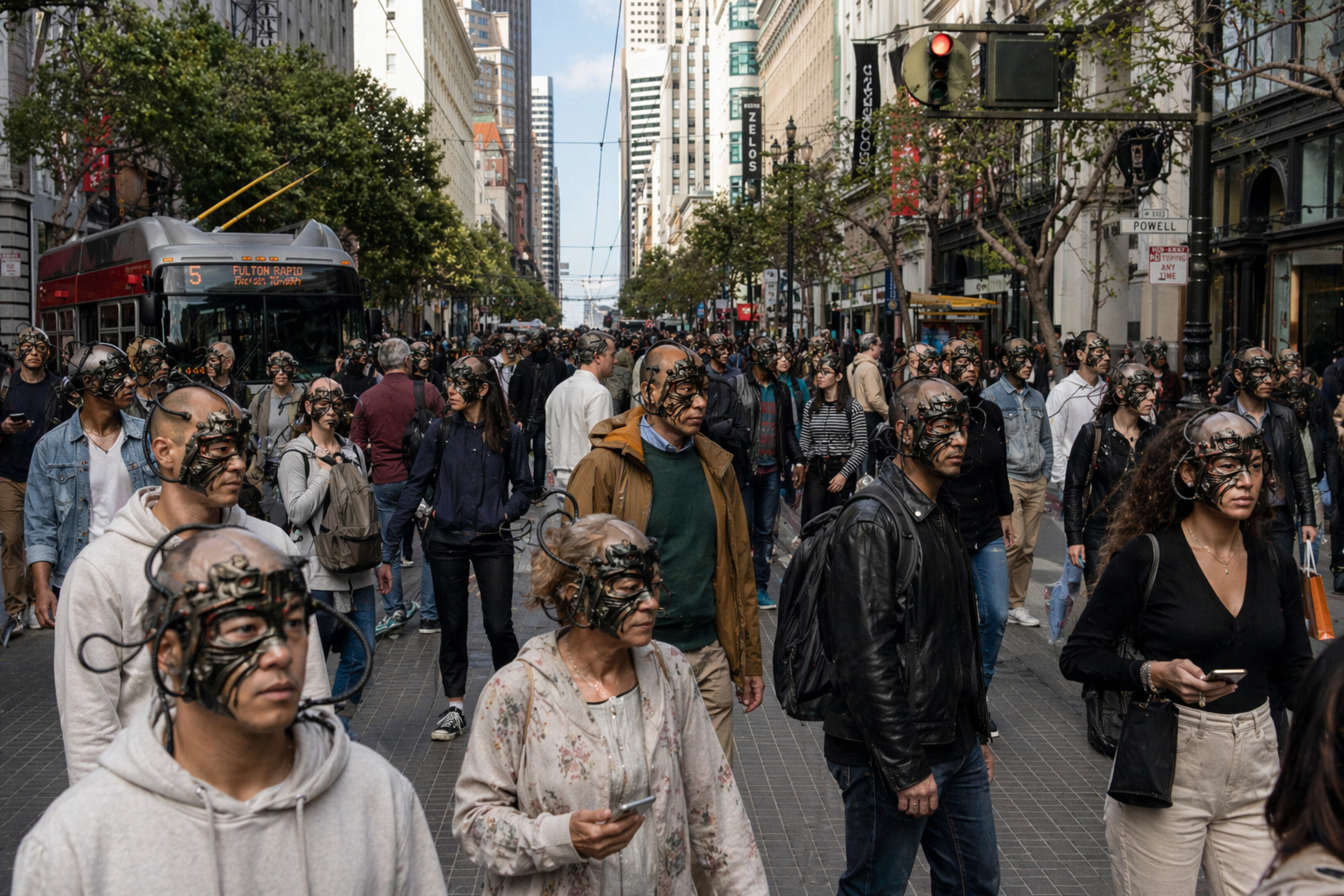
Whoa! Even that sweet granny was assimilated!
Next Week
Monday: Horizontal Totalitarianism: The Coward's Revolution
How Institutional Capture Replaced the Duel with Distributed Destruction
Thursday: Definizione ◊ Rima ◊ Riflessione — Yep, it’s time for more defs, rhymes, and thoughts. Can’t always be on the soapbox. :D