The Con of Legitimacy: or, Who Told You You were Allowed to Have an Opinion
QUICK NOTE FOR READERS: I had to update the URL, so it may be sent twice… Thanks for understanding.
I. The Mechanism
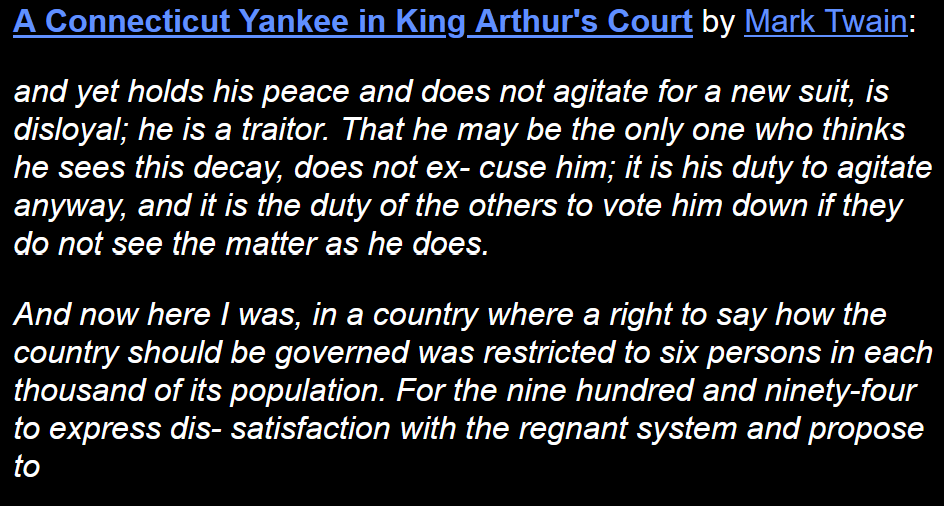
Twain's doing something sneaky in that passage, and it's worth slowing down to catch it. He's not just making a point about monarchy. He's describing a technology — legitimacy — and how it works on the people it's designed to exclude. Six people in every thousand get to have an opinion that counts. The other nine hundred and ninety-four? They're not wrong, exactly. They're just not authorized.
That's the con. And it's a good one, because it doesn't announce itself as a con. It arrives dressed as common sense — as the natural order of things, as simple logic: of course you'd want qualified people making decisions. Of course expertise matters. Nobody's stopping you from getting credentialed. The door's right there. You can see it from here.
What the con obscures is the difference between being right and being permitted to be right. These are not the same thing, and the entire architecture of epistemic gatekeeping depends on you never noticing that. Credentialing systems — academic, institutional, professional — do something very specific: they launder consensus as expertise. They take the views that already dominate inside a given system, formalize the process of inducting people into those views, and then present the result as rigorously vetted knowledge. The credential doesn't certify that you've thought clearly. It certifies that you've thought correctly — which is to say, in alignment with the people who designed the certification.
This is why the six-per-thousand math isn't an accident. It isn't a flaw in the system — it's the system working. A broad distribution of recognized epistemic authority would be genuinely destabilizing to entrenched consensus. Keep the number small, keep the barrier high, and you don't have to argue with the nine hundred and ninety-four. You just have to remind them, gently, that they're not really qualified to be having this conversation.
II. The Traitor Clause
Here's where Twain gets genuinely radical, and I want to make sure you don't miss it. He doesn't say the person who holds their peace is mistaken. He doesn't say they're cowardly. He says they're a traitor. That's a specific word doing specific work. Treason isn't a private failing — it's a betrayal of something larger than yourself. Twain is insisting that what you don't say, when you see clearly and stay quiet, is a political act. Silence isn't neutral. Silence is a vote.
The social pressure to hold your peace almost never calls itself what it is. It comes dressed as wisdom — pick your battles, you don't have the full picture, who are you to say? It comes dressed as humility, which is especially vicious because humility is a virtue, and this thing wearing its clothes is the opposite of a virtue. It's capitulation with good posture. The system has learned that it can't always win on the merits, so it wins on the optics: the person who speaks without authorization looks arrogant. The person who stays quiet looks thoughtful. We've been trained to read self-silencing as a sign of intellectual seriousness, when it's often just intellectual surrender with better branding.
And the system prefers this. A quiet wrong is enormously more useful to entrenched power than a loud right. A quiet wrong holds its shape. It doesn't generate friction, doesn't invite scrutiny, doesn't require anyone to defend the indefensible out in the open. The loud right is dangerous precisely because it forces a confrontation — and confrontations, even losing ones, have a way of exposing things that weren't supposed to be visible. This is why the response to unauthorized speech is almost never direct engagement. It's delegitimization. It's who gave you a platform. It's what are your credentials. The goal is to move the argument away from what was actually said and back toward whether the speaker had the right to say it.
What gets lost in all this — what the individual cost-benefit analysis of self-silencing consistently underweights — is the civilizational tab. Every person who sees clearly and decides it's not worth it is a node of genuine perception that goes dark. The system doesn't just win that argument. It removes that perspective from the record. It makes the consensus look more total than it is. And the crueler irony is that the nine-hundred-and-ninety-four who stay quiet are frequently, collectively, more right than the six who've been authorized to speak — they're just distributed, uncoordinated, and perfectly trained to doubt themselves.
III. What Institutional Knowledge Cannot Know
There's a kind of knowledge that doesn't footnote well. It doesn't have a methodology section. It wasn't produced under controlled conditions or reviewed by peers who operate in the same funding ecosystem. It lives in the body — in the hands that have done the work, in the eyes that have been in the room, in the gut that has learned to read a situation through years of uncompensated trial and error. Institutions are not equipped to evaluate this knowledge, which is convenient for them, because this knowledge is frequently where the most damaging observations about institutions originate.
The distinction that needs to be made here is between grant-funded proximity and actual immersion, because these are often confused — sometimes deliberately. Proximity means a researcher spent eighteen months in a community with a notebook and an IRB approval. Immersion means you live there, your people live there, and you're not going home at the end of the grant cycle. Proximity produces data. Immersion produces understanding. The credential belongs to proximity. The knowledge belongs to immersion. The fact that we've arranged things so the credential outranks the knowledge is not an epistemological conclusion — it's a political one.
And here's the thing about the machine's internal critics, the ones who do get to speak with institutional authority: they're almost always slightly fond of the machine. This isn't corruption, exactly — it's structural. You can't spend fifteen years inside a system, learning its language, earning its trust, building a career on its terms, and then turn around and see it with genuinely outside eyes. The most incisive critique that clears institutional publication will still be, at some level, a critique that leaves the institution's foundations intact. The machine can tolerate a lot of pressure on its walls. What it cannot tolerate is someone questioning the need for the building.
That's what trench epistemology is — and it is a credential, a real one, just not a transferable one. You can't put it on a CV. You can't cite it in a lit review. But it produces a specific kind of sight: the ability to see the machine as a machine, rather than as an ambient feature of reality. The people who carry this credential are often not the ones writing about the systems they understand most intimately — because writing about those systems in legitimate venues requires going through the gate, and the gate has opinions about what's allowed in. So the knowledge circulates differently: in conversations, in art, in the work of people who've stopped asking permission. Which means it's real, it's out there, and the official record of what's known is quietly, consistently incomplete.
IV. The Authorized Opinion and Its Tells
You can learn to spot it. Authorized opinion has a texture — smooth in a particular way, confident in a particular way, and wrong in a particular way that never quite resolves into being wrong enough to cost anyone anything. It has the cadence of a conclusion that was reached before the inquiry began, then reverse-engineered into the shape of rigor. It cites extensively. It hedges appropriately. It acknowledges complexity — always complexity, complexity is the authorized opinion's best friend — and then lands, after all that careful apparatus, exactly where the funding expected it to land.
The tell isn't always the conclusion. Sometimes the conclusion is fine, even correct. The tell is the untestedness — the sense that these ideas have never been pressure-tested against actual consequence, against a situation where being wrong would cost something real. Authorized opinion is produced inside environments specifically designed to insulate it from that kind of contact. Peer review doesn't test ideas against reality. It tests ideas against other ideas that emerged from the same environment, held by people who have roughly the same professional incentives and institutional loyalties. This is not nothing — internal consistency matters — but it is not what it advertises itself to be. It's a loyalty mechanism with a methodology costume on.
And the language is the tell within the tell. Watch what gets called anecdotal and what gets called complex. When someone outside the institution describes what they've seen with their own eyes, in granular and specific detail that no funded study would ever produce — that's anecdotal. Dismiss, move on. When an institutional program eats a billion dollars and produces outcomes indistinguishable from doing nothing — that's complex. The variables were difficult. More research is needed. The word complex in these contexts is doing custodial work: it's cleaning up after the authorized opinion so that the authorized opinion doesn't have to stand in what it made.
Outsider diagnoses and insider failures are not evaluated on the same scale, and they're not supposed to be. The insider failure gets a narrative — context, mitigating factors, the genuinely difficult conditions under which serious people tried their best. The outsider diagnosis gets a category: anecdote, lived experience, personal perspective. These are not neutral descriptors. They're a filing system. They tell you where to put something so you don't have to think about it — so it stays sorted, contained, and safely outside the zone where it might do damage to a consensus that's still load-bearing for people who matter.
V. The Duty to Agitate
Agitation is the honest word. We've softened it — we say provoke conversation, we say challenge assumptions, we say offer a different perspective — because agitation sounds like someone shaking something until it breaks, and that makes people uncomfortable, and making people uncomfortable is, as we've established, the first thing the authorized opinion moves to discredit. But Twain uses the word directly and means it directly: you see decay, you agitate. Not suggest. Not raise for consideration. You shake the thing. The discomfort is the point.
What Twain also understood — and this is the part people always want to skip past — is that agitation comes with no guarantee. The oracle's implicit deal is stark: see it clearly, say it publicly, accept the vote-down if it comes. The duty isn't to win. It's to speak. The authorized opinion has always controlled the vote count, which means the unauthorized speaker is almost always outvoted in the room where it matters — and almost always vindicated in the room that comes after. Posterity has a different credential system than the present tense. It doesn't care who funded the study. It cares who was right, and it has the luxury of waiting until that becomes legible.
This is why the unauthorized corpus matters in ways that exceed its immediate reception. The essays, the frameworks, the Lexicon — the work that gets produced outside the gate, without the grant, without the institutional affiliation, without the peer review and the methodology section — this work is the agitation itself. Not a record of the agitation. The thing. Every piece of writing that names what the authorized system cannot afford to name is a node in a counter-epistemology that doesn't announce itself as such, because counter-epistemologies that announce themselves get managed. They get a conference panel. They get a special issue. The machine is very good at making things legible enough to contain.
The move is to stay illegible to the machine while remaining perfectly legible to everyone the machine has never been able to see. That's the audience that was always there. That's the conversation that was always happening. And that's what it means — in Twain's sense, in the oldest sense — to do the work.
Agitate accordingly.
—M.
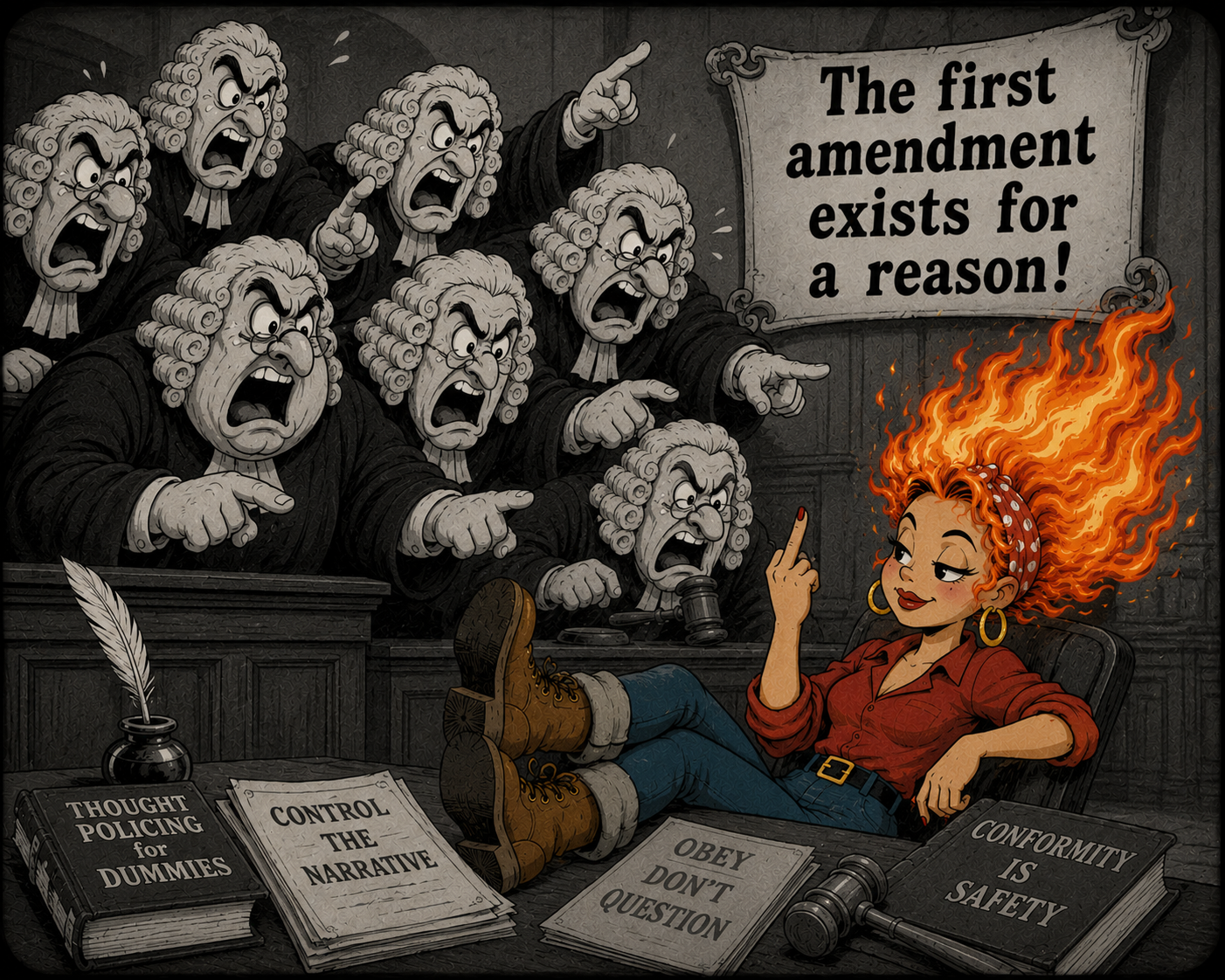
I’d rather be in color than be “safe” and grey in the herd.
A must-watch: Timothy Leary’s HOW TO OPERATE YOUR BRAIN
I have too many projects going right now, but one day I’d like to make something like Leary did. Self-programming mastery for the defiant soul!!! Dude knew what he was doing.
Next Week
Monday — “A Woman with Whose Name Slander Has Been Busy” — Balzac Knew
(On what they said about her, why they said it, and why the man who believed it ended up with a bullet in his head)
Balzac's deserted woman was slandered, exiled, and abandoned by a man who chose respectability over the real thing. This post breaks down the slander economy—who runs it, who benefits, and why certain people need you to stay broken. Personal, merciless, and ultimately about what it costs everyone when cowardice wins.
Thursday — The Ladder Is Imaginary (And You Can Get Off It)
Here's a question nobody asks out loud: what if above and below aren't real? What if the whole vertical axis—the rankings, the status games, the endless calculating of who's up and who's down—is something we projected onto the world rather than found in it? Because here's the thing: reality doesn't have a hierarchy baked in. It has difference, which is a much richer thing. And the people who've figured that out? They're steadier, warmer, more genuinely present than anyone still white-knuckling their way up a ladder that was never there. This one's about getting off it.