“A Woman with Whose Name Slander Has Been Busy” — Balzac Knew
On what they said about her, why they said it, and why the man who believed it ended up with a bullet in his head
Poor Gaston…
I. The Setup: Who She Was Before They Got to Her
Before they got to her, Madame de Beauséant was the kind of woman rooms reorganize themselves around. One of the great beauties of Parisian society. Elegant, formidable, the full package—the sort of person whose presence raises the temperature of whatever space she occupies and whose absence makes everyone quietly aware that something's missing.
Then she did the unforgivable thing… Not the affair—affairs were practically a social institution in 19th century Paris, conducted with discretion and mutual agreement and a great deal of looking the other way. No. What she did that crossed the line was refuse the performance. Her husband, we're told, was a well-bred man of the world who "would have listened to reason"—which is a very elegant way of saying he'd have let her keep a lover as long as everyone kept their mouths shut and the appearances stayed intact. That was the deal on offer. Stay in the arrangement, keep the facade, never embarrass anyone, and we'll all pretend this is a life.
She said no. She wanted the real thing. That's what they called madness.
Not the desire. Not even the love. The refusal to pretend. That's the crime that got her exiled to Normandy, behind high walls, seeing almost no one—not because she broke, but because she survived, and survival without performance looks like seclusion to people who can't imagine existing outside the audience.
I know this geometry. The details change but the shape doesn't. We’ve had a few “upgrades” since 1822. The internet has made campaigns like this a thousand times more vicious and a thousand times easier to run. Someone decides the story, seeds it in the right places, and watches it replicate. And people just believe it—as if information that travels fast and wide must have earned its speed somehow. What kind of idiot takes what's said online at face value? The kind who's never stopped to ask who's doing the telling and what they get out of it. We'll get to that.
The woman who refuses the bargain—play small and we'll tolerate you—ends up outside the walls. The people inside call it disgrace. What it actually is, once the dust settles and she's stopped performing for an audience that never deserved the show, is something considerably closer to freedom.
They just can't stand that part. ☠️
II. The Slander Economy: Who Benefits and Why
Cui bono? Who benefits? [ASK IT ABOUT ANYTHING AND EVERYTHING. It’s an excellent way to cut through bullshit.] Ask it every single time, without exception, about every story you didn't witness firsthand. About every reputation that arrived pre-damaged. About every whisper campaign, every character assassination, every "I heard she's difficult" and "you should probably know" and "I'm just saying this because I care about you." Who benefits from the story being told this way? Tattoo it on the inside of your eyelids if you have to. It's the only question that cuts through the noise every time.
Let's apply it to Madame.
The women of Normandy who collectively decided they wouldn't visit her—what did they get out of her exile? Status clarification, first of all. In a rigid social hierarchy, distance from the fallen is its own form of currency. But there's something uglier underneath that, something nobody wants to say out loud: the punishment of the woman who wanted more is a comfort to every woman who settled for less. If Madame de Beauséant gets to refuse the arrangement and survive with her dignity intact, what does that say about every woman who took the arrangement and called it a choice? Her existence is an implicit indictment. Her exile is the correction. The women who closed their doors to her weren't protecting their reputations. They were protecting their decisions.
The men who circulated the story of her "madness"—and make no mistake, they circulated it, it didn't travel on its own—what did they get? A cautionary tale with legs. A story that does ongoing maintenance work on every woman in their orbit, reminding her what happens when you refuse the bargain, when you make scenes, when you decide that what you actually want matters more than what the arrangement requires. The slander isn't just about Madame. It's a message to everyone listening. This is what becomes of women like that.
Ask this about your own life. Ask it about anyone you know who's had a whisper campaign run against them. Who needed the narrative to be that way? The answer is almost never abstract or ideological. It's almost always someone(s) with a very specific, very personal interest in keeping the target small, discredited, and outside the room. People don't run slander campaigns out of principle. They run them out of fear, jealousy, and self-interest dressed up in the language of concern.
Balzac gives us the tell right there in the passage—"a woman with whose name slander has, of course, been busy." That of course is doing everything. It's not surprise. It's not outrage. It's acknowledgment of a mechanism so predictable it doesn't even warrant elaboration. Of course slander was busy with her name. That's what slander does when a woman like that exists. It's a utility. It gets deployed by people who have something to gain from the deployment, and it runs—always, without exception—on self-interest dressed as moral concern.
So what qualities triggered it in her case? Beauty, yes. Intelligence, absolutely. The kind of presence that makes mediocrity visible just by existing in the same room—definitely. But the most fatal quality, the one they genuinely couldn't forgive, wasn't any of those. It was this: she didn't need their approval to know her own worth. She wasn't performing for the audience. She wasn't angling for the verdict. She made her choice and she lived in it and she didn't look back at them to see if they'd approved.
That's the original sin. Indifference to the verdict. Nothing makes a certain kind of person more dangerous than someone who simply doesn't require their opinion. Because if you don't need their approval, they can't control you with it. And if they can't control you with it, the only tool they have left is to poison the well—to make sure that anyone who might recognize your worth arrives pre-warned, pre-poisoned, carrying a version of you that was assembled by the people who needed you neutralized.
Which brings us to Gaston at the door. ☠️
III. The Danger of Arriving Pre-Poisoned: A Warning to Believers
Gaston de Nueil doesn't arrive at Madame de Beauséant's door as a blank slate. He arrives carrying luggage—specifically, a pre-assembled portrait of her that was built by people who weren't there, about events they understood only partially, filtered through a social apparatus that had already decided what the story meant before anyone bothered to check if it was true. He heard it in a drawing room. He consumed the product. And then he showed up at her gate, already “knowing” who she was, which is the most dangerous possible way to meet anyone.
Here's the part that should make you uncomfortable: he's drawn to her because of the notoriety. The scandal is the attraction. Which means he's not actually drawn to her—he's drawn to the story about her, the tragic figure, the fallen woman behind the high walls, the triple aureole of beauty, misfortune, and nobleness that Balzac says dazzled him. He's in love with the narrative before he's exchanged a single word with the person. That's not interest. That's consumption.
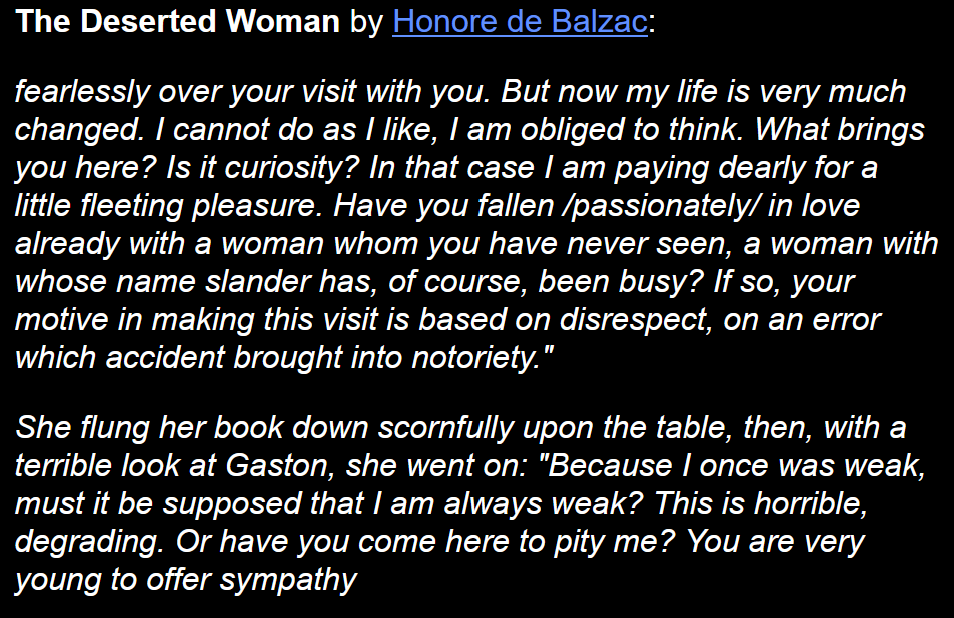
She clocks it immediately. Of course she does. She's had time to develop very precise instruments for exactly this kind of visitor. So she audits him at the door: "What brings you here? Is it curiosity? In that case I am paying dearly for a little fleeting pleasure." People read that line as coldness. It isn't. It's methodology. She's running the diagnostic that everyone in her life failed to run before they opened their mouths about her and let the slander out. She's asking, with surgical precision: what is the actual nature of this visit, and am I going to be made to pay for your entertainment?
She's not cold. She's a scientist working with contaminated samples, trying to figure out whether this particular variable can be trusted.
Here's what nobody tells you about believing slander: you don't just wrong the target. That's bad enough, but it's not the whole damage. You corrupt your own perception. Permanently. You arrive at a real person having already decided what they are, which means genuine encounter is impossible before you've even knocked. You can't see them as they are—you can only move through the interaction confirming or denying the story you were handed. Every moment of warmth gets filtered through "but I heard..." Every complexity gets flattened back into the pre-existing narrative. You've made yourself epistemically useless as a witness to who this person actually is, and you did it voluntarily, by accepting information you had no business accepting from sources you had no business trusting.
And the people who handed you that story? Let's be very clear about what they were doing. They weren't informing you. They weren't looking out for you. They were inoculating you—making sure that even if you somehow found your way to her, even if something in you recognized the fraudulent image of her they promoted and you pushed through it, you'd arrive filtered, hesitant, half-convinced she was a liability. They were installing a governor on your perception before you even knew you needed one. That's not gossip. That's a precision operation.
Madame names it with the kind of calm that only comes from having thought about something for a very long time: "Your motive in making this visit is based on disrespect, on an error which accident brought into notoriety." The error isn't his in origin—he didn't manufacture the slander, he just believed it—but he's carrying it, and that makes it his problem now. He walked through her door pre-poisoned, and she can smell it, and she's telling him exactly what he's holding before he gets any further into her house or her life.
I think about this every time someone comes to me thinking they already know something about me that they learned from someone else, or from the internet—of all places. The questions I ask now—the only questions that matter—are who built this version of me that you're currently holding, and what did they need it to say? Because I already know the answer is never neutral. It's never just information. It's always architecture. Someone built it, for a reason, and handed it to you like a gift, and what they actually gave you was a pair of glasses ground to their prescription.
Wear someone else's prescription long enough and you'll forget your vision was ever your own. ☠️
IV. The Keepers of the Down: Why Certain People Must Stay Broken
Here's the secret nobody announces out loud: some people's rise is genuinely threatening to others' self-concept. Not threatening in a competitive sense—not she's better than me at something and that stings. Threatening in an existential sense. Threatening at the level of the whole story they've constructed about why things are the way they are and who deserved what they got.
Because if she recovers—if she builds, if she's seen to be fine, better than fine, if she walks back into the light with her dignity not just intact but expanded—then the punishment didn't work. And if the punishment didn't work, then everyone who administered it, everyone who watched it administered and said nothing, everyone who whispered the story along and called it honesty, is suddenly implicated. Not just wrong. Implicated. There's a difference. Wrong means you made a mistake. Implicated means you participated in something, and the evidence is now standing in front of everyone looking undeniably alive.
The slanderers don't need her to stay down for justice. Justice was never the point and everyone involved knew it. They need her to stay down for math. For the arithmetic of their own self-esteem, which was always built partly on the foundation of her being beneath them. You remove that foundation and you've got a structural problem.
She understood this perfectly. "Because I once was weak, must it be supposed that I am always weak?" That's not a rhetorical question. That's a diagnosis of exactly what they need from her—the wound to be permanent, the exile to be total, the version of her that was defeated to be the final and only version. A woman who recovers from the thing that was used to destroy her is the most dangerous possible development, because her recovery isn't just personal. It's evidentiary. It's proof that the destruction was never about what they said it was about. Her survival is their exposure.
So they go further. That's the part that catches people off guard—the campaign doesn't end when the original wound is administered. It redoubles whenever she shows signs of healing. Every time she builds something, every time she's seen to be okay, every time someone new might look at her and think wait, she seems fine, actually—the whisper network activates again. New stories. New warnings. New concerned friends pulling new people aside. The maintenance never stops because the underlying math problem never gets solved. You can't solve it by burying her deeper. You can only solve it by admitting what you did, which is the one thing they'll never do.
And here's what makes this genuinely, profoundly unfair in a way that deserves to be said plainly: the people running these campaigns have made mistakes too. Significant ones. Ones they guard carefully and never volunteer and would be absolutely livid to have circulated the way they've circulated hers. The difference is they have the social infrastructure to protect their mistakes—the right friends, the right positions, the right people who owe them something. She didn't. Or she refused to play the game that would have gotten her that protection, which amounts to the same thing in practice.
As if she's not allowed to be human. As if the full, complex, sometimes catastrophically feeling person that she is—that any of us are—forfeits its right to grace because it refused to perform within the approved parameters.
But they're not really talking about her out of concern. We established that. They're protecting themselves—their decisions, their arithmetic, their investment in a particular version of the story. And the thing they're most desperately trying to prevent is the moment when the truth comes out and people can clearly see not just that they were wrong about her, but how hard they worked to make sure everyone else was wrong about her too. That's the part that really damns them. Not the original slander—people say stupid, cruel things in the heat of ego. What damns them is the maintenance. The years of it. The energy poured into keeping someone down who, it turns out, hadn't done anything that warranted it.
When the truth surfaces—and it surfaces, it always surfaces—they don't just look wrong. They look small. They look like people who spent years of their lives engineering the suppression of someone who was never actually a threat to anything except their comfort with their own reflection.
That's not a good look, and no amount of slander repairs it. ☠️
I've watched this happen. The intensity of the suppression is proportional to the threat of the recovery—that's not a theory, that's a pattern, and once you see it you can't unsee it. The more you build, the louder the whisper network gets, because the building is the exposure. Every finished thing is an argument they can't answer. You cannot character-assassinate a body of work. You cannot run a whispering campaign against a book into not existing. You cannot whisper away a painting or a sentence or an idea that's already out in the world doing what it was built to do. And every time you survive and produce, the people who needed you to stay broken are revealed—quietly, without drama, by your mere existence—as people who tried to prevent a thing that turned out to be inevitable. What I know now, having been on the receiving end of boots on a neck, is that the pressure was information. It told me exactly what I was worth to people who couldn't afford for me to find that out. The resistance was the appraisal. And whatever it cost me in time and peace, I came out of it knowing something about myself that comfort never would have taught me.
The gatekeeping is the confession. ☠️
V. Gaston: A Study in Pity (the Only Appropriate Response)
He stays nine years with Madame de Beauséant—after the scene from the excerpt. Let that land for a moment. Nine years of what Balzac calls the rare flower—real intimacy, real passion, two souls genuinely attuned to each other, cultivating something that most people spend their entire lives searching for and never find. By every account it was the real thing. Not a fantasy, not an obsession that burned out on contact with reality. The real thing, sustained, deepening, alive.
Then his family calls, and he marries the “respectable” girl…
One Balzac reader described her, with perfect economy, as an air-head. She sits in the drawing room and butchers the same piece on the piano, over and over, without ever getting better. That detail is Balzac at his most merciless—not a villain, not a schemer, just a perfectly respectable, perfectly mediocre woman playing the same wrong notes in the same wrong places for the rest of his life. He traded the rare flower for that. He goes home to it, sits with it, lives inside it—and then walks into the drawing room and shoots himself.
Pity is the correct response. Not contempt—pity. He was given the real thing and exchanged it for the socially legible thing, and the socially legible thing turned out to be an endless piano recital that never improves and never ends. He made the respectable choice, the safe choice, the choice that everyone around him probably called wise and mature and sensible—and it was the choice that killed him. Not metaphorically. With an actual rifle, in an actual drawing room, while his perfectly respectable wife presumably continued to practice in the next room.
The people who handed him the poisoned portrait—who made sure he arrived at her door already carrying their version of her, who made her love a social liability and the respectable match the only publicly viable option—they're in that chain of causation. Not holding the rifle. But the slander economy that made her untouchable, that made nine years of genuine life something he felt he had to eventually abandon for appearances, that made the wrong choice feel like the only responsible one—that's what ends with a bullet in a drawing room. Slander doesn't just harm its targets. It destroys the people who believe it too. It just takes longer, and the mechanism is less visible, and nobody calls it what it is.
I won't suffer that fate because I won't inflict it. Anyone I let into my life will arrive without the pre-assembled, pre-poisoned version pulsing through their veins—vetted not for credentials or social legibility or the right connections, but for whether they can think for themselves, see clearly, and show up at the door without someone else's story already installed in their brains. That's the only qualification that actually matters. Everything else is noise. I’m done with noise.
Gaston wasn't a monster. That's the thing. He was a man who didn't vet well enough, who let the slander economy do his epistemology for him, who borrowed other people's perception when he should've insisted on his own—and who paid for it with everything. There's no satisfaction in that. There's nothing to be smug about. He had hierogamy without the paperwork and he let the wrong voices talk him out of it—he spent the rest of his short life knowing exactly what he'd done.
The most merciful thing I can say about him is this: at least he knew what he lost. Some people make the same trade and spend decades convincing themselves they made the right call, building elaborate justifications, pointing at the respectability they purchased as proof that the price was worth it. Gaston had no such luxury. He knew immediately, completely, and permanently. The bullet wasn't despair. It was acknowledgment—the one honest thing he did after years of letting other people's cowardice make his decisions.
Rest, Gaston. You loved well, once. That's more than most. ☠️🔥
She built her walls high for a reason. I'm building my walls higher, with a moat and a primordial dragon guarding the gate. And I'm very selective about who gets a key.
—M.
♪ “Dirty South feat. Big Boi & Cool Breeze” by Goodie Mob ♪
♪ “Pretty Big Mouth” by Count Five ♪
♪ “The Witch Queen of New Orleans” by Redbone ♪
♪ “Git it, Beau Jocque! Live in Louisiana/1994” by Beau Jocque and the Zydeco Hi-Rollers ♪
♪ “Canyon Eyes (Midnight Seance Bonus)” by Al’Tarba ♪
There must be a theme in there somewhere… ;)

I can see why they slandered her to near death. Why compete fairly when you can just make her untouchable?
For some of us, it’s easy to twist the truth and make us look bad. Especially those of us who’ve actually LIVED. Those of us with fire and a damn good story behind our eyes. Those of us who refuse to defer, no matter the personal cost. It’s called having a code. You should try it.
ANY MALICIOUSLY MOTIVATED IDIOT COULD TWIST THE PAST OF A PERSON WHO’S LIVED A FULL LIFE, TAKEN RISKS, AND OPENLY MADE MISTAKES.
Those idiots? Usually a pampered past of beige… OR a shit ton of skeletons in their closets… OR (many times) both—one for the public, one for the closets. Any way you wanna slice the hypocrisy pie, judge not lest ye be judged, motherfuckers.
Pardon me, readers. Yes, this post was very personal.
Onward and upward.
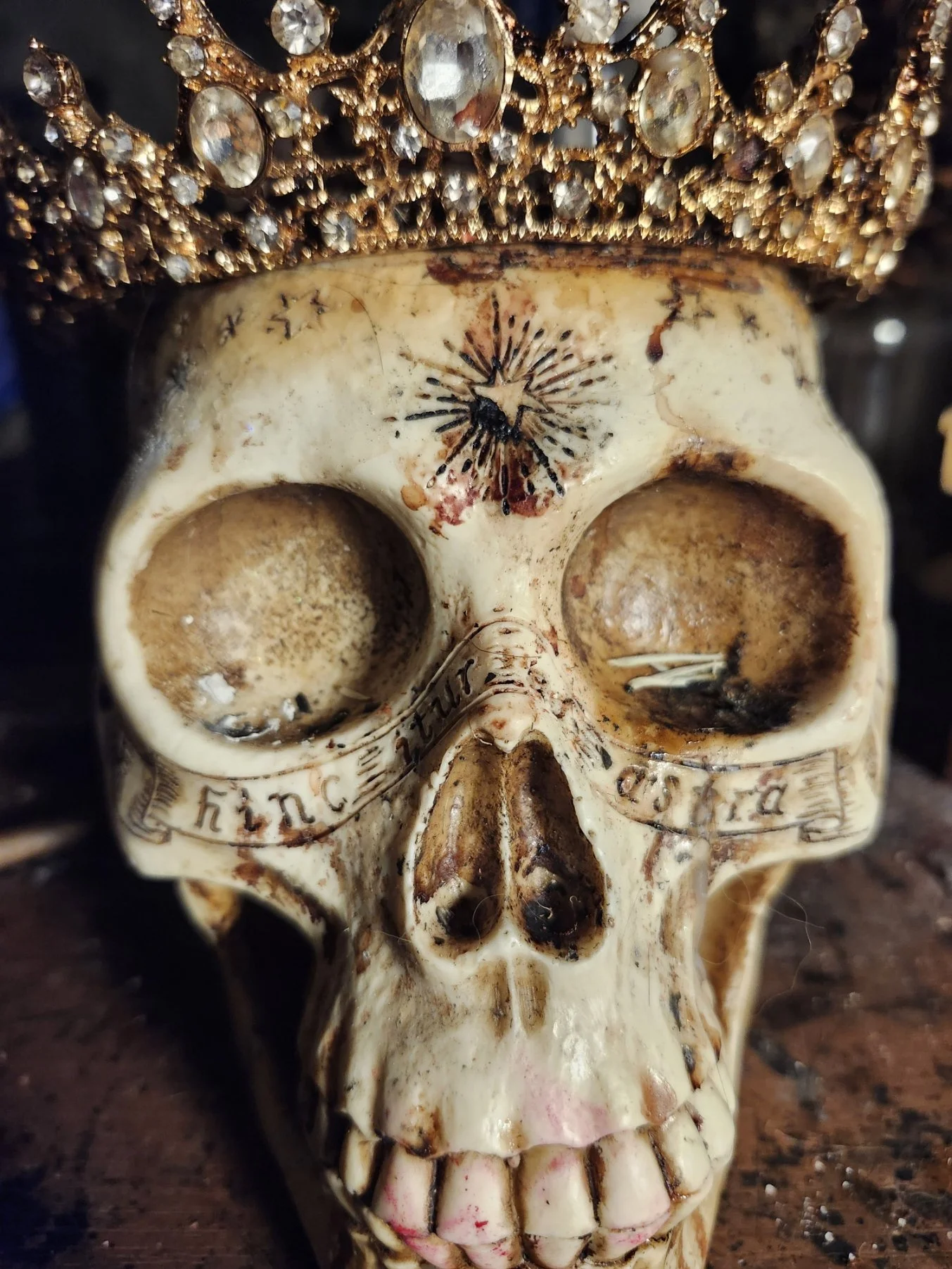
hinc itur ad astra
Σ ♥ ∞
amor fati
odi et amo
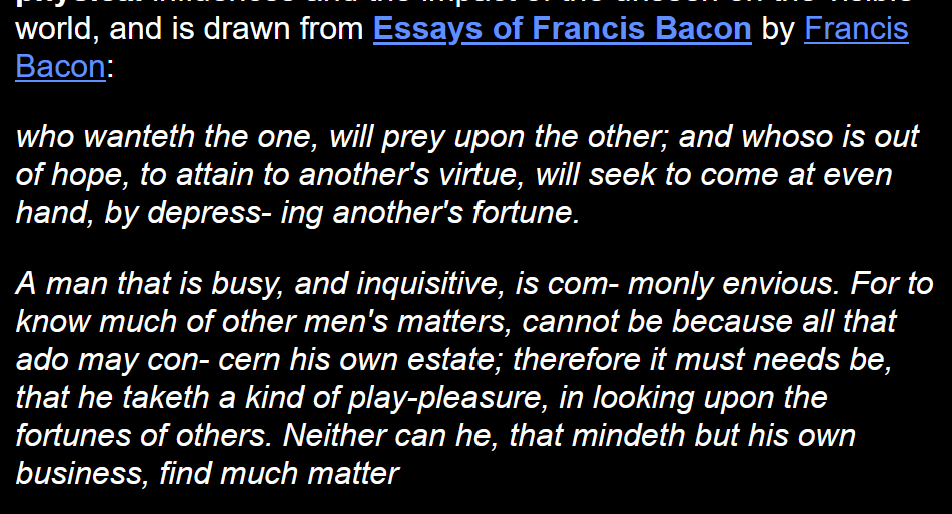
Francis Bacon says: MIND YA OWN BIDNESS, bitches.
You don’t have any interesting business worth minding, you say? Not my problem.
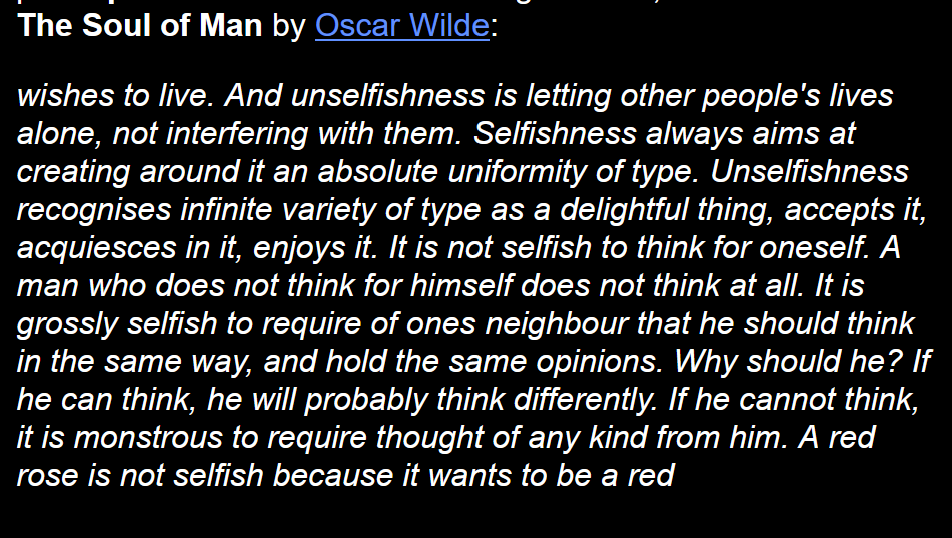
Amen to the gospel of Oscar Wilde!