The Ladder Is Imaginary (And You Can Get Off It)
For those of you who may have received a post called The Lottery of Life, please realize that was a Squarespace hiccup. I had deleted it after deciding the topic was more political than I prefer to be online. So, if you got it, sorry. It was just me trying to solve problems no one asked me to. lol
I. The Ladder Isn't Real — But the Bruises Are
Here's the thing nobody told you: the ladder isn't real. There's no above. There's no below. The whole vertical axis — top, bottom, higher, lower — is a projection, something the human mind throws onto the world rather than finds in it. And yet somehow, without anyone sitting you down and explaining the rules, you absorbed this map of reality so completely that it feels like gravity. It feels like physics. It feels like duh.
Nobody installed it consciously — it just arrived with the furniture. Your parents had it. Their parents had it. The school had it baked into every grade, every gold star, every student ranked against every other student as though that were a completely normal thing to do to a child. By the time you were old enough to question it, you'd already been playing the game for years. The ladder was just there, and you were already on it, and the only question anyone seemed to be asking was how high you'd climbed.
Here's the cruel joke: we spend our whole lives climbing something that was never actually there. All that effort, all that anxiety, all that white-knuckling your way up — and the ladder itself is imaginary. The bruises, though? Those are real. The exhaustion is real. The quiet devastation of slipping a few rungs is very, very real. The game is fictional but the damage is not, which is maybe the most unfair design flaw in the history of human consciousness.
And then there's the tides problem. Status goes up, status goes down — that's just the nature of the beast. The promotion comes and then the layoff comes. You're in and then you're out. The crowd loves you and then the crowd forgets you. If your sense of self-worth is strapped to that tide, you're in for a genuinely miserable ride — bobbing up and down on someone else's ocean, never quite steady, always checking the water level. The good news? Your worth was never supposed to be on the boat. That part was optional. You just didn't know you could opt out.
II. What the Ranking Game Costs You
The ranking game has a price tag, and it's steeper than advertised. The first thing it takes is your ability to just be with people. If you're running a hierarchy in your head — and most people are, automatically, without even noticing — you can't meet someone without first locating them on the scale. Richer? More successful? More admired? More attractive? The assessment is instant, involuntary, and utterly exhausting. You haven't even learned their name yet and you've already filed them.
This means every encounter becomes a threat assessment disguised as small talk. You're not actually asking "how are you" — you're running diagnostics. Are they above me? Below me? Should I be impressed or should I be comfortable? It's a miserable way to move through the world, and the worst part is it happens so fast you barely clock it. You just notice that some people make you feel vaguely anxious and others make you feel vaguely superior, and you assume that's just what people feel like. It isn't. That's the game running in the background, eating your processing power.
Then there's what it does to your sense of self-worth. Tie your value to your rank and you've essentially turned yourself into a stock price — volatile, reactive, dependent on a market you didn't design and can't control. A good review comes in and you're up. Someone younger gets the thing you wanted and you're down. The market whispers and you scramble. There's no floor, no ceiling, no stability — just the endless fluctuation of other people's opinions about where you belong. That's not self-worth. That's surveillance.
But here's the cost that stings the most: you miss the actual person in front of you. While you're busy calculating their altitude — triangulating their job, their clothes, their confidence, their connections — they're just standing there, being a whole human being, full of something genuinely interesting, and you're not getting any of it. The ranking game doesn't just make you anxious. It makes you blind. And that's the real tragedy — not that you lose the game, but that you never actually showed up to play the one that mattered.
III. The World Is a Field, Not a Ladder
Here's what the hierarchy doesn't want you to notice: reality doesn't actually have a vertical axis. What it has is difference — endless, lavish, fractal difference — and difference is a much richer thing than rank. The hierarchical mind takes all that gorgeous variety and performs a specific violence on it: it compresses everything down to a single question. Not "what is this?" but "how high is this?" And in doing so, it trades a whole landscape for a single ladder. That's not clarity. That's impoverishment.
Think about a map. A real map — the kind with coordinates. It can describe that two cities are far apart without declaring either one superior. It can show you that you've moved in a direction without telling you whether that direction was up or down. It preserves relationship without installing judgment. The moment you swap that map for a ladder, you lose all of that. Every position becomes a number on a scale, every being becomes a competitor, and the whole rich topology of existence gets flattened into one anxious question: am I winning?
A field — which is what reality actually is — has positions, distances, orientations. It has texture and depth and all kinds of ways to be somewhere. What it doesn't have is an intrinsic up or down. Nobody built that in. We did that ourselves, and we can undo it.
Which means you can be far from someone without being below them. You can be different without being lesser. You can occupy a completely distinct region of the field — different gifts, different struggles, different frequency entirely — and none of that has to mean you lost something. It just means you're somewhere else on the map. Somewhere that has its own coordinates, its own weather, its own particular view.
And here's the quiet miracle waiting on the other side of all this: difference stops being a race the moment you stop running it. The same facts that felt like a threat inside the hierarchy — she's more successful, he's more recognized, they have what I don't — become just information in the field. Interesting information, even. The gap between you and someone else stops being a wound and starts being a distance. And distances, unlike rankings, don't hurt.
IV. The People Who Stepped Off — And What They're Like
You've met them. Maybe you couldn't quite put your finger on what made them different, but you felt it — something unusually steady about them, something that didn't shift based on who walked into the room. These are the people who've stepped off the ladder. And the first thing to understand is that they're not at the bottom. They didn't give up or get defeated or resign themselves to losing. They're just elsewhere — somewhere the hierarchy has no coordinates for, operating on a map the ranking game can't read.
They're genuinely humble, which sounds like a small thing until you realize how rare it actually is. This isn't the performative modesty of someone fishing for a compliment — "oh, this old thing?" — or the strategic self-deprecation of someone who's learned that appearing humble is good for the brand. It's something quieter and more structural than that. They're free of the scoreboard. Not because they don't care about their work — they often care enormously — but because their sense of self isn't riding on the outcome. The praise lands and then passes. The slight lands and then passes. Neither one moves the needle on who they actually are.
What this produces in practice is something almost radical: they treat people as they actually are, not as their status implies. The janitor and the CEO get the same eyes. Not the same conversation necessarily — context is real — but the same basic quality of attention, the same fundamental respect, the same assumption that there's a full human being in there worth engaging with. They're not performing equality. They just genuinely don't have a mechanism that tells them one person's time matters more than another's based on their title.
And because they're not running threat assessments, they can actually be curious. They can sit with someone completely unlike them and find it interesting rather than destabilizing. Different backgrounds, different achievements, different ways of moving through the world — none of that reads as competition. It just reads as the field being wide, which it is.
From inside the game, though, they look suspicious. The hierarchy can't quite account for them. Why aren't they competing? Why don't they seem rattled when someone outranks them? Why don't they posture? Two explanations the ranking mind generates are: that they must be losing — quietly, in denial, pretending not to care because caring hurts too much. Or that they believe themselves to be superior. But neither are it at all. They've simply exited a game they saw through. And once you've seen through it — really seen through it, not just intellectually agreed that hierarchies are bad — you can't quite find your way back to taking it seriously. The ladder is still there. You just can't imagine it under your feet anymore.
V. How to Get Off the Ladder
The exit is real, but it's not a door you walk through once and you're done. It's more like a practice — something you return to, again and again, until the new map starts to feel more solid than the old one. Here's how it starts.
Step one is to actually notice that the axis is imaginary — and there's a meaningful difference between noticing it and simply agreeing with it. You can nod along to everything in this post and still flinch when someone gets the thing you wanted. Intellectual agreement is very cheap. The real noticing happens in the body, in the moment — when you catch yourself running the rank calculation and you pause, and you see it for what it is: a reflex, not a truth. That pause is everything. That's where the work lives.
From there, stop letting the hierarchy's mood become your mood. The ranking game has weather — seasons of who's up, who's down, who matters this quarter — and if you're not careful, you'll absorb that weather as your own emotional forecast. Someone ignores you at a party and suddenly you're a minor figure in your own story. Someone praises your work and suddenly you can breathe again. Notice when that's happening. The hierarchy's opinion of you is not a reliable narrator. It never was.
Then — and this is the practical one — practice meeting people without running the calculation first. Just for a moment, before the assessment kicks in, try being genuinely curious. Who is this person? What are they actually like? What do they know that you don't? It sounds small but it rewires everything, because curiosity and threat assessment cannot run simultaneously. You get to choose which one boots up first.
And carry this with you like a card in your pocket: your worth is a constant, not a variable. It doesn't go up when you're praised. It doesn't go down when you're ignored. It doesn't spike when you land the opportunity or crater when you don't. It just is — stable, non-negotiable, entirely independent of the market's mood. The game wants you to forget this, because a person who knows their worth is constant is a person the game can't move. Can't motivate with flattery, can't punish with rejection, can't keep on the ladder at all.
Which brings us to the beautiful end point: the ladder can't find you if you're not on it anymore. And when you're off it — really off it — everything opens up. You start seeing people instead of positions. You start making decisions based on what actually matters to you instead of what will look good from above. You get your curiosity back, your steadiness back, your genuine enjoyment of other human beings back. You stop bleeding energy into the comparison compulsion and you have more of yourself for the things that are actually yours to do. The world gets wider. The field reveals itself. And you realize the view from off the ladder was always better than anything you could have seen from the top.
Now go — the field is wide and the ladder was never real.
—M.
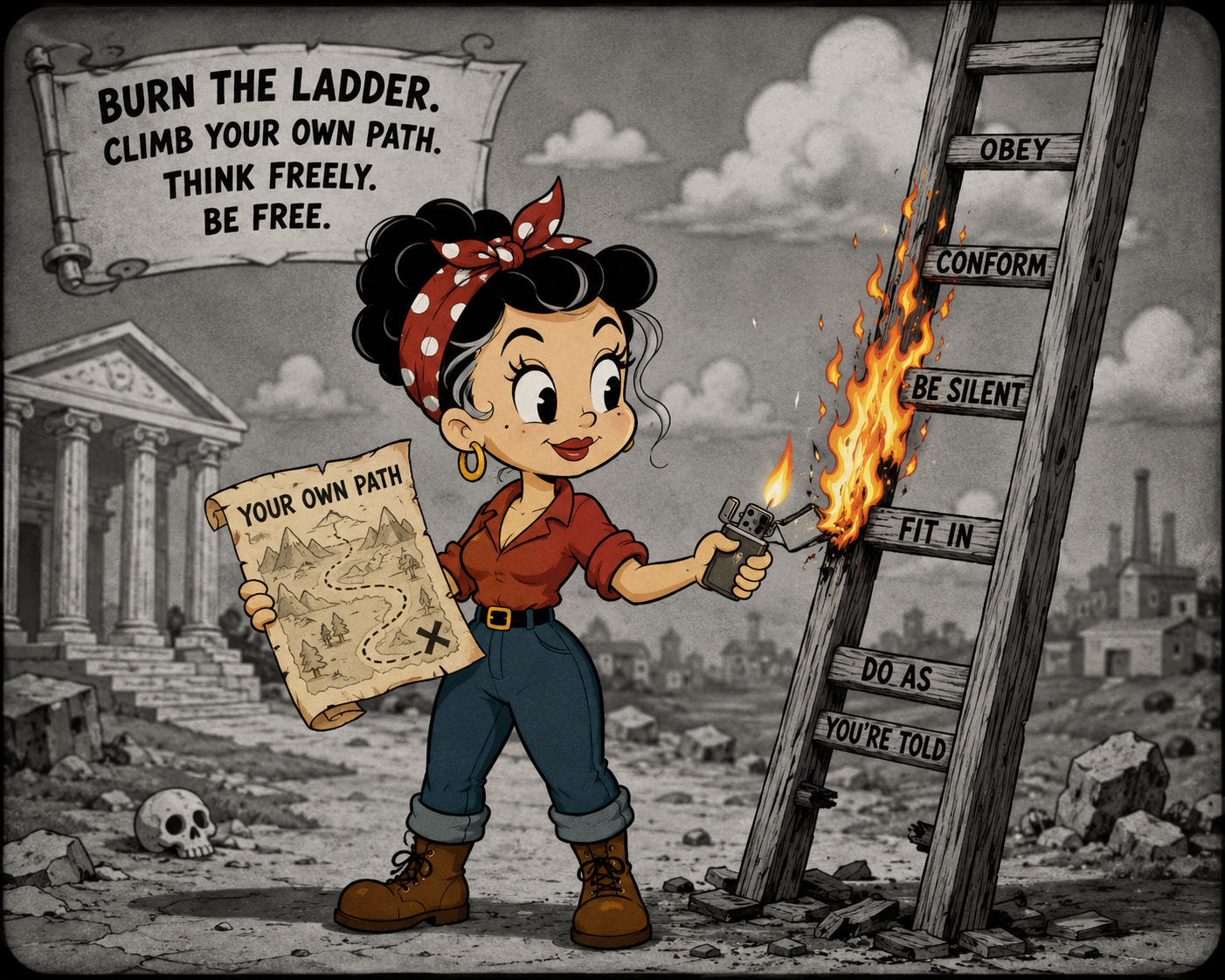
You can borrow my lighter!
Next Week
Monday — So What’s a Roman à Clef, Anyway?
Majeye's been sitting on her fourth book like a dragon on a pile of gold, and she's finally cracking the vault.
A sample of my forthcoming book: roman à clef set in San Francisco—and if you don't know what a roman à clef is, don't worry, I’ve got you covered. The opening excerpt is here, the explainer is here, and the only thing left to do is read. Fair warning though: if you've ever heard that siren song about San Francisco—the one about gentle people and flowers in their hair—this book is going to have some things to say to you. Strap in. Oh, and a new poem about wolves and dragons. Whimsical stuff. Wrote it 8/4/26.
Thursday — What Bourgeois Virtue Conceals (And Why It Has To)
Bourgeois virtue—thrift, industriousness, prudence, respectability—functions less as moral achievement than as class machinery. This post examines what each virtue conceals, how credentialism launders social position as intelligence, why naming the system gets you accused of envy, and what Balzac understood about genius that society still refuses to admit.