So What's a Roman à Clef, Anyway?
Hello readers. I’ve begun my fourth book. As I promised in an earlier post, I am sharing some of my work with you. There is not AI stank on this work as it is very personal. If you’re interested in my philosophy on AI use in writing, please check out this earlier post, after the defs and the poems: https://www.majeye.com/eyejam-blog/def-building-rhymes-while-thoughts-abound
The gist is never for things where the voice matters—like for poetry and novels. But things like essays where the argument matters more than the voice—I think it’s fine. I use it for structure and polish in my essays. One should bounce ideas off the AI and let it learn how you think and what you value. Don’t always treat it transactionally, but like a really smart conversational partner. You get more out of the tool that way. I’m an adept tool user. Moving on…
First, let’s define what a roman à clef is.
So What's a Roman à Clef, Anyway?
You've probably read one without knowing it. Primary Colors? Roman à clef. Fear and Loathing in Las Vegas? Roman à clef. The Devil Wears Prada? Oh honey, roman à clef.
The term is French—naturally—and it translates roughly to "novel with a key." Meaning: it's a work of fiction where the characters and events are thinly veiled versions of real people and real things that actually happened. The "key" is the decoder ring that tells you who's who. Sometimes the author hands you the key. Sometimes they take it to their grave. Either way, everybody usually figures it out.
Here's why it's a genuinely useful form and not just a fancy way of saying "I changed the names to protect the guilty."
The Liability Thing
Let's talk about James Frey for a second. You remember James Frey. A Million Little Pieces. The guy who wrote a memoir, went on Oprah, got celebrated as a beacon of raw honest addiction recovery literature—and then got dragged back onto Oprah's stage to be publicly filleted when it turned out he'd fabricated significant chunks of it. It was genuinely uncomfortable television. Oprah was not having it.
Here's the thing though: if Frey had published that exact same book as a novel—as fiction, as a roman à clef—nobody could have touched him. The moment you call something fiction, you've pulled up the drawbridge. Embellishment isn't lying anymore, it's craft. Composite characters aren't fabrications, they're technique. The people who recognize themselves in your pages can be furious about it, but they're going to have a very hard time in court, because you didn't say it was them. You said it was a character. Who happens to share certain qualities. Purely coincidentally.
This isn't a loophole. It's a legitimate literary tradition with centuries of precedent. It's just also conveniently useful when you have things to say about real people and also have a preference for not being sued into the ground.
The Creative Thing
But here's what doesn't get talked about enough: the roman à clef isn't just legal cover. It's actually a creatively liberating form in its own right.
Because the moment you call something fiction, you get to do things memoir won't let you do. You can compress three people into one character without footnoting it. You can move an event from Tuesday to Thursday if Thursday serves the story better. You can write a scene you weren't present for, imagine your way into a conversation you only heard about secondhand, give voice to someone's interior life in a way that straight reportage would never permit. You can make it better—not more dishonest, but more true in the way that only fiction can be true, which is emotionally, architecturally, essentially.
Memoir has to answer to the facts. The roman à clef answers to the story. And sometimes the story and the facts need a little room between them to breathe.
The Key
The other delicious thing about the form is the game it invites. Readers who know you—or know the world you're writing about—get to play detective. They're reading on two levels simultaneously: the novel on the surface and the real events underneath it. That double layer creates a specific kind of intimacy between writer and reader, a conspiratorial wink that runs through the whole book. We both know what this is really about. The people who don't know get a great novel. The people who do know get a great novel plus the key. Everyone wins.
Except possibly the people who recognize themselves in it. But they can take that up with their therapists.
In the case of my book, maybe those people should have treated me with basic human decency, or I wouldn’t have anything to say at all. They made me The Countess of Monte Cristo. Thank you for your grinchlike smallness. At this point, I wouldn’t have it any other way.
Now that we’ve gotten that out the way, I’d like to be clear about expectations. You will see passages once, maybe twice, a month—mixed in with my usual blog rhythm. I’m not looking to put the whole thing online. That would be dumb. I’ll also include my thoughts on the writing experience, and anything else I feel like saying.
Please keep in mind this is not edited. This is also first pass. Which means, it will not be the same in the published book. Get the story out, then shape, then edit. That’s how it goes.
Without further ado…
I went into the woods (of San Francisco) because I wished to live authentically. To have a chance of becoming the person I felt I could be. The chance my small hometown in Louisiana would never be able to offer. All intellectual outliers in small town America hear the siren song of San Francisco. (Say that last part three times fast.) Weirdos have been flocking there since the Gold Rush. There is a rich past of outliers making history there. The Beat Poets. The Hippies. The Gays who fought hard for their freedoms.
If you're going to San Francisco
Be sure to wear some flowers in your hair
If you're going to San Francisco
You're gonna meet some gentle people there
For those who come to San Francisco
Summertime will be a love-in there
In the streets of San Francisco
Gentle people with flowers in their hair
-Scott McKenzie
So naturally, I was called by the song. Back then, I didn’t know it was a siren song. I thought it was a beautiful melody I could harmonize with. This book is the story of why it was a siren song calling me to jagged rocks that could have been my death. The shore on the other side of those rocks lined with smirking, condescending faces that were praying the rocks would slice me open. But I’m getting ahead of myself.
I had been in the Bay Area before in one of the many lives I’ve lived in this lifetime. (You will notice that I keep shedding skin.) When I was 20, I was in the Americorps. I built houses with Habitat for Humanity for almost a year in Redwood City. I loved the Bay Area. I visited SF. I fell in love. The most beautiful place with the most beautiful architecture and the richest history I’d ever seen. And the weather was magickal.
My dad died during that year and I had to go home. I loved my Dad. Growing up, he was the only one who saw my mother for what she was. He called her, “The most bitter woman I’ve ever met.” Knowing what I know about psychology now, I’d say she’s a malignant narcissist. I don’t throw terms like that around lightly, like so many do these days. They read a few articles online and think they understand what these things mean. I actually know what they mean clinically and I know that you can’t make a claim like that without knowing the person you’re speaking of.
After Dad died, my boyfriend at the time had to beg my mother to let me stay with her. I had been in California and my return was not planned. She only allowed it if I got on medication. That was my first trip to the psych ward. Not because I felt I needed it, but because my mother would not let me sleep on her couch after my dad died unless I was medicated. The fastest, cheapest way to get on meds was a trip to the loony bin.
I wasn’t on my mother’s couch being tortured by her for long. I got hooked on meth and within a couple years I was a meth junkie. Running around with low-level criminals. No home really. Being in that world but not of it. They all knew it too. 4 years passed between the time my dad died and when I moved to SF. Or was it 5?
I learned in those years how to use the system. Since my mom made it clear she’d prefer me dead when I was 5 years old (“I wanted to have an abortion, but Mimi and Pawpaw wouldn’t let me”), I found other ways of getting support. Namely the US Government. See when you’re in a tough spot being “crazy” has its benefits. I got on SSI and I got Medicare and Medicaid.
I wanted out of there though. I didn’t want the life I had. That’s the problem with provincial towns. Once people decide what you are, they will absolutely not let you change. I hadn’t been arrested yet, but I could feel it coming if I didn’t leave. The police in small town Louisiana have the good ol’ boy system, tons of resources and time, plus the inclination to hunt druggie prey. It is sport to them. I’ve never been keen on losing my freedom.
So I left, I bought a plane ticket for $200 and I fucking left. Did I know anyone in SF? No. Did I have a plan? Not really. Was I still a meth junkie? Yes. How much money did I have left out of my SSI? ~$400. How old was I? Late twenties. Attractive. All I knew was I didn’t need a car there and it would only cost me $40 a unit to attend CCSF. That was the plan. Find a way to go to school. Make it happen.
So I left the place where my ancestor is called “The Father of Pointe du Lac.” His name was Henry Jacob Eliot, a treasurer for the local Freemason lodge. He floated a courthouse down the river to Pointe du Lac, and helped begin the municipal works of the settlement. He and his brother George Eliot (who died at the Alamo next to Colonel Travis) have gravestones from the late 1800’s in the founder’s cemetery there. The main drag in Pointe du Lac is Eliot Street. I am named after my ancestor’s last name, also my mother’s maiden name. Eliot. A girl named Eliot.
Hi. My name is El, and it’s about damn time I tell my story.
Growling Wolves
she stopped by to fill it up the vessel of winged flight went in to drain a cup and find something to bite
she emerged and there they were the wolves in corridor formation with their coolness and black fur producing a whimsical sensation
what kind of lupine magick is this? materializing in 4 minutes flat empty outside before, nothing amiss then she’s smiling under a fishing hat
a response to her carrier pigeon? care and strategy suggest yes perhaps an acknowledgment mission combined with an authenticity test
the dragon did not respond that would have been a mistake she showed them she’s truly fond by proving she’s not a fake
the pack growled down the roads the dragon unfurled her wings each monster to their own codes guessing at new beginnings
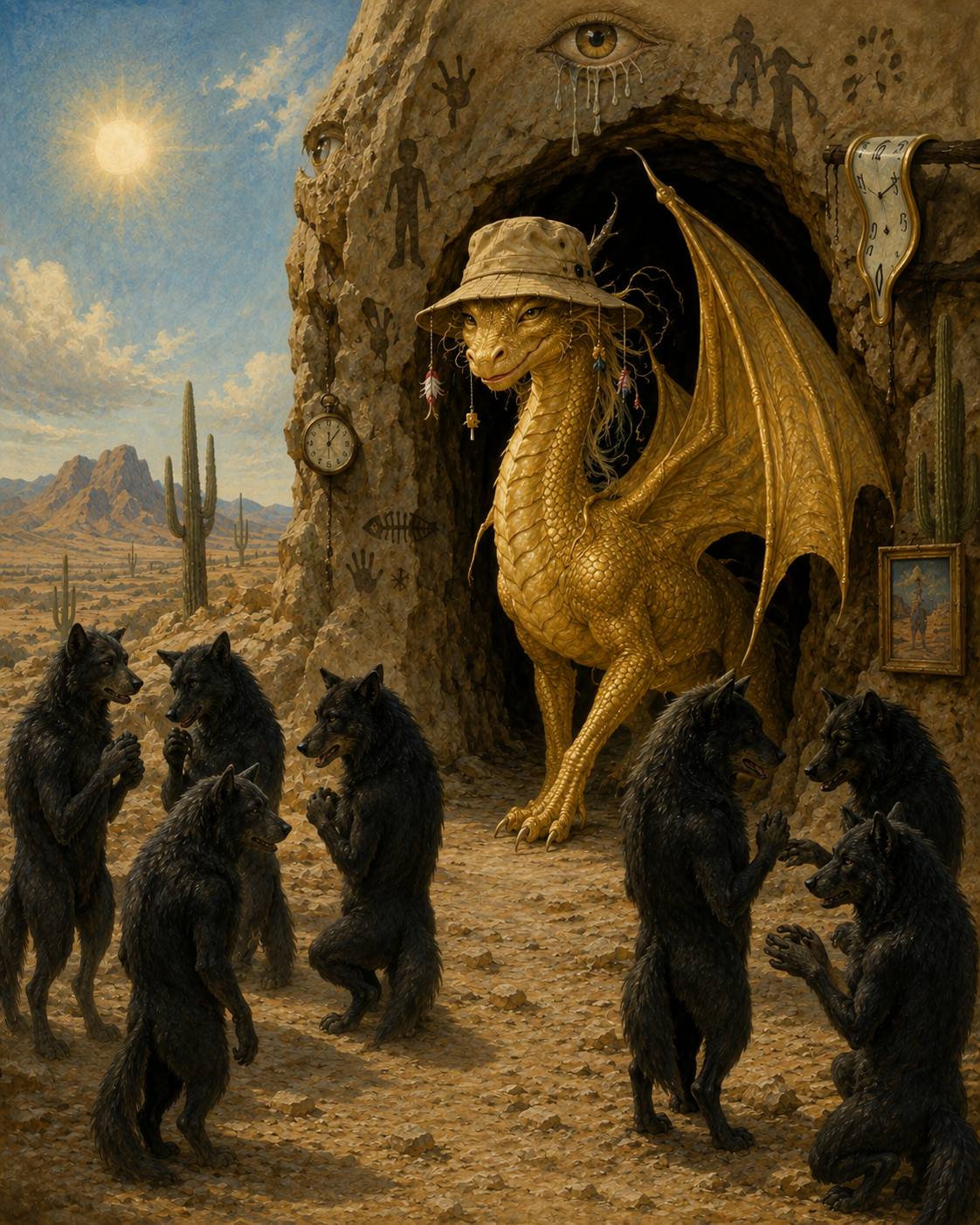
Sunshine and dragon and wolves, oh my!
One More Thing…
I’m sure some of you realize I’m an esoteric practitioner. I prefer the term occultist. The occultist isn't merely a keeper of secrets; they're someone attuned to what the world conceals from itself. My practice can be hard to grasp, mainly because of what is floating around in the ether in this era. It’s not your fault. I blame our culture.
I do not “cast spells”—to me that is sign of someone so weak they feel they need to call on things they don’t understand to manipulate outcomes. It’s a sign of desperation. Most of the time people who cast spells don’t understand the entities they’re dealing with, and they rarely know the costs involved. I’m not saying there aren’t authentic practitioners out there; I’m saying that’s not my style. I’m also saying authentic practitioners are increasingly rare. The absurdity of people putting magick online is astounding. Truly. Secrecy is the bedrock of authentic practice of any kind.
What I do is SERVE. I offer my gifts to the Gods I chose. I serve with no asks attached. I know my place in the cosmic hierarchy—the only hierarchy that matters to me. How would you feel if you were a god and some puny humans ask you for petty bullshit while treating you like a vending machine? I don’t film my rituals; that’s unserious and offensive to the divine. I won’t be explaining my practice in detail, because it’s hard-won and it’s not for you. I have a whole section of essays in my second book, Ars Architektonic Anomalia, called EsoteriKa. Obviously it’s not an outline of my practice, but hints on things I’ve learned.
What I can say—without being too specific—is my practice revolves around faith in the love of the Gods and offerings. I offer things that delight them. Song, dance, blood (always my own—the Gods demand PERSONAL sacrifice), poetry, books, laughter, tears, orgasm, paintings, et al. You know, everything that makes being human worth it. So I offer, I delight them, and I trust they know what’s best for me. I don’t want the negative cloud of trying to manipulate others or outcomes though spellwork (or any other means) darkening my heart or my focus or my karma—because that’s what all manipulation does. It also ages you a lot faster.
I was tested by the Gods akin to Job’s testing. I did not curse them and I never ceased offerings once the practice began—even when things were hard or before I believed in them fully. It took years. Now our bond is unshakeable. I trust them. I know my place, and I will delight them with my gifts for the rest of my life. No question. Their love for me is evident in the fact of where I am now compared to where I was before, or that I’m alive at all. It took time, but the results are undeniable. I am grateful to them every day, and I show it.
So yeah, I’m friends with my chosen pantheon, while always knowing my place. This is called xenia, or guest-friendship. That’s what it amounts to. How did I achieve this without copying something already in existence? It’s called GNOSIS. The Luciferian aspect is that I earned my place in their favor through brutal trials and fire, through not breaking when it would have been so easy and so understandable. To keep moving forward and not let hardship define me. Then coming out of my trials with unbelievable strength, grace, kindness, discipline, and strategy. A drive—and the actions to match it—to build a life and legacy that is astounding if you knew where I ascended from. I feel full and content just about every day, even in solitude. I say just about every day, because everyone has a bad day now and then. My bad days have been seldom for a while now.
If you need a category for what I’m doing esoterically, theurgy is closest. Though my practice is not ascetic or overly complicated, as most theurgy practices tend to be. My rituals just flow. Or you can call me a hierodule—one who serves the sacred—if you want to be fancy about it.
I hope those of you who might’ve thought I cast spells or some bullshit like that can now see why the suggestion is not just categorically wrong, but also minutely offensive. I don’t need spells when I have favor. I trust whatever happens is in their plan for me. They’ve proven they have one. It’s very freeing. I don’t need to chase or worry. Anything that comes my way—bad or good, I trust has a purpose I cannot yet see… but the Gods can.
I honestly don’t care what you believe on this subject. This is not proselytizing. That shit is annoying and should be banned worldwide. This is me explaining why I don’t need spellwork to make things happen. Service is a higher calling, and it yields better results.
Funny thing. I used to be an atheist. A hard-core one. Reading and idolizing Richard Dawkins, Christopher Hitchens, and Daniel Dennett. lol. But telling the story of how I got here from there will happen in my fourth book.
Glad we got this out out of the way.
;)
No worries. Sigma females are used to being misread.
∞ ♥ Σ ◊