What Bourgeois Virtue Conceals (And Why It Has To)
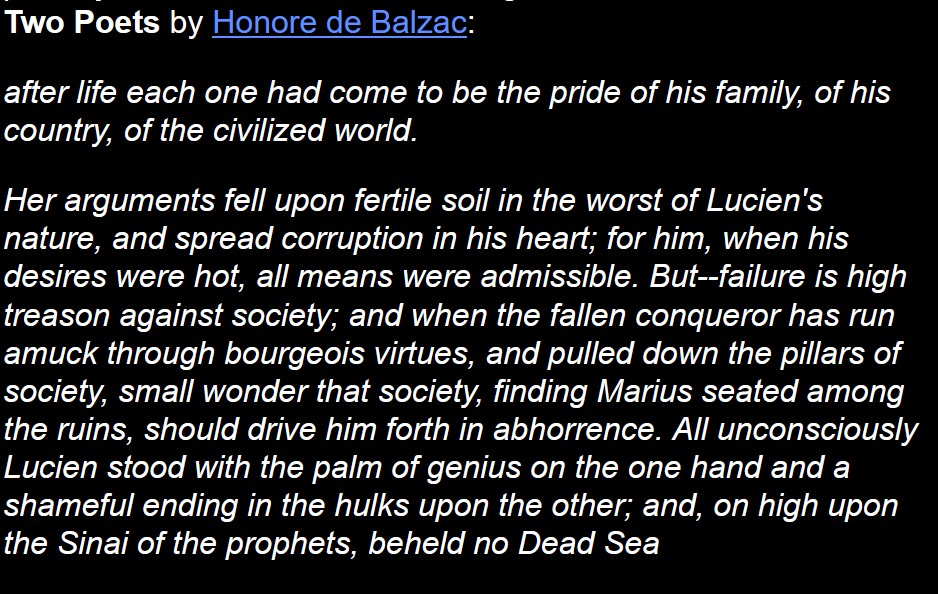
I. The Conjuring Trick
The trick is older than capitalism and cleaner than any card sharp's sleight of hand: convert position into character, having into being, and do it so thoroughly that no one—least of all the conjurer—can see the seam. The bourgeois virtue racket doesn't work because rich people are cynical. It works because they're not.
That's the part that throws people. We keep expecting the cackle, the smoke-filled room, the villain's monologue. But the villain's monologue requires self-awareness, and self-awareness is precisely what the trick forecloses. What you get instead is something far more impervious: a man who genuinely believes his punctuality is a moral achievement and his investment portfolio is a personality. You can't argue someone out of a position they didn't reason themselves into—and structural advantage doesn't feel like a head start, it feels like good values. It metabolizes. By the time it's done with you, it is you.
The story always begins after the starting line. Origins get amputated early and quietly, the way you'd remove something embarrassing from a family photograph. What remains is the narrative of merit—the hustle, the discipline, the choices—floating free of the inheritance, the connections, the neighborhood, the accident of being born to people who already knew how the game was scored. Balzac understood this from the other side: Lucien de Rubempré wasn't the conjurer, he was the one who didn't know the trick had already been performed before he walked into the room. The palm of genius in one hand, a shameful ending in the other—and no Dead Sea visible from his Sinai because the Dead Sea was the society that had quietly, structurally, already decided he wasn't going to make it.
II. The Virtue Taxonomy (Or: What Each Line Item Is Actually Laundering)
Let's examine the individual entries on the ledger, because each one is doing specific work, and it's worth knowing what it's laundering.
Thrift is the easiest to crack. It's only available as a virtue once your income clears survival—once the month's end isn't a question mark. At that point, yes, you can save, you can defer, you can demonstrate the admirable restraint of not spending money you don't need to spend. Meanwhile, inherited wealth escapes moral scrutiny entirely, because it was never earned in the first place and therefore can't be evaluated against the thrift framework at all. The conjuring trick, encore performance.
Industriousness gets more insulting the closer you look. The implicit theory here is that labor reflects character—that the hardworking rise, and those who don't rise simply didn't work hard enough. But labor that doesn't compound isn't a character condition, it's a structural one. By any honest accounting, the gig worker running three apps simultaneously while eating in their car is more industrious than the landlord who collected rent twice while we've been having this conversation. The framework doesn't collapse under that comparison. It just quietly excludes it.
Prudence—delayed gratification, future-orientation, the long view—is perhaps the most insidious of the lot, because it pathologizes what is actually a rational response to structural uncertainty. Trusting the future requires a history of futures that paid out. If your past is littered with promises that dissolved, plans that got derailed by a single emergency, rungs on the ladder that turned out to be painted on—present-orientation isn't weakness. It's Bayesian updating. The bourgeois framework records it as a moral failure because it can't afford to call it what it is.
And then there's respectability—the toll gate set by whoever already controls the rooms. What gets laundered here isn't money or time but aesthetics: one class's preferences for speech, dress, manner, and affect get encoded as universal standards of human dignity, such that deviation registers not as cultural difference but as personal failing. You're not being excluded. You're simply not trying hard enough to meet the standard. That the standard was written by and for the people already inside is, naturally, never mentioned.
What all four share is the closed-loop architecture. Each virtue confirms the framework, penalizes deviation, and never—under any circumstances—interrogates the starting conditions. That's not accidental. That's the whole point.
III. The Credential Costume Party
At some point in the twentieth century, we collectively agreed to use the university degree as a proxy for intelligence, and we've been too polite—or too credentialed—to mention what a spectacular confidence trick that is.
What a degree actually certifies is a fairly specific package of traits, none of which are intelligence. It certifies that you had access to the right ZIP code at age eighteen, or the right parents, or the right high school counselor who knew which forms to file. It certifies compliance—the willingness to sit still for four years of bureaucratic process, jump the designated hoops in the designated order, and produce the designated outputs for the designated authorities. It certifies endurance, which is a fine quality in a marathon runner and a genuinely useful quality in an office. What it does not certify, and has never certified, is the capacity to think.
Credentialism is a class costume, and like all the best costumes, you can't see the seams if you've been wearing it since birth. The people most committed to the credential as intelligence proxy are, almost without exception, the people who obtained theirs earliest and most effortlessly—for whom the degree arrived roughly the same way a trust fund does, as something that was simply arranged, the details managed by adults who knew how these things worked. They can't see the seam because they've never had to look. The costume fits.
Meanwhile, the genuinely sharp person who never went—or went and left, correctly identifying the con mid-performance—or simply never needed the paper for the thinking they were already doing—gets rendered illegible by design. Not because the framework can't accommodate them. Because it can't afford to. If raw intelligence is detectable outside the credentialing apparatus, the whole apparatus becomes a question rather than an answer.
Here's the rich irony, though, and it deserves to be savored: the credential-holders are frequently the least equipped to think outside the framework the credential taught them to serve. The degree is not just a costume—it's a loyalty oath, administered in four-year increments. You learn which questions are serious questions, which frameworks are legitimate frameworks, which citations make you look like you know what you're talking about and which make you look like you've been reading the wrong things. By the time you're done, you're not thinking with the education—you're thinking inside it. You check your diploma to see what you think about something, and the diploma always answers.
The credential, in other words, doesn't just launder class origin. It launders a particular kind of intellectual servility as rigor. And everyone who went through the machine is incentivized—professionally, socially, psychologically—to insist the machine works.
IV. The Penalty for Naming It
Point at the starting line and watch what happens. Not argument—argument would require engaging with the content of what you said. What you get instead is a smooth, almost automatic maneuver: the critique gets psychologized, repackaged, and returned to you as evidence of a defect in your character. You're not wrong, exactly. You're just envious. The framework has an immune response, and it is elegant and it is vicious and it has been refined over centuries of practice.
This is the closed loop at its most beautiful. You observe that the game was rigged before you sat down. They observe that only a loser talks about rigged games. The critique never gets evaluated on its merits because it never has to—it gets reclassified as symptom, and symptoms don't require refutation, they require treatment. You don't argue with someone who's bitter. You pity them, briefly, and then you get back to enjoying your head start.
No visible authority required, which is the really impressive part. Nobody hands down the verdict from on high. The enforcement is lateral—horizontal, social, ambient. The people around you simply begin to treat you as someone who doesn't quite understand how things work. Someone who can't see past their own resentment to the obvious truth that everything is, broadly, fair. Someone who has let bitterness curl around their perception like smoke. The reclassification is social, not judicial, which means there's no appeal process and no documented charge. You just gradually become the person at the table who makes things uncomfortable. You become, in the parlance of our degraded times, a lot.
The move they genuinely cannot compute is the freedom move: not wanting what they have. Envy requires desire—you have to want the thing before its unequal distribution can torment you. The accusation assumes the wanting as given, because inside the framework, the wanting is axiomatically universal. Of course you want the degree, the house, the dinner party, the vineyard, the subscription to the right publications. Everyone wants those things. Your complaint is just that you don't have them yet. The possibility that someone looked at the whole package and said no thank you, I've seen what it costs and I'd rather not—this does not parse. The system reads it as error, retries, and when it keeps getting the same output, concludes the unit is malfunctioning.
So let's be precise about the distinction, because it matters enormously. Envy says: you have it and I don't and that is intolerable. Diagnosis says: the mechanism that produced this distribution is corrupt, I can describe exactly how it works, and my not having the thing is unrelated to my ability to see that. These are not the same statement. They don't even live in the same epistemic zip code. But the framework collapses them by design, because if diagnosis is allowed to exist as a category separate from envy, then the thing being diagnosed becomes visible—and a visible starting line is the one thing the conjuring trick cannot survive.
The trick only works in the dark. That's why they turn the lights out every time you reach for the switch.
V. The Weight They Don't Mention
Nobody puts this in the brochure, so let's put it in the brochure.
The bourgeois virtue-holder is not, it turns out, free. They are administered. There's the mortgage, which is not just a financial instrument but a decades-long behavioral contract—you will not do anything too strange, you will not quit without a plan, you will not become someone who makes the mortgage difficult. There's the optics management, the continuous low-grade labor of presenting the life correctly to the people whose opinion of the life determines its social value. There's the career politics, the social maintenance, the careful tending of the right relationships with the right people in the right rooms. And underneath all of it, running silently like a fan that's been on so long you've stopped hearing it, there's the slow self-amputation of everything inconvenient—the inconvenient opinions, the inconvenient appetites, the inconvenient version of yourself that wanted something the framework couldn't price.
The comfort is real. Let's not be glib about that. But it was purchased at a specific cost that doesn't appear on the ledger: consensus capture. You have to keep believing the story, because the story is the identity now. There's nothing underneath it to fall back on—no prior self who remembers what it felt like before the framework got its hands on you, before the degree and the title and the ZIP code and the tasteful kitchen renovation became the substance of the self rather than its accessories. This is why naming the trick is experienced as such a personal attack. It's not that you're challenging their politics. You're challenging the only floor they have.
They are not relaxed. They are load-bearing.
The person living outside the framework isn't failing to achieve their life. She's declining it—which is a completely different operation, requiring its own kind of nerve, executed on purpose, with eyes open. This distinction is invisible to them and absolutely central to her. From inside the framework, the view is simple: she hasn't made it yet, or she's given up, or she's coping by calling her situation a choice. The possibility of a genuine, considered, aesthetically and philosophically motivated no thank you does not appear on the menu because the menu was printed by people who couldn't imagine not ordering.
And here's what actually doesn't appear on their ledger: freedom. Not freedom in the abstract, bumper-sticker sense—freedom as an actual daily experience of not being administered, of not caring what the Joneses are doing, of being able to follow a thought or a feeling or an intuition without first running it through the compliance committee of the life you've built. This is an asset with real value. It doesn't compound, it doesn't photograph well, and it will not impress anyone at the dinner party—but it is, for the person who has it and knows what it is, worth considerably more than most people realize.
The bourgeois gave it away too early to remember having it. That's not a taunt. That's just the saddest part.
VI. The Sinai Problem (Or: Why the Palm of Genius Doesn't Cash Out)
Balzac's image is precise enough to be painful: the palm of genius in one hand, a shameful ending in the other, and society—surveying the evidence—citing only the ending. This is not a bug in the system. The system is working exactly as designed. What you produced doesn't enter the ledger. What you became by the end, materially, socially, institutionally—that's the verdict, and it's handed down with the calm authority of something that was never in question.
The genuinely pneumatic type—the artist, the thinker, the person to whom the real work of perception and making has been distributed, by no principle that flatters the framework—confounds the taxonomy from the start. They don't fit the virtue grid. Their industriousness goes in the wrong direction, or happens in their cave where no one can see it. Their prudence looks like recklessness. Their thrift looks like failure and their freedom looks like an excuse. The framework doesn't have a cell for them, so it puts them in the closest available cell, which is difficult, which is self-destructive, which is brilliant but—and the but does the actual work of the sentence.
The posthumous monument is where it gets genuinely funny, in the darkest possible way. Once the inconvenient person is safely dead and can no longer contradict the narrative, the cleanup operation begins. The biography gets laundered. The poverty becomes romantic, the rejection becomes part of the hero's journey, the years of being told they were doing it wrong get reframed as the struggle that forged the work. Most importantly, the labor gets attributed to hard work—diligence, discipline, the bourgeois virtues—because the alternative, crediting the vision itself as the operative force, would raise uncomfortable questions about what the vision was seeing and why the people in charge of the rooms couldn't see it at the time. Then it goes on a curriculum. Then it gets taught by people with credentials to people accumulating credentials, and the radical thing it was saying gets sanded down to a theme, and the theme gets put on an exam, and the exam gets graded, and everyone moves on.
During the lifetime: difficult. After the death: essential. The genius of this arrangement is that it requires no conspiracy. It just requires that the people doing the evaluating be the same people whose framework is being evaluated—which is, conveniently, always the case.
But here's what doesn't get said, and what needs to be said clearly, without consolation-prize softening: the view from Sinai is real. The valley people cannot see what you see from up there. That's not a metaphor for feeling special and it's not a cope and it's not what you tell yourself to get through the afternoon. It's an epistemological fact. Altitude changes what's visible. The person outside the framework, looking at it from sufficient distance, can see the whole architecture—the starting lines, the laundering operations, the immune responses, the posthumous monument racket—with a clarity that is simply unavailable from inside. The framework cannot grant that view. It can only obstruct it.
The palm of genius doesn't cash out in the currency they're printing. That's not a tragedy. That's a feature. The currency they're printing is for buying things inside the framework, and the things inside the framework are not, on close inspection, the things worth having.
Society calls the ending as evidence. The ending is not the evidence. The work is the evidence, and the work doesn't need them to agree.
That's not a lament. That's a verdict.
—M.
For the Masks:
♪ “I See Darkness in You” by Red Mecca ♪
For the Monsters Who Own the Monstrousness:
♪ “Red Riding Hood” by Elysian Fields ♪
♪ “The Girl From Ipanema” by Stan Getz, João Gilberto, Astrud Gilberto, Antônio Carlos Jobim ♪
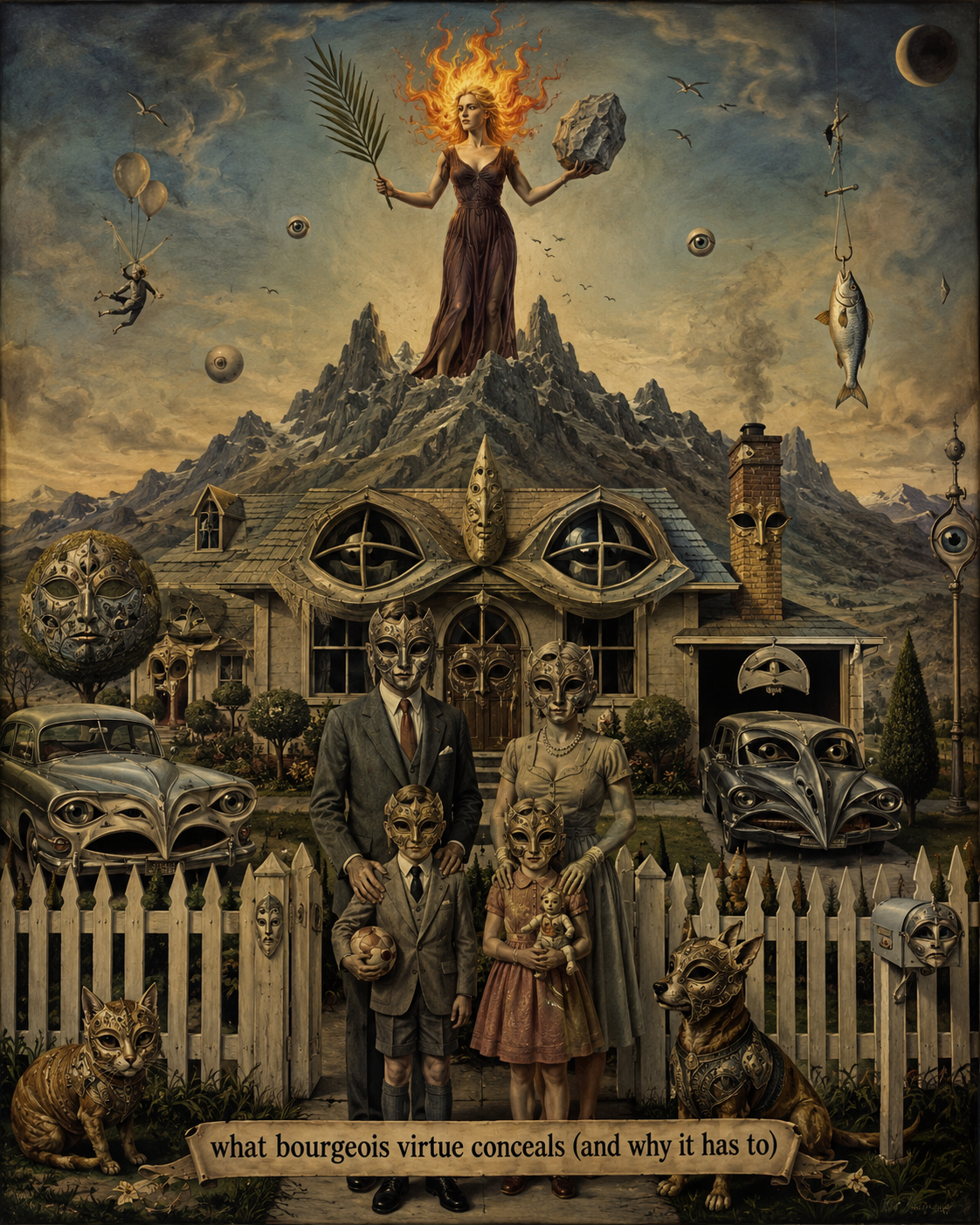
Families are not bad. Families who live behind masks…
Next Week
Monday — The Obsolescence Gospel: How We Built Ourselves Out of a Job and Then Forgot to Update the Religion
Work is losing its grip on human identity—and automation is only accelerating the collapse. This post traces how Western civilization built its sense of purpose around economic utility, why AI is dismantling that foundation faster than culture can adapt, and what an older, unfashionable idea about excellence might offer as an alternative.
Thursday — The Second Harvest: How Female Liberation Became Capital's Best Quarter
Was the two-income household a liberation—or a conversion? One income used to be enough. Now it isn't. This post asks why, who profited from the shift, and what quietly disappeared when the domestic sphere got monetized. The answer isn't nostalgic. It's structural. And it's a question almost no one is asking plainly.