The Confession Hiding in the Critique
What Ad Hominem Actually Reveals
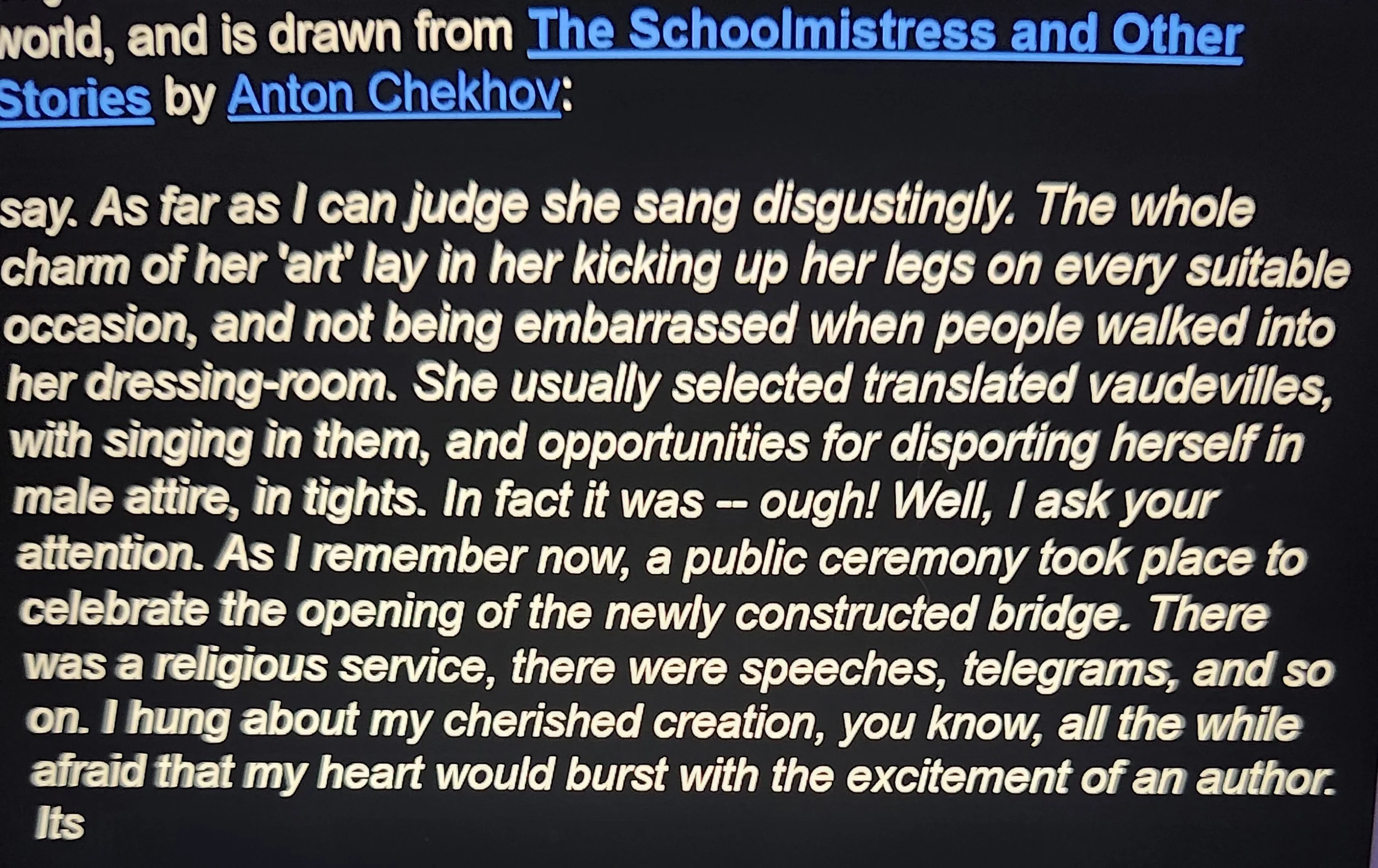
Now time to deconstruct this…
I. The Chekhov Passage as Case Study
Anton Chekhov, in The Schoolmistress and Other Stories, gives us a narrator who wishes to discuss a performer. He does not, as it turns out, discuss the performance.
What he gives us instead is an inventory. The legs, deployed on every suitable occasion. The tights. The translated vaudevilles chosen for their opportunities. The dressing room door, left open without embarrassment. He is thorough. He is detailed. He has clearly been paying attention for some time. What he has not done—what he conspicuously never does—is assess the work on its own terms. Whether the vaudevilles achieved what vaudevilles are designed to achieve. Whether the audience was moved, entertained, transported in the particular low and genuine way that popular entertainment can transport. Whether she succeeded at the thing she was attempting. These questions never appear. The work is present only as an occasion for the person, and the person is present only as an occasion for the inventory.
Then comes the ough. A small spasm, almost parenthetical, dropped into the middle of the description like a coin falling from a pocket. It’s the most honest moment in the passage—the place where the apparatus of detached assessment briefly fails and something more personal surfaces. One does not ough at something one has successfully dismissed. Dismissal is quiet. The ough is a tell.
A disinterested critic of the same performer might have noted the limitations of the repertoire, the calculation in the staging, the particular brand of charm that substitutes accessibility for artistry. These are legitimate observations. They engage the work as a work. They could survive the performer's absence from the room. They would read as criticism because they are criticism—cool, specific, aimed at the proposition rather than the person making it.
Instead, the narrator pivots. From the performer's legs to his bridge—his cherished creation, the newly constructed civic achievement around which a whole public ceremony was organized, speeches delivered, telegrams received. He needs the bridge the way a man needs a coat in weather he did not expect. Something has destabilized him. Something in the spectacle of a woman who kicks up her legs on suitable occasions and does not apologize for it in her own dressing room has required a counterweight. The bridge is the counterweight. That he reaches for it tells us everything the ough already suggested—that the performer has gotten further under his skin than any merely mediocre act of entertainment has any business doing.
II. The Anatomy of Ad Hominem
Ad hominem is Latin for against the person. Stripped of its academic packaging, it means this: you have abandoned the argument and gone for the arguer instead. Not because the arguer is the more interesting target, but because the argument defeated you and you needed somewhere else to go.
It feels like criticism. This is its primary structural advantage. It arrives in the same register, uses the same vocabulary of assessment, and occupies the same social position as legitimate critique. The person deploying it believes, often sincerely, that they’re doing the same thing a disinterested critic does—evaluating, weighing, then rendering judgment. The audience, primed to receive criticism, processes it as such. The costume is convincing because it is worn with conviction. But remove the personal element and examine what remains, and the machinery is exposed: there is no argument underneath. There is only the person, restated with increasing vehemence.
The objectivity is the costume's most important feature. Genuine feeling—envy, threat, wounded pride—cannot present itself as such and retain social authority. It must play dress-up. It must adopt the posture of the dispassionate observer who has simply, regrettably, found the subject wanting. The more elaborate the performance of reluctance, the more telling it is. As far as I can judge—Chekhov's narrator actually uses this phrase, the classic gesture toward the appearance of fair assessment—before delivering an assessment that is anything but fair and nothing but personal.
Here is what ad hominem actually is, beneath the costume: a concession. It’s the losing hand dressed as an attack. The moment a critic abandons the work and reaches for the person, they have communicated, in the clearest possible terms, that the work did not give them sufficient material. That they looked at the proposition and found nothing to defeat. That the only available target was the one holding it. This is not a position of strength. It presents as aggression because aggression is the most effective disguise for retreat.
Which is why the personal inventory is always more detailed than the artistic assessment. The narrator knows the legs, the tights, the dressing room, the repertoire choices, the precise quality of her shamelessness. He does not know—or won’t say—whether a single person in the audience left differently than they arrived. The detail accumulates where the attention actually lives. And the attention lives where the wound is. The inventory is not evidence of a thorough critic. It’s evidence of a thorough preoccupation. These are not the same thing, though they are frequently mistaken for each other, sometimes even by the person conducting the inventory.
III. Disinterest as the Precondition for Legitimate Critique
Disinterest is not indifference. This distinction matters and is worth making precisely, because the two are routinely conflated by people who find disinterest inconvenient. The indifferent critic does not care. The disinterested critic cares enormously—about the work, about the standard, about the integrity of the assessment—but has nothing at stake in the outcome. No wound to avenge. No equilibrium to restore. No bridge to reach for when the inventory is complete.
The disinterested critic is recognizable by a particular quality of attention. They look at the work. Not through it at the person behind it, not around it at the social context that produced it, and certainly not beneath it for evidence of the maker's unworthiness. At it. The assessment that results has a specific texture—cool, precise, inhabiting the work's own terms rather than importing a framework designed to condemn in advance. It can be harsh. Disinterest does not require generosity. It requires only that the harshness be aimed correctly, at the proposition rather than the person, at what failed rather than at the one who failed it. This kind of criticism, even when it is devastating, has a quality that can be recognized and even respected by the person receiving it. It doesn’t linger in the body the way interested criticism does. It lands and it’s done.
Interested criticism contaminates.This is the operational difference. It does not merely assess—it deposits something, a residue that has nothing to do with the work and everything to do with the critic's interior weather. The receiver often knows this on contact, even if they can’t immediately articulate it. There’s a feeling of having been touched by something that was never really about you—or rather, that was entirely about you and not at all about what you made. The work becomes incidental. The person becomes the actual text being read, annotated, and condemned.
The test is simple and remorseless: remove the author from the room. If the argument stands without them—if it addresses the work on its own terms, engages its internal logic, identifies specific failures with specific evidence—it is criticism. If it requires the author's presence to function, if it collapses without someone to gesture at, it’s something else wearing criticism's clothing. Chekhov's narrator cannot survive this test. Extract the performer entirely and he has nothing. The legs cannot be discussed in the absence of the person attached to them.
What makes the mechanism socially durable is that the audience is frequently not disinterested either. The critic does not operate in a vacuum. They operate in a social environment where others may share the investment, the same wound, and/or the same need for the particular target to be found wanting. The critic in this context becomes a permission-giver—they articulate what the audience already feels but hasn’t yet authorized itself to express. The audience ratifies. A small ceremony of consensus is performed. The interesting and troubling consequence is that this collective investment makes the interested criticism feel more authoritative, not less. Numbers lend it the appearance of objectivity it lacks structurally. The costume becomes a uniform.
IV. What the Ad Hominem Reveals
Every ad hominem is a confession. This is its most underappreciated quality. The critic believes they’re delivering a verdict on the subject. What they are actually doing is disclosing themselves—their preoccupations, their vulnerabilities, the precise location and dimensions of whatever has been disturbed. The inventory is not evidence about the performer. It’s evidence about the one taking inventory. Read in this light, the passage becomes a remarkably intimate document, and not in the way its author intended.
The obsessive catalogue is the first disclosure. One does not maintain detailed records of what one has successfully dismissed. Dismissal, genuine dismissal, is an erasure—the thing recedes, loses resolution, and stops occupying space. What Chekhov's narrator gives us is the opposite of erasure. He has the legs. He has the tights. He has the specific character of her relationship to her own dressing room door. This is not the filing system of a man who looked once and looked away. This is the filing system of a man who kept looking, kept returning, and kept finding the subject frustratingly unresolved. She lives in his mind and has clearly done so for some time. The critique is the eviction notice that doesn’t work.
The specific wound here is worth examining because it’s not about artistic quality at all. A performer of genuine mediocrity, one who inspired true indifference, would not generate this. Mediocrity is boring. It does not destabilize. What destabilizes—what inflicts the particular injury that produces this quality of response—is a certain kind of unapologetic existence. The performer in question kicks up her legs on suitable occasions. She is not embarrassed when people enter her dressing room. She selects her repertoire for its opportunities and exploits them without apparent anxiety about how this reads from the outside. She is, in the most precise sense, unaudited. She has not submitted herself for approval and structured her behavior around the result. This is the thing that certain observers cannot metabolize. Not the mediocrity. The freedom.
An artistic failure can be processed. It fits into an existing framework—the work attempted something and fell short, the standard was not met, then the verdict is rendered and filed. But a person who simply does not require the critic's verdict, who would kick up her legs regardless of whether the narrator approved, who leaves her dressing room door open because she has nothing to hide and no investment in managing his impression—that person represents something the framework cannot contain. The ad hominem is the framework's response to what it cannot contain. It’s not a critical act. It is a defensive one.
Then the audience arrives, and the private wound becomes a social event. The critic, having articulated the indictment, has performed a service for everyone in the room who shares the investment. Who also finds the unapologetic existence threatening. Who also needs the subject to be found wanting, diminished, and returned to manageable proportions. The critic gives permission. The audience ratifies. The consensus assembles itself with the appearance of independent verification, each member believing their agreement constitutes corroboration when it constitutes only echo. The ceremony concludes. The performer remains, legs intact, dressing room door open, entirely unaware that she has been the subject of a collective operation whose intensity was always, at its root, a measure of her effect.
V. The Standard
Good criticism is a discipline. In the sense of a practiced craft with requirements, a thing that can be done well or badly according to criteria that exist independently of the critic's feelings. What it requires, first and always, is engagement with the work on its own terms. Not the terms the critic would have preferred. Not the terms that would make condemnation easier. The work's own terms—what it was attempting, what internal logic it was operating by, what it would need to have done to succeed at the thing it was actually trying to do. This requires the critic to temporarily inhabit a perspective that’s not their own. It requires, in other words, a quality of imaginative generosity that has nothing to do with approval and everything to do with intellectual honesty.
From that foundation, precision becomes possible. The good critic can tell you not merely that something failed but what failed and why—with enough specificity that the argument stands on its own, that another person examining the same work could follow the reasoning and either concur or dispute it on evidentiary grounds. This is the standard. It’s not a charitable standard. It is simply a rigorous one. Rigor, notably, also requires the critic to acknowledge what works—even in a work they find largely wanting, even in a maker they find personally uncongenial. The critic who can say this section succeeds and this one does not, and here is precisely why in both cases—that critic has earned the assessment. Their condemnation, when it comes, carries weight because it has been paid for with demonstrated fairness.
Posterity, it turns out, applies this standard retroactively and without mercy. The historical record is littered with narrators who compiled their inventories, delivered their verdicts, received their ratification from sympathetic audiences, and then quietly disappeared—while the performers they catalogued with such intimate thoroughness went on to become the reason anyone opens the book at all. This is not a coincidence. It’s the natural consequence of the difference between work that engages reality and work that engages only the critic's wounded pride. One of these has a longer half-life than the other. The audience that ratified the dismissal disperses. The ceremony is forgotten. The legs will continue to be discussed.
The work survives. This is the fundamental and humiliating fact that the ad hominem critic cannot outmaneuver, no matter how elaborate the inventory or how satisfying the consensus ceremony. The work, if it’s any good, simply continues to exist—indifferent to the verdict, untouched by the ough, and stubbornly present in the world long after the critic's feelings about it have ceased to interest anyone. The ough itself—that small, involuntary spasm of a man undone by a woman in tights—survives only as a specimen. As evidence not of her failure but of his. As a case study, preserved in amber, in what it looks like when a critic abandons the argument and goes for the person, when the losing hand is dressed as an attack, when the obsessive inventory finally confesses what the performance of detachment was always trying to conceal.
He meant to dismiss her. He documented her instead. She got the legs. He got the sad footnote.
Yours in magnificent detachment,
Majeye

Can you guess which man is a real critic and which one will resort to ad hominem?