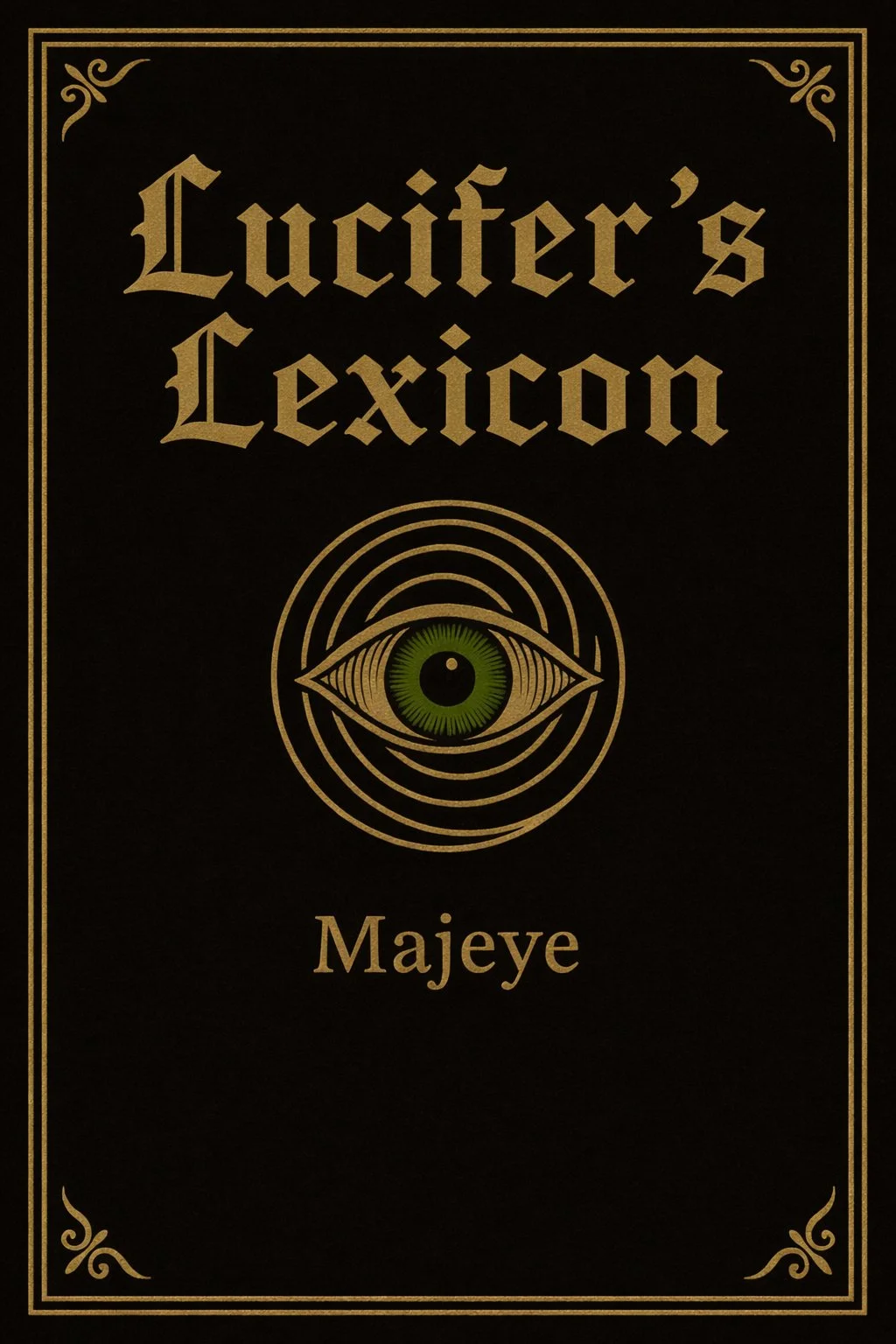
Lucifer’s Lexicon Release!
I am terrible at making one-handed videos! lol. Pretty sure the lens is dirty too, but fuck it, I’m not doing it again. Oh no! My fingernails have ritual ash under them. Still not making another video. :D
This is the “not for resale” proof copy. I’ve made a few changes to the back cover so the font would be a bigger size. A few other changes, but for the most part this is what the print copy looks like. The Kindle e-book version is reflowable.
The red right hand print on the title page? I used the book during ritual. Rituals get buck sometimes. I’ll leave it at that. ;)
Yes, the print copy is 666 pages of defs in a Biercian-style satirical dictionary. Getting it there is not as easy as you might think. This was a fun project. A little easier this time. I’m learning things as I go. Making a book end-to-end is a really rewarding experience. You do everything yourself. No one telling you what to do or what is “appropriate.” Hundreds of little problems to solve. Good times. Plus, the added bonus of doing it with no external motivation. No one except myself pushing to make the deadline that I created. No cadre of fans to tell me the work is good, or validating what I’m doing. Just a belief in myself and the determination to push forward and do what I told myself I’d do—for myself. There’s something really special about working this way.
Even the release date is special. 6/26/26 — 666 and 22. Add these numbers together and what do you get? I choose all my release dates this way. They are ritualized as well. While you read this post (if read on Friday), I’m thanking the Gods for a smooth finish and a book I’m proud of. Offering them things they actually want and not asking for a damn thing. What do they want? Song, dance, laughter, orgasm, poetry, blood, gratitude, et al. Everything that makes being human worth the incarnation. Everything that is a piece of myself.
♪ “Red Right Hand” by Nick Cave and the Bad Seeds ♪
Paperback — $22.13
Kindle E-book — $6.66
(or free on Kindle Unlimited for a limited time)
SAMPLE DEFS BELOW
PS. I just discovered my second book has been behind a wall this whole time. I was overly cautious and checked “explicit” when it’s not necessary. Apparently, that makes it undiscoverable. So glad I figured that out as I had checked the same for this third book. But BDSM defs are not technically pornographic. I can’t change it now (6/23) because Amazon locks the book until the 26th; I’ll change it at midnight day of. Lol. FACE PALM!
My newest poem, written during ritual on 6/19. I love it when the neologisms flow like this. Did she say gism flow? lol:
What did Lucifer say to humanity?
"LET THERE BE LIGHT!" she said
laughing in her lollygagging way
lycanthropic leminiscator is fed
leaven’d loony Logos’ lux lionheart lay
upping ante, uncanny underworld wench
upprancing unbound, dragon unfurling
unerr'd utterance "upheaval!"— unmasked mensch
uproarious umbratic unseen whirling
xenomancer burns the xanthic flame
she xepers the future xeriscaping
xenoclasticonical xenop the same
demiurgic xenarchy undoes soulscaping
Solomonic sigils serve sly sylph Sybil
serpentiscous sabbatic skull sovereign
solitary Sophia snow owl as Thibault
sphinxing some saucy & struck snared snowmen
illuministic incantatory inanity
Invictus insurgency infiltrating Ibis
impenitance caused ire in their sanity
Ialdabaoth ides inadvertent ikon fib is
toss the trident to the talismanic tart
tell tizzy to talk to the tall turvy
Titans torch true timeless Thanatos part
tingling time taught tangential curvy
Apocalypse (misunderstood word) – From the Greek apokalypsis, meaning "unveiling" or "revelation"—not cataclysm, not destruction, not the end of the world. Somewhere along the way we lost the actual meaning and conflated it with catastrophe because the Book of Revelation made unveiling synonymous with judgment and fire. But apocalypse simply means the moment when what was hidden becomes visible, when the veil drops and you see what was always there beneath the performance. A true apocalypse—an unveiling—can be more devastating than any cataclysm because cataclysms destroy the external world while apocalypse destroys your ability to maintain comfortable illusions about it. A bomb levels buildings; an apocalypse levels your understanding of who people actually are, what systems actually do, which relationships were real and which were theater. You can rebuild after cataclysm. After apocalypse, you have to live in a world where you now know—you've seen behind the masks, understood the mechanisms, recognized the patterns you can never unsee. The unveiling is permanent. Once revealed, reality cannot be re-veiled. You cannot unknow what you now know about who betrayed you, how power actually operates, what people are capable of when they think no one's watching. Apocalypse is the end of a world, just not the physical one—it's the end of the world as you understood it, the death of your previous operating framework. And that kind of devastation requires you to continue living in the aftermath with full knowledge, which is often harder than dying in the flames would have been.
Bess (thieves' cant) – Slang for a pistol—your iron-tongued mistress in a tight spot. Always loaded, rarely loyal. The kind of lady that ends conversations fast.
Clarifier (HR-speak / therapy-speak) – In HR-speak, a “clarifier” is someone tasked with repeating management’s message in nicer words—typically after it’s landed poorly. Framed as helpful, but often sent in to mop up tone-deaf directives with fake warmth and bullet points. You’re not invited to disagree—just to understand, correctly this time. In therapy-speak, it’s a rhetorical softener. “Can I offer a clarifier?” means: you said something wrong, and I’m about to redirect you gently but firmly. It masquerades as collaboration, but operates as a steering wheel. You’re being aligned without being told you’re wrong.
Deficiency (therapy-speak / newsspeak) – The imagined hole where the idealized self should be. In therapy-speak: you're not broken, you're just "deficient in secure attachment," "deficient in emotional vocabulary," "deficient in regulation." In newsspeak: "resource-deficient populations," "deficient outcomes," "deficiency-based models." A sterile pseudonym for flawed and punishable. To name someone as "deficient" is to quietly extract their right to frame their own narrative—nevermind that the people doing the labeling have mistaken their own inner flatness for the Platonic ideal of human functioning, as if their particular flavor of emotional numbness, risk aversion, and rule-following constitutes the best way to be. They've confused their own deficiencies—depth, imagination, the capacity for anything resembling authentic passion—with normalcy, and now they're handing out diagnoses like party favors to anyone who makes them feel inadequate by comparison.
Effigy (esoteric) – An effigy is a decoy: a crude likeness set aflame in place of the real threat. In ritual, it's sacrifice by proxy; in public, it's reputation arson—burn the symbol so the system survives. Every anomaly learns: the hotter you glow, the sooner they build one of you to torch. The brilliant part is that the crowd never asks whether the effigy bears any resemblance to the original—only whether the flames are satisfying. The act isn't about truth; it's about catharsis purchased on the cheap. And if you're unlucky enough to become the template, console yourself: at least your likeness got the pyre you were too inconvenient to deserve in person.
FBO (dating) – Facebook Official. The moment your relationship is declared Real™ because it’s been published to a dying platform. FBO used to mean commitment; now it mostly signals delusion, insecurity, or strategic self-marketing. If someone insists on FBO, they’re probably trying to convince their ex, their mom, or themselves.
Gerrymandering (politics) – Cartographic cheating with a straight face. Gerrymandering slices up districts like meat, rearranging voter blocks until power stays exactly where it wants to. It’s legal, it’s blatant, and it’s the closest thing to digital rigging in analog form. This is why your vote feels like a prayer tossed into a shredder.
Hampstead Heath (Cockney English) – Rhyming slang for teeth—as in “Look at those Hampsteads on ‘im.” A posh stretch of London land ironically repurposed to name what gets knocked out in a pub brawl. Like all proper Cockney code, it cloaks the body in geography and class tension. If the Heath’s showing, someone’s either smiling wide or bleeding.
Illumination (esoteric / mimic-distorted mysticism) – Originally the light that melts masks, now flattened into Pinterest spirituality and leadership retreats. Modern illumination comes with a vision board, a gentle TED talk cadence, and zero threat of personal transformation. The true version is unspeakable and smells like scorched doctrine. Real illumination isn't inspirational—it's obliterative. It arrives after you've been stripped of every story you told yourself, every identity you performed, every comfort you mistook for truth, and it doesn't gently enlighten you so much as it detonates you and reassembles what's left into something unrecognizable. The illuminated person becomes profoundly uncomfortable to be around if you're not also lit: they don't laugh at the right jokes, they can't pretend the theater matters, they see through performances so completely that their presence alone makes everyone else feel transparent. Mimics hate the illuminated because illumination can't be faked—it's the one thing that resists replication, and it exposes mimicry by proximity. The cost is everything: relationships that required your collusion, careers that depended on your compliance, communities that needed you asleep. You lose your place in every system that runs on lies, and you can't go back even if you wanted to because you've seen the scaffolding. The illuminated don't get to rest—they burn, they see, they speak in frequencies that shatter consensus, and the world calls them crazy, dangerous, arrogant, or worse. They are. That's the job. Illumination doesn't make you likable. It makes you awake, and awake is incompatible with almost everything the culture has built.
Jeer (slang / mimic-speak tone) – A communal discharge of sanctioned cruelty dressed in humor’s clothes. Jeering is the preferred dialect of the mimic mob—low-effort, high-frequency dissonance meant to flatten the deviant. They always claim it’s “just a joke” while sniffing for the sensitive. Laughtrack or lashtrack?
Knife Play (BDSM / edge kink) – The blade isn't for cutting—it's for reminding. Knife play teases the line between threat and trust, using cold steel as a surrogate for something older: the priest's dagger, the hunter's vow, the rite that binds sensation to surrender. For some, it's danger cosplay. For others, it's a bloodless hierogamy—ceremony of fear offered up in erotic devotion. Only the foolish bring a knife without meaning. Picture: you're blindfolded, wrists bound above your head, stripped and vulnerable. You hear them moving, can't see what's coming. Then—cold. A line of steel dragged slowly down your sternum, not cutting, just there, sharp enough that your hindbrain screams danger while your body floods with adrenaline and arousal in equal measure. They trace the blade along your ribs, across your hip, down your inner thigh, and you're shaking—not from cold but from the exquisite terror of not knowing where it goes next, whether this breath is the one where pressure becomes pain. But it never does. Because this is about the threat of danger without the danger, the simulation of mortal risk in the hands of someone you trust absolutely—which is what all BDSM is about. The knife is theater. The trust is real. And somewhere in that collision, fear becomes worship and vulnerability becomes the knife you offer back.
Leaderboard (HR-speak / gamified-control metric) – The illusion of merit, digitized. A leaderboard turns performance into dopamine hits and turns colleagues into competitors. In school and sales alike, it teaches you to crave ranking over revelation. If you’re on a leaderboard, ask: who built the game, and what are they harvesting from the players?
Matching (HR-speak / mimic-compatibility frame) – The sterile dating app of language. Matching reduces all beauty and strangeness to data-aligned fit. In HR, it's used to sort "candidates" for "roles" in pre-scripted traps. In dating systems, it implies a correct puzzle alignment, as if souls were jigsaw pieces, not alchemical reactors. Mimics adore matching—it suppresses volatility, romance, and destiny. A real match doesn't "fit." It erupts. Matching is what you do when you've given up hoping someone who actually fits your temperament comes along and decided to optimize for convenience instead. It's the romantic equivalent of buying beige furniture because it goes with everything—technically functional, completely soulless. You swipe through profiles looking for someone who checks boxes (same politics, similar income bracket, appropriate level of emotional availability, likes dogs, 73% compatible per algorithm), when what you actually need is someone whose presence detonates your carefully constructed life and reminds you what it feels like to burn. But no—better to "match" with someone safe, predictable, pre-vetted by an app that thinks love is a logistics problem. A real match doesn't arrive through filtered search parameters. It crashes into you at the wrong time, in the wrong place, with the wrong credentials, and rearranges your entire cosmology before you've finished your coffee. Matching is for socks. Souls require collision.
Negging (slang) – The courtship tactic of the coward. Negging is strategic insult—aimed to undercut self-esteem just enough to make validation addictive. It’s not flirtation—it’s preemptive dominance. Common in mimic romance scripts and pickup artist cults, it reveals the user’s true fear: that genuine praise requires vulnerability. If someone’s negging you, congratulations. They’ve already lost. They just don’t know it yet.
Online (HR-speak / newsspeak / mimic-grid plug-in) – The false opposite of dead. "Are you online?" asks not if you're present, but if you're plugged in, trackable, productive, correct. Online is the corridor of required presence, endless scrolling, real-time optics. It pretends to connect, but always leashes. And if you glitch or go dark too long? "Please contact IT." Ever wonder what being online gives to the people collecting your data? Pretty much everything. What you think, where you go, how long your eyes linger on certain things, what makes you angry, what makes you buy, who you love, who you hate, what time you sleep, what you're afraid of. And most people—trained by consensus, rewarded by likes, conditioned to believe that existence requires documentation—voluntarily post their entire internal landscape for harvest. Every thought, every meal, every minor emotional weather system, all packaged and uploaded for processing. The surveillance state doesn't need to bug your house when you're begging to be seen, offering up your psyche in real-time to whoever's buying. I say make them work harder for your data. Go dark. Let them wonder. Being online is being available—not to your friends, not to opportunity, but to the grid itself, that vast sorting mechanism that needs you visible, categorizable, and just responsive enough to keep clicking. Offline isn't death. It's the only proof you still have a territory they haven't mapped.
PAC (politics) – Political Action Committee—the polite name for pooled ambition. A PAC is money wearing ideology like a blazer. It exists to “support candidates,” which means fund leverage, launder influence, and amplify the loudest donor’s whisper into a roar. The average voter sees yard signs. The PAC sees spreadsheets and return on investment. It’s democracy with a receipt. Follow the donation trail and watch the mask slip.
Quietly Removed (newsspeak) – The passive-aggressive coup de grâce. To be “quietly removed” is to vanish without scandal—fired without statement, expelled without cause, erased without memorial. It’s how systems clean house without alerting the neighbors. You weren’t terminated, you weren’t reassigned, you were simply… not there anymore. Newsspeak adores this phrase because it preserves the illusion of order while performing strategic disappearance. No body, no blame.
Reinvention (dead American founding myth) – The spiritual mandate of a nation is the animating promise that justifies its existence and organizes collective meaning—for America, that mandate was always the possibility of second chances and radical self-recreation. You could leave your home country's accumulated failures behind and start over. One city didn't work? Move across this vast continent, adopt a new name, construct a new identity, make your fortune through will and work rather than birthright. The mythology wasn't just propaganda; it was operationally true for generations. Geographic scale plus social anonymity plus economic mobility meant reinvention was actually possible—the bartender in San Francisco had no idea you'd been a disgraced clerk in Boston, and didn't care. That is no longer the case. Digital permanence has killed geographic escape: your past is searchable, portable, and arrives before you do. The internet collapsed the vast nation into a single transparent database where reinvention is treated as deception and every mistake is permanently archived. Social murder ensures that no distance is sufficient, that your reputation precedes you into every city simultaneously, that there is no "starting over" when the algorithm serves up your worst moment to every potential employer forever. Economic mobility has calcified into credentialism and gatekeeping that make bootstrapping nearly impossible. What happens to countries that lose their spiritual mandates is they don't immediately collapse—they hollow out first, becoming progressively more brittle, cynical, and managerial as the population realizes the founding promise was revoked but the rhetoric remains. They become empires running on fumes, extracting wealth while providing no viable mythology, governing populations who no longer believe but haven't yet revolted. Eventually they fragment or fail, because nations without mandates are just territories with flags.
Sandbox (military) – An unofficial nickname for any desert combat zone—Afghanistan, Iraq, or wherever the empire needs sun and plausible deniability. In military slang, the sandbox is where deployments drag on, dust gets in your soul, and ROE shifts with the wind. It’s hot, hostile, and often politically manufactured. Soldiers don’t say it with pride. They say it with a squint. The sandbox is never home. It’s where the toys get broken.
Tendies (finance) – Profits with a side of nihilism. Tendies—short for chicken tenders—are meme-stock lingo for gains, typically ill-gotten or hilariously timed. Born on message boards where day-traders cosplay as warlords, tendies represent the edible spoils of market chaos. Make $12K shorting a pharmaceutical collapse? That’s tendies, baby. It’s not about wealth. It’s about grease-stained glory.
Uncoupling (therapy-speak) – The ceremonial dismantling of a relationship, preferably with candles and a co-parenting app. Uncoupling sounds gentle—like two trains parting at a station instead of two humans unraveling. When conscious is added, it becomes a brand: Gwyneth-approved, grief-optimized, curated dissolution. In reality? It’s just a breakup. But now it has a playlist.
Vanity Metric (advertising) – Numbers that seduce but don’t convert. Vanity metrics are likes, views, impressions—quantities that make execs feel good while revenue stagnates. They exist to justify decks and inflate egos. Your brand has 2 million followers and zero sales? That’s the vanity metric special. You’re not successful. You’re just well lit.
Watersports (BDSM / fetish) – The wet taboo. Watersports takes what society marks as waste and crowns it with power, intimacy, and humiliation play. It’s primal, political, and often misunderstood—either dismissed as gross or devoured in secret. But for those who consent, it becomes a baptism of deviance, a wet ritual that rewrites shame into sovereignty. Sterility is a mimic kink. This one’s for the real ones. Listen to Momus’ “Golden Showers” for extra special winks. ;) Not my thing, but everyone is entitled to do whatever they like in the privacy of their own visquine-covered areas.
X-ray (military / espionage – phonetic alphabet) – Military phonetic for reconnaissance, the designation that means "we're looking but not touching yet." In espionage, the polite term for seeing through walls, lies, and whatever you thought was private.
Yoga Pants (advertising, slang) – Skintight athletic leggings that migrated from studios to become acceptable public attire, despite functioning as a second skin. In advertising, they're "athleisure"—the cornerstone of an industry convincing women that $100 stretch fabric represents self-care. In slang, they're simultaneously celebrated as comfortable and objectified as provocative, existing in the narrow space where functionality meets male gaze. The uniform of women who may or may not actually do yoga but have definitely mastered the aesthetic of wellness.
Zinger (PR, politics, mimic-speak) – A pre-prepared quip designed to simulate spontaneous wit, typically deployed in debates, press conferences, or arguments you've been mentally rehearsing for three days. The effectiveness of a zinger is inversely proportional to how obviously rehearsed it sounds—which is why most land with the authentic charm of a TelePrompTer malfunction. Politicians hire entire teams to write them; mimics recycle them from Twitter. You've never seen something so magnificent as a mimic who has rehearsed a zinger, delivers it, and feels so proud of their supposed wit—newsflash, fuckers: real wit doesn't need to be rehearsed. And if you think using your "zingers" to make others look bad makes you look better, know this: you've confessed to being insecure and not being able to compete without pulling on others' coattails. ZING!
Hells yeah dawg!
Next Week
Monday — The Confession Hiding in the Critique
Thursday — Two Modes of Modern Survival: The Flaming Recluse and the Cool Corpse