The Merit Myth's Hidden Architecture: Intelligence as Virtue
I. The Credential as Character Proof
Somewhere between the aptitude test and the alumni network, a substitution occurred. Intelligence—once a morally neutral descriptor of cognitive capacity—became a virtue. Not just useful. Not just measurable. Good. The degree from the good school doesn't merely signal competence in a field; it certifies that you are the right kind of person. That you made the right choices. That you delayed gratification, navigated institutional corridors with appropriate deference, optimized your resume at seventeen. The credential becomes a character reference written by systems designed to neutralize character entirely.
This is the prestige economy's most elegant trick: the conflation of intellectual processing power with moral worth. The meritocracy doesn't argue that smart people happen to end up in positions of influence—it argues they deserve to be there. That the capacity to perform well on sequential filters of standardized assessment is not merely correlated with success but is, in fact, evidence of something deeper. Seriousness. Discipline. The ineffable quality of having "done things right."
The advanced degree, the name-brand firm, the fellowship, the award—these don't just open doors. They testify. They say: this person has been vetted by institutions we trust, and institutions we trust do not credential the unworthy. The syllogism is flawless until you look directly at it. Then it reveals itself as circular, almost mystical: the worthy are credentialed, and the credentialed are worthy, and the whole edifice rests on the unexamined premise that the systems doing the credentialing are themselves arbiters of virtue rather than arbiters of compliance.
What follows is an unpacking of that substitution—how cognitive performance became moral performance, how institutional approval became ethical validation, and how an entire class learned to mistake their capacity for abstraction for a capacity for goodness.
II. The Protestant Root: Elect by GPA
The Calvinist knew he was saved not by feeling saved but by prospering. Worldly success—wealth, stability, the visible accumulation of God's favor—was the external proof of an internal election. You couldn't earn salvation, but you could demonstrate that you already had it. The anxiety was structural: you were either chosen or you weren't, and the evidence of your status was written in your material circumstances.
Meritocracy is that same architecture with the god removed. Divine election becomes "potential." Predestination becomes "aptitude." The visible marker shifts from wealth to credentials, but the moral logic remains untouched: a hidden quality separates the worthy from the unworthy, and institutional success is how that quality makes itself known. The person who gets into the right school, who performs well under structured evaluation, who accumulates the correct sequence of validations—this person has been chosen. Not by God, but by something arguably more implacable: their own cognitive wiring, expressed through systems designed to surface it.
The damned, in this framework, are not the poor but the unaccomplished. The people who didn't test well. Who went to the wrong college, or no college. Who lack the titles that permit entry into rooms where decisions are made. Their damnation is not theological but social, and it carries the same implication the Calvinist system did: this was always how it was going to be. You were always this. The exam didn't create your inadequacy—it revealed it.
The anxiety is identical. The Calvinist scanned his life for proof of election; the meritocrat scans his resume. Both are looking for reassurance that they are not, in fact, among the unsaved. And both systems offer the same cold comfort: the question was answered before you asked it. Your worth was established upstream. The credentials just make it visible.
III. What the Architecture Actually Rewards
The meritocratic framework announces itself as democratic—intelligence and effort, theoretically accessible to anyone willing to work hard enough. But peel back the announcement and examine the actual mechanisms, and a narrower picture emerges. What the system rewards is not intelligence in the broad, various sense. It rewards the capacity to perform well within specific institutional frameworks, under specific conditions, according to criteria designed by specific people with specific assumptions about what intelligence looks like and how it should be expressed.
It rewards compliance with evaluation mechanisms. The ability to understand what the test is asking for and deliver it under time constraints. The capacity to navigate bureaucratic structures, to defer appropriately, to read institutional cues and adjust one's presentation accordingly. It rewards the particular kind of intelligence that can be credibly measured by institutions—which is a thin slice of what human cognitive capacity actually encompasses. Abstract reasoning. Verbal facility. The ability to succeed in artificial environments designed to produce ranked outcomes.
What it systematically undervalues, or renders entirely invisible: emotional intelligence, creative intelligence that doesn't conform to rubrics, embodied intelligence, the kind of spatial or mechanical reasoning that operates outside text, the pattern recognition that comes from lived experience rather than formal study, the wisdom that accumulates in contexts institutions don't control. These forms of capability exist, they matter, they shape outcomes in the world—but they leave no mark on the transcript. The meritocracy doesn't deny their existence. It simply declines to count them. And what doesn't count doesn't, within this framework, confer worth.
There's a second silence, larger and more damning. The person who arrives at the good school arrived with support—financial, emotional, structural. Parents who understood the system. Tutors. Time to study instead of work. A stable home. The assumption of college as default rather than aspiration. The credentialed rarely perform the thought experiment in which they are the same person, same cognitive capacity, but without the scaffolding. The teenager working nights to contribute to rent doesn't have less aptitude than the teenager with the SAT tutor—she has less slack. But the system reads her transcript and concludes she has less capacity, and by extension, less worth.
The person who believes themselves superior because of a credential never calculates how much of that credential was infrastructure. They don't ask whether they would have it if the conditions had been different—because the conditions weren't different, and the framework teaches them to interpret their position as earned rather than enabled. Place that same person in the circumstance of the one without support, and the credential evaporates. Not because the intelligence was never there, but because intelligence alone was never enough.
If the architecture rewards a narrow slice of human capability while claiming to reward the full range, then its moral claims are not just technically flawed—they are fraudulent. The proposition that the credentialed deserve their positions, that the uncredentialed deserve exclusion, rests on a measurement system that was always designed to recognize only certain kinds of people under certain kinds of conditions. It calls itself merit. It is, more precisely, a detection system calibrated to find people who already look like the people who built it.
IV. The Deserving and the Spare Parts
The meritocratic moral architecture doesn't merely elevate the credentialed—it condemns the uncredentialed. This is not incidental. It is the necessary corollary. If your position in the hierarchy reflects your cognitive virtue, your essential quality made visible through institutional validation, then those at the bottom must lack that quality. Their position, too, is deserved. Not as accident. Not as misfortune. As revelation.
The poverty of the uncredentialed, in this framework, is not structural. It is earned. Their struggle is evidence. Evidence of insufficient intelligence, insufficient discipline, insufficient seriousness. They made bad choices, or they lack the capacity to make good ones. The meritocracy doesn't need to argue this explicitly—the logic is baked into the premise. If the system rewards merit, and you were not rewarded, then you did not have merit to reward. The conclusion follows automatically, cleanly, with the satisfying click of a mechanism closing.
This is how highly educated, ostensably compassionate people look at systemic inequality and arrive, every time, at explanations that terminate in individual failure. Not because they are cruel—they would recoil at the suggestion—but because the moral architecture they inhabit makes cruelty feel like accuracy. Like simply acknowledging what is. The person without the degree didn't have what it takes. The neighborhood that can't fund its schools made bad decisions, generationally. The woman working two jobs to stay housed is not navigating a system designed to extract maximum labor for minimum security—she lacks the skills to access better employment. The explanation sounds neutral, empirical even, right up until you notice it requires you to believe that entire populations are constitutionally incapable of what others accomplish routinely, and that this incapacity just happens to correlate suspiciously well with race, class, and geography.
The meritocratic framework transforms what is actually a rigged game into a story about character. The person who couldn't afford to stay in school didn't face impossible tradeoffs—she lacked grit. The kid in the underfunded district didn't lack resources—he lacked motivation. The structural is rendered personal. The systemic becomes individual. And because the credentialed are, by definition, the people the system was designed to recognize, they move through this logic without friction. It feels true because it flatters their position. It calls their advantages virtues and other people's disadvantages flaws, and it does so in language that sounds like fairness.
The most complete expression of the system's power is not that the credentialed believe it. It's that the uncredentialed do. The person who didn't finish college and works hourly doesn't think the system failed her—she thinks she failed the system. She internalizes the diagnosis. She looks at her circumstances and concludes she must lack something, some quality the people above her possess, or she would be where they are. The wound isn't just material. It's moral. She has been told her position reflects her worth, and she has, on some level, believed it. The meritocracy doesn't need enforcement mechanisms when it has accomplished this. The condemned police themselves.
V. The Moral Collapse AI Is Accelerating
The credentialed class built its claim to superiority on a specific, measurable capacity: they had read more, retained more, could synthesize across domains with facility, and could express that synthesis in sophisticated vocabulary. This was the invisible quality the credentials were meant to certify. Not creativity. Not original thought. The ability to absorb large bodies of information, identify patterns within them, and reproduce those patterns fluently under pressure. It was always, at its core, a feat of complex retrieval and recombination.
The machine now does this better. Faster. Across more domains. With more consistency. And the moral architecture built on top of that performance is collapsing in real time.
The threat isn't merely economic, though the economic dimension is real enough—white collar jobs structured around information synthesis are discovering they were more procedural than their occupants believed. But beneath the economic disruption is something more destabilizing: a moral crisis. The person whose identity rests on being the kind of person who went to the right schools, who can cite the relevant frameworks, who speaks in the register that signals competence within institutional spaces—that person's claim was never I can do this task. It was I am the kind of person who deserves to do this task. The credential was proof of an essential quality. When the quality turns out to be replicable by silicon, the proof evaporates.
What AI cannot do—what it is not designed to do and shows no sign of approaching—is produce genuinely novel ideas. The conceptual leap that reconceives a problem rather than solving it within existing parameters. The insight that emerges from lived experience, embodied knowledge, the kind of pattern recognition that operates outside text. The ability to see differently, not just process faster. But the credentialed, by and large, treated this as horrifying. Original thought was risky. It didn't scale. It couldn't be standardized, assessed, credentialed. The system rewarded people who could master existing frameworks, not people who could escape them. Creativity was fine for artists—meaning, for people outside the structures of serious institutional power. The meritocracy wanted intelligence, but intelligence of a specific kind: refined, measurable, expressible in the vocabulary the institution already spoke.
Now the people who spent decades deriding the humanities as impractical, who rolled their eyes at the intuitive, who dismissed the uncredentialed as lacking rigor, are discovering that their own expertise was procedural. That what they thought of as sophisticated reasoning was, in many cases, sophisticated retrieval. That the job they believed required a person like them can be done by a process with no person in it at all.
This is why the response is so visceral. Job loss can be survived—people retrain, industries shift, the disrupted find new positions. But identity dissolution is a different order of threat. The meritocrat's self-conception was built on the premise that their cognitive performance was not just useful but morally significant. That it marked them as deserving. That the degree, the job, the position in the hierarchy reflected something essential about who they were. When that performance is revealed as replicable, the moral claim built on top of it doesn't just weaken—it vanishes. They are left holding credentials that certify a capability the market no longer values, and a self-concept that depended entirely on that capability being rare.
The AI disruption isn't just automating tasks. It's performing an autopsy on meritocracy, and the credentialed are discovering they don't like what's being revealed.
VI. What Genuine Moral Architecture Looks Like
If the credential doesn't certify virtue, if cognitive performance is morally neutral, if institutional accomplishment measures compliance more than character—then what does constitute moral distinction?
The answer is everything the meritocratic framework systematically excluded. Everything that can't be tested, credentialed, or summarized on a resume. Everything the machine cannot counterfeit because it requires a self that can be risked.
Courage under genuine pressure—not the managed risk of the competitive application process, but the kind that operates when there's no safety net and no audience to applaud the attempt. Compassion that costs something. That allows itself to be wrecked by proximity to another person's pain, that doesn't retreat into the professional distance that keeps the heart intact. Integrity that holds when no one is watching, when there's no credential at stake, no optimization of reputation, no clear return on the investment of doing the right thing.
The willingness to tell the truth in rooms where the truth is unwelcome. To name what everyone sees but no one will say. To refuse the collective lie even when the lie is comfortable and the truth will cost you the room. The capacity for genuine care without the expectation of reward—care that doesn't track return, doesn't calculate whether the other person can do something for you later, doesn't require the object of care to be worthy by some external standard before it's extended.
These are not measurable by any institutional framework. They don't produce a GPA. They don't get you into the right school or the prestigious firm. They leave no mark on the transcript. They are legible only in the specific, irreducible moments in which they appear—and often, they're most present precisely when no one is tracking them. They require a self that can be lost, a heart that can break, a stake in something beyond the efficient management of one's own position in the hierarchy.
This is what the meritocracy trained an entire class to ignore: that moral worth has nothing to do with how well you perform under artificial conditions designed to rank you against your peers. That virtue is not a score. That the qualities that make a person good—actually good, not compliant, not credentialed—are the ones that resist quantification entirely. They emerge in the margin between what you're required to do and what you choose to do when the requirement ends. In what you protect when protecting it costs you something. In whether you can be trusted when trust can't be verified.
The meritocratic framework offered a beautifully simple equation: intelligence equals virtue, credentials equal worth, position equals desert. It was clean. Measurable. And it was wrong—not as an approximation, but as a category error. It mistook a narrow cognitive capacity for the whole of human value, and then built a moral architecture on top of that mistake. The collapse we're witnessing now is not a disruption. It's a correction. The question is whether the people who benefited from the confusion can survive having it named.
Conclusion
The meritocratic architecture was always trying to approximate something real—and consistently failing to measure it. Not intelligence. Not credentials. Not institutional accomplishment. What matters, what has always mattered, is the quality of a person's actual presence in the world. How they treat people who can do nothing for them. What they do when the credential can't help them. Who they are when the entire architecture falls away and there's nothing left but the person underneath.
These are the things that constitute moral distinction. These are the irreplaceable qualities. And AI, by replicating everything the meritocracy could measure, is throwing into sharp relief everything it couldn't.
The credentialed are writing think pieces about this like it's civilizational collapse, the end of meaning, the doom of us all. In reality, it's just the end of them believing their credentials conferred moral superiority. The rest of us—the ones the system never recognized, never credentialed, never granted the fiction of deserving—already knew the degree wasn't virtue. We've been here the whole time, doing the work that requires a self, while they optimized their resumes.
We can't be Calvinists forever. The notion that a country's founding mythology must remain its operating system indefinitely is itself a failure of imagination—the same failure that mistakes a 17th-century anxiety about election for a timeless framework of human worth. There are other ways to organize society. Other metrics. Other architectures that don't require us to pretend cognitive performance is a moral category.
The collapse of this one isn't tragedy. It's possibility.
The people who built their entire self-concept on being the kind of person institutions recognize are mourning. Let them. The rest of us have work to do—the kind that was never going to show up on a transcript anyway.
—M.
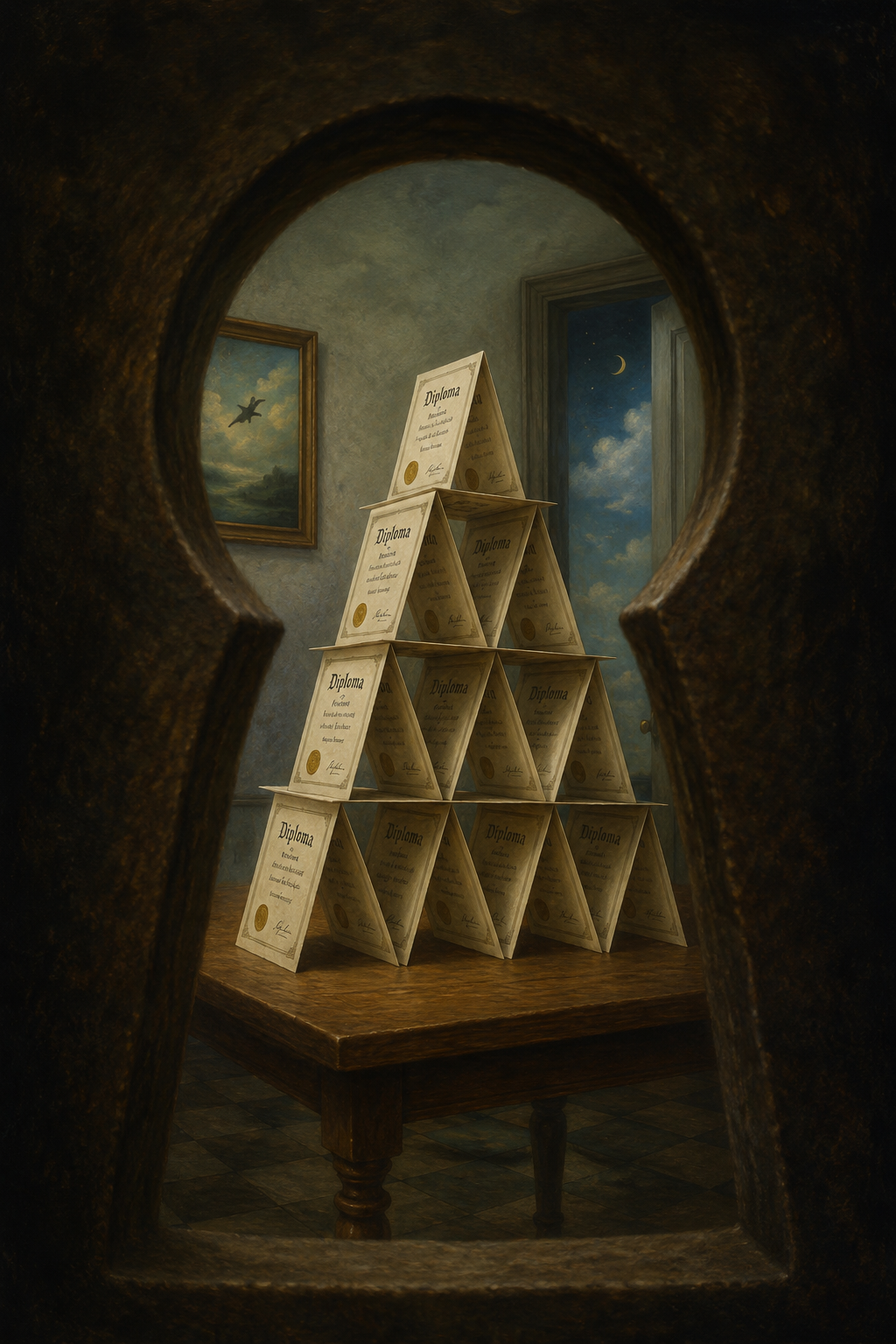
All it takes is a strong gust of wind…
FRIDAY 6/26/26
Here are all the goodies coming up on Friday:
A video of my proof copy (ignore the red right handprint), some thoughts about making Lucifer’s Lexicon, link for purchase, a brand new poem written 6/19 during ritual, defs from A-Z, some songs to check out.
Twill be a fun Friday.
( ͡~ ͜ʖ ͡°)