The Crack Scanner: A Field Guide to the Reader Who Isn't Reading
I. Habitat and Identifying Features
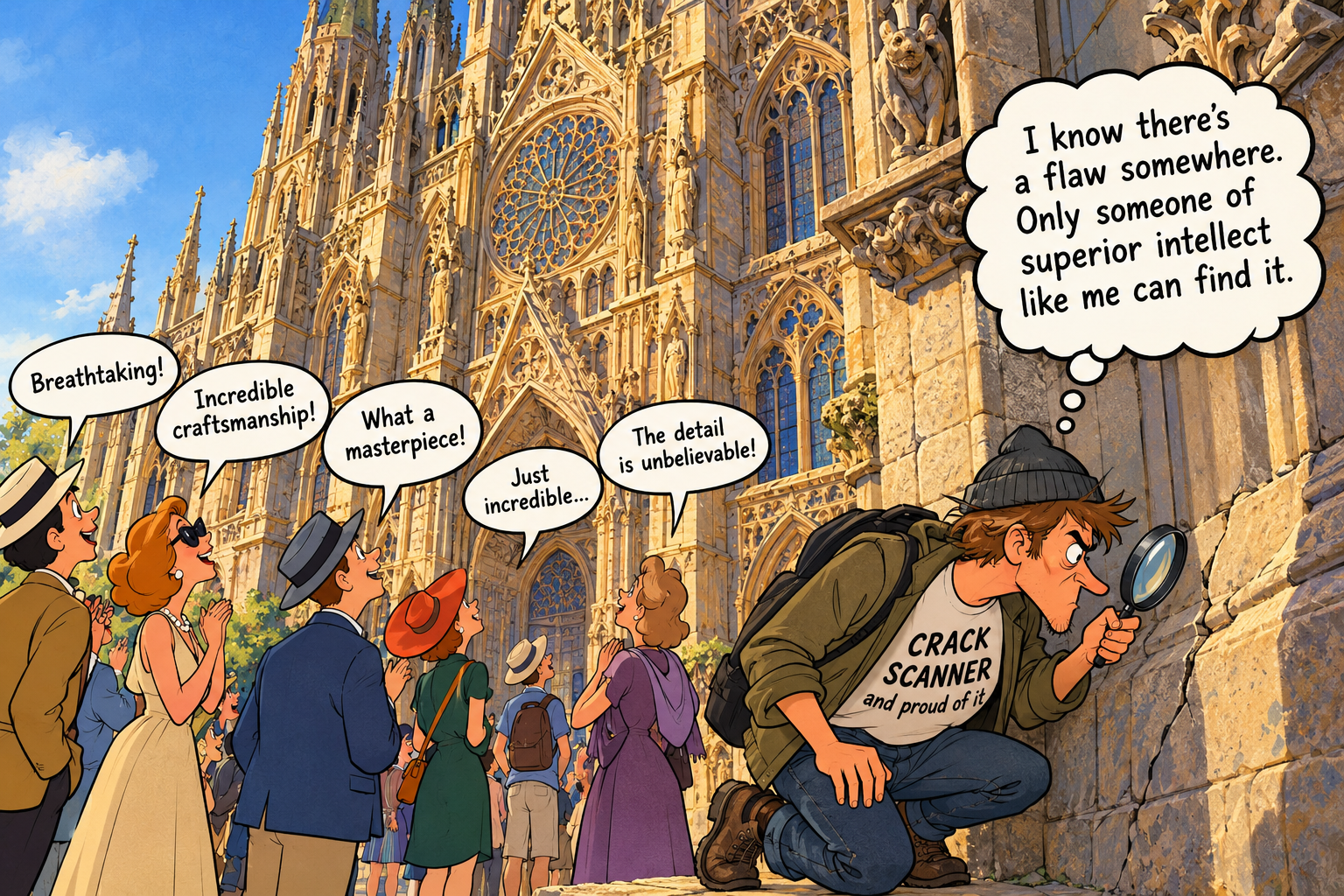
Scrutinarius perimetricus—known in the field as the Crack Scanner, the Perimeter Critic, or simply That Person In The Comments—is one of nature's more peculiar specimens, and frankly, one of its least self-aware. It does not read to understand. It does not read to feel. It doesn't even read to disagree in the honest, bracing way that makes intellectual combat worthwhile. No. It reads the way a customs agent reads a suspicious passport: scanning for the irregular, the mis-stamped, the technically off. It's looking for the crack. Always the crack. The crack is the whole point.
You'll find it—and here is where things get interesting, naturalists—not inside the arena where ideas are being tested, but hovering in the comments section just outside it. That's prime habitat. The comment section of someone else's work is, for Scrutinarius perimetricus, what the watering hole is to the lion: a place to assert dominance without expending any of the energy required to actually build something. The prey—the idea, the argument, the creative work—has already done the grueling labor of existing. The Crack Scanner simply descends to remind everyone it noticed a hairline fracture in paragraph four.
What makes this creature identifiable in the field is its eyes. The genuine reader has a quality of stillness when they engage a text. They lean in. There's absorption happening—the way water moves through soil, the way a person looks when something is actually getting in. But Scrutinarius perimetricus never really lands. The eyes are scanning. Fast, restless, skipping wholesale over the paragraphs where the beautiful and complicated things live, hunting for the one place the author might have slipped up. You can practically watch the verdict forming before the first paragraph has even cleared the screen. That's not reading. That's prosecution. And the verdict—guilty, obviously, of something—was drafted in the parking lot before they came inside.
The specimen's most remarkable survival adaptation is its near-total imperviousness to exposure. It has no natural predators because it never, under any circumstances, puts itself in a position to be caught. To be caught, you'd have to produce something. An argument. A counter-thesis. A competing work. Something that could be subjected to the same scrutiny it dispenses so freely and with such evident pleasure. But Scrutinarius perimetricus doesn't do that. It lives in the space just outside the arena—near enough to the heat to feel important, far enough from the fire to remain completely safe. The superiority is free.
II. What They Actually Do (And Call Reading)
Here's the thing about Scrutinarius perimetricus that the uninitiated observer might miss: it genuinely believes it's reading. This is perhaps the most poignant detail in the field guide. It's not performing incomprehension. It's not consciously avoiding the actual content. It has simply mistaken a completely different activity—let's call it forensic hovering—for the act of engaging with a text, and it has been making this mistake so long and so consistently that the confusion has calcified into identity.
What it actually does is treat the text as a crime scene. Not a territory to explore—not a piece of architecture you can walk through and feel the proportions of—but a crime scene. It arrives with the yellow tape already up. Something happened here, it can feel it. Someone wrote things, and some of those things are probably wrong, and its job—its sacred, self-appointed, thoroughly unpaid job—is to find the body. So it doesn't read the way you'd explore a building you'd never been inside, moving from room to room with genuine curiosity about where things lead. It goes straight for the load-bearing walls and starts pressing. The architecture? Irrelevant. The view from the window? Not its department. The question it never asks—what does this place open up?—simply doesn't occur to it as a question worth asking.
Every qualified statement gets mentally filed as an admission. The author wrote "arguably"? Noted. Defensive hedging. They know this doesn't hold. The author made a bold, swinging claim without a battery of citations? Overreach. Hubris. I've got you. The absence of footnotes becomes, in the Crack Scanner's cosmology, evidence not of a different register of thinking but of the absence of thinking entirely. It has somehow never encountered the concept of an essay. It has somehow never considered that some of the most consequential ideas in human history arrived without an academic apparatus stapled to them. That Montaigne didn't footnote. That Baldwin didn't footnote. That the footnote is a tool, not a certificate of intellectual legitimacy—this thought is simply not available to it. The footnote isn't evidence of rigor to Scrutinarius perimetricus. It's evidence that you showed up. And if you didn't bring one, you obviously didn't do the work.
The crowning confusion—the one that really separates this specimen from anything resembling a reader—is the equation it makes between finding a crack and understanding the building. These are not the same thing. They are not even in the same neighborhood. A building inspector who finds a hairline fracture in the foundation and declares the building worthless has not understood the building. They've identified one data point and declined to engage with the rest of the structure. But Scrutinarius perimetricus doesn't know this, because to know it you'd have to have once loved a building—to have once cared about what something meant rather than whether it was technically unassailable. And it hasn't. It doesn't love buildings. It just finds cracks.
So it finishes the piece. It puts the text down. And here's what's genuinely almost impressive about this creature in the clinical sense: it feels satisfied. Not the deep, rattled, productively destabilized satisfaction of having been somewhere and come back changed. Not even the clean satisfaction of having disagreed and known why. It feels the smooth, self-confirming satisfaction of someone who went looking for exactly what they found. It didn't encounter the work. It conducted a sweep of the premises, confirmed its suspicions, and filed the report. It was never anywhere near the thing that was actually being said. And it will never know that. That's the real crack in the building—and it's in the scanner.
III. The Skeptic vs. The Crack Scanner: A Necessary Taxonomy
We must pause here, naturalists, because a dangerous misidentification is rampant in the field, and it's doing real damage to the ecosystem. The Crack Scanner has a cover story, and the cover story is: skeptic. It will call itself a critical thinker. It will invoke rigor. It will say things like "I just ask questions" and "extraordinary claims require extraordinary evidence" in a tone that suggests it invented both sentences. And because genuine skepticism is a real and valuable thing—a beautiful thing, honestly, one of the better things human minds do—we owe it to the actual skeptics of the world to draw this taxonomy clearly, carefully, and with the kind of precision Scrutinarius perimetricus only pretends to value.
The skeptic engages the argument. The Crack Scanner engages their own need to win. This sounds like a subtle distinction until you watch them in the field side by side, at which point it becomes as subtle as the difference between a surgeon and someone who just really enjoys holding a scalpel. The skeptic reads the work and genuinely wrestles with it—takes it seriously enough to push back on it seriously, which is itself a form of respect the Crack Scanner is constitutionally incapable of offering. The Crack Scanner isn't wrestling with the argument. It's wrestling with the unbearable possibility that someone, somewhere, said something it didn't say first, and winning that wrestling match is the entire project.
Here's the field test, and it's a reliable one: can they be moved? The skeptic can. Not always to full agreement—that's not the requirement—but something happens to them inside the work. They enter genuinely and come out different in some small way. Maybe they've updated a position. Maybe they've sharpened their objection into something more honest. Maybe they've just sat with a discomfort they didn't have before. Something got in. Persuasion was always on the table as a possibility, even if it didn't happen today. The Crack Scanner cannot be moved because persuasion was never on the table. It wasn't even in the building. It came to prosecute, and you don't acquit the defendant mid-prosecution just because the evidence turned out to be complicated. That's not how prosecution works. The verdict was the point. The trial was the theater.
Watch the objections, too. The skeptic's objections are proportional—they scale to the actual claims being made, they live in the same neighborhood as the work itself, they cost the skeptic something to articulate because a real objection requires real engagement. The Crack Scanner's objections are proportional to its ego, which means they're frequently enormous, frequently beside the point, and almost never priced in proportion to what's actually on the page. A modestly-argued essay about, say, the phenomenology of boredom will receive objections sized for a manifesto. A personal essay will be treated as a failed academic paper. The Crack Scanner doesn't scale its response to the work. It scales its response to the wound—whatever ambient, low-grade, largely unconscious wound the work reopened just by existing and being someone else's.
The distinction that matters most, though—the one that should go on the plaque at the natural history museum—is the question of exposure. The skeptic is willing to be wrong in front of you. This is not a small thing. Being wrong in front of someone requires that you entered the conversation as a real participant, that you put a genuine position on the table, that you treated the exchange as something that could go either way. It requires, at some level, that you gave a damn about getting it right more than you gave a damn about being seen to get it right. The Crack Scanner has arranged things so that this is impossible. It never makes a claim that can be tested. It only interrogates yours. It's always at the net, never at the baseline, never in the position where it might have to run for something. It has built an entire intellectual identity out of the one posture that can never be falsified: I'm not convinced. And it calls this rigor. It calls this standards. It calls this thinking.
The skeptic is an intellectual interlocutor. The Crack Scanner is a tourist with a clipboard—moving through the exhibit, making little check marks, never once considering that the exhibit might change how it sees the world if it put the clipboard down long enough to look.
IV. What It Costs Them (And Why They'll Never Know)
And here, naturalists, we arrive at the part of the documentary where the music gets a little quieter and even the most hardened field researcher has to pause and acknowledge something almost—almost—melancholy about the specimen. Almost. Because what Scrutinarius perimetricus has done to itself, in the long project of perfecting its defense against being affected by anything, is deprive itself of the only thing reading actually offers. Not information. Not ammunition. Not the satisfaction of confirming that someone else's argument had a soft underbelly. The thing reading actually offers is encounter—the specific, unreproducible, slightly alarming experience of another mind getting inside yours and rearranging the furniture. The disorientation before the reorientation. The moment where you're not quite sure what you think anymore because something genuinely new got in. That's the thing. That's what's on the menu. And the Crack Scanner has never once ordered it.
It has, in fact, done something rather more committed than simply failing to order it. It has immunized itself against it. Deliberately, systematically, over years of practice, it has built an immune response so robust that no idea, however beautiful or destabilizing or alive, can penetrate the perimeter. And it experiences this immunity as sophistication. As discernment. As the hard-won critical faculty of a serious mind that can't be fooled. What it actually is—and this is the part it will never know, which is why we're putting it in the field guide—is impoverishment. Voluntary, self-administered, thoroughgoing impoverishment. It has made itself poorer and called it discipline. It has sealed the windows and called it insulation. Every book it's ever cracked, every essay it's ever swept for vulnerabilities, every piece of writing it's processed and filed and moved on from without being touched—those are meals it sat down to and ate without tasting. Technically completed. Calorically accounted for. Nutritionally void. It can tell you it ate. It can describe the restaurant. It cannot tell you what anything tasted like, because it never once stopped performing the act of eating long enough to actually swallow something.
The tragedy—again, almost, we're not made of stone over here at the field station—is that this accumulates. The Crack Scanner is often a person who has read a lot. Genuinely a lot. And all of that reading, all of those hours, all of those pages turned in prosecution mode, all of that text processed through the fine mesh screen of where's the weakness—it delivered essentially nothing that lasts. Not in the way that lasting things last. It will die, Scrutinarius perimetricus, having moved through an enormous quantity of human thought and having been genuinely moved by almost none of it. That's not a small thing to lose. That's most of the point. The books didn't change it. The essays didn't expand it. The ideas slid off the surface because the surface was designed to make things slide off, and it called that surface standards, and now it's seventy years old and it has standards, and it has not been anywhere.
And the crack! Let's talk about the crack, because this is really where the cost becomes visible if you're watching closely. Let's say it finds one. A genuine crack—a weak inference, a slightly overextended claim, a spot where the author reached further than the evidence comfortably supports. It finds it. The little dopamine flag goes up. There's a moment—brief, bright, self-congratulatory—of superiority. Got one. And then? Nothing. The crack delivers nothing with any architecture to it. No new thought was generated. No alternative framework was constructed. No better argument was built from the rubble of the one it found wanting. Just the high, clean, calorie-free sugar rush of having found the thing it came to find, followed by a return to baseline, followed by the need to go find another one. It's a slot machine that pays out in the feeling of being smart rather than in actually being smart, and it's been pulling that lever for decades, and the pile of winnings, if you look at it honestly, is entirely made of air.
Because here is the final, fatal confusion at the heart of Scrutinarius perimetricus—the one that explains everything else, that sits underneath every scanning eye and every prosecutorial comment and every footnote-shaped accusation: it has mistaken the ability to find fault for the ability to think. These are not the same ability. They are not even related abilities in the way it imagines. Finding fault is a retrieval function. Thinking is a construction function. One locates what's already there; the other builds something that wasn't. The Crack Scanner has refined its retrieval function to a genuinely impressive degree and has produced, in forty or sixty or seventy years of operation, almost nothing. It's like spending a lifetime perfecting the ability to spill paint and believing this makes you a painter. You've interacted with the medium, sure. Your hands are definitely covered in it. But there is nothing on the canvas. There has never been anything on the canvas. And the people whose canvases you've been critiquing all this time—they knew. They always knew. They just didn't say anything, because they were busy painting.
V. What It Says About Them (The Diagnosis)
We've observed the habitat. We've documented the behavior. We've tallied the costs. And now, as is tradition in any responsible field guide, we must sit down with our notes and our specimens and our lukewarm coffee and render the actual diagnosis. Not the one Scrutinarius perimetricus has rendered about itself—rigorous thinker, high standards, won't be fooled—but the one the evidence supports. And the evidence, naturalists, is not kind.
The Crack Scanner is not an intellectual. It's an ego wearing an intellectual's costume, and the costume—let's be honest—doesn't quite fit. The sleeves are a little long. The vocabulary is doing a lot of heavy lifting. The posture of critical detachment is so studied, so performed, so carefully maintained that it tips, for the careful observer, from detachment into avoidance, and that's where the costume starts to slip. Because actual intellectuals—people genuinely in love with ideas, people for whom thinking is a pleasure rather than a defensive maneuver—they don't need the other person to be wrong. They're fine if the other person is right. They're delighted, actually. Being shown something you hadn't seen is the whole game if you're genuinely playing it. But the Crack Scanner cannot tolerate the other person being right, because the Crack Scanner is not playing the game of ideas. It's playing the game of self. And in that game, your rightness is a direct threat to its position, and the threat must be neutralized before it lands. This is not a critical faculty. This is a defense mechanism wearing critical faculty's costume inside the ego's costume, and we are now three layers of costume deep and there is no actual person in here, just a very anxious need to come out on top.
Here's the thing that should absolutely destroy the Crack Scanner and somehow never does: the audit posture is a compliment. An involuntary, backhanded, totally unconscious compliment, but a compliment nonetheless. You don't mobilize your entire defensive architecture against something that didn't threaten you. You don't arrive in prosecution mode for a piece of writing that didn't, on some level, have enough force to require neutralizing. The scramble to find the flaw—the urgent, pre-emptive need to locate the crack before the building can make any impression on you—that scramble is the work landing. That's impact. The Crack Scanner, in its furious and highly sophisticated effort to not be affected, is constantly revealing exactly how affected it is, and it will never know this, and that's the most exquisite irony the natural world has produced since the peacock decided the most effective defense against predators was to become extremely visible.
But the diagnosis gets worse before it gets poignant, so stay with us. The Crack Scanner will never—not once, not under any configuration of circumstances—produce anything as interesting as what it spends its life scanning. This is not cruelty. This is physics. Because production requires vulnerability, and vulnerability is the one substance Scrutinarius perimetricus has organized its entire existence to avoid. To make something is to put it in front of people and say here, this is what I thought, this is what I saw, this is the shape of how my mind moved through something—and then to stand there while they look at it. That's terrifying. That's genuinely, legitimately terrifying, and the people who do it anyway are doing something courageous that deserves more acknowledgment than it gets. The Crack Scanner has looked at that terror and made a different choice. A permanent, structural, lifestyle-level different choice. It will audit rather than author. It will scan rather than build. It will spend its entire reading life in the one posture that never requires it to be seen—and in doing so, it will need, always, someone willing to be seen, because without the work there's nothing to audit. It is, in the most precise taxonomical sense, a parasite on other people's courage. It feeds on the willingness of actual thinkers to think in public, and it calls this feeding criticism, and it has the absolute audacity to feel superior to its host.
And so we arrive, at last, at the final diagnosis. Not delivered with pleasure—well. A little with pleasure. We're not robots over here. But with precision, which is what the occasion demands and which the Crack Scanner, ironically, would claim to respect. Scrutinarius perimetricus is not a reader. It never was. It's a mirror—a very complicated, very defended, highly mobile mirror—that moves through other people's work looking for its own reflection, and when it doesn't find one, when the work refuses to be about the Crack Scanner, when the ideas are genuinely pointed somewhere else and don't curve back to confirm what it already believed, it files this under flaw. It calls this criticism. It walks away feeling it has done something rigorous and exacting and intellectually serious, when what it has actually done is gone looking for itself in someone else's sentences and come home empty-handed and called the author's fault.
The crack, in the end, was never in the work.
It was always in the scanner.
[Field notes concluded. Specimen released back into the comment section. No Crack Scanners were harmed in the filming of this documentary.]
Coda: A Note to the Crack Scanner, With Affection
You found the crack. Congratulations. Write it down somewhere safe, where it can stay perpetually undefeated because it will never meet the argument it thinks it's won.
The rest of us will be over here, reading...
—M.
The need to feel superior tends to make people miss out on things…