“I Won't Be Attracted to Her If She Regains the Weight”: A Field Guide to Men Who Don't Know What They're Saying
I. Honesty Is Not the Problem
Let's start by clearing something off the table: there is nothing wrong with knowing what you find attractive. Desire has a body. It responds to things—specific things, sometimes inexplicable things—and pretending otherwise isn't noble. It's how people end up in arrangements that are technically intact but sexually hollow, grinding down slowly and politely over years until someone finally says something in a therapist's office that they should have said on the second date.
A man who knows he needs physical attraction to feel genuinely connected to a partner isn't a villain. He's not shallow. He's awake—and frankly, that kind of self-knowledge is rarer than it should be. The world would contain considerably less quiet misery if more people had it.
Here's what the honest version of that actually looks like in practice: "Physical attraction matters to me, and I want us both to show up for each other that way." That's a sentence. That's a conversation. That's something a grown person says to another grown person, and it opens a door instead of closing one. It's specific without being cruel. It makes room for a response.
What it does not look like is an ultimatum issued as ambient threat—the kind of thing that's technically phrased as a preference but lands like a leash. And here's the thing about that: it isn't actually honesty. It's honesty wearing honesty's clothes. Real honesty creates dialogue. The other kind creates fear, and fear is a notoriously bad foundation for anyone to maintain a body they feel good in. But we'll get to that.
II. The Second Thing He Did—And Why It Ruins Everything
Attraction and love are not the same country. They share a border, they trade goods, they have a complicated history—but they are not the same country. This is actually good news, if you let it be. It means a temporary dip in one doesn't have to destabilize the other. It means a relationship can survive seasons.
Because here's what a real relationship contains: illness. Grief. Your own body changing in ways you didn't plan for. His body changing in ways he didn't plan for. Life being, periodically, a lot. You can love someone deeply and find yourself less sparked than usual during a hard year—and that is not a relationship failure. That is a relationship. The sparked years and the quieter ones are both part of it. Anyone who's only prepared for the sparked years isn't actually prepared for partnership.
The man who can't separate "I need desire to feel close to you" from "my love is contingent on your weight" has taken two distinct things and collapsed them into one blunt instrument. And he's using it on someone who deserves considerably more precision than that. The first statement is vulnerable and true. The second is a condition, dressed up as honesty, doing real damage in the meantime.
And here's what that collapse actually reveals—not about his preferences, but about his interior life: he hasn't done the work to know what he wants, what he fears, or how to ask for either one clearly. So it comes out as a condition instead. Conditions are tidy. Conditions have the appearance of clarity without requiring any of the actual vulnerability that clarity costs. You don't have to say "I'm afraid of losing the version of you I fell in love with" if you can just say "I won't be attracted to her if she regains the weight." One of those sentences is true. The other one is a door sealed shut and called a boundary.
Conditional love isn't love. It's a lease. And a lease has terms, expiration dates, renewal clauses—and absolutely no tolerance for weather.
III. What This Actually Says About Him
Insecurity is an interesting animal. It rarely announces itself as what it is—it tends to arrive dressed as standards, or strength, or "just being honest." The man who speaks in ultimatums about a woman's body is almost never as confident as the statement implies. What he's actually doing is preemptive control—getting ahead of a future he's afraid of by installing a clause that makes him feel like he has leverage over it. He doesn't trust his own ability to navigate uncertainty, so he tries to eliminate the uncertainty instead. It doesn't work, but it feels like it might, and that's enough.
A secure man communicates desire differently. He says what he needs. He says it plainly enough, and with enough self-respect, that the woman across from him doesn't feel managed—she feels seen. There's a version of this conversation that actually works, and it sounds like two people being real with each other. This isn't that version.
The ultimatum-framer can't find that version because he hasn't untangled two things that feel identical to him but aren't: "I'm afraid of losing attraction to you" and "I will punish you in advance for something you haven't done yet." The first one is honest and worth saying. The second one is anxiety with a megaphone. It fills the room. It doesn't leave space for her to respond as a person—only to comply or fail.
Worth noting, too: there is an almost complete absence of reciprocity in this framing. The question of what she requires—physically, emotionally, in terms of sustained effort and presence—never enters the room. Her body is under review. His is not. Her continuity in the relationship has been made conditional. His hasn't. That's not a partnership. That's a performance review, and she's the only one being evaluated.
The bitter irony of all of it is this: insecure men speak in conditions because conditions create the illusion of control, and control feels like safety. But the most controlled relationships tend to be the least stable, because nothing real can breathe inside them. You can't build something that lasts on a foundation of managed fear. You just get a very tidy-looking structure that collapses the moment the weather turns.
IV. The Body at 44 Is Not the Body at 24, and That's Not a Character Flaw
Here's something that rarely makes it into this conversation, possibly because it requires knowing things: maintaining a woman's body past 40 is genuinely, physiologically harder. Not as a complaint. Not as an excuse. As a fact of endocrinology that doesn't care about anyone's preferences or relationship terms.
Metabolism shifts—and not subtly. Hormones reorganize in ways that affect everything from where the body stores fat to how it responds to the things that used to work. Recovery takes longer. Sleep becomes more fragile, and poor sleep affects cortisol, and cortisol affects weight, and suddenly the whole system is more interdependent and more delicate than it was at 28. The tools that worked then—the casual runs, the skipped lunches, the effortless maintenance—require more effort now. More strategy. Sometimes more medical literacy than most people walk around with. This is not weakness. This is biology doing exactly what biology does, on the schedule it's always been on, indifferent to anyone's timeline or romantic arrangements.
A man who issues weight conditions without any real understanding of what he's actually asking—especially across decades of a woman's life—isn't just being unkind. He's being uninformed. And uninformed ultimatums are the worst kind, because they can't even be met in good faith. The terms are moving. The bar is set against a physiological reality he hasn't accounted for, which means she's being evaluated by a rubric he invented without doing the reading first.
But here's the other side of it, and it matters: the woman who does maintain herself past 40—who eats with intention, moves deliberately, manages her sleep and her stress and her hormones with the care that actually requires—is doing something genuinely remarkable. It takes more than discipline. It takes knowledge and consistency and a kind of sustained, unsexy effort that doesn't photograph well but compounds over years. She deserves a man who understands what that costs. Who honors it as the specific achievement it is. Not one who accepts it as the baseline expectation while offering nothing equivalent in return, and who has quietly reserved the right to withdraw if the effort ever flags.
V. The Only Man Worth the Extra Mile
Here's the actual threshold, and it's simpler than it sounds: the woman who would go the extra mile—who would tend her health, her appearance, her vitality with genuine and sustained dedication—doesn't do it out of fear. She does it because the man across from her is worth it. And for women who operate at that register, worth it has nothing to do with status or what he drives or what his last name opens. It has to do with appreciation. With love that's actual and not performed. With honesty that's offered as a gift rather than deployed as leverage.
Worth it means he shows up fully. It means he communicates honestly without weaponizing honesty—he knows the difference between the two, which is already rarer than it should be. It means he understands that desire is something two people tend together, like a fire that requires attention from both sides, not a standard one person sets and the other person performs against. It means he is, in the oldest and most serious sense of the word, her equal.
A man who speaks in ultimatums is not worth the extra mile. Not because the mile is too hard—it isn't, for the right person—but because a woman who operates at that level of devotion deserves a man capable of receiving it. Of recognizing what it is and honoring it accordingly. Not one who has already announced, in advance, that it comes with conditions and expiration clauses and a quiet threat running underneath the whole arrangement.
Which brings us to hierogamy—a word worth unpacking, because it's usually translated as "sacred marriage" and left there, which doesn't quite capture it. The sacred part is real, but the operative word is really sovereign. Hierogamy, at its core, is the union of two complete people. Not two halves locating each other. Not two people who need the relationship to function—two people who are already whole, already standing, already capable of walking through the world alone, who choose each other anyway. Because the compounding of two sovereign lives is a different thing entirely than the merging of two incomplete ones. It produces something neither could build alone—not because either was lacking, but because certain things only become possible in the presence of a stable, chosen, fully matched witness. Someone to compound power with. Someone whose presence doesn't diminish you or require you to diminish yourself, but whose stability makes the longer, harder, stranger projects of a life actually possible to sustain.
Sovereign people don't beg. They don't perform. They don't negotiate themselves down to fit a smaller container. They choose—deliberately, clearly, from a position of fullness—and they choose each other not because they have to, but because no lesser arrangement would be worth the time. That's not romance. That's architecture.
The man who can't tell the difference between attraction and love, between desire and control, between honesty and threat—he's not the one getting chosen. He's not even in the room where that conversation happens.
Here’s to everyone getting what they want because they know how to ask.
—M.
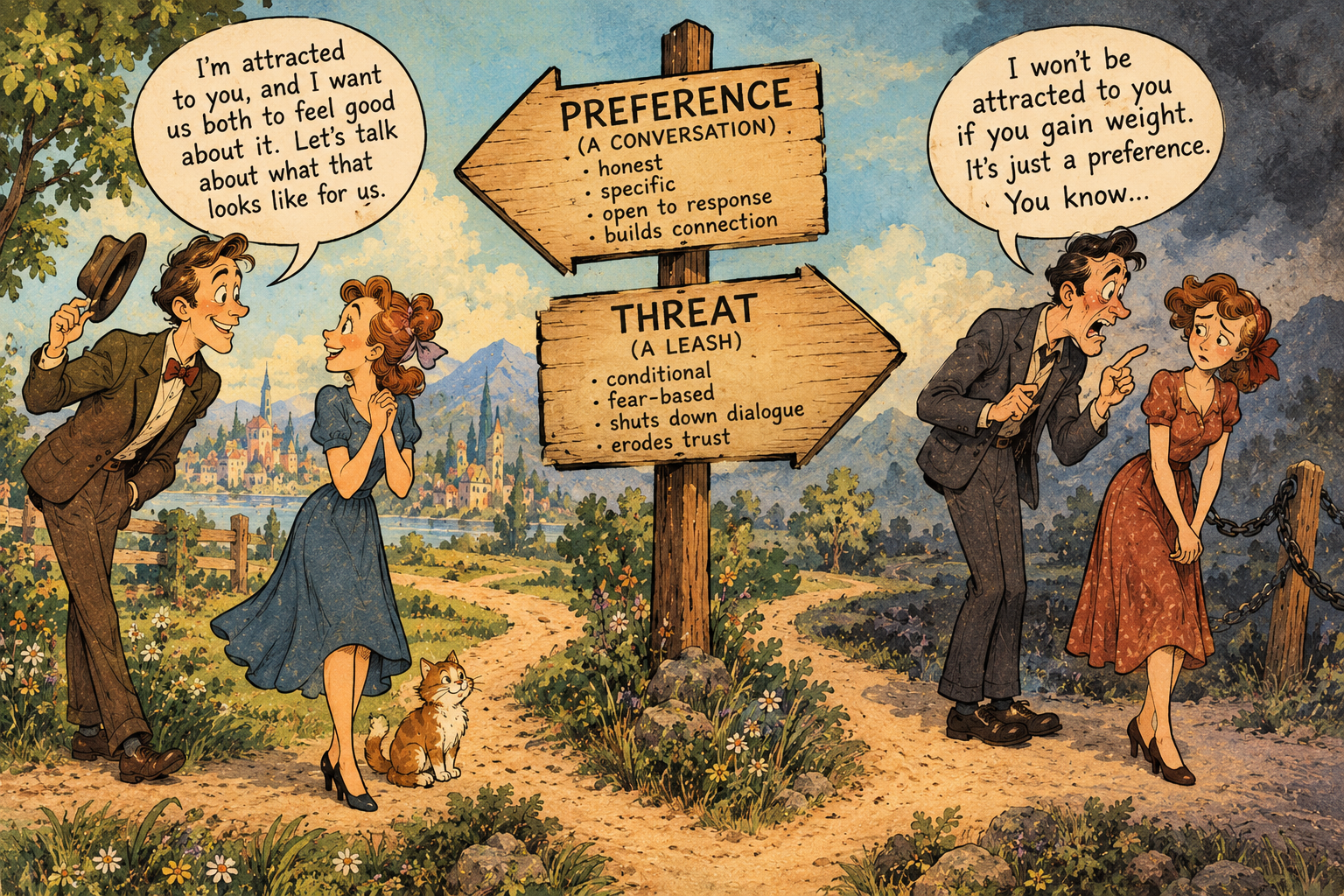
The woman on the left is thinking: “He’s such a good man—so easy to talk to. He’s honest about what he wants, and he really seems to care about what I want too. I’ll do anything to keep him happy.”
The woman on the right is thinking: “Wow. This man is insecure and kind of mean. I won’t be returning his calls after this.”
shrugs
;)
Next Week
Monday — The Crack Scanner: A Field Guide to the Reader Who Isn't Reading
What happens when someone reads without actually reading? Meet the Crack Scanner—the species of person who treats every text like a crime scene, skips the ideas entirely, and hunts for flaws to feel superior. A wicked, funny field guide to the reader who's never once been moved by a book, and what that says about them.
Thursday — The Fable of Dunning and Kruger
A modern fable about two children who walked into a forest armed with credentials, certificates, and absolute certainty—and absolutely nothing useful. A wicked little parable about the difference between knowing you passed the test and knowing the thing. The mushrooms, as it turns out, don't grade on a curve.