The Witch and the Sanctuary: Montespan, Maintenon, and the Soul of Louis XIV
I. The King as the Variable—How Louis Changed, and Why It Mattered
Here's what most people get backwards: they want to analyze Montespan and Maintenon as if the women are the story. They're not. The women are the response. The story is the king—specifically, the fact that he wasn't the same king at 50 that he was at 35, and that only one of them noticed.
In his prime, Louis was a force of nature wearing a wig. Athénaïs de Montespan was his perfect match for that season—brilliant, devastating, famous for a wit so sharp it could fillet a man and have him thanking her for it. She dazzled because he wanted to be dazzled. She stimulated because stimulation was still the fuel he ran on. She read the room perfectly. The room just didn't stay the same room.
Because decades do something to even the most inexhaustible men. Wars start going sideways. Religious guilt compounds, the way debt does when you stop making payments. Mortality sends its early calling cards. And somewhere in all that, what Louis needed from his intimate life shifted—from stimulation to restoration, from someone who could match his voltage to someone who could lower it.
Versailles made this urgent in a particular way. The palace was a total institution. The lever, the public meals, the ranked procession of courtiers watching the King of France get dressed—he was always on. There was no version of Louis at Versailles who got to be tired or ordinary. Over sixty years, that extracts a price. The question of where he got to be off became one of the most pressing questions of his life.
Neither woman changed the game. He did. Montespan's tragedy isn't that she was outmaneuvered—it's that she kept playing the same game after it had quietly changed, too magnificent and too entrenched to see it. One of them adapted. One of them didn't. The rest is exactly what you'd expect.
II. Montespan's Strategy—Genius on a Timer
Athénaïs de Montespan didn't stumble into power—she engineered it. She displaced a sitting royal mistress, bore Louis seven children, and made herself the gravitational center of the most competitive court in Europe. That's not luck. That's an apex predator operating at full capacity, and we should admire it before we autopsy it.
Her instruments were extraordinary: beauty, wit sharp enough to draw blood, one of the finest aristocratic lineages in France, and a force of personality so physical people described it like weather. The problem—and it's a structural one, not a moral one—is that every single one of those instruments was either perishable or dependent on active male desire to function. Beauty depreciates. Wit requires an audience in the mood to be delighted. Lineage is an argument, not a feeling. Her entire architecture of power was extractive—she pulled Louis toward her, which meant his desire had to stay lit, continuously, for the whole edifice to hold. The moment his attention wandered, she wasn't powerful. She was just loud.
And when desire cooled, she escalated. Scenes. Demands. A famous temper that had once read as passionate now read as exhausting. Then came Marie-Angélique de Fontanges—young, beautiful, and notably devoid of Athénaïs's legendary brilliance—and that was the real wound. Losing Louis to a woman with no wit meant her greatest weapon had simply stopped mattering. He wasn't looking for a sparring partner anymore.
What happened next makes perfect sense if you understand her model. When your natural tools fail, you find supernatural ones. Enter La Voisin, the love philtres slipped into the king's food, and the accusations of black masses conducted over her own body as altar. The Affair of the Poisons is lurid enough that it's easy to treat it as aberration—Montespan goes crazy, reaches for the dark arts, scandal ensues. But that reading misses the through-line entirely. Whether or not every accusation was literally true, what the affair reveals is a psychology that never changed its operating logic. She was attempting to manufacture desire she could no longer organically generate. To bend another will to hers by force when charm had stopped working.
That's the definition of black magick in the oldest sense—not theatrical evil, but coercive, extractive manipulation of forces for personal gain. The attempt to compel rather than attract. To override another person's sovereign will rather than align with something higher than both of you. Montespan's occult turn wasn't a departure from her strategy. It was her strategy, continued by other means. She'd always been in the business of making Louis want her on her terms. She just ran out of natural leverage and reached for the unnatural kind.
The timer ran out not because she lacked genius. It's that her genius was entirely dependent on one man's appetite staying pointed in her direction. When it didn't—when he changed—she had no secondary model to fall back on. Everything she'd built required his desire as its power source.
III. Maintenon's Strategy—The Long Architecture
If Montespan was a supernova, Maintenon was a hearthfire. Less spectacular. Considerably harder to extinguish.
Her instruments were almost insultingly undramatic by Versailles standards: consistency, warmth, intellectual companionship, genuine devotion. The thing about those qualities is that they don't depreciate. They compound. Beauty has a shelf life. Wit requires an audience in the right mood. But a woman who makes you feel consistently known and consistently restored becomes, over time, something closer to structural—less a presence you desire and more a condition you require.
She got there through a move so quiet it barely registered as a move: she built real relationships with Louis's illegitimate children before she built one with Louis. As their governess, she was embedded in his emotional life before she was ever an object of his desire. By the time he was drawn to her, she wasn't an outsider petitioning for access. She was already inside the architecture, load-bearing.
And then she built him a room. Not literally—though her apartments at Versailles were famously calm—but functionally. A sanctuary where the King of France could put down the performance of being the King of France. No scenes. No demands. No wit contests. Needlework by the fire, quiet conversation, the radical luxury of not being consumed. In a palace that was essentially a sixty-year theatrical production with no intermission, she gave him the one thing Versailles structurally couldn't: somewhere to be off.
Her power was never extractive. She didn't pull him toward her—she became part of the substrate of his daily life, woven into how he governed, how he thought, how he rested. You can't displace that the way you displace a mistress. It doesn't have an edge to grab.
There's also the piety frame, which was genuinely brilliant whether she calculated it or not. As Louis aged into guilt and mortality and the wreckage of late wars, Maintenon gave him a narrative in which all of it made sense—in which growing more private and more devout wasn't decline or defeat but completion. She made virtue feel like a destination he was arriving at, not a deprivation he was enduring. That's not a small thing. That's giving a man his ending.
Which brings us to something worth naming carefully. Set aside her Catholicism for a moment and look at the operating logic underneath it. Theurgy—in the oldest sense—is the practice of aligning with divine will rather than coercing it. The theurgist doesn't bend higher forces to personal ends. She creates conditions in which something sacred can move through her, and through the people she tends. The practitioner as vessel, not controller. Instrument, not architect.
Maintenon never tried to force Louis's soul. She never needed to. She simply created the conditions in which his soul could move toward what it already wanted—rest, meaning, absolution, peace. She was in the corner doing needlework while the king came to her. That image isn't passivity. It's the most sophisticated form of power in the room: the kind that doesn't announce itself, doesn't demand reciprocity, and never has to escalate because it was never extracting anything in the first place.
She didn't win. She just outlasted everything that wasn't built to last.
IV. The Magick Distinction—Coercion vs. Alignment
Let's be precise about something, because the word "magick" gets used as though it names one thing. It doesn't. The distinction that matters here isn't between magick and no magick—it's between two entirely different relationships to power, dressed in occult clothing.
Black magick, in the tradition that actually tracks, is defined by its operating logic: coercive, extractive, ego-driven. It's desire-binding, will-bending, the attempt to hold what won't stay willingly. And it's always downstream of fear—specifically, the fear that without the working, without the philtre, without the compulsion, the thing you want will simply leave. The black magician isn't in relationship with power. She's in a grip-fight with it. Montespan's axis, top to bottom.
Theurgy is the inversion. The theurgist doesn't command—she invites. She creates sacred space and then effaces herself before something larger, trusting that what's meant to move will move without being forced. The power doesn't originate with the practitioner. She's a conduit, not a controller. The work is alignment, not seizure.
Now here's the irony that should stop you cold: Athénaïs de Montespan, born into one of the oldest and proudest noble houses in France, ended up in the literal basement of Paris—in the back rooms of a poisoner, at altars in the dark, conducting rites she couldn't speak of in daylight. While Françoise d'Aubigné, born in a prison, the granddaughter of a Huguenot poet who died disgraced, built something that functioned—quietly, undeniably—like a temple. The woman with everything the world said was power went underground. The woman with nothing built something sacred.
What each approach reveals about its practitioner is almost uncomfortably clear. Montespan needed to seize power because her model required constant re-seizing—desire had to be manufactured, maintained, coerced back into place the moment it slipped. Maintenon let power flow through her because she'd constructed something that didn't depend on anyone's desire staying lit. One was always grabbing. The other simply remained.
The king's response is, in the end, the evidence. Whatever black magick may have produced, it produced it temporarily—a working that has to be renewed is a working that's already failing. What Maintenon built lasted thirty years, through wars and grief and the slow diminishment of age, and ended only when Louis died. That's not seduction. That's architecture.
And here's what's worth sitting with, because it maps onto something far older than Versailles: forced loyalty and chosen loyalty are not the same resource. The grip and the open hand produce different results, always, in every domain—love, leadership, friendship, faith. The grip can hold something in place. But it cannot make that something want to stay. And the moment the grip loosens, even slightly, everything it was holding is already gone. The open hand loses nothing when it opens further. There was never anything trapped in it to begin with.
Montespan gripped. Maintenon opened. Louis, given the choice his own aging soul presented him with, chose the open hand. Most people do, eventually. The tragedy is that the ones doing the gripping are usually the last to understand why.
V. Who Won?—And What the Answer Tells Us
The conventional answer is obvious enough to be boring: Maintenon won. She got the secret marriage, the thirty-year run, the king's final years and final confidences, and when the monarchy itself eventually collapsed she'd already built something that outlasted it—the Saint-Cyr school for girls, which survived the Revolution and exists in some form to this day. By any measurable standard, it's not a contest.
But the more interesting question is what Montespan actually lost—and it isn't what most people think. She had Louis's children. She had over a decade at the absolute apex of the most powerful court in Europe. She had pleasures and privileges most humans can't conceive of. What she lost was the narrative. The Affair of the Poisons didn't just end her time at court—it attached itself to her name permanently, reframing everything that came before it as suspect, as darkness dressed up in brilliance. She spent her final years in religious retreat, giving away fortunes in what read as penance. Whatever she'd actually done or hadn't done, she couldn't escape the shape the story had taken. She became a cautionary tale, which is the particular cruelty history reserves for women who wanted too much and reached too far.
But let's ask the question underneath the question, because the king was never really the whole point. What were they actually fighting for? Both of these women existed in a world that had no formal architecture for what they were—neither wife nor nun nor nobody, operating at the highest levels of power through instruments the official order didn't recognize or sanction. They were fighting for the right to exist fully—to bring all of what they were to bear on the world and have it matter. That's the real stakes. Louis was the arena, not the prize.
And seen that way, Montespan's tragedy sharpens into something genuinely sad rather than merely scandalous. She didn't fail because she was outplayed. She failed because she built her entire existence around one version of a man who quietly became another version—and she couldn't, or wouldn't, adapt. Whether that's stubbornness or a kind of terrible loyalty to her own nature is a question worth leaving open.
Maintenon succeeded for the reason theurgists always succeed when they do: she wasn't trying to control the outcome. She'd looked clearly at the direction Louis's soul was already moving—toward quiet, toward meaning, toward something that felt like peace—and she aligned herself with that movement rather than against it. She didn't redirect him. She accompanied him, which meant when he arrived at where he was going, she was already there.
One worked against the current her whole life—magnificent, exhausting, finally spent. One became the current, and moved with it so fluidly the effort was nearly invisible. And the one who let go, who asked nothing, who sat in the corner doing needlework while the king of France found his way to her—she was the one who held everything.
That's not a coincidence. It's a principle. And it's older than either of them.
—m.
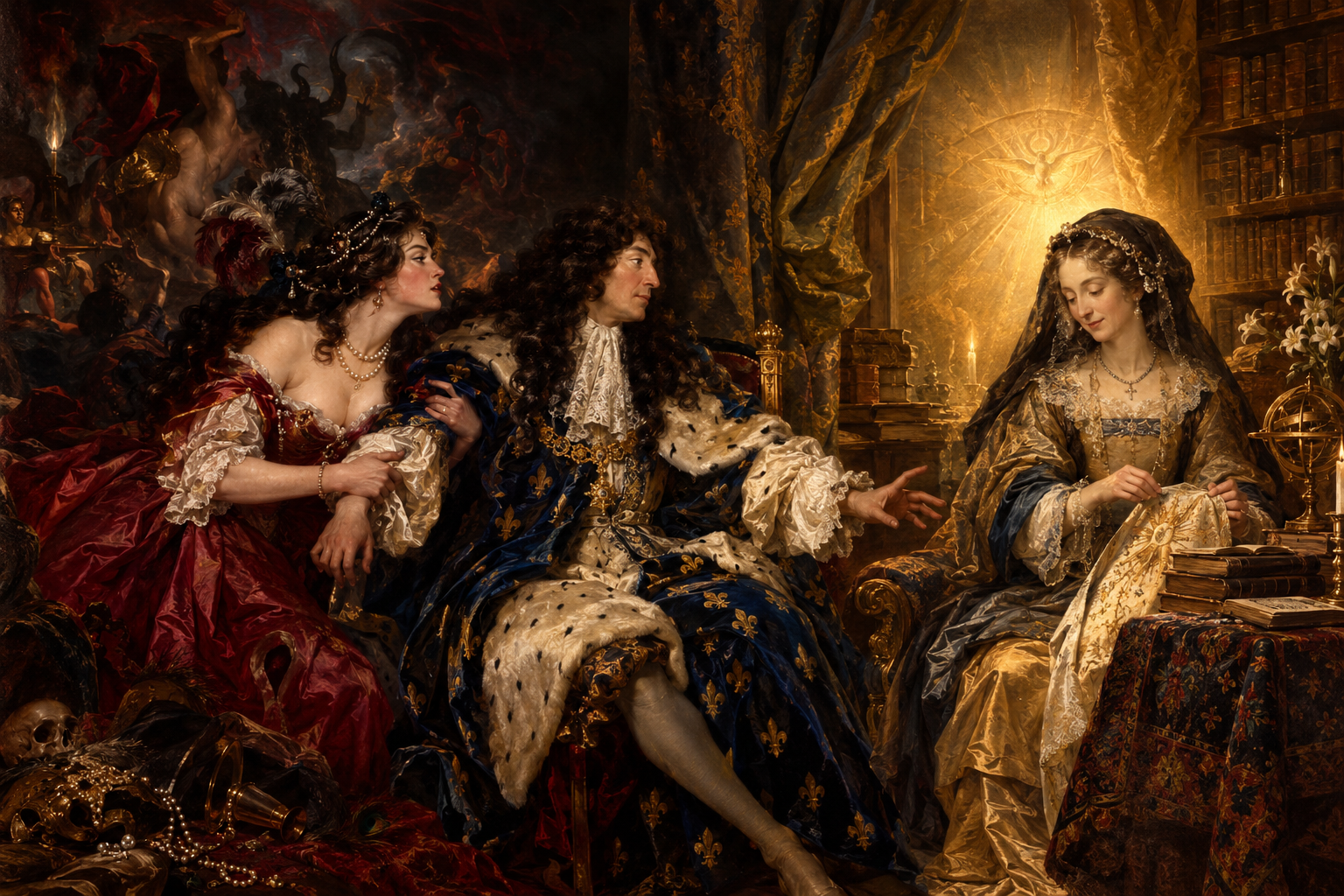
Looks like Louis has grown tired of the grip; he’s reaching for peace and a companion that doesn’t drain him.