For Women Who Were Never Told: Beauty Is a Depreciating Asset
What no one tells you about investing everything in appearances
This one is a bit long, but I’ve been thinking about this topic for ages.
I. The Portfolio You Didn't Know You Were Building
Nobody sat you down and explained the terms. That's the first thing I want you to know. From the time you were old enough to notice that certain things got you praised and certain things got you ignored, the culture was already making deposits into a particular kind of account on your behalf—one you never agreed to open. You learned, without anyone saying it plainly, that your surface was your most valuable product. That how you looked when you walked into a room mattered more than what you were thinking when you got there. You didn't invent that lesson. You inherited it. And you did what any reasonable person does with the hand they're dealt: you played it.
So let's start there, with compassion, because this conversation isn't about blame. It's not an indictment of lipstick or a lecture about vanity. Taking care of your appearance is fine. Enjoying beautiful clothes, a great haircut, a skincare routine that makes you feel good in your own skin—none of that is the problem. Pleasure in beauty is human and old and completely legitimate. What we're talking about is something more specific: proportion. We're talking about what happens when the packaging becomes the whole project.
Here's a way to think about it that might reframe everything. Whether you're conscious of it or not, you're running a portfolio. Every day, you're allocating resources—your time, your money, your attention, your energy—into various kinds of investments. Some of those investments are in the exterior: the hair, the nails, the wardrobe, the upkeep. Some are in the interior: the skills you're building, the ideas you're wrestling with, the self you're quietly becoming underneath all of it. Both columns are real. Both cost something. And like any portfolio, what you put in determines what you can eventually draw out.
The question was never whether to invest in your appearance. Of course you do—we all do, to some degree. The question is what else you're building while you're at it. Because here's what the culture forgot to mention, buried somewhere in the fine print it never actually showed you: the exterior investment has a time horizon. It peaks. It requires increasing capital to maintain. And if it's the only position you've been building, the day the market shifts—and it will shift, for every single one of us—you'll find yourself holding an asset that's lost most of its value with very little else in the account.
That's not a cruel fact. It's just the one nobody told you up front. And you deserved to know it a long time ago.
II. The Bull Market Years—And Why They're Misleading
Here's the thing about youth: it's doing most of the work, but it never announces itself. The returns just arrive, and they feel like yours, because they're coming from your face, your body, your presence in a room. What nobody tells you is that you're largely living off a principal you were born with—and that the market is quietly, invisibly, running a clock on it the whole time.
And those early returns are real. Let's not pretend otherwise. Doors open. Rooms shift when you enter them. Men pay attention. Employers make favorable assumptions. There's a social fluency that comes with being a young, attractive woman that functions almost like a currency—frictionless, spendable almost anywhere, and so reliable that it starts to feel structural. Like just the way things work. The dividends arrive early and they arrive often, and when a strategy pays off consistently, every rational investor does the same thing: they double down.
That's the trap, and it's a sophisticated one because it doesn't feel like a trap at all. It feels like evidence. You invest more in your appearance and the returns confirm the decision. The positive feedback loop does what feedback loops do—it deepens the position and makes any alternative feel unnecessary, even risky. Why develop something slow and invisible when this works so well and so immediately? The market is telling you something, and you're listening. That's not stupidity. That's just how reinforcement works.
But here's what's being quietly drained from another account while all this is happening. Every hour spent in pursuit of the exterior is an hour that didn't go somewhere else. This isn't a moral judgment—it's just arithmetic. Time is the one resource with no credit line. The hours that went to perfecting the surface didn't go to building a craft, sitting with a difficult book, developing a skill that compounds, or learning to be alone long enough to find out who you actually are underneath the performance. Those aren't dramatic losses. You can't feel them happening. There's no notification, no overdraft alert, no moment where something visibly breaks. The account just quietly accumulates less than it could have. The interior stays a little more undeveloped than it needed to be. And because nothing hurts yet, there's no reason to adjust.
That's the most insidious feature of this particular market: no alarm sounds. The underlying asset is time-denominated—meaning its value is structurally, inescapably tied to something you cannot stop—but that fact is nowhere in the prospectus, because there was no prospectus. No one sat across a desk from you and said, "Just so you know, these returns are partly borrowed against a future you haven't thought about yet." The bull market years feel like proof of a sound strategy. And in that warm, validating, dividend-rich season, the idea that it could ever work any other way feels almost absurd.
Until it doesn't. And by then, the reallocation is harder than it would have been—not impossible, but harder. Which is why the conversation worth having is this one, now, while there's still time to diversify.
III. What Atrophies—The Hidden Losses on the Balance Sheet
Every portfolio has two sides. We've talked about what gets built when the investment goes primarily outward. Now let's talk about what doesn't get built—the interior capacities that quietly go undeveloped while the surface work is happening. These aren't dramatic collapses. They're more like muscles that never quite get used. They don't announce their weakness until the moment you actually need them.
The first loss is critical thought—and this one stings a little because it's so easy to miss. The hours really are zero-sum. There are only so many of them, and the ones that went to mastering a contour technique, tracking which microtrend just replaced last season's microtrend, or scrolling through content about other women's surfaces—those hours were borrowed from somewhere. From a book that didn't get read. From an idea that didn't get wrestled with long enough to become an opinion. From the slow, unglamorous process of learning to think carefully about the world and your place in it. Critical thought isn't innate. It's developed, through practice, through exposure to hard material, through the willingness to sit with something that doesn't resolve quickly. It requires an investment of exactly the kind of time that gets quietly redirected when the surface becomes the primary project. A woman who hasn't built this capacity isn't less intelligent—she's just been working with a different set of priorities. But intelligence without development is potential, not power. And potential doesn't compound on its own.
The second loss is subtler and, I'd argue, more consequential: the tolerance for solitude. Here's what happens when the external gaze becomes your primary orientation—when the mirror, the phone, the comment, the reaction is always the reference point. You gradually train yourself out of being comfortable in your own interior. The habit of constant surface-checking creates a kind of restlessness toward the inside, a low-grade discomfort with silence and stillness, because the interior is a place you haven't spent much time and it's unfamiliar in there. So you fill it. With noise, with plans, with other people's opinions, with anything that keeps the surface busy. And here's the structural problem with that: a woman who cannot be alone with herself without discomfort is dependent. Not in a weak way—in a mechanical way. She requires external input to feel okay, which means her sense of herself is always, to some degree, in someone else's hands. That's a vulnerable position, and it tends to get more vulnerable with time, not less.
Then there's the loss that hits hardest in midlife: genuine competence, and the quiet authority it produces. Real skill has a texture you can feel from across a room. It's a settled, unperformative confidence—the kind that doesn't need an audience because it wasn't built for one. It comes from having actually done difficult things. From having failed at something and tried again. From having mastered material that pushed back. Many women arrive at forty or fifty without this, and I want to be clear—it's not because they weren't capable. It's because their attention was captured early and aimed at something that doesn't compound the same way. Competence produces authority. Authority produces a particular kind of freedom. And that freedom, once you have it, doesn't care what the mirror says in the morning. Without it, the mirror has more power than it should ever be allowed to have.
And finally, the one that might matter most in the long run: the capacity to age from the inside. The women who become more interesting as they get older—and they exist, and they're remarkable to be near—all share a common feature. They built a self that doesn't depend on the mirror's verdict for its validity. They had somewhere to go when youth left. Not because they were planning ahead in some calculated way, but because they'd been genuinely curious, genuinely building, genuinely living inward alongside whatever was happening on the surface. When the exterior changed—as it does, as it must, for every single woman alive—they didn't lose the plot, because the plot was never only about the packaging. They had accrued something real. Ideas, capabilities, depth, a point of view that had been sharpened over decades into something worth encountering. They aged into their value rather than away from it. And that trajectory—that particular kind of becoming—was available all along. It still is. But it requires investment, and it requires it to begin before you think you need it.
IV. The Margin Call—When Both Sides of the Trade Feel Cheated
This is the section I want to handle carefully, because it's the most tender part of the conversation and the easiest to get wrong. This isn't about indicting men, and it's not about shaming women. It's about what happens when two people build a relationship on a foundation that was always thinner than it looked—and what it costs both of them when the structure finally shows its limits.
If the investment in appearance was made, even unconsciously, as a strategy for attracting and holding male attention—and for many women, that's exactly what the culture trained them to do—there's a painful irony waiting further down the road. Because a man who's drawn primarily to the packaging has, in a real sense, fallen for a performance rather than a person. He doesn't actually know her. He knows her surface, her presentation, the carefully maintained exterior she's offered as the primary point of contact. And if she hasn't fully inhabited her own interior, hasn't developed a rich inner life she's capable of sharing, then in a very honest sense there may not have been much else available to know. The relationship forms around the surface because that's where both of them are living.
Then the packaging changes. As it must. As it does for every woman on earth without exception. And here's where the margin call arrives—sudden, disorienting, and for both parties, genuinely painful. He may feel something he can't quite name: a confusion, a distance, a sense that something he depended on has shifted. If he's not an especially self-aware man, that feeling might come out sideways, as withdrawal or criticism or a restlessness he doesn't examine too closely. He's not necessarily cruel. He's just bonded to a surface, and surfaces change, and nobody told him that was what he'd done.
She, meanwhile, may feel something equally devastating: that she kept her end of the bargain. That she did everything right. That she maintained the investment, honored the terms, showed up as she was supposed to—and it still wasn't enough. That particular betrayal cuts deep, because it followed the rules. She played the game she was taught and the game moved the goalposts anyway. The anger is understandable. So is the grief.
But here's what I want you to hear: neither of them is the villain in this story. Both of them were operating inside a system that sold them a bad product and never disclosed the return policy. She was taught that her surface was her most valuable offering. He was taught to respond to exactly that. They found each other inside that system and did what people do—they tried to build something. The tragedy isn't that they failed each other. The tragedy is that they might have had something real. Two people, in the same room, with the potential for genuine intimacy—the kind built on depth and interiority and the slow, revelatory process of actually knowing another human being—who never quite got there because the packaging kept getting in the way of the person.
And here's the quiet truth about men who are actually worth keeping for the long haul: what holds them isn't the surface. It's density. It's the sense that there's more to discover—that the woman they're with has rooms they haven't been in yet, ideas they haven't heard, a perspective that surprises them, a self that continues to unfold. Presence. The particular gravity that comes from someone who has genuinely inhabited their own life. That's not something you can buy or apply or contour into existence. It's built, slowly, from the inside. And it doesn't depreciate. If anything, it does the opposite—it deepens, it develops, it becomes more itself over time. Which means the man who fell in love with it at thirty-five is even more in love with it at fifty-five, because the thing he loves has been quietly, steadily becoming the whole time.
That's the relationship the surface strategy was never going to get her. Not because she wasn't worthy of it. But because you can't attract depth with packaging. You attract depth with depth. And depth has to be built.
V. The Reallocation—It's Not Too Late to Diversify
Here's where I get to tell you the good part. And I mean it genuinely, without the forced optimism that usually shows up in conversations like this one—the kind that feels like a participation trophy. The good part is real: it is almost never too late to begin building the interior position. The market for inner worth doesn't have an age cutoff. It doesn't care when you start. It just starts compounding from whatever day you make the first deposit. That's not a motivational poster. That's just how compound interest works.
So start there. Start small and start honestly. Not with a self-improvement program or a reading list curated to impress someone—those are still surface moves, just dressed differently. Start with a quieter question: what did you love before the mirror became an evaluator? There was a version of you that existed before the culture installed its metrics. She wanted to know things, make things, understand things. She had instincts and curiosities that had nothing to do with how she looked while having them. She's not gone. She's just been waiting, probably longer than either of you would like to admit, for someone to come back and ask what she was interested in. Go ask her. The answer is the beginning of your reallocation.
What happens next is quiet but it's real. A year of genuine reading—not scrolling, not content, but actual engagement with ideas that push back—does something to a woman that can't be photographed but absolutely can be felt. A year of making something, studying something, sitting with hard questions long enough to develop actual opinions about them, changes the texture of how you move through a room. People feel it before they can name it. You feel it too, in the way your relationship with your own reflection starts to shift—not because the reflection changed, but because it quietly stopped being the most interesting thing in the frame.
And please hear this clearly: keep taking care of your appearance. This was never an argument against that. Get the haircut. Wear the thing that makes you feel good. Enjoy the ritual if the ritual genuinely brings you pleasure. But let it be the dividend, not the principal. Let it express something real rather than substitute for it. There's a difference—and once you know what it feels like, you can't unknow it—between dressing from a self and dressing as a self. One is play, creative and light and genuinely fun. The other is labor. It's the exhausting, daily work of constructing a self out of exteriors because the interior hasn't been sufficiently inhabited yet. One feels like freedom. The other feels like a job you can never call in sick from. You'll know which one you've been doing.
One of the most underrated investments available to you right now, at whatever age you're reading this, is solitude. Real solitude—not the loneliness of feeling unseen, but the chosen, deliberate practice of being alone with yourself without immediately reaching for something to fill the silence. It's uncomfortable at first, especially if you're not used to it. The interior can feel unfamiliar, even unwelcoming, when you haven't spent much time there. But that discomfort is information, not a stop sign. It's telling you where the work is. A woman who can sit with herself—who can be genuinely alone without distress, without the scroll, without the noise—is a woman who has begun to trust that there's someone worth being alone with. That trust is radical. It's also the foundation of every good thing that follows.
The goal was never to stop being beautiful. Beauty is fine. Beauty is even wonderful when it's an expression of something true. The goal is to become someone for whom beauty is a detail—one interesting feature of a life that has many interesting features—rather than a life's work. To become someone who could walk out of the house without a stitch of effort and still be, unmistakably, someone. Not because she stopped caring how she looks. But because she built something underneath it that holds. Something that was there before the mirror and will be there long after it stops mattering what it says. That's the position worth building. And the best day to start was twenty years ago. The second best day is today.
VI. The Appreciating Asset—What Compound Interest Looks Like on a Woman
Let me paint you a picture. She's fifty-three, or sixty-one, or seventy and change, and when she walks into a room something happens that's difficult to describe precisely but impossible to miss. It's not that she's the most conventionally beautiful woman there—she may or may not be, and she genuinely hasn't organized her morning around that question. It's that she has weight. Presence. The particular gravity of someone who has been somewhere, thought something, built something, lost something and survived it and turned it into material. You find yourself wanting to sit near her. You find yourself wondering what she thinks about things. She has that rarest of social qualities: she makes you feel like the conversation might actually go somewhere.
That's what compound interest looks like on a woman who kept building.
She has authority—and I want to be precise about that word because it gets misused. Not performed confidence, which is a different thing entirely and most of us can smell it immediately. Not the aggressive self-assertion of someone who needs the room to agree with her. Actual authority—the kind that comes from having done hard things and thought carefully about them afterward. From having held opinions that cost her something. From having failed, genuinely failed, and metabolized that failure into something usable rather than something to hide. It's the authority of a person who has a relationship with her own experience—who has processed her life rather than just lived it on the surface. You can't fake it. You can't buy it. You can only build it, slowly, over years of being willing to go inward when the easier thing would have been to look outward.
And here's what she's not doing: she's not competing with younger women. Not because she's made peace with losing a race, but because she exited that particular race a long time ago and replaced it with something so much more interesting that the original contest now looks, from where she's standing, almost unbearably small. She's not watching what twenty-five-year-olds are wearing or doing or getting attention for. She's working on something. She's thinking about something. She has a life with momentum—her own momentum, pointed in her own direction—and that tends to make the approval economy feel like a game for people who haven't found anything better to do yet. She doesn't say that out loud. She doesn't need to. Her direction says it for her.
She ages the way rare things age: into her value rather than away from it. Wine, not cut flowers. Cut flowers are beautiful and they should be—that's exactly what they're for, that brief, vivid, spectacular bloom. But wine is doing something else entirely. It's becoming. Every year adding something that wasn't there before, developing complexity that couldn't have existed without time, arriving at a depth that the younger version was only ever a promise of. That's a different relationship with time altogether. Not a battle against it. A collaboration with it. And it was always available—it just required a different kind of investment to get there.
So here's what I want to leave you with, and I mean every word of this.
You were never just a surface. The culture told you otherwise, and it told you early, and it had a great deal of infrastructure behind that message—magazines and algorithms and social hierarchies and the accumulated weight of centuries of women being evaluated primarily on their appearance. It was a sophisticated lie delivered by a thousand seemingly unrelated sources, and it worked on most of us to some degree because it started before we were old enough to interrogate it. That's not your fault. None of it was your fault.
But the interior has been waiting. Quietly, without complaint, without deadline—just waiting for you to turn some portion of your attention toward it and begin. It doesn't depreciate. It doesn't go out of style. It doesn't require a more expensive version of itself every five years to stay competitive. It just grows, slowly and honestly, in whatever direction you aim it. And it compounds in ways that will surprise you—in the quality of your relationships, in the texture of your own solitude, in the authority you carry into rooms, in the face that looks back at you from the mirror, which will eventually tell a story you're proud of rather than one you're managing.
It is never too late. Not at thirty-five, not at fifty, not at sixty-eight reading this on a Tuesday afternoon wondering how it went so fast. The second best day to begin was always today. Go find out what you're made of. I have a feeling it's considerably more than you've been told.
With love and zero apologies
—m.
This song is about a blow-up doll. I thought it apropos since so many women try to look like blow-up dolls these days. It’s not their faults; they get their beauty advice from an algorithm:
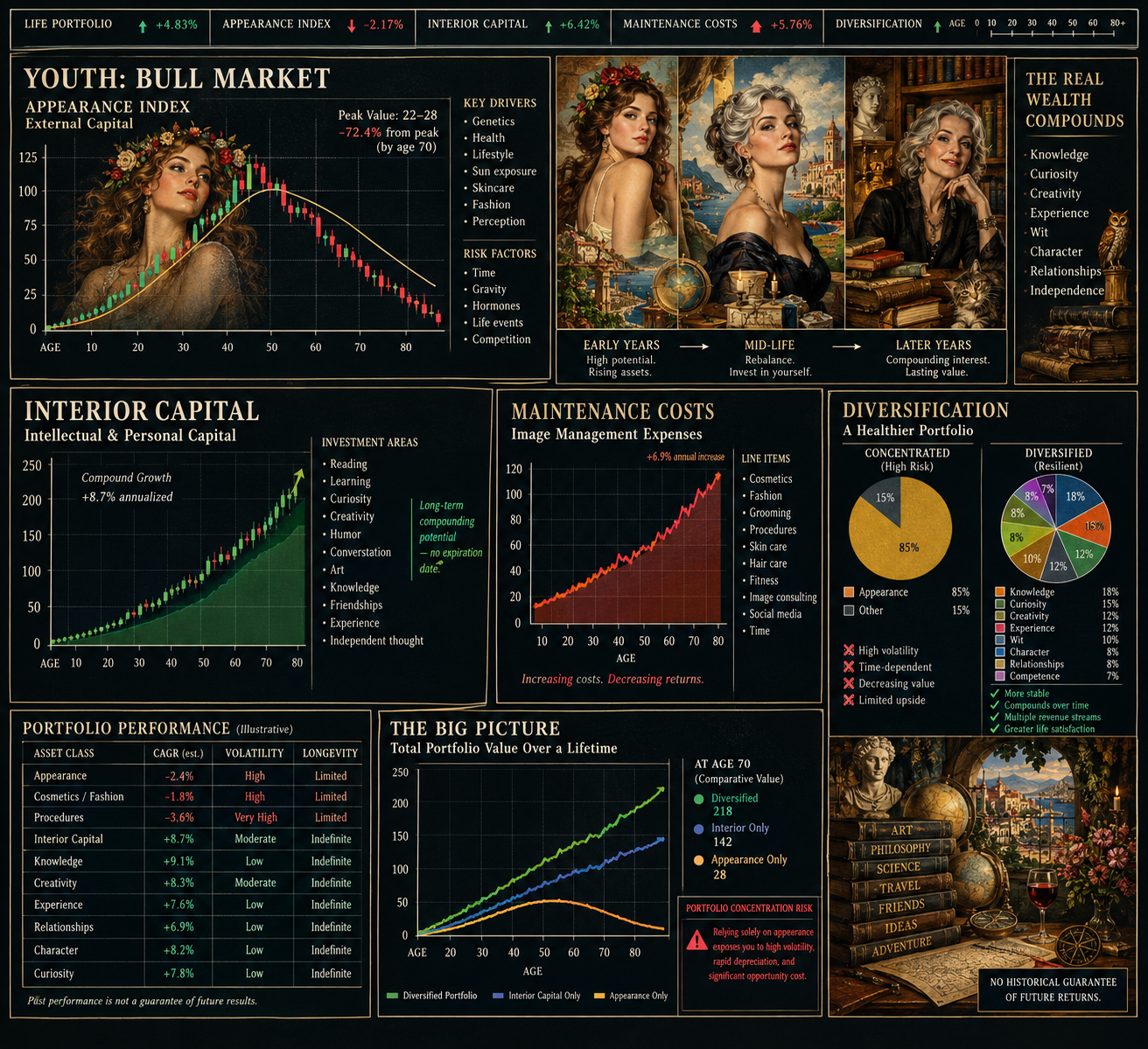
Sometimes when I prompt the AI for images, I’m like “WHOA!” This is one of those times. Lovin’ it.
Let’s give ChatGPT a pat on the back—at least it’s still good for something. lol
Next Week
Monday — The Witch and the Sanctuary: Montespan, Maintenon, and the Soul of Louis XIV
Two royal mistresses, one aging king, and a lesson in power that still holds. Athénaïs de Montespan wielded beauty, wit, and allegedly black magick. Françoise de Maintenon offered quiet, warmth, and something closer to theurgy. Louis XIV chose. This is the story of why—and what it reveals about coercion, alignment, and the architecture of lasting influence.
Thursday — “I Won't Be Attracted to Her If She Regains the Weight”: A Field Guide to Men Who Don't Know What They're Saying
There's nothing wrong with knowing what you find attractive. Desire is real, preferences are real, and pretending otherwise is how people end up in quietly miserable arrangements that collapse on a Tuesday after eleven years. This isn't about that. This is about the difference between a preference and a threat—and why the men who can't tell them apart are accidentally disqualifying themselves from the very thing they want. A field guide, offered in good faith.