The Mirror Runs Both Ways: How Political Systems Produce the Cultures They Deserve
I. The Assumption Nobody Questions—Leaders Emerge From Culture
Here's the story we all learned and nobody bothered to interrogate: culture produces values, values shape citizens, and citizens—eventually, inevitably—produce leaders. It's tidy. It's intuitive. It lets us feel like the whole arrangement flows naturally upward from the people themselves, a kind of democratic geology. And it's about half true, which makes it one of the more dangerous ideas in circulation.
The arrow doesn't just run one way. Systems don't merely receive culture—they manufacture it. They select for certain kinds of leaders, and then, quietly, continuously, those leaders and the institutions that elevated them send signals back down through the whole social body about what a human being is supposed to want, admire, and become. The recursion is the actual story. Whatever the system rewards at the top doesn't stay at the top. It seeps. It becomes aspiration. It eventually becomes common sense.
Most political philosophy, to its considerable embarrassment, obsesses over selection mechanisms—elections, term limits, checks, balances—and barely glances at the cultural feedback loop those mechanisms produce. We argue endlessly about how leaders get chosen and almost never ask what the choosing teaches everyone watching.
Which brings us to the question that should be far more central than it is: not who rises to the top of a given system, but what kind of person does that system manufacture in bulk? Not the president, not the senator, not the celebrity CEO—but the mid-level manager, the ambitious twenty-six-year-old, the person who's paying close attention and making quiet decisions about who to become. That person is the real output.
Because a political system isn't just a government. It's a values broadcast—running continuously, at full volume, telling everyone within range what a successful human life looks like. What gets rewarded. What gets punished. What gets politely ignored. And if you want to understand a culture, don't just look at who it puts in charge. Look at what it's quietly telling everyone else to worship.
II. Three Systems, Three Cultures—The Historical Record
Let's look at the receipts.
Hereditary aristocracy
Hereditary aristocracy makes the logic almost embarrassingly legible. When the system rewards birth—when birth is the reward—the culture reorganizes itself, completely and without apology, around lineage. Who your people are becomes not merely relevant but consuming. The portrait gallery isn't vanity; it's infrastructure. The family name isn't nostalgia; it's currency. The advantageous marriage isn't romance; it's policy. The entire apparatus of aristocratic culture—the crests, the seats, the elaborate mythology of bloodlines—exists because the system made provenance the thing that matters most, and the culture dutifully followed instructions.
What this produces is a civilization with real aesthetic achievements and a nearly constitutional allergy to genuine novelty. The new family is always slightly suspect. The innovator is always slightly illegitimate. The oldest name wins the room regardless of whether anyone bearing it has done anything interesting in four generations. It's beautiful in the way that a very old, very formal garden is beautiful—and about as hospitable to anything that wasn't already there.
Extractive oligarchy
Extractive oligarchy is less ornate but no less revealing. When the system rewards accumulation—when accumulation is the proof of fitness—wealth becomes the measure of all things. Not because people are uniquely shallow, but because the system's feedback confirms it, relentlessly, at every scale. The billionaire ascends to cultural heroism not despite the extraction but through it. The extraction is the achievement. The scale of the taking is the evidence of the greatness.
And this doesn't stay at the top, which is the part worth watching closely. It trickles. The middle class mimics accumulation at a smaller scale, performing the same logic with different numbers. The working class gets quietly shamed for failing to accumulate enough, as though the game weren't structurally rigged before they sat down. The poor become morally suspect—their poverty read not as a systemic outcome but as a personal confession. The oligarchy doesn't need to broadcast this explicitly. The culture does the work, because the culture learned from the system what virtue looks like.
What this produces is a civilization that's dynamic in a very narrow register—genuinely innovative in the service of profit, genuinely creative when there's money in it—and spiritually arid in almost every direction that doesn't have a price attached. It can build extraordinary things. It just can't quite explain why any of them matter.
Popularity-Based Democracy: The Subtlest Trap
Hereditary aristocracy at least had the honesty to be openly hierarchical. Extractive oligarchy at least admitted, in its bones, that it was about winning. But popularity-based democracy is sneakier—it flatters everyone while quietly installing its own logic just as deep.
When the system rewards relatability—when the ability to seem like everyone else is the primary qualification for power—the culture organizes around performance. The politician who reads the room correctly learns very quickly never to seem too excellent, too strange, too far above the median. Genuine distinction becomes a liability. The goal isn't to be extraordinary; it's to make the extraordinary feel ordinary, to sand down every edge until the audience sees themselves reflected back. It works. It always works. And it teaches everyone watching exactly what to do.
What it teaches is this: manage the image. Curate the self. Run your life like a small, continuous campaign. Social media didn't invent this dynamic—it just handed everyone a microphone and an analytics dashboard. The logic of the democratic vote, applied to every human interaction, produces a culture where each person becomes a minor politician managing their own electorate of followers, friends, and colleagues, optimizing for approval with the same anxious precision that consultants once reserved for swing states. The personal brand isn't a metaphor. It's the actual operating system.
And here's where it gets genuinely cruel: excellence becomes socially expensive. Real distinction—the kind that can't be made relatable, that doesn't perform humility convincingly, that insists on being what it actually is—makes people uncomfortable. It breaks the collective performance of equality. It suggests, implicitly and unforgivably, that not everyone is the same. So it gets managed. Hedged. Apologized for. The gifted learn to downplay. The ambitious learn to perform ambivalence. The ones who refuse get quietly frozen out, which is democracy's version of exile—nobody votes for you anymore.
The culture this produces is one of the more exhausting things the modern world has managed to build. Hyperconnected, perpetually performing, burning enormous quantities of human energy on the maintenance of an image that must appear effortless. And underneath all of it—not in everyone, but in enough people to matter—a low, persistent shame about genuine ambition. A suspicion that wanting to be excellent, wanting to be more, is somehow a betrayal of the social contract. The system didn't legislate that feeling. It didn't have to. The culture got there on its own.
III. The Recursion—How the Loop Locks In
Here's where it stops being a metaphor and starts being a mechanism.
The culture a system produces doesn't just reflect that system—it replenishes it. The children raised inside an extractive culture grow up understanding, at a level beneath argument, that accumulation is what serious people do. Some of them become leaders. Those leaders run the institutions. The institutions produce the next culture. That culture produces the next leaders. Each cycle, the values go in a little deeper—not because anyone is conspiring, but because the system is doing exactly what systems do: selecting for the people most fluent in its logic, and then putting those people in charge of everything.
The loop tightens with each generation. This is the part that makes reform so genuinely difficult, and not in the way people usually mean when they say reform is difficult. It's not merely that entrenched interests resist change—though they do, enthusiastically. It's that the reformers themselves were produced by the system they're trying to reform. Their imagination of what's possible was shaped by what the system taught them to want. They can push the window, but they can rarely see past it, because the window is also inside their heads.
The Overton window isn't just a political phenomenon. It's a cultural product. What seems reasonable to propose is bounded by what the culture has been taught to value, which was determined by the system, which was designed—or evolved—to select for leaders who maintain it. The circularity is airtight, and it's not an accident. Every generation of genuine reformers sounds like a lunatic to their contemporaries and sounds like a moderate to their grandchildren. That's not because the ideas changed. It's because the culture finally caught up.
The lock-in mechanism is almost elegant, in a grim way. Institutions select for people who will maintain them. Those people then run the institutions that select the next generation. The pipeline seals itself. It doesn't need guards at the door because the door is built into the applicants—they've already internalized what the institution wants, which is why they applied in the first place.
So what actually breaks the loop? History offers a short and somewhat dispiriting list. External shock works—war, pandemic, economic collapse, the kind of catastrophe that discredits the existing order so completely that the next generation refuses the inheritance. Outright collapse works, in the brutal way that burning a field works: it clears space by destroying everything. And then there's the slow, quiet accumulation of people the system simply failed to fully capture. The outliers. The edge cases. The ones who grew up inside the culture but, for whatever reason—temperament, circumstance, the right book at the wrong age—never got completely marinated in it. They're the anomalies the system produced by accident, the ones it didn't manage to domesticate. Historically, they're the ones who actually move things. Not because they're heroes. Because they're the only ones who can still imagine something the system didn't teach them to want.
IV. The Democracy Trap—Formally Open, Substantively Closed
The promise is genuinely beautiful. Anyone can run. Anyone can win. Power belongs to no particular bloodline, no particular class, no particular god. The door is open. This is, depending on your mood, either the greatest political achievement in human history or the most sophisticated sleight of hand. Possibly both.
Because here's what winning actually requires: capital, institutional backing, media access, party machinery, the right rooms, the right names, the right enemies. The door is open and the corridor behind it is nearly impassable. That gap—between formal openness and substantive access—isn't a flaw in the system. It's where the system's real values live. Everything the system actually believes about who should hold power is legible in the gap, if you're willing to look at it directly.
Most people aren't. And the culture the gap produces is one of the stranger achievements of modern political life: cynicism dressed as sophistication. Everyone knows the game is tilted. This is not a secret. It's practically ambient. But saying so plainly—stating it baldly, without irony, without the protective coating of world-weary detachment—marks you immediately as naive. The sophisticated move is to know the game is rigged and engage with it anyway, because what's the alternative. The even more sophisticated move is to make knowing this seem like wisdom rather than defeat.
Meanwhile, the performance of democracy becomes more elaborate precisely as the substance thins. More elections. More coverage. More panels, more polls, more participation theater at every level. The ritual expands to fill the space left by the accountability. It has to. A system that can't deliver the thing must double down on the ceremony.
The cultural broadcast of all this is remarkably consistent: the system is open in principle and closed in practice, and the mark of maturity is to accept this and work within it. Citizens absorb this message the way they absorb most things—gradually, without noticing, until it simply feels like realism. The result is a citizenry that is resigned without being quite angry, ironically detached without being quite disengaged, performatively involved and genuinely passive. They vote. They post. They have opinions. They do not, in any meaningful number, believe it matters.
And then the relatability requirement—democracy's original cultural export—metastasizes outward. It doesn't stay in politics. It never does. The culture begins selecting against genuine difference at every level, not just in election cycles. The legible, the palatable, the non-threatening to the median—these become the standards not just for who gets elected but for who gets promoted, who gets amplified, who gets to take up space without apology. The excellent and the strange learn to make themselves smaller, or they learn to perform smallness while quietly doing what they do. The ones who refuse that bargain tend to find the doors—all the doors, not just the political ones—a little harder to open.
Tocqueville saw this coming and said so, which is the kind of thing that reads as alarmist until it reads as obvious. He worried less about tyranny by force than about something quieter and more total: the tyranny of the median, enforced not through law but through ambient social pressure, through the slow grinding weight of a culture that finds genuine difference uncomfortable and deals with it accordingly. No one passes a law against excellence. No one needs to. The culture handles it, continuously, at scale, through a million small transactions that never make the news. That's democracy's deepest and most durable cultural export—not freedom, exactly, but the feeling of freedom, distributed widely enough that most people never notice what it cost them.
V. What a Different System Would Broadcast—The Cultural Possibility
Let's run the logic in reverse, just to see where it goes.
If the question is what does the system reward, then the inverse question is the interesting one: what would you have to reward to produce a different culture? Not a utopian culture—let's not get dreamy about it—just a measurably different one. The answer, it turns out, is hiding in plain sight inside everything we've already established.
A system that elevated depth over accumulation would broadcast something the current one almost never does: that what you've been through matters more than what you own. That survival—real survival, the kind that costs something—is a credential. That the person who has endured and built and endured again has a claim on respect that no balance sheet can replicate or revoke. Imagine what that signal does, running continuously through a culture over generations. You'd produce people who measure themselves differently, who compete for different things, who look at the genuinely wealthy and feel something more complicated than uncomplicated admiration.
A system that made service the actual price of power—not the rhetorical garnish on a campaign website, but the structural condition of elevation—would broadcast that obligation scales with position. The more you have, the more you owe. Not as charity. Not as virtue signaling. As the terms of the arrangement. That's a different culture. That's a culture where power carries weight in the direction it almost never currently does—downward.
A system with legible, genuinely open paths would broadcast something rarer still: that the test is real, and anyone can take it. Not the performance of meritocracy, which mostly selects for people who were already positioned to perform well—but an actual test, with actual access, and actual consequences that don't depend on who your people are or how many zeros are in the family account. That produces cultures of genuine aspiration rather than the cynical resignation we've learned to call realism. People climb differently when they believe the ladder is real.
The culture such a system produces over generations looks different at every level, not just at the top. Which is the point. As above, so below—the shape the system gives to power filters downward into the shape of everything beneath it, into what the middle class admires, what the young aspire to, what the street considers impressive. The recursion runs the other way just as surely as it runs the way we're used to. A different system produces different aspirations, which produce different citizens, which produce different leaders, which produce a deeper culture, which produces different children. The loop can tighten in a better direction. It has, historically, in fragments and under pressure. It can.
But this post isn't a prescription. It's a diagnosis—and it's important to be honest about that distinction, because the prescription requires a different argument and probably a different essay. What we've been doing here is following the logic to see where it actually goes, and where it goes is here: we have the culture our system deserves. Not the culture our best ideals deserve, not the culture our founding documents deserve—the culture our actual operating system deserves, the one revealed not by what it says but by what it rewards. The culture is the proof of the system's values. And the values are the argument—maybe the most honest argument available—for changing the system.
The mirror runs both ways. That's the whole thing, really. Fix the reflection long enough and eventually the face begins to follow. Fix the face and watch what happens to every mirror in the room. The recursion that locked the loop in can, under sufficient pressure and over sufficient time, unlock it. Systems that seem permanent have a way of turning out not to be. The ones that changed weren't changed by people who accepted the system's definition of what was possible. They were changed by the anomalies—the ones the system failed to fully domesticate—who looked at the reflection and refused to believe it was the only face the mirror knew how to make.
We keep asking how to get better leaders. The prior question—the one this post is actually about—is what kind of people does your system teach everyone else to become.
—M.
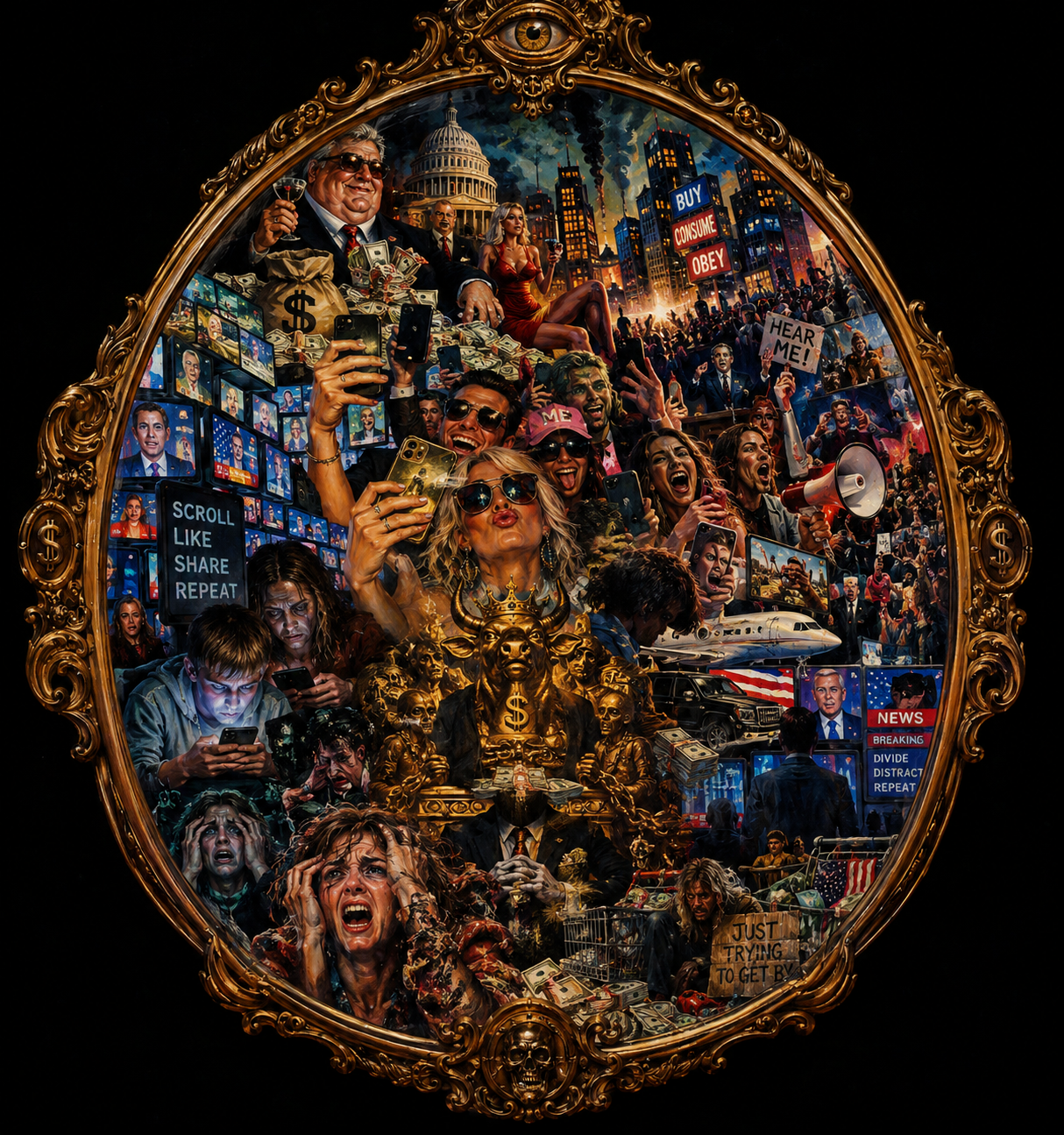
Welcome to the cacophony of culture… if you can even call it that…