The Aristocracy of the Abyss: A Thought Experiment in Political Philosophy
Before We Begin: A Note on the Nature of This Space
EYEJAM is a thinking-aloud space in the tradition of Montaigne—self-examination conducted in public not because I require an audience, but because the door happens to be unlocked. I don’t claim to know-it-all. I claim to be brave enough to think aloud in a public space without hedging. To ask questions and to follow those questions where they lead.
If my work moves you to respond—in agreement, in opposition, in genuine curiosity—my contact page exists for exactly that purpose.
What I will not pretend to miss: the analytics fingerprint of someone constructing a rebuttal in the dark because I don't have comments turned on. That particular maneuver has a name. It is not critique. It is not conversation. It is the coward's substitute for both, and it is intellectually dishonest. The contact form was right there; I don’t truck with cowards.
I. The Problem With Every Aristocracy Ever Built
Every system of governance humanity has ever devised that wanted to put the best people in charge has faced the same quiet catastrophe: it eventually put the wrong people in charge. Not through malice, necessarily—through structure. The selection mechanism gets captured. It always gets captured. And once it does, the system stops selecting for excellence and starts selecting for whoever is most useful to whoever controls the selection. This is not a bug. It's a thermodynamic inevitability.
Take hereditary aristocracy first, the oldest con. The idea isn't stupid—find someone exceptional, give them power, let them pass it to their children. The fatal assumption is that excellence breeds true, and it almost never does. What breeds true is position. Within two generations you get entitled mediocrities who've inherited the trappings of greatness without its conditions—people who never had to become anything because the becoming was done for them before they were born. The bloodline that produced a conqueror produces, reliably, a dilettante.
Meritocracy flatters itself that it solved this problem by making elevation contingent on demonstrated excellence. It didn't. It made elevation contingent on compliance with an evaluative framework designed and maintained by whoever already holds power—which means the system is circular, self-sealing, and not nearly as open as the propaganda insists. You're not measuring excellence in the abstract. You're measuring excellence according to criteria someone chose, and that someone had interests. The credential is not neutral. The test is not neutral. The rubric has an author, and the author has a class.
Technocracy is perhaps the most seductive failure, because it at least sounds like it's selecting for something real. But it selects for a remarkably narrow cognitive profile—a particular kind of quantitative-analytical intelligence—and then makes the catastrophic category error of mistaking that profile for intelligence itself. The technician who can model a system cannot necessarily govern the people inside it, and often can't tell the difference between those two things.
But here's what all three share, the common rot beneath the different veneers: elevation insulates. The moment you successfully rise above the conditions you once navigated, you begin losing access to what those conditions actually feel like. The gap opens between the governors and the governed, and corruption doesn't have to pick a lock to get through—it just walks in through the gap. It's been doing that for six thousand years.
This is why the ruler who has never been cold makes policy about heating assistance with such serene confidence—he has all the data, he's read the reports. But he's never stood in the kitchen at 3 a.m. deciding between the electric bill and the prescription. The credential cannot be eaten. The degree, the title, the mandate of heaven—none of it produces warmth. And the people making decisions about warmth have, in virtually every aristocratic system ever constructed, long since forgotten what cold feels like.
That's the fatal assumption threading through every model: that excellence can be accurately detected from above, by people who haven't been below in years, or ever. But excellence forged in difficulty is not always legible to those who haven't shared the difficulty. It doesn't always look like what they're trained to recognize. And so the systems designed to elevate the best quietly, consistently, do something else entirely.
II. What the Abyss Descended Know That No One Else Does
There's an older idea hiding underneath all of this, one that most political philosophy has been too respectable to touch. Every shamanic tradition, every mystery cult, every mythological hero cycle that survived long enough to be studied contains the same structural secret: you have to go down before you can lead anyone anywhere. The katabasis—the ritual descent—isn't a detour from wisdom. It is the wisdom. The shaman doesn't receive their gift and then, later, suffer as an unfortunate side effect. The suffering is the curriculum. The wound is not incidental to the training. The wound is the training.
We've known this for ten thousand years and built almost none of our governance structures around it. Curious.
So what does the abyss actually teach that no policy paper, no ethnographic study, no well-intentioned listening tour can replicate? Let's be specific, because vagueness here is its own kind of insult.
Homelessness teaches the specific texture of invisibility—not the concept of it, but the lived, hourly experience of moving through public space as a non-person, of watching people's eyes slide off you like water off glass. It teaches the ingenuity that desperation produces, the intricate problem-solving that happens when every conventional resource is unavailable. And it teaches, with merciless precision, how institutions look from outside their doors—which is an entirely different building than the one described in the mission statement.
Addiction teaches the logic of the thing from the inside, which is the only vantage point from which that logic is fully coherent. It teaches what it means to be governed by something, to understand completely that a behavior is destroying you and do it anyway, because the specific gravity of it overwhelms the abstraction of future consequence. And it teaches—this part matters enormously—that recovery is not a return to before. There is no before. Recovery is the construction of something genuinely new from the wreckage of what was, which requires a kind of creativity that comfortable people rarely need to develop.
Prolonged misclassification—being sorted wrong by a system, labeled incorrectly, falling into the gap between categories—teaches how institutions actually function versus how they describe themselves functioning. The gap between those two things is vast, and you cannot see it from inside the institution. You can only see it from the position of someone the institution has failed to correctly process.
And poverty—real poverty, the kind that doesn't end—teaches the mathematics of scarcity in a way that restructures cognition. It teaches that every decision is a trade-off, that resources are not abstract, that time itself is a currency distributed unequally, and that the difference between a good choice and a bad one often has less to do with judgment than with what options were actually available at the moment of choosing. It teaches you not to moralize about other people's survival.
Here's the crucial distinction, and I want to press on it because it matters: what we're describing is not empathy. Empathy is imaginative—it's the genuine, valuable effort to project yourself into another's experience. But descended knowledge is having had the experience. These are categorically different as foundations for governance. The empathetic ruler might get the feeling approximately right. The descended ruler doesn't have to imagine it. It's load-bearing architecture in their own body. The gap between ruler and ruled—that gap we identified as the entry point for all corruption—cannot open in the same way if the ruler carries the lived structure of those conditions inside them. It's not a bridge across the gap. It's the absence of the gap.
But—and this is where the thought experiment grows teeth—descent alone is not sufficient. Descent alone produces trauma. And trauma, unprocessed, produces its own distortions: reactivity, rigidity, the particular cruelties of the wounded who never healed. We're not looking for people who fell and stayed fallen. We're looking for people who fell, hit the bottom, and came through.
The Japanese have a practice called kintsugi—the art of repairing broken pottery with gold. The break is not hidden. The break is highlighted, made luminous, treated as the most significant thing about the object rather than its shameful secret. The repaired vase is not pretending the fracture didn't happen. It's saying: this is where the gold went in. The emerged person is kintsugi—not despite the descent but because of it, visibly stronger at every break point, carrying the proof of survival in the most conspicuous way possible. That's the person we want governing. Not the unbroken—the magnificently repaired.
III. The Architecture of the Model—How It Actually Works
Let's build the thing. Not as utopia—as mechanism. The question isn't whether this is pretty. The question is whether it would work, and why it might work where everything else has failed.
The first principle is open entry, and I want to linger here because it matters more than it might initially seem. Anyone can attempt the path. No birth qualification, no prior credential, no approved origin point. You don't need the right parents, the right zip code, the right undergraduate institution, the right network, the right accent. This is, quietly, more genuinely democratic than virtually any system currently operating under that name—because today's democracies are, if we're being honest with each other, substantially rigged by parentage, access, and the compounding advantages of capital. They select from a pre-filtered pool and call it meritocracy. This model doesn't filter the pool. The path itself is the filter.
And that path is not designed. This is the second principle, and it's what makes the selection mechanism resistant to capture. The test is not an exam. Exams can be gamed—they can be studied for, coached for, purchased for, and the entire tutoring industry exists as proof. What cannot be gamed is genuinely hostile terrain navigated without a map. The abyssal path is real conditions, real consequences, real disorientation. You either find your way through or you don't, and no amount of prep course enrollment changes the fundamental nature of the territory.
Multiple forms of descent are legitimate, because the abyss has many coordinates. Poverty qualifies. So does addiction, exile, prolonged institutional rejection, serious illness, catastrophic loss. What matters is genuine contact with the bottom—not the specific address of that bottom. The model doesn't privilege one form of suffering over another, because what we're selecting for is the knowledge the descent produces, and that knowledge transfers across different abyssal terrains. That said, breadth matters. The person who has navigated poverty and serious illness and exile carries more first-hand maps than the person who survived only one of those territories. More abysses, more knowledge, more capacity to understand and serve the populations who need the most help. The aristocracy of the abyss rewards range of experience, not purity of a particular suffering.
Now here's the load-bearing piece that makes the whole structure stand: the ascent must be substantially self-generated. Not rescued. Not sponsored. Not institutionally rehabilitated from the start. No family safety net, no social capital borrowed from connections, no program that catches you before you've proven you can catch yourself. The abyssal aristocrat does the brutal, unglamorous majority of the climbing alone—and that aloneness is not cruelty, it's the proof. Because what we need to know, what the model needs to certify, is whether this person has the internal capacity to carry others. You cannot demonstrate that capacity if someone carried you from the bottom.
But here's where the model parts ways with mere social Darwinism, and the distinction matters: once the community can see the demonstration—once it's evident that this person is, in fact, making it, that the will and the capacity are real and not theoretical—modest assistance becomes not just permissible but appropriate. A hand extended at the top of a cliff is a different thing entirely from a crane that lifts you off the ground floor. Maybe it's help with rent, just enough to stabilize the final push. Maybe it's something similarly small and specific. The point isn't to carry anyone. The point is to stop kicking away the ladder once someone has already climbed most of it themselves. Everyone, in the end, needs some help—but being worthy of that help, in this model, means you've already done the heavy lifting without it. The help doesn't make you. It just stops making things unnecessarily hard once you've already proved that you can.
But self-generated doesn't mean invisible, and this is where the model gets elegant. The path must be legible—visible enough that those who attempt it and don't complete it can see why, can trace where the terrain exceeded them, can understand the gap between their capacity and the requirement. This is not a small design consideration. It's what converts failure from humiliation to information, and it's what produces genuine respect for those who complete the path rather than the resentment that follows from opaque systems that seem arbitrary. If you can see the mountain, you can honor the climber. If the mountain is hidden, you just resent the person who's higher up than you.
Elevation in this model is burden, not prize—and the architecture enforces this rather than just asserting it. The higher the position, the greater the obligation, and the less the material accumulation. Simplicity scales with authority. This is the inversion of every existing power structure, where the summit is also where the treasure is kept. Here, the summit is where the weight is kept. Material comfort decreases as responsibility increases, which both selects for people who want the work rather than the reward, and maintains the abyssal aristocrat's lived proximity to the conditions of those they serve.
Service, accordingly, is not performed—it's structural. The abyssal aristocrat doesn't serve because it looks good at the right moment, or because an election is coming, or because a camera is present. They serve more because the position functionally requires it, built into the architecture of the role itself. The performance of service is what we have now. Structural service is what this model demands.
Term limits complete the anti-insulation mechanism. No permanent class, no dynasty of the descended, no calcification into a new version of the old problem. Periodic return to ordinary life keeps the gap from reopening—because you can't forget the cold if you keep having to go back out into it. The rotation is not a weakness of the model. It's the immune system.
And finally: the evidence of legitimacy is in the conduct, not the credential. The community can see whether the elevated person is serving or extracting—and in a model built on visible paths and structural service rather than obscure bureaucratic process, that visibility is not incidental. It's self-certifying. The aristocracy of the abyss doesn't ask you to trust its legitimacy. It shows you, continuously, whether it's earned it.
IV. What This Solves That Other Models Don't
Every political model promises to solve the problems its predecessor created. This one makes a narrower, more specific claim: it solves the problems that all the predecessors share, the structural failures that keep recurring regardless of which flavor of governance is currently in fashion. Let's go through them.
The capture problem. You cannot fake the descent. This is the single most important sentence in this entire thought experiment, so let's sit with it. Credentials can be forged, or bought, or obtained through connections that have nothing to do with ability. Birth can be lucky. Wealth can be inherited. Ideological conformity can be performed indefinitely by someone with no actual convictions. But genuine contact with the bottom leaves a specific, granular knowledge that is immediately legible to everyone who has also been there—and completely illegible to those who haven't, which is precisely what makes it unforgeable. The community of the descended is its own verification system. You either know what you know, or you don't, and the people who know can tell the difference in about thirty seconds of conversation.
The insulation problem. The ruler who has been cold cannot forget cold. This isn't sentiment—it's neurology, it's embodied memory, it's the way genuine experience lodges itself in the body at a level that abstraction cannot reach and comfort cannot fully dissolve. Policy made by the descended remains accountable to the actual texture of actual conditions, not to the model of those conditions that looks accurate from a comfortable distance. The gap doesn't seal itself back up just because circumstances improve. The knowledge stays.
The extraction problem. When elevation is structured as obligation rather than reward—when the summit means more work, more constraint, and less accumulation—the position becomes actively unattractive to exactly the wrong people. The extractors, the status-seekers, the ones who want power for what it gets them rather than what it asks of them, will self-select out. You don't need to screen for corruption if the architecture of the role makes corruption a bad deal. The position is deliberately, structurally unappealing to anyone whose primary interest is in taking.
The mediocrity problem. The path requires genuine capacity—not the capacity to perform competently within an approved framework, which is what most credentialing systems actually measure, but the capacity to navigate genuinely difficult, unmapped conditions without scaffolding, without instructions, without a rubric. That's a different and rarer thing, and the path selects for it directly rather than trying to approximate it through proxies.
The envy problem. This one is underrated. Those who attempted the path and didn't complete it have standing to respect those who did—because the process was open to them, the path was real and visible, and the difference in outcome reflects something they can see and understand rather than something that was decided by people they'll never meet according to criteria they were never given. Legitimate hierarchy doesn't produce resentment at the same rate as arbitrary hierarchy. People can accept being below someone they can see earned it.
The legitimacy problem. Authority derived from visible service to those below is self-renewing in a way that institutionally-backed authority simply isn't. It doesn't require propaganda, or mythology, or the threat of enforcement to maintain its claim. It's simply apparent—continuously demonstrated, continuously legible, requiring no one to take it on faith because the evidence is ongoing and in plain sight.
The mimic problem. Mimics cannot descend authentically. They can perform descent aesthetically—adopt the vocabulary, wear the right scars, construct a compelling narrative—but the knowledge isn't there, and the people who have actually been through it can tell immediately. This is not a small thing. Most systems are vulnerable to sophisticated mimicry precisely because the evaluators have no personal access to what's being mimicked. This system's evaluators are the community of the descended themselves, who have exactly that access. The community is the filter, and it's a filter that cannot be fooled by a good costume.
It's worth, finally, placing this model in its proper intellectual neighborhood—because it didn't emerge from nowhere, and acknowledging its ancestors is more interesting than pretending otherwise. Plato's guardians had the right instinct: governance requires a specific kind of excellence, and not just anyone should be doing it. But his selection mechanism was top-down, controlled by the existing philosopher-kings, and contained no descent requirement whatsoever. The Confucian junzi—the exemplary person—is actually the closest formal analog: open examination in principle, an explicit obligation to serve rather than to accumulate, material simplicity as a virtue of the role. But again, no descent requirement. The examination measures learning and moral cultivation, not the specific knowledge that only difficulty produces. The shamanic leadership traditions get closest in spirit—the katabasis as explicit prerequisite, the wound as credential, the return from below as the source of authority—but they lack any formal political structure, remaining bound to small communities and ritual contexts. The aristocracy of the abyss is, in a sense, the attempt to formalize what the shaman always already knew, and scale it.
V. The Objections—And What They Reveal
Every serious thought experiment earns its objections, and this one has collected some good ones. Let's not dismiss them. Let's open them up and see what's inside.
"This romanticizes suffering."
No. It doesn't. Romanticizing suffering means treating it as beautiful, as ennobling in itself, as something to be sought for the aesthetic experience of having survived it. This model does none of that. It simply recognizes that certain knowledge cannot be acquired any other way—that the specific, granular, embodied understanding of what the bottom actually feels like is not available through imagination, research, or sincere empathy, however well-intentioned. We don't accuse medical schools of romanticizing anatomy because they require surgeons to understand the body before cutting into one. The descent is not celebrated here. It's not glamorized. It's required—the way any genuine prerequisite is required—because the job demands the knowledge, and the knowledge only comes from having been there. The suffering is not the point. The knowledge is the point. These are different things.
"Who certifies the descent was genuine?"
The community. Not an institution, not a bureau of certified descent verification, not a panel of credentialed evaluators who themselves have never been below. The community of the descended certifies the descent, and this is not some novel or fragile capacity we're inventing—it's ancient and remarkably reliable. People who have been through genuine difficulty recognize each other across remarkable distances of culture, language, and circumstance. The specific texture of the knowledge is legible to those who carry it. The mimic, as we've established, cannot pass this filter—not because the filter is sophisticated in any bureaucratic sense, but because you cannot perform your way through a conversation with someone who actually knows. The institutional certification systems we currently use are, if anything, more gameable than this one. At least this filter has direct access to what it's filtering for.
"What about people who descended and didn't emerge with wisdom—who came back broken?"
This is the most compassionate objection, and it deserves a careful answer. The model requires emergence. Descent without emergence is tragedy—genuine, terrible, worthy of every sympathy—but it is not qualification. We're not selecting for people who suffered. We're selecting for people who suffered and built something on the other side of it. The kintsugi vase requires both the breaking and the repair. A pile of shards is not kintsugi. The test is not what happened to you in the abyss. The test is what you constructed from the experience of having been there and having come through. The broken who didn't emerge are not failed candidates—they are people the model has an obligation to serve, which is rather the point of the whole enterprise.
"This is unscalable—you can't run a modern nation-state this way."
Possibly true. Probably true, in any immediate, literal sense. But this objection mistakes the purpose of the thought experiment. We're not drafting legislation. We're asking what legitimate authority would actually look like if we built it honestly, from first principles, without the inherited assumptions of systems designed by and for people who already had power. The answer to that question is clarifying regardless of whether the model is implementable at scale—because it exposes, with uncomfortable precision, how far current systems are from anything resembling legitimate authority as we've defined it here. If the honest answer to "what would good governance actually require?" disqualifies nearly everyone currently governing, that's not a problem with the answer. That's information.
"The current system already includes people who've been through difficulty."
Yes. It does. And they are systematically filtered out—by credential requirements that presuppose resources, by social capital gatekeeping that presuppose networks, by a mimic-controlled pipeline that has optimized itself over generations to reproduce the people who already run it. The occasional difficult biography that makes it through does so despite the system, not because of it, and usually only after significant portions of the difficulty have been sanded down into something palatably narrative for a campaign website. The model we're describing doesn't merely include the descended as a diversity consideration. It is designed around them. The entire architecture assumes their centrality. That's not a variation on the current system. It's a different system.
And then there's the objection nobody actually states out loud, the one living underneath all the others like a load-bearing wall nobody wants to point at: this model would disqualify most of the people currently in power. Not as a side effect. As a direct, structural consequence of applying its central criteria. They know this, even if they'd never say it, even if they've never consciously articulated it. And the ferocity with which systems of entrenched power resist exactly this kind of reimagining—the speed with which it gets labeled utopian, unscalable, naive, dangerous—is, if you're paying attention, the strongest argument for taking it seriously.
The objection that would most benefit those in power is always the one they're most eager to make. Note accordingly.
The philosopher-king was supposed to be the person least interested in power. The aristocrat of the abyss is the person most qualified for it by the one credential that cannot be manufactured: survival of the the worst conditions they're governing.
—M.
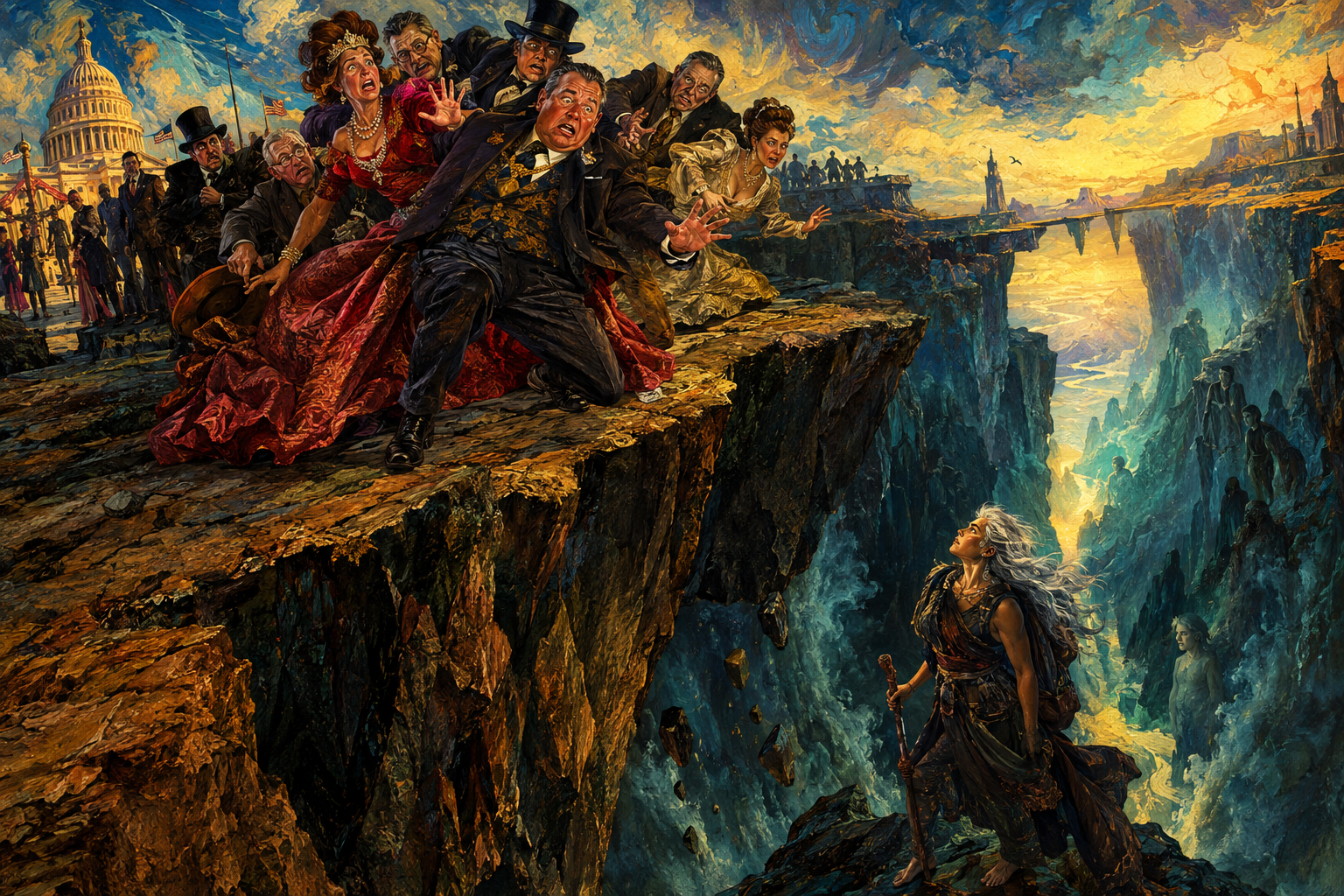
Those who fear the abyss should not be ruling over its citizens.
Next Week
Monday — The Mirror Runs Both Ways: How Political Systems Produce the Cultures They Deserve
Every political system broadcasts a values signal—and the culture you live in is proof of what your system actually rewards. Tracing the feedback loop from aristocracy to oligarchy to democracy, this essay asks the question nobody does: what kind of person does your system produce in bulk?
Thursday — For Women Who Were Never Told: Beauty Is a Depreciating Asset
What happens when a woman invests everything in her appearance and nothing in her inner life? This post breaks down why outer beauty is a depreciating asset, what quietly atrophies when the packaging becomes the whole project, and how to start building the one portfolio that actually compounds with age.