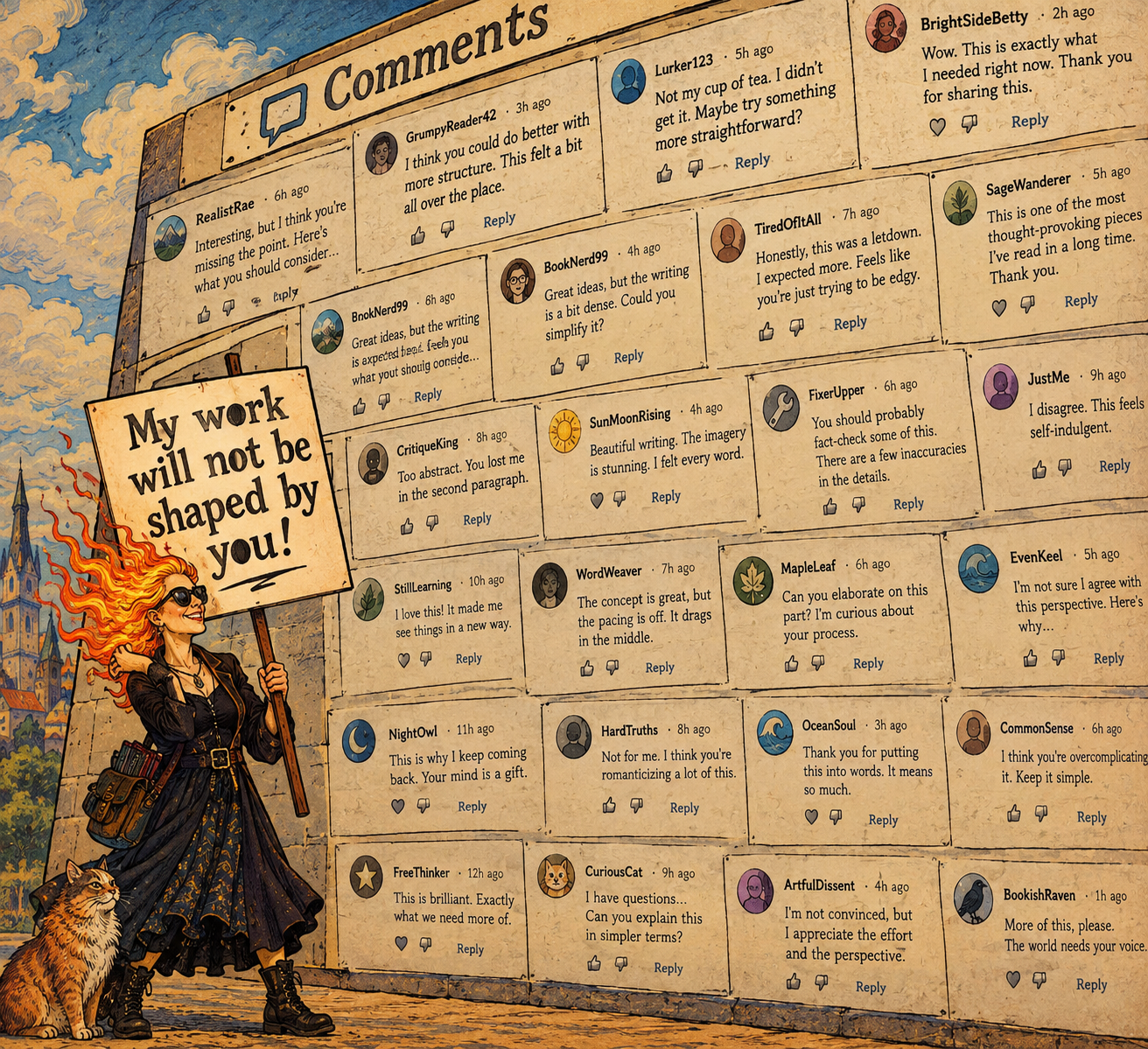
Comments Are Off. That's Not an Oversight.
Or: A Philosophical Position on Writing Into Silence
I. The Loop and What It Does to You
Here's the feedback architecture of contemporary publishing, stated with the clarity it's usually denied: you publish, the audience responds, you calibrate, you publish again—slightly adjusted, slightly more of what landed, slightly less of what didn't, slightly further from whatever you originally had to say. And then you do it again. And then again. The loop is elegant, self-reinforcing, and operates on a timescale long enough that you can be well inside it before you've noticed you entered.
What makes it effective as a trap is that it's never presented as one. It's presented as connection—which is a real thing, a good thing, a thing writers have always wanted. It's presented as community, as democratization, as finally giving the audience a seat at the table. And all of that is true, in a way, the way that a lot of effective traps are true in a way. The seat at the table is real. What's also real is that the audience, once seated, has opinions about the menu. And the kitchen, over time, adjusts.
The drift mechanism is identical to the one running in every other corner of the flattery economy: not conscious sellout, never conscious sellout—that story's too dramatic and too easy to avoid. What actually happens is colder and more hydraulic. A piece gets shared. Another one doesn't. A certain register earns subscribers; another one quietly loses them. Nobody issues a directive. The corpus just shifts—piece by piece, almost imperceptibly, toward the affirming and away from the demanding—until the writer who began with something genuinely strange to say has become a highly polished delivery system for what the audience already believed, rendered in prose good enough that everyone, including the writer, mistakes it for thinking.
The variable that determines everything is this: does the writer need the loop's approval? Because the writer who needs it can be captured—will be captured, eventually, by the cold hydraulics alone, no malice required. And the writer who doesn't need it simply cannot be captured in the same way. This isn't a moral distinction. It's not about virtue or discipline or being too proud for feedback. It's about what the work is for—what it's oriented toward, what it's answerable to. If the work is answerable to the argument, the loop has no leverage. If it's answerable to the response, the loop has all the leverage it needs and will use every bit of it.
Comments off, then, is not a technical preference. It's not shyness, not arrogance, not an oversight in the settings. It's a refusal to enter the loop in the first place—a decision made before the first post goes up, about what the work will and won't be answerable to. The silence on the other end isn't absence. It's the condition under which honest writing becomes possible.
II. What Writing Is Actually For (My Version)
There are a few different things writing can be, and it's worth being honest about all of them. There's writing as performance—the work that exists to be received, that shapes itself around the receiving, that is in some fundamental sense about the audience even when it's pretending to be about ideas. There's the therapeutic journal, which is writing for the self in the most literal sense, the private metabolizing of experience with no particular claim on anyone else's attention. Both of these are legitimate. Neither of them is what I'm doing.
The third thing is harder to name and easier to dismiss, so let me try to be precise about it: writing because the ideas have a claim on existence independent of whether anyone is currently equipped to receive them. Not I want to say this but this needs to be said—and the difference between those two positions is enormous. The first is still audience-adjacent, still oriented toward the self's desire for expression. The second is almost impersonal. The work isn't for me and it isn't for you; it's for the argument, for the record, for the frequency that will eventually find the receiver it needs even if that receiver doesn't exist yet in any appreciable number.
This is not the consolation version of writing for yourself. That version—the one you adopt after the numbers disappoint, the one that arrives wrapped in a certain defensive dignity—is still answerable to the audience, just negatively. It needs the audience's absence to justify itself. What I'm describing is more demanding than that, because there's no external signal of any kind. No approval, obviously, but also no disapproval to heroically endure. Just the work and the internal standard and the question of whether the thing is true and well-made, with no outside apparatus to confirm or deny.
Which means you have to carry your own measure of quality entirely. This is rarer than it sounds. Most writers never develop it—not because they lack the capacity but because the feedback loop gets to them first, colonizes the evaluative function before it's had a chance to become autonomous, and from that point forward the writer is using the audience as a prosthetic for their own judgment. The loop doesn't just change what you write. It changes the equipment you use to decide whether the writing is good.
The RSS departures after The Second Harvest were, by this measure, informative rather than injurious. The unsubscribes arrived before the second paragraph—which means they weren't a verdict on the work. A verdict requires engagement. What they were was a measurement: a precise, if painful, instrument for gauging the distance between where the work is and where the median subscriber was. The work went somewhere the median subscriber wasn't prepared to follow. That's not a failure of the work. That's a description of its coordinates.
A piece that no one can safely appropriate to either tribe is a piece doing something real—something that followed its logic rather than its incentives, that ended up somewhere unclassifiable because the argument actually went there, not because the writer was performing independence. These pieces will cost you subscribers. The immune response is fast and it is thorough and it does not wait for the second paragraph. Good. The cost is a kind of confirmation. If everyone can fit it comfortably into their existing framework, you probably didn't go anywhere. The unsubscribes are the work's integrity, measured in departures.
III. The Tradition of the Trunk
Fernando Pessoa died in 1935 and left behind a trunk. Inside it: tens of thousands of pages, multiple complete literary personalities—heteronyms, he called them, each with their own biography, their own aesthetic, their own handwriting almost—and a life's work that was, by any contemporary metric of success, essentially unpublished. He was not waiting for the moment to be right. He was not building toward a launch. He was writing because the writing needed to exist, which is a different orientation entirely, and one that the feedback-loop economy cannot parse because it contains no mechanism for monetization and no obvious pathology to diagnose.
Dickinson put hers in a drawer. Melville wrote what is arguably the great American novel, watched it fail commercially, and spent decades out of print while he worked as a customs inspector—which is the universe's idea of a joke, apparently. The pattern is consistent enough across enough cases that it would be intellectually dishonest to call it coincidental. What it is, instead, is structural. The work that is most fully itself—most undeferred to the comfort of its immediate audience, most committed to going where the argument actually goes rather than where the audience has pre-approved—tends to arrive before its moment, or after, or so far outside the current frequency that the current moment simply has no apparatus for receiving it. This is not tragedy. This is how the thing works.
What makes work date is worth understanding precisely, because it's not age and it's not obscurity. It's calibration. The topical hook that made a piece feel urgent in the week it was published. The current vocabulary—the exact lexicon of a particular cultural moment, the words that felt like precision and now read like period costume. The careful adjustment to what the present audience can comfortably receive, the way the argument stops just short of the conclusion that would have cost subscribers. All of this has a shelf life, and the shelf life is the length of the cultural moment it was built for. When the moment passes, the calibration is all that's left, and calibration is not interesting.
What makes work durable is simpler and less comfortable: following the argument to its honest conclusion regardless of the approved destination. Not because durability is the goal—that's its own kind of calibration, just aimed at a longer timeline—but because honest conclusions are the only ones with any structural integrity. The work that Pessoa left in the trunk wasn't built for the future. It was built for the truth of what he had to say, and the future turned out to be the only place large enough to hold it.
The future reader, then, is not a fantasy you construct to console yourself when the present audience fails to materialize. They are the structural consequence of honest work done in an inhospitable moment—not promised, not guaranteed, but genuinely possible in a way that has nothing to do with hope and everything to do with the work's actual properties. Pessoa's trunk got opened. Dickinson's drawer got opened. The customs inspector got a second hearing that dwarfed his first. None of them engineered this. They just refused to let the inhospitality of the moment become the ceiling of the work. That refusal is the whole move. Everything else is patience.
IV. The Age of Comfort and Its Shelf Life
The comfort economy of ideas is, at bottom, a luxury product. It requires a specific set of conditions to function: a readership with enough material security and surplus attention to spend its intellectual energy on the confirmation of priors rather than the navigation of genuine difficulty. When you're not actually scared—when the problems are real but abstract, when the stakes are ideological rather than immediate—you can afford to read in order to feel right. The flattery economy is, in this sense, a fair-weather architecture. It was built for the long afternoon of relative stability, and it is exquisitely calibrated for exactly those conditions and no others.
Brittle minds are a product of abundance. This is worth sitting with, because it inverts the usual anxiety about intellectual decline. The audience-captured reader isn't deficient—they're optimized for an environment that rewarded a particular kind of fast, frictionless, confirmation-seeking cognition. The greenhouse mind is a response to greenhouse conditions. The problem is not that it was built wrong. The problem is that the weather is changing.
Because here is what happens when the conditions degrade: people who are genuinely scared do not read to have their priors confirmed. Something shifts in the appetite when the abstractions start having consequences, when the ideological becomes material, when the questions stop being about identity and start being about survival. The demand for honest diagnosis—for writing that actually accounts for what's happening rather than writing that makes you feel correctly positioned relative to what's happening—grows under pressure. It always has. The pamphlets that mattered during genuinely dangerous moments were not comfort objects. They were tools. People read them because they needed to think, not because they wanted to feel smart.
The questions that couldn't be asked cleanly—the ones that got you unsubscribed before the second paragraph, the ones that refused tribal appropriation, the ones that followed their logic somewhere neither side had pre-approved—are going to force themselves into the conversation. Not because the culture has matured or the algorithm has been reformed, but because the conditions that made them unspeakable are dissolving. Unspeakability is a luxury too. It requires a situation stable enough that you can afford to not know certain things. That situation has a shelf life, and the shelf life is expiring.
This age is crumbling at the load-bearing walls, and the comfort economy of ideas will not survive contact with the scale of what's arriving. The essays written without deference to the conditions producing the crumbling—the work that followed the argument honestly when honesty was unfashionable, that accepted the unsubscribes as a measurement rather than a verdict, that wrote into the silence because the silence was the only honest condition to write into—these are the ones pre-positioned for what comes next. Not through strategy. Not through prophetic self-congratulation. Through the simple, structural fact of having been honest when the incentives all ran the other way. The trunk gets opened. It always gets opened. The question is only whether there's anything in it worth reading.
V. Why the Silence Is the Point
No comments. No calibration. No loop. The work goes out and the work stands alone—which is, if you think about it, the only condition under which you find out whether it actually stands. The feedback loop doesn't just change what you write; it changes what you're able to evaluate, because the response becomes load-bearing in the assessment of the work itself. Remove the response and you're left with the only question that was ever worth asking: is this true, and is it well-made, and does it go where it needed to go? The silence is not an obstacle to answering that question. The silence is what makes it possible to ask it honestly.
On not needing to see it land: the record is the record whether or not the witness arrives in your lifetime. This is not mysticism and it's not cope—it's closer to physics. The tree falls. The sound exists in the physical fact of the event, in the compression waves that moved through the air whether or not there was an ear present to receive them. Pessoa didn't know about the trunk's eventual opening. Dickinson didn't know about the drawer. The not-knowing didn't retroactively silence the work or render it unreal. The work was real when it was made. That's when realness happens. Everything after is just arrival.
The future reader who will understand the frequency is not a fantasy, not a consolation figure conjured to make the present loneliness bearable. They are waiting on the other side of a moment that hasn't arrived yet—a moment when the conditions will have shifted enough that the work becomes fully legible, when the questions it was asking will have forced themselves into the conversation whether the conversation wanted them or not. The work is the message in the bottle. You write it past the present, past the current vocabulary and the current tribal geography and the current incentive structure, toward the conditions that will make it make sense. The bottle goes into the water. The ocean does what oceans do. You don't stand on the shore waiting for confirmation.
This is a different game, played on a longer board, for stakes the quarterly metrics cannot measure and were never designed to. Writing for the age that's coming rather than the age that's here isn't strategic positioning and it isn't self-mythology—it's just the honest acknowledgment that the present moment is not the only court with jurisdiction over the work. The age that's here is loud and fast and very confident in its classifications. The age that's coming will have different questions, and the answers it needs are being written now, into what currently looks like a void, by people who declined the loop and kept going.
Comments are off because the conversation this work is having is not with the current moment. It's with the record. And the record doesn't need a reply section. It needs true things, carefully made, sent forward without deference and without apology—into the silence, past the silence, toward the reader on the other side who will pick up the bottle, read the frequency, and know exactly what it was.
EyeJam is published at majeye.com without a comments section, an editorial board, or a strategy meeting. If this found you, it probably found the right person.
—M.
Thankfully I never read this bullshit. And I mean NEVER. These AI created comments are the first ones I’ve read in years. Do people really still do this? Guess who will not be finding out. raises hand