The Arrival
As I’ve said before, this is not edited and will not be exactly the same in the published book. I thought just this once I’d continue the story where we left off. But after this one it will likely jump forward in time for you.
Getting off the plane at SFO was like diving into an abyss. I knew I was unprepared, but knowing and experiencing are completely different things. I had very little money and a raging drug addiction that had to be sated. Getting on BART to The City was a challenge. Finding my way was the easy part. The hard part: I didn’t know you have to hold on when it takes off. I almost fell. I loved listening to the passengers. “Nah, I’ll just take the J to Duboce and walk up and take the 43.” Gods, they sound so cool to a small town Louisiana girl. I wanted to sound like that one day.
I didn’t know where I would stay or how far the money I had would go. I (stupidly) brought a huge suitcase full of stuff. I lugged it around looking for somewhere to stay. “Check out the hostel on Ellis at Larkin.” Thank you, kind sir. So I lugged my suitcase through the TL to the hostel, checking the maps at Muni stops to find my way. That’s what you do when all you have is a dumb Nokia phone. Nothing could have prepared me for the hills. Where I come from it’s flat as the eye can see, and any hill is man-made. The streets were full of all kinds of different people. The energy was electric and invigorating. The air was brisk and cool. The smells changed considerably within the span of a couple blocks. The dirty and human smell of the Tenderloin, then 2 blocks later, the smell of food that was completely foreign to me. Turns out it was Vietnamese, which I now love. I got to the counter and paid for the room for 2 nights. It was 2 bunk beds, 4 beds in all, in an extremely small room. About $60 a night for one of those beds—at least I got free breakfast. There was a bathroom in the room, which eventually would become a luxury to me.
My roommates and I exchanged pleasantries, but we were all eager to get out into the city. What did I do? I immediately began looking for drugs. I could sense their presence near me, even though I knew little of what being in the Tenderloin meant. I had been to SF before, but not long enough to understand the fascinating mini-worlds that are San Francisco neighborhoods. I went and struck up a conversation with a guy standing outside a tiny market on Larkin. Turns out those are called “bodegas.” Watch Half-Baked, that film explains them perfectly. He said said he was about to get off work. “Would you like to take a walk?” Of course I would. I was on a mission. We walked to the park on Eddy and Gough and sat on a bench. I could tell he was trying to get with me. “I’m Egyptian,” he said. I told him I just got out of a relationship and nothing between us would be possible. Eventually, I asked him where I could find some meth. He knew someone.
We walked to a nearby building where the dealer was. He hung his head out the window and told me to lift up my shirt to make sure I wasn’t a cop. Oh great. He’s one of those dealers. The kind that thinks what they do is cool and gets off on being a gatekeeper to the substance. Ugh. I protested, but I had a bra on and eventually relented. I wanted my drugs after all. I got them and went back to the bathroom in my hostel, put the meth into my needle and drew up water. Locked, loaded, and fire! It was ok. Surely a scumbag like Rivers would not have anything decent. I walked around all night. The TL was safer back then.
I called my mother and asked her for a little money. She sent me $100 and said no more. She had turned her back on me long before I got to this point. My little sister is the “golden child” that she chose. She bought her a car, paid her rent and helped her throughout her life. I was the “scapegoat” and my little brother was the forgotten one. Look it up. This is common for children of narcissists. They designate each child as worthy or unworthy, and help them accordingly. My little sister was very good at making my mother think she was getting her way, while my sister got what she wanted out of it. I was never willing to comply with her not letting me be my own person. I never respected her, even from a young age. She was physically and emotionally abusive and cared only what others thought of what we did. Appearance was everything. Loving home non-existent. So, she basically gave me the middle finger and who was I to complain? That’s how she’d always been. I was a junkie. Guess I deserved to be left to the wolves at that point, but not when I was 16. That’s when this path began.
I got a call from Rivers that day. He wanted to introduce me to some people. We went to a parking lot on Eddy. There I met Roberto and Juan. They ran the parking lot. From what I witnessed, people from the neighborhood would bring them stolen goods and the were a fence of sorts. They were good guys though; they sent the money to their families in their home countries. They took pity on me and offered me a small room in their house for $300 a month. I guess they realized what would happen to me if they didn’t. They sent one of the neighborhood kids with me to go collect my stuff. He was a sweet black kid they called “Cookie Monster.” I never asked his real name; one doesn’t ask things like that in certain situations. I don’t think they called him that to be racist as he was constantly eating all their cookies. They were happy to oblige.
When we were on our way to the hostel, we sat at a bus stop and Cookie Monster was about to roll us a joint. I saw the cops coming and told him to hand me the weed. He put it in my hand. The cops got out and asked what we were doing and what was in my hand. I opened my hand and the weed was there. The cop looked at us and said don’t do that here. Remember, this was 2009. They also said something to him along the lines of “We don’t want to have to pick you up again.” I knew the realities of the police (not that it’s right) and, my being white and unknown, I wouldn’t get in trouble, whereas he might. I’m glad I took it from him because apparently they knew him.
We retrieved my things from the hostel and walked back to the parking lot. There was a tiny shack on the lot where they did business from. The parking lot smelled like urine, because they pissed there. They spoke in Spanish at times, but from my background in French and Latin I could figure out some of what they were saying. They asked me if I knew what they were talking about. I said, “Not everything, but I know you were talking about work.” Their eyes got wide. “I thought you didn’t know Spanish.” I don’t. But “travajo” is very similar to “travaille.” Not to mention voice intonation and context. They were impressed. I loved their constant ribbing on each other because of their respective countries. Roberto was from Mexico and Juan was from El Salvador. I would tell you what they said, but I would get canceled—even though they actually said it. Suffice to say, it was funny and cute.
We headed to Roberto’s house in his tiny blue truck. I watched from the window as the city changed into different forms while we wormed our way through the sleepy, nighttime SF streets. He explained his uncle owned the house and the parking lot and he was just working for his uncle. Also, the house was on the market and people might be coming to view it, but not to worry because it would be a while before they found a buyer. He drove far out to 45th and Taraval. We walked inside and he showed me my room. It was tiny, but I was extremely grateful. He said if I wanted a ride into downtown, I could leave with him when he left early any morning. I rarely had that pleasure.
I walked around the Outer Sunset. It had an eerie, quiet feel. Overcast and misty . . . you got the feeling no one would hear you if you screamed, especially at night. I went to Ocean Beach. I expected a warm, sunny beach. That’s what beaches are, right? Not all of them . . . Apparently that was just my local, never-been-far connotation. You can’t imagine what one might discover if they left their comfort zone. Whole other worlds exist, even within one’s own country. How many of us never travel far? I hadn’t; I was myopic. Stepping out of your comfort zone is enlightening. Difficult, certainly.
I started dating. It was back when you could meet people on Craigslist. Romantic encounters, or whatever it was called. I met a cool cannabis horticulturist who introduced me to (what is still) one of my favorite beers, at Noc Noc. We only had drinks once. Oh, La Fin du Monde, how do I love thee? With your bananaliciousness and your sparkly 9% ABV? Spooky Noc Noc, I would ever swim in your Tim Burton-esque, beery, gothic wonderland. Ahhh.
Then, I met Saul. Oh my word. This dude showed up in a suit, with a combover, to a very low-key Haight bar that escapes my feeble memory. There was free jazz there some nights. He was frontin. I didn’t care. I just wanted to get out and have fun. I was never going to fuck this dude; I knew that just from his messages. I’m always open to the weirdness of others, being a strange cat myself. He “had a business” and worked the door at an all-male strip club (Nob Hill Theater) “on the side.” How I love text/air quotes. I could feel the energy of a sociopath of low-intelligence. You know the feeling? They feel oily, and you catch them in silly lies they wouldn’t have told if they were smarter. Unfortunately for me, not all psychos are so obvious.
I made a few rides with Roberto to the p-lot. He was very kind and gentlemanly. Always appreciated. I could also meet him before he left at night to go home. The ride from the Outer Sunset took almost an hour on the L-Taraval. Muni is great, but it’s so much better when you’re in the thick of things. That far out, you feel the distance. How does SF do that? It’s 7x7 miles, and yet numerous worlds exist within it. I loved the family-oriented Latino culture. They were always kind and had a smile on their faces. They did what they had to do. Nothing they did was hurting anyone; they were HELPING me. I got to try new dishes I’d never heard of. Espcially El Salvadorean Pupusas! Juan’s family cooked them. Mwahhh, heaven!
I got a call from Saul. He had VIP tickets to this show at the Mezzanine. Ok, hells yeah. He wanted me to meet him at a hotel room he had gotten. Whatevs, I knew where I stood on fucking him—so what did it matter? I had gotten some meth (finally) before I met him. Clean needles, the works. About that, I didn’t just share that information with normies, or even crazy psychos. I was always well-aware of how needles would be taken by someone not involved. It was a secret I tried my best to keep. I packed my makeup and what I needed to get ready, then headed to the hotel room. I was late. This paragon of society was chiding me for it. Urrrr. How could I get him to shut up? I gave him a line of speed. Big fucking mistake. He was happy, but more annoying than anyone could ever imagine. Never give people speed. You have no idea what it will do to them. Most people should NOT do it. Probably a neurochemistry thing. We made it to the Mezzanine. He was up my ass. Wouldn’t be chill and let me dance and have fun. He introduced me to a dancer from his job at the strip club. A guy named Malincoeur—Mal for short.
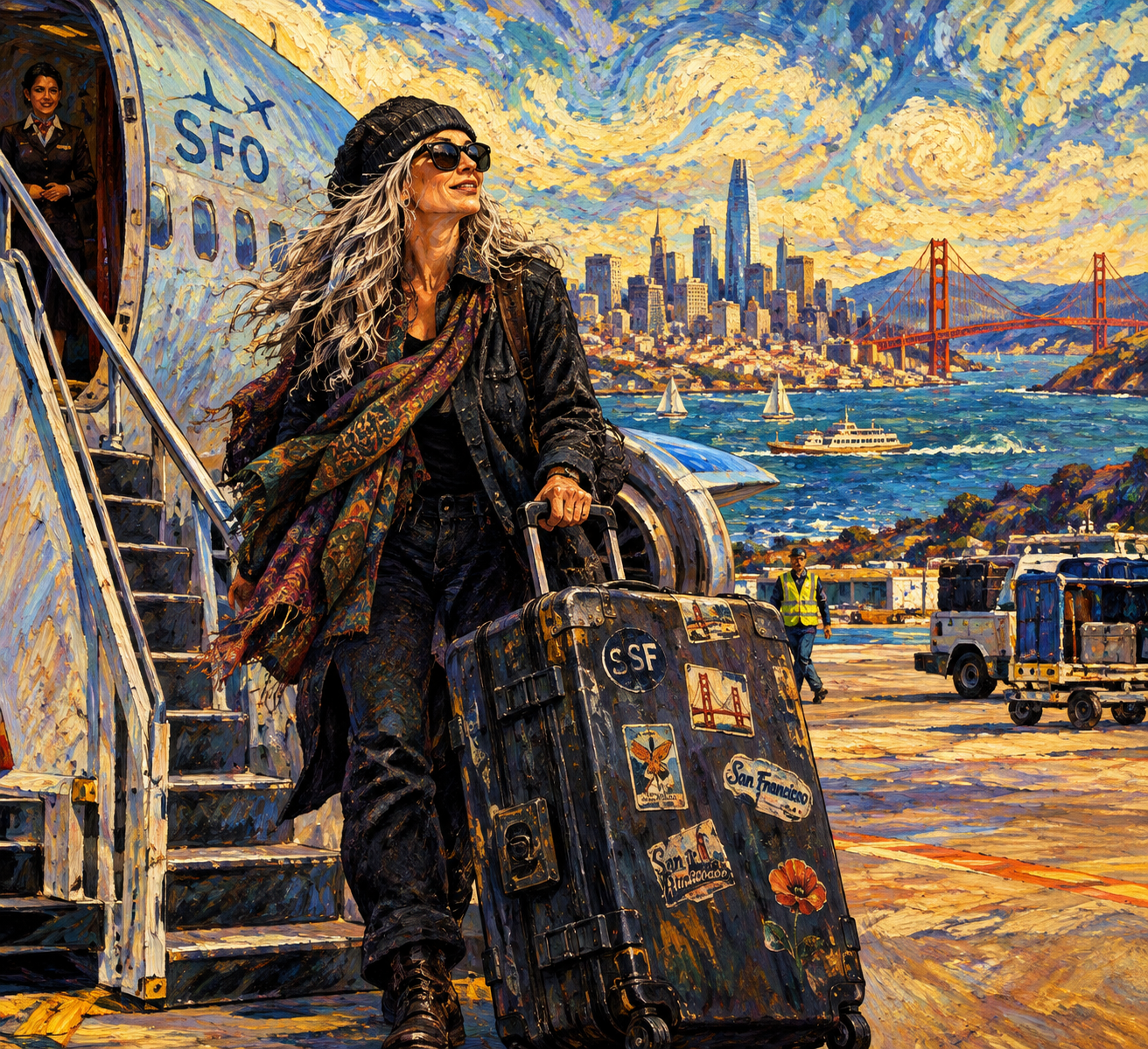
Little did she know…
Next Week
Monday — Comments Are Off. That's Not an Oversight, Or: A Philosophical Position on Writing Into Silence
Comments aren't off because the work is precious or the writer is fragile. They're off because the feedback loop is a trap with excellent branding—and the only way to find out if the work actually stands is to let it stand alone. This is a philosophical position on writing into silence: on Pessoa's trunk, Dickinson's drawer, the unsubscribes that arrive before the second paragraph, and why the future reader isn't a consolation prize. The conversation this work is having isn't with the current moment. It's with the record.
Thursday — The Aristocracy of the Abyss: A Thought Experiment in Political Philosophy
Every system ever devised to put the best people in charge has ended up putting the wrong people in charge. Not through malice—through structure. The selection mechanism gets captured, the elevated forget what the bottom feels like, and the gap between ruler and ruled becomes the address where corruption lives. But what if the qualification for governance wasn't birth, or wealth, or credential, or ideological compliance—what if it was the abyss itself? What if the people most fit to carry others were precisely the ones who'd already proven they could carry themselves out of the worst possible circumstances, alone, without a net? The Aristocracy of the Abyss is a thought experiment in political philosophy that takes that question seriously—and lands somewhere that should make anyone currently comfortable in power quietly nervous.