The Signal and the Silence: So You Think You Could Do It
Core argument: The obstacle between you and serious creative work is not time or money. It's that you have never been alone with yourself long enough to find out if there's anything there.
I. The Fantasy Is Extremely Convincing (And Also Wrong)
Almost everyone believes they have a book in them. A body of work. Some luminous cluster of ideas that just needs the right conditions to finally crack open and bloom. This belief is so widespread it's practically a personality trait at this point—and it is, statistically speaking, almost entirely untested.
Here's how the fantasy goes: a patron materializes, obligations evaporate, and genius emerges naturally, organically, like something that was always there just waiting for decent soil. It's a lovely story. It also has essentially nothing to do with what actually happens.
What actually happens is the obligations dissolve—and you discover, with a particular species of horror, that the obligations were the only thing making you feel like a person. The structure was load-bearing. The busyness was the identity. And now there's just you, a blank document, and an afternoon with no exits.
The belief that resources are the missing variable is a comfortable lie, and it's comfortable for a very specific reason: it puts the problem somewhere else. In circumstance. In capitalism. In bad luck and bad timing and the specific cruelty of your particular life situation. Anywhere, really, except in the interior—which is the one place nobody actually wants to look.
I'm not saying you don't have ideas. I'm genuinely not. I'm saying you don't know yet whether you can be alone with them long enough to do anything about it. Those are two very different claims, and only one of them is the interesting problem.
II. What Actually Happens When the Noise Stops
Here's the sequence, and it's so predictable you could set a clock to it. First comes relief—genuine, physical, the shoulders dropping two inches. You did it. You made space. This is already more than most people manage. Enjoy the relief. It lasts about forty minutes.
Then comes restlessness. A low hum at first, then louder. You find yourself checking things. Tidying. Making elaborate coffee. The restlessness shades into something with more edge to it—a low-grade panic that your nervous system will almost certainly misfile as boredom. I'm just bored, you'll tell yourself. I need stimulation. I'm the kind of person who needs stimulation.
You're not bored. What you're having, possibly for the first time in years, is an honest encounter with your own interior. That's a much stranger and more vertiginous experience than boredom, and your brain, being a seasoned professional at self-protection, would really prefer you didn't find that out.
The silence doesn't feel like freedom at first. It feels like a room with no furniture—not peaceful, just exposed. Acoustically weird. Like you've been making noise your whole life and didn't realize it was structural. Most people have never actually distinguished between quiet and empty, because they've never stayed in genuine quiet long enough to find out which one they're in. The experiment always gets aborted. Something comes up. Something is allowed to come up.
And then comes the urge to fill it. With anything. With Netflix, with errands, with texts, with the ambient scroll of social media—that particular genius invention for making sure you are never, ever alone with a thought that hasn't been pre-validated by someone else's attention. The urge to fill the silence is not laziness, and it's not weakness. It's self-protection, operating exactly as designed, doing its job with real competence. What it's protecting you from is an uncomfortable and genuinely unwelcome discovery.
There may be less signal in there than you thought.
Not no signal. But less. Fewer actual ideas and more accumulated impressions borrowed from other people's work. Fewer original obsessions and more aesthetic preferences—things you like, things that please you, but nothing that's demanding to be made. The difference between having taste and having something to say is a distinction that the noise very conveniently prevents you from having to make. Silence makes it unavoidable. Which is, of course, exactly why most people keep the noise on.
III. Discipline Is the Wrong Frame — And So Is Talent
The flattering story we tell about people who can actually work—who disappear into a room and come out months later with something real—is that they're more disciplined. They resist distraction better. They have stronger willpower, a more austere relationship with pleasure, some moral fiber the rest of us are lacking. This explanation is extremely satisfying because it makes the whole thing a matter of character, which means it's fixed, which means you're either born with it or you're not, which means you're off the hook.
It also explains essentially nothing.
Discipline implies suppression—white-knuckling through the urge to do something else. But that's not what's actually happening when someone can work in genuine silence for eight hours and surface blinking and slightly feral and not particularly interested in what they missed. What's happening is simpler and stranger: the work is just louder than the silence. The interior—the problems that won't resolve, the half-formed things demanding to become fully formed, the particular obsessions that have been accruing mass for years—generates enough signal that external input isn't a temptation. It's interference. It's static on a frequency you're already locked onto.
That's not a moral achievement. It's not discipline and it's not talent, which is the other word people reach for when they want to explain creative output without examining what actually produced it. Talent is an origin story. It tells you nothing about the daily texture of the work or why it continues.
What it actually is, is a built thing. Something constructed slowly, through years of sustained and unrewarded and almost entirely unwitnessed interior labor. Notebooks nobody read. Ideas that went nowhere but still had to be followed to their dead ends. Problems turned over in the dark at 2am not because it was productive but because something in there wouldn't let it rest. That's the building. It's not dramatic. It doesn't look like anything from the outside. It looks, from the outside, like someone who doesn't get out much.
Here's the part nobody loves to hear: you cannot shortcut the building. The patron doesn't build it for you. The grant doesn't build it for you. The sabbatical, the residency, the sudden clearing of your schedule—none of it builds it for you. The cruel and clarifying truth is that you have to have already been doing the work before the conditions improve. Which is exactly what serious artists have always been doing, invisibly, in the margins of lives that didn't accommodate them, before anyone noticed, before anything was confirmed, before there was any particular reason to keep going except that the interior had gotten loud enough that stopping felt worse than continuing.
The conditions don't create the work. They just finally give the work enough room to be visible. What was already there determines everything else.
IV. The Attention Economy Has Been Quietly Eating Your Capacity for This
The standard complaint about social media is that it's distracting. This is true the way it's true that a house fire is warm—accurate, but missing the point by a significant margin.
The distraction is the surface. The deeper damage is structural, and it's been happening slowly enough that most people haven't noticed it happening at all. What the attention economy has done, with extraordinary efficiency and zero malice—it doesn't need malice, it just needs your continued participation—is systematically replace the generative impulse with the reactive one. These are not the same thing. They are not even cousins. They run on entirely different circuitry, and only one of them can build a body of work.
Here's the seductive part: you are always producing. Posts, captions, takes, threads, replies, the perfectly calibrated response to someone else's thing. It feels like creativity. It has the texture of creativity—the making of something, the putting of words together, the sense of having expressed yourself. But what you're actually doing is responding to stimuli. [Look up Pavlov’s dog.] Someone posts something and you react. Something happens and you take a position on it. The input precedes the output every single time. That's not generation. That's almost its exact opposite.
What it trains, over months and years of repetition, is a reflex: stimulus, response, wait for signal, repeat. The waiting for signal is the part that really does the damage. You put the thing out and then you monitor. Did it land? Do people agree? Is this who I am? The external confirmation starts to feel load-bearing, because it becomes load-bearing—you've handed the validation function to the crowd, and now you need the crowd to know whether the thing was any good.
Serious creative work runs the circuit in the other direction entirely. Interior to output to silence and back to interior again. No external confirmation required at any step. Not because you're above it or indifferent to it, but because the interior has enough coherence to be self-sustaining—to tell you whether something is working before anyone else has seen it, and to keep you going in the absence of any signal whatsoever.
I don't use social media. I want to be careful about how I say this, because it's easy for it to sound like self-congratulation or like some aesthetic pose, and it's neither. It's more like a load-bearing architectural decision and a firmly held principle. The muscle you build when you're not spending years training the reactive reflex is a different muscle entirely—slower to develop, less immediately gratifying, not optimized for the social feedback loop that makes you feel like you're doing something. It turns out to be the one that actually matters for the kind of work I care about. Whether that trade is worth it is a question everyone has to answer for themselves. But it is a trade. You can't do both at full capacity. The circuitry conflicts.
The attention economy's real achievement—and it is an achievement, in the way that certain disasters are impressive—is that it has made more people feel creative while quietly making fewer people capable of the specific thing that creativity actually requires. Which is to be alone with an interior that has something in it, and to stay there long enough to find out what.
V. You Would Have to Try — And That's the Whole Point
I'm not saying you can't do it. I want to be precise about that, because this whole essay could easily be misread as a closed door, and it isn't. It's more like a door that's been left conspicuously open with a note on it that says have you actually tried the handle yet?
You don't know whether you can do it. I don't know whether you can do it. Nobody knows, and here's the thing about not knowing—there's an experiment available. It's not complicated. It's just uncomfortable, which is why almost nobody runs it.
"I could do that if I had the time" is a hypothesis. So is "I could do that if I had the money, the patron, the room of my own, the year off, the circumstances that aren't these circumstances." Hypotheses are not credentials. They have not been tested. They feel like something because you've been carrying them around long enough that they've developed a kind of weight, a kind of intimacy, but feelings of certainty are not the same as evidence, and the hypothesis has been living a very comfortable, very unexamined life in the part of your mind where you keep things you intend to get to eventually.
The test is not whether you can enjoy a sabbatical. The test is whether you can sit in a room with no one watching—no deadline generating artificial urgency, no feedback loop, no praise incoming and no criticism incoming, no external structure of any kind—and produce serious work on no authority whatsoever except your own private conviction that it matters. And then do it again the next day. And the next. Not because the conditions are finally perfect. Not because someone is waiting. Because the interior said so, and you've decided that's enough.
Most people who actually ran that experiment would find out something true about themselves. Some of it would be encouraging—genuinely, surprisingly encouraging, the kind of thing you wish you'd known sooner. Some of it would be uncomfortable in ways that are harder to describe and harder to sit with. All of it, every uncomfortable and encouraging and clarifying bit of it, would be more useful than the untested hypothesis that's been living in your head since whenever you first decided you were probably creative if only things were different.
I'll tell you what I got tired of a long time ago: the implication that the difference between me and someone who hasn't produced anything is that I somehow got lucky with the conditions. I do have a patron. I also drive for Amazon. Neither of those facts wrote a single sentence. The patron believes in the work, which is genuinely not nothing—but belief is not the same as execution, and nobody can outsource the part where you sit down and build a novel or a Lexicon end-to-end, from cover design to architecture to last line to print, on nothing but your own interior compass. That part doesn't transfer. You can have all the support in the world and still open the document every morning and find out, again, whether you have what it takes to do the thing today. The help doesn't do the work. It just removes the excuse. And removing the excuse is when it gets really interesting—and really honest.
So go ahead and try. I mean that with complete sincerity and zero irony. Clear the calendar. Close the tabs. Tell people you're unavailable. Sit down in the room with no exits and no audience and find out what's actually in there.
Come back and tell me how it went.
—M.
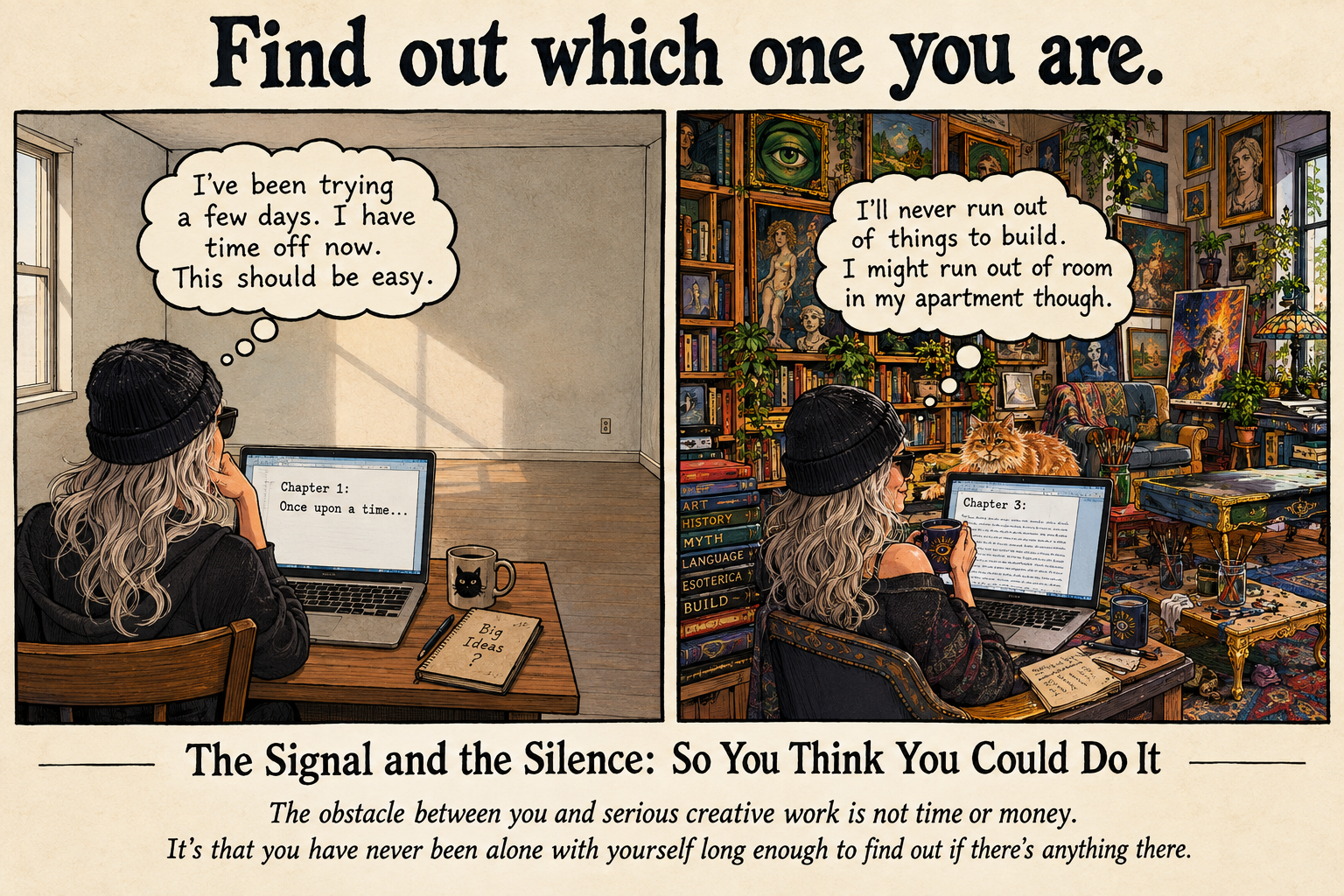
You never know until you try.