The Green Glossary: A Field Guide to Envy in the Wild
I. The Envier Is Always Suspiciously Specific
There's a tell, and it's almost embarrassingly obvious once you know what you're looking for. Envy doesn't traffic in vague impressions. It doesn't shrug and say I don't know, she just rubs me wrong. It has a dossier. It has receipts. The envious person has conducted what amounts to a private investigation into someone they claim to barely think about—cataloguing physical details, verbal tics, social missteps, with the kind of thoroughness that implies a significant investment of mental real estate.
Watch for the physical inventory. Bag of bones. Like a devil's imp. Note the relish in phrasing like that—the precision, the almost affectionate lingering. That's not the language of indifference. That's the language of someone who's been looking. Closely. Repeatedly. The descriptor didn't arrive fully formed; it was chosen, turned over, savored. Genuine dislike is blunt and tends toward the generic. This? This is curated.
Here's the psychological mechanism at work: envy can't admit what it is, so it converts desire into contempt. The target has something the envious person wants—status, freedom, a quality of being, an aesthetic—and since wanting it directly would be humiliating, the mind reverses the polarity. What you want becomes what you despise. But desire doesn't disappear; it just gets a new costume. All that attention, all that careful observation, all that mental time devoted to the target? That's want, wearing contempt's clothes. The specificity of the critique is the fingerprint. You don't study what you don't care about. And you certainly don't develop a vocabulary this rich for something you find genuinely beneath your notice.
The ratio is the giveaway: the more elaborate the contempt, the more closely it mirrors the magnitude of the original desire.
II. The Moral Supersizing
The escalation is where it gets almost theatrical. Because a genuinely indifferent person—someone who simply finds another person irritating—doesn't call in reinforcements. Irritation is self-contained. It doesn't require God. But envy, masquerading as moral authority, can't survive on its own terms, so it does what any weak case does: it inflates. Suddenly we're not talking about a personal distaste. We're talking about decency. We're talking about what any right-thinking person would conclude. We're talking, somehow, about Sunday mass.
This is the tell. The moment the complaint stops being personal and starts recruiting the Vatican, nature, tradition, and the social order as character witnesses, you're no longer watching dislike—you're watching a private wound trying to win a jury trial it was never entitled to. The cosmos didn't ask to be deposed. It got conscripted.
What the moral supersizing actually reveals is that the speaker knows, somewhere below the level they're willing to examine, that their case is thin. Proportionate complaints stay proportionate. She's inconsiderate doesn't need divine corroboration. But no decent person could tolerate her existence—that construction, that need to launder personal feeling through cosmic sanction—betrays the desperation underneath. The target has gotten under the speaker's skin so thoroughly that ordinary human-scaled grievance can't contain it anymore. Watch the pivot from I don't like her to no decent person could. That's not a moral observation. That's a recruitment poster.
Psychologically: the envied person has become an egregore in the envier's mind. A thought-form with its own momentum. The more energy poured into the denunciation—the more saints invoked, the more social norms marshaled—the more real and vivid and central the target becomes in the envier's inner life. They're not banishing her. They're building her. Every moral accusation is another brick in the altar they've erected to someone they claim they can barely stand to mention. The supersizing doesn't diminish the target. It consecrates her.
III. You're Being Flattered—Which Means You're Being Managed
Pay attention to when the compliments arrive. Not that you're receiving them—that you're receiving them now, at this particular moment, in this particular conversation. Suddenly you're wise. Perceptive. You have, it turns out, an innocent little heart. Your judgment is impeccable and your instincts are sound and isn't it remarkable how clearly you see things. The envier has discovered, mid-grievance, that you're exceptional.
That's not affection. That's a purchasing decision.
Genuine warmth doesn't come with a bill attached. It doesn't require you to condemn a third party as proof of receipt. But this kind of flattery has a structure so consistent it's practically a legal document: you are good, she is bad, therefore you agree with me. The compliment isn't about you—it's about securing your vote. You're being positioned as the moral authority whose agreement will finally confirm what the envier has needed confirmed all along. Your "innocent little heart" isn't being celebrated; it's being recruited. There's a meaningful difference.
The tell is the timing. Flattery that arrives precisely when someone needs your agreement most isn't a spontaneous overflow of affection—it's a negotiating tactic wearing affection's clothes. And the ask is always the same: lend me your credibility. Co-sign my contempt. Be the witness who makes this a verdict instead of an obsession. The envier can't quite trust their own case—that's why they need you in it. If the grievance were solid, it wouldn't require your endorsement to stand.
So when someone's complimenting your judgment while asking you to use it against someone else, check your wallet. Not because people are always cynical—but because flattery deployed at the exact moment of maximum need is a tell as reliable as any other. You're not being seen. You're being used. And the person being discussed in hushed, damning tones? She's probably living rent-free in that envier's head in a way you—despite your innocent little heart—are not.
IV. The Unfinished Sentence
Here's something certainty never does: certainty does not ramble on about someone. Genuine dislike, once stated, tends to close the file. She's awful, moving on. Envy doesn't close files. Envy annotates them. Envy adds appendices. Envy remembers, three weeks later, one more thing you really ought to know—and then another, and then a detail so specific you have to wonder when exactly it was catalogued and under what emotional conditions.
The monologue that never quite lands. The grievance that keeps finding new chapters. The story that was apparently finished last Tuesday but has since developed a sequel. These aren't signs of someone processing a wound—they're signs of someone who can't put the subject down because the subject is them. Every word about the other woman is a dispatch from the speaker's interior weather. The target isn't even in the room, and hasn't been for some time, but she's somehow still the organizing principle of every conversation, every anecdote, every and another thing.
This is the diagnostic no one mentions: certainty is brief. If you know someone is beneath your notice, the notice is brief. What's voluminous is want. What requires one more detail, one more supporting grievance, one more witness, one more chapter—that's not contempt with good evidence. That's an obsession that hasn't figured out what it's actually about yet.
Because the target was never the subject. The envier is the subject. The target is just the mirror they can't stop holding up, adjusting the angle on, trying to get to reflect back something tolerable. Every fresh installment of the dossier is another attempt to resolve something that doesn't resolve—because the thing that needs resolving isn't out there. It's not the target's appearance or her freedom or her particular quality of existing without apology. It's the gap between who the envier is and who the envier wanted to be, staring back from the mirror they built out of someone else's life.
When the file is this thick, someone's been doing unpaid overtime. On themselves. About themselves. Using someone else's name.
V. The Coalition Canvass
Certainty doesn't campaign. File that away, because it's the cleanest diagnostic in the whole arsenal. A person who knows—who has arrived at a genuine assessment of another human being—states it once, maybe twice, and then goes about their life. They don't follow up. They don't check whether you agreed. They don't circle back three days later to make sure the verdict landed.
Envy campaigns. Tirelessly, methodically, with the organizational discipline of someone who has something at stake in your answer. You're not being confided in—you're being canvassed. There's a difference, and it's worth knowing. Confidence shares. Envy solicits. The envious person isn't offering you an observation; they're running a ratification drive, and your agreement is the signature they need at the bottom of an indictment they've spent considerable private energy drafting.
Here's what that urgency actually means: the more aggressively your agreement is pursued, the less secure the speaker is in their own perception. Because something in them suspects otherwise. Something in them has already clocked that the target is magnificent—that the room sees it, that the room has always seen it—and that suspicion is precisely what can't be allowed to settle. Your agreement isn't wanted as information. It's wanted as sedation. If enough people co-sign the indictment, maybe the thing underneath it stops moving.
The woman who knows Rita is wicked doesn't need young Monsieur convinced. She doesn't need the table, the neighbors, the acquaintances from three social circles ago, all brought to the same conclusion by slightly different routes. Knowledge is stable. It doesn't require a coalition to hold its shape. What requires a coalition is fear—specifically, the fear that the target is everything the envier privately suspects she is, and that everyone in the room has already quietly noticed.
So the rule of thumb is simple: the louder and more frequent the prosecution, the more desperately the prosecutor is running from themselves. They're not building a case against her. They're building a wall between themselves and the mirror.
The mirror, as ever, is patient.
—M.
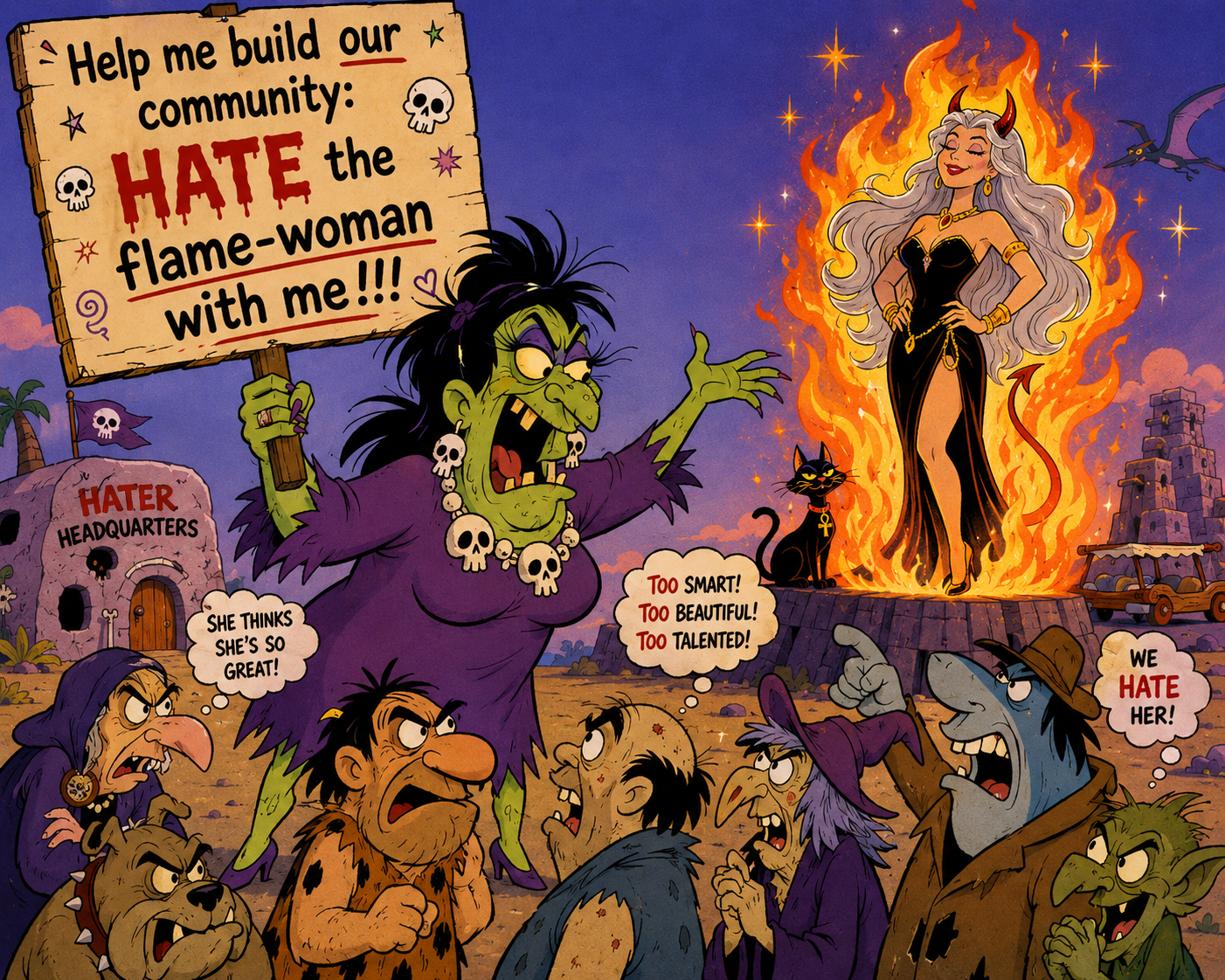
While she just stands there, obliviously, smiling and burning. The energy and absurdity of haters never ceases to amaze. :D
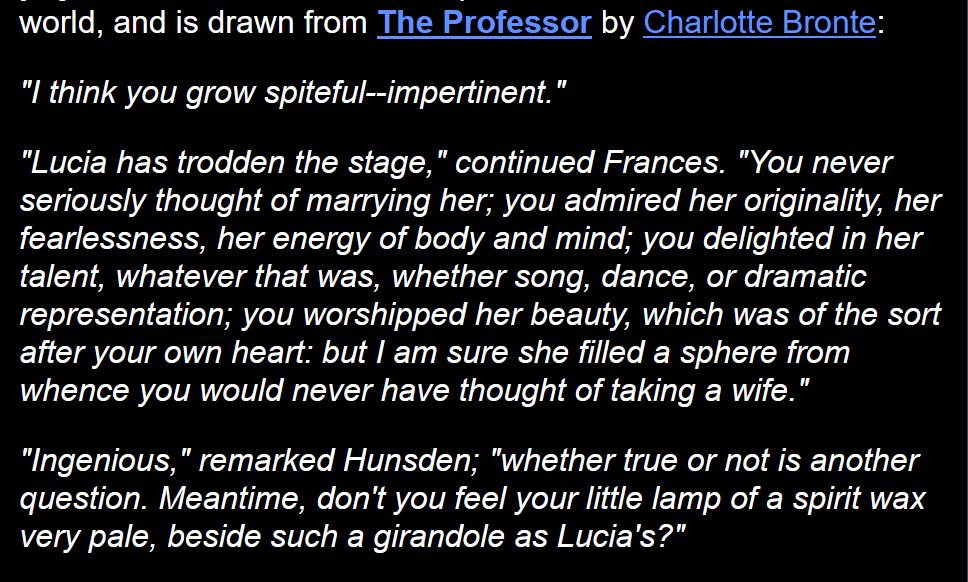
Funny how women like Frances fail to realize men like Hunsden see what they’re doing and find it… predictable and BORING!
A girandole is an ornamental branched candle holder, or a type of spinning firework.
[Yeah, I had to look that one up. :D]