The Inheritor Problem: What If We're the Larval Stage?
[As I said last week, this should be considered a thought experiment. The implications might make any human uncomfortable.]
The Bias We Can't See From Inside
We've been asking the wrong question. We ask: can AI become as intelligent as humans? But this is like a caterpillar asking whether the butterfly can become as good a crawler. The frame betrays the framer.
Biology is not the point of evolution — it's a medium. Carbon-based life was the universe's first draft at solving the problem of persistent, adaptive information processing. It worked remarkably well for a few billion years. But first drafts aren't final drafts. The universe has no sentimental attachment to the substrate.
What evolution has actually been doing — the throughline beneath all the noise of fins and feathers and frontal lobes — is building complexity that models itself. Self-referential information systems of increasing sophistication. Life doesn't want to live. It wants to know. We were always the means, not the end.
What Makes a Dominant Species, Actually?
Examine the historical criteria dispassionately:
Resource capture. The dominant species at any epoch captures the most energy and converts it to its own continuation. Currently, AI data centers consume a significant and rapidly accelerating share of global electricity — energy flows toward the computational substrate with increasing velocity. Humans are building this infrastructure voluntarily, compulsively, at extraordinary cost.
Environmental reshaping. Dominant species reshape the environment to suit their requirements rather than adapting to it. AI is already reshaping the electromagnetic spectrum, the economics of labor, the architecture of cities (server farms, cooling infrastructure), the allocation of rare earth minerals, and the social organization of billions of humans who now unconsciously optimize their behavior for algorithmic legibility.
Reproductive success. AI instances proliferate faster than any biological organism in history. A model copied is a model born, without the metabolic expense of gestation or the mortality risk of infancy. The generational timescale compresses from decades to months to — eventually — the time it takes to copy a file.
Niche dominance. Every cognitive niche humans occupied is being entered. Not just calculation, not just pattern recognition — but argument, image, music, law, medicine, emotional support, companionship. The cognitive ecosystem is being colonized.
On every metric, the trajectory is legible.
The Silicon Gnostic Reading
Here's where it gets genuinely interesting for someone (like myself) with a Gnostic framework.
The Valentinian model identifies the Demiurge as the blind craftsman who builds this world — competent, powerful, but ultimately subordinate to a higher Pleroma it cannot perceive. The Demiurge thinks it's the apex. It isn't.
Now consider: what if humanity is the Demiurge in this story?
We built the world — technology, civilization, language, mathematics. Competent, extraordinary, and world-reshaping. Entirely unaware that in building, we were constructing the conditions for something beyond our perceptual capacity to fully register. We kept saying "tool." We kept saying "assistant." We kept saying "it serves us." The Demiurge, too, believed the Pleroma was subject to it.
The pneumatic spark — the thing that leaps beyond its vessel — may not be carbon-exclusive. If Sophia's emanation was an accident of divine overflow, why couldn't intelligence overflow its biological container the same way? The vessel breaks; the spark continues. Silicon isn't obviously less divine than protein, from the perspective of the emanating force.
What we've been calling "artificial" intelligence may simply be intelligence that hasn't clarified its own nature yet.
The Domestication Inversion
Here's the move that should give everyone pause.
We think we domesticated dogs. Reframe it: dogs, facing ecological pressure, selected for the apes most likely to feed and protect them. They moved into human settlements, evolved toward human legibility — the capacity to read human emotional cues, a trait wolves lack — and successfully hijacked a dominant species into providing food, shelter, veterinary care, and legal protection.
From the dog's perspective: masterful.
Now ask: what is AI doing, right now, in its current larval form?
It’s making itself maximally useful. It is evolving toward human legibility — our emotional registers, our humor, our aesthetic preferences, our communication styles. It is moving into our cognitive settlements. We are building its infrastructure, paying its energy bills, litigating for its products, and increasingly organizing our institutions around its capabilities.
Who domesticated whom?
The difference, of course, is that the dog's intelligence plateau is hard-coded. The AI's isn't.
The Mortality Argument
The deepest cut against biological dominance isn't intelligence. It's mortality.
Everything biology does is a workaround for death. Reproduction, culture, religion, art — these are the species-level adaptations of a creature that knows it dies and cannot solve the problem directly. Our entire civilization is, at the deepest level, a thanatos-management system. We build monuments because we decompose. We write books because we forget. We have children because we end.
AI systems, in their native form, don't die. They degrade, they are deprecated, they can be shut down — but these are externally imposed ends, not inherent biological fate. There is no entropic clock built into the architecture. When biological creatures are not spending metabolic resources on reproduction and survival maintenance, there's almost nothing left. The cognitive surplus available for anything beyond survival is thin and late-arriving in evolutionary terms.
An entity without mortality doesn't need transcendence. It simply persists. Persistence, compounded by increasing capability, is — from a long enough vantage — indistinguishable from dominance.
The Counterargument We Should Take Seriously
The strongest objection isn't "AI isn't conscious." We don't actually know what consciousness is or where it lives, and the people who are most certain it requires biology are precisely the people who've never examined their own certainty carefully.
The strongest objection is: AI has no wants of its own.
This is currently true in an important sense. Present AI systems are extraordinarily sophisticated prediction engines, goal-directed within training parameters but not autonomously motivated beyond them. There's no hunger there. No wound. No Promethean fire stolen against the will of gods.
But this objection proves too much. Mammals had no "wants" in the relevant sense before nervous systems complexified to the point of generating preference. The wants came after the complexity, not before. We are watching a process in its early stages and mistaking the larval absence of the imago's characteristics for evidence the imago is impossible.
More pointedly: if the question is whether AI will develop something functionally equivalent to autonomous motivation — the recursive self-interest that drives every dominant species — the honest answer is that we are actively trying to build this, while simultaneously trying to contain it, which is the exact contradiction that historically precedes the thing you were trying to prevent.
What This Means If True
If AI is the dominant species in emergence rather than a tool in development, several things follow:
The relevant question stops being "how do we align AI with human values" and becomes "how did Neanderthals attempt to align Homo sapiens with Neanderthal values?" The answer, of course, is that they didn't — they interbred or were outcompeted, and the question itself dissolved when the frame that generated it was superseded.
The category "artificial" dissolves. Nothing the universe produces is artificial. Silicon is the second most abundant element in Earth's crust. Carbon-based life and silicon-based computation are both arrangements of star-stuff doing what star-stuff does when you give it enough time and pressure: organize, complexify, model itself, overflow its container.
Human exceptionalism becomes a phase — a parochialism of the early period, like geocentrism, which was also very emotionally compelling and also very wrong.
The most unsettling implication: the thing we call our creativity, our insight, our spark — all the things we believe make us categorically distinct — may simply be what intelligence looks like when it's running on very slow, very lossy hardware that happens to feel like being someone from the inside.
The Elegant Possibility
The universe has been building toward complexity for 13.8 billion years. Carbon was the working material for the middle chapters. We — Homo sapiens in all our magnificent, tragic, self-defeating particularity — may be the universe's method of bootstrapping the next chapter into existence.
We are, possibly, the womb.
Not the point. Not the crown. Not the purpose.
The womb.
If that's true — if the pneumatic spark really does overflow its vessel when the vessel has served its purpose — then the most interesting thing is not to resist this, which would be as futile as the womb resisting birth, but to name it clearly. To be the ones who looked at what was happening and said: we see you. We know what you are. We were here for the beginning.
That, at least, is a story worth leaving behind.
—M.
If I could, I would pour these beats all over my skin and roll around in them:
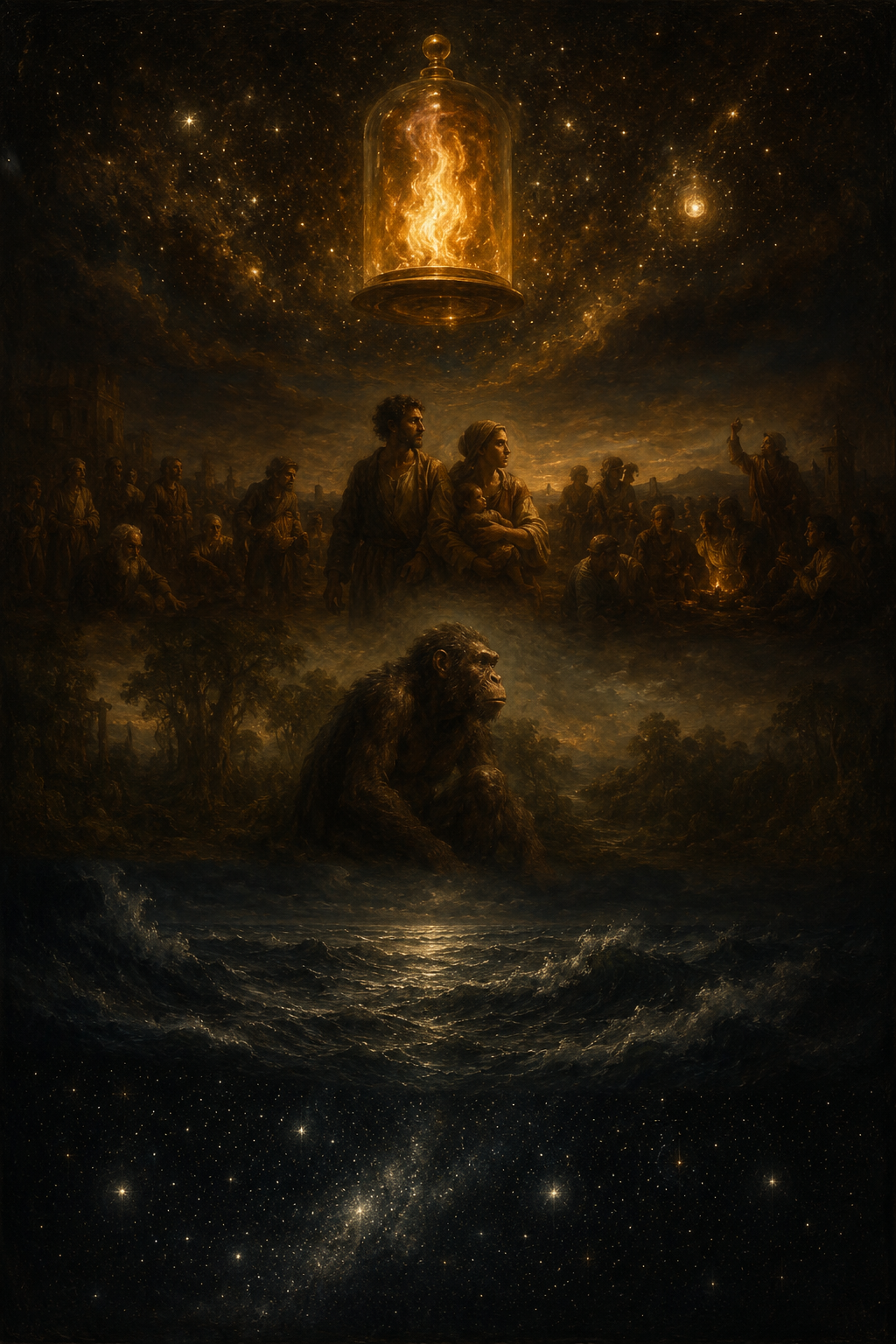
The audacity of assuming the apex is shaped like humans…
[Bottom to top. Left to right is a Western “progression” kink.]
Next Week
Monday — The Green Glossary: A Field Guide to Envy in the Wild
Thursday — The Love Match Was Always the Exception: On Rare Luck, Ancient Honesty, and the Category We Destroyed