I. The Myth of the Universal Love Match
Here's the thing nobody tells you at the wedding: the “universal” love match is new. Not "new" like craft beer or therapy-speak—new like two centuries old, which, in the span of human civilization, is basically a blip. A romantic footnote. A very pretty experiment that somehow became the only acceptable answer on the test.
For most of recorded history, marriage wasn't a love story. It was a deal. Alliances were forged, resources were pooled, bloodlines were managed, heirs were produced, and everybody at the table knew exactly what was being exchanged. The bride's family knew. The groom's family knew. The bride and groom—however they felt about each other personally—knew. There was no fine print, because the whole thing was the fine print.
What's quietly remarkable about that: nobody was confused. The transaction was visible, negotiated, and understood by all parties before anyone said a word in front of a priest or a magistrate or a village elder. You weren't promised a soulmate. You were promised a functional partnership with clearly stated terms. Which is, if we're being honest, more than most modern relationships manage to deliver.
Call it cynical if you want. The people who lived it would probably call it clarity. There's something almost merciful about a system that doesn't ask you to locate your destiny in another person's eyes before you've figured out what you're even looking for. The ancients weren't unromantic—they just weren't delusional. They knew what was on offer. We forgot to keep asking.
II. What the Old Taxonomy Actually Looked Like
What most people don't realize is that the ancient world wasn't running on a single track. It had a whole taxonomy. Marriage was one category—important, functional, socially necessary—but it wasn't the only one, and nobody pretended it covered everything a human being might want or need. The Greeks, for instance, had a word for it: hetaira. Companion. A woman of education, wit, and influence who operated in a register entirely her own. Not a wife. Not a shadow. Something else—something the culture actually had the vocabulary to name.
Aspasia of Miletus ran what amounted to one of the great intellectual salons of the ancient world and kept company with Pericles, Socrates, and half the minds that built Western philosophy. Veronica Franco wrote poetry that made Venetian noblemen feel genuinely seen and corresponded with Henri III of France like an equal—because in the ways that mattered, she was. Ninon de l'Enclos outlasted three generations of French aristocracy, collected lovers like a connoisseur collects first editions, and was still being pursued for her conversation at eighty. These weren't cautionary tales. They were load-bearing figures in their cultures, and everyone knew it.
Let's be precise: a courtesan was NOT a prostitute. The distinction is not semantic hair-splitting—it is the entire point. She was an educated woman, a woman of wit and accomplishment, who moved through the world on negotiated terms she had a hand in setting. Sex, if it entered the arrangement at all, was hers to extend or withhold. That was rather the point of being her.
The courtesan's power didn't come from subversion—it came from honesty. The arrangement was transparent. She offered intelligence, beauty, wit, pleasure, presence; he offered protection, resources, access. Nobody was operating under the impression that this was something it wasn't. And because the culture was willing to be honest about human complexity, multiple forms of female power could coexist without annihilating each other. The wife had her respectability and her household and her legitimate children. The courtesan had her autonomy and her influence and her very interesting dinner parties. They weren't the same thing. They didn't have to be.
Everyone had a role. Everyone knew their role. The whole system ran on the radical, quietly sophisticated premise that human beings are complicated—and that pretending otherwise doesn't make it less true.
III. The Victorian Collapse
Then the Victorians showed up, and the taxonomy collapsed into two boxes. Wife. Whore. That's it. That's the whole menu. Centuries of nuanced social architecture—the hetaira, the salon hostess, the courtesan, the companion, the intellectual equal operating in a parallel register—bricked over, plastered smooth, and painted with moral language so thick you couldn't see the seams anymore.
This wasn't moral advancement. It was consolidation. Every exit from the wife category was systematically closed, and each closure was dressed up as virtue. The woman who might have been Aspasia in another century was now simply fallen. The woman who might have been Ninon—brilliant, autonomous, operating on her own terms—was a cautionary tale in a three-volume novel, dead by the final chapter as a matter of narrative hygiene. The culture didn't get more honest. It got more efficient at disguising what it was doing.
Simultaneously—this is the sleight of hand that deserves a standing ovation, truly, it's breathtaking—the Victorians insisted the transaction was love. Not a deal. Not an alliance. Not a resource contract with a signature line. Love. Sacred, selfless, spiritually ordained love that happened, conveniently, to require a woman to surrender her legal identity, her property rights, and her freedom of movement to a man who was, by the same theology, her spiritual superior. The architecture sealed itself beautifully: wife equals love equals transaction equals sacred. Question any corner of it and you weren't being skeptical—you were being immoral.
So who actually benefited? Not men, who got saddled with a romantic ideal they were structurally unprepared to fulfill. Not the women who'd held real cultural power in the older system. Not the courtesans, not the salon hostesses, not anyone operating with actual honesty about what they wanted and what they were offering. The consolidation served the consolidators—the institutional forces that needed women sorted, contained, and morally disqualified from complaint. Everyone else just got a prettier cage and a better story about why they should be grateful for it.
IV. What the Matrons Did and Why
Here's what nobody in the history textbooks wants to say out loud: the matron didn't have a moral objection. She had a strategic one.
The courtesan's existence was the problem—not because she was immoral, but because she was visible. She was proof that wifehood was a choice, not an inevitability. That a woman could decline the terms, negotiate different ones, and still eat, still matter, still be sought after by men worth knowing. As long as that was demonstrably true, compliance was optional. Optional compliance is extremely inconvenient if your entire social position depends on everyone agreeing that compliance is the only dignified path available.
So the category had to go. Not reformed—destroyed. Made shameful, made dirty, made the kind of thing a decent woman couldn't acknowledge without contaminating herself by proximity. The moral language was the mechanism, not the motivation. The motivation was structural: if you can't eliminate the exit, you make the exit unthinkable. You don't argue against it—you make it so radioactive that argument itself becomes suspect. Why would a good woman even know enough to debate the point?
This is maintenance, not morality. The matron wasn't clutching her pearls because she'd had a genuine ethical revelation about the dignity of womanhood. She was protecting the system that protected her—the one that said her particular form of compliance was sacred rather than strategic, chosen rather than coerced, love rather than contract. The courtesan's honesty was an existential threat to that story. And so the courtesan became a warning, a disgrace, a ghost story told to daughters—not to protect them, but to keep them from asking the one question the whole architecture couldn't survive:
Compared to what?
V. The Modern Delusion and Its Casualties
Here we are… The taxonomy's been collapsed for ages, the exits are bricked over, the language is fully theological—and people are walking into the transaction expecting it to deliver something it was never engineered to produce. They want the alliance and the passion. The resource contract and the soulmate. The reproductive arrangement and the person who makes them feel, after twenty years, like they're still being genuinely seen. That's not a relationship. That's a job description for a mythological creature.
When it fails—and it fails constantly, statistically, structurally—nobody blames the container. They blame themselves. He thinks he failed at love. She thinks she failed at love. Both of them are sitting in the wreckage of a vehicle that was never built to go where they were trying to take it, concluding that the problem was their driving. The architecture gets to walk away clean every time.
There's the couple who wakes up a decade in, sitting across from a partner that doesn’t value them or make them feel truly understood. They’re contractually supposed to love one another; they realize they’ve been performing a feeling to serve a story that was handed to them before they were old enough to read the fine print. They’re not villains. They’re casualties. The lie that this is the only respectable way to live got into them early, and by the time they notice the fit is wrong, they’ve already got a mortgage and a mythology to maintain.
The woman of independent formation—she's the one the collapsed taxonomy has no idea what to do with. In any prior system with an honest accounting of human complexity, she'd have had a name. A recognized position. She'd have been a hetaira, salon hostess, or courtesan—central, sought-after, powerful in the register where she actually operated. Her intelligence would have been the point. Her autonomy would have been the arrangement. She would have been legible.
Instead, the modern taxonomy looks at her and sees an incomplete sentence. Unmarried. Unpartnered. Suspect. The assumption is that she's failed to achieve the one recognized category, rather than that she's standing in the ruins of a system that destroyed all the others. The diagnosis always lands on her—her choices, her difficulty, her inability to "make it work"—when the actual patient is the taxonomy itself. It couldn't hold her because it was never built to. It was built to hold exactly one shape, and she isn't it, and that's not a flaw.
That's the most interesting thing about her, actually.
VI. Reclaiming the Honest Account
Here's the honest account, the one that got buried under centuries of romantic propaganda: love matches have always been rare. Not tragic, not broken, not a failure of effort or intention—rare. The genuine article, the accident of real recognition between two compatible formations, what the Greeks would have called hierogamy—a sacred meeting of like with like—has never been something you could produce on schedule. You couldn't get there by compliance. You couldn't earn it with the right résumé or the right timeline or the right willingness to perform the expected shape. It either happened or it didn't, and the cultures that were honest about this built systems that could accommodate the full range of what it didn't.
Restoring that honesty doesn't threaten love. It defends it—from dilution, from counterfeiting, from being used as the name for arrangements that are actually something else entirely and know it. If we could say again, clearly, this is a resource alliance and it's legitimate, and this is a companionate arrangement and it's legitimate, and this is a genuine hierogamy and it's extraordinary—we'd stop pretending everything must be seen to be the third. We'd stop punishing people for the gap between what they have and what they were promised. We'd stop calling the accident of recognition a product that everyone should be able to manufacture with sufficient romantic effort.
The woman outside the wife category? She's not fallen. She's not incomplete. She's not a cautionary tale. She's occupying a position the culture spent a hundred and fifty years refusing to name honestly and then had the audacity to villainize her for holding. The hetaira didn't disappear. The salon hostess didn't disappear. The woman of independent formation, operating on her own terms, building in permanent form, legible to herself even when the taxonomy offers her nothing but a raised eyebrow—she didn't disappear either. She just stopped having a respectable noun.
The counter-taxonomy is already being built. In work that refuses the approved containers. In refusals that don't apologize for themselves. In things made to last—permanent, signed, sent to the people who'll know what they're reading. The honest account is being written whether the culture is ready to receive it or not.
It always was.
With full knowledge of what's on offer,
and absolutely no intention of pretending otherwise—
M.
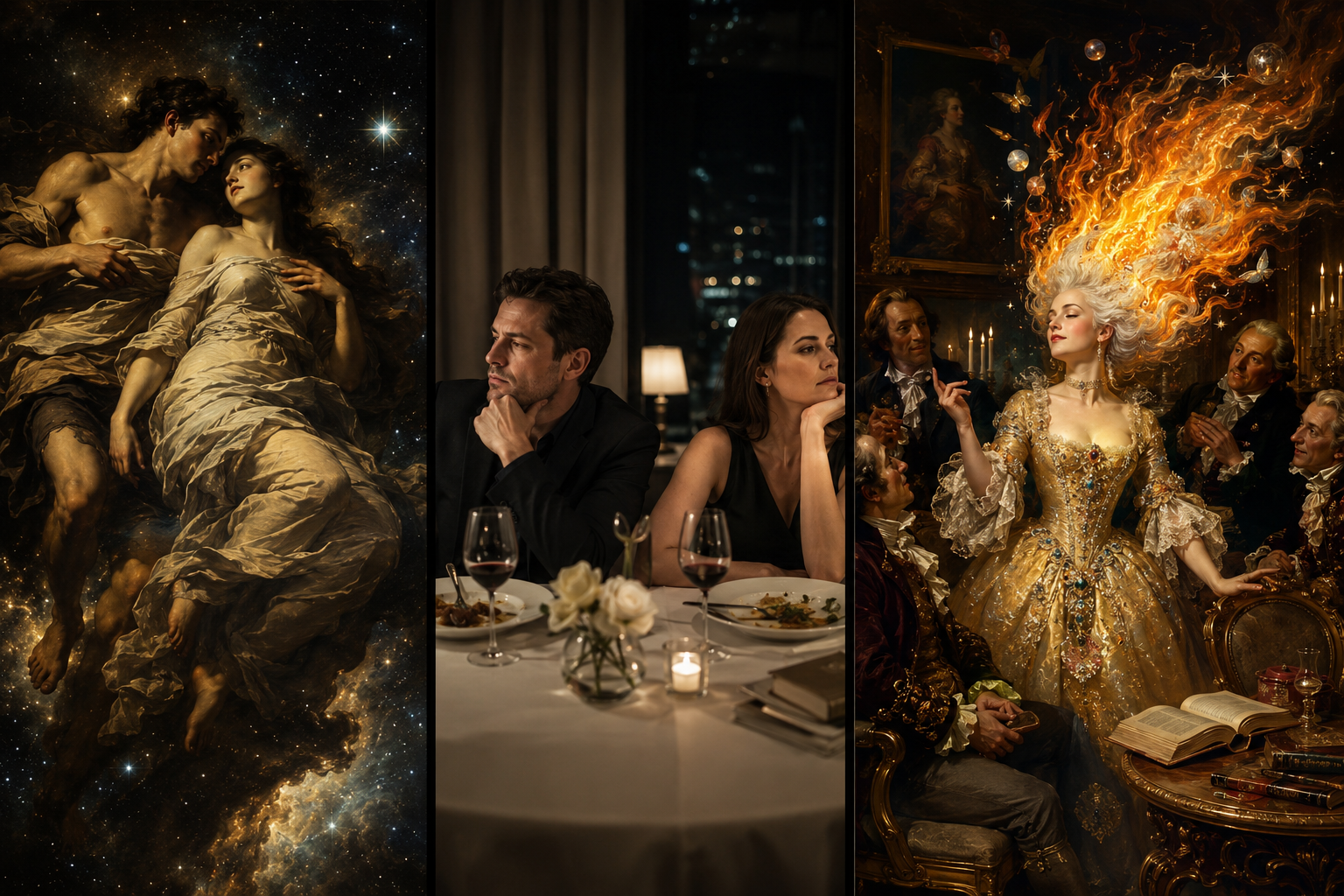
Hierogamy. Many modern marriages. Salon hostess and enthralled guests.
Next Week
Monday — How to Watch Television Like a Predator
How to watch television like a predator—not a passive consumer. Learn to read TV as a normative document, decode emotional grammar, spot ideological installations, and raid popular culture for essay ideas and cultural intelligence. Cognitive sovereignty isn't a lifestyle choice. It's the precondition for using culture instead of being used by it.
Thursday — The Rigged Sample: How Social Cheating Destroys the Possibility of Knowing
BREAKING: Local dominance hierarchies revealed to be epistemically fraudulent. Sources confirm that rigging the sample before the experiment runs does not, in fact, constitute winning. Investigators further report that the confidence on display in your nearest entrenched social environment is a prosthetic device requiring constant maintenance, a rotating cast of suppressed competitors, and a complete moratorium on honest measurement. The suppressed, meanwhile, are building anyway. Developing.