The Misdiagnosis: Why Self-Sufficiency and Narcissism Are Not the Same Animal
I. Defining the Terms: Let's Be Precise for Once
The word "narcissism" has been mugged. Borrowed from clinical psychology, stripped of its actual meaning, and repurposed as a catch-all insult for anyone who seems a little too comfortable in their own skin, it's now nearly useless as a descriptor—which is a problem, because the real thing is worth talking about precisely.
So let's restore the terms to something workable.
Clinical narcissism—Narcissistic Personality Disorder—is not confidence. It's not self-respect, and it's certainly not knowing your worth. It's a specific, diagnosable condition built on a paradox: an ego so inflated in presentation and so hollow at the core that it requires constant external input just to hold its shape. We're talking about a near-total dependency on outside validation, a chronic inability to sustain genuine empathy, a compulsive need to insert itself into other people's lives and arrangements, and a fragile inner architecture that buckles the moment the supply runs dry. It's not a personality type. It's a structural failure.
Self-sufficiency is something else entirely. The Stoics had a word for it—autarkeia—and what they meant was the condition of having a rich enough interior life that you simply don't require external validation to remain stable. The self-sufficient person has built something inside. A foundation. A working relationship with themselves.
The narcissist has built nothing—only a hall of mirrors in which every face, looked at long enough, resolves into their own. Other people are not absent from this world. They are simply unrecognizable as themselves. Other people exist, in the narcissist's perceptual field, as data points on a scale that has the narcissist at its center. Someone else's success is not a fact about that person. It's a fact about the narcissist's relative position. Someone else's beauty, intelligence, accomplishment—none of it lands as information about a distinct human being. It lands as a number on a scale the narcissist is always, secretly, compulsively checking. This is also why narcissists are, paradoxically, among the loneliest structures in existence. Not because no one is there—often many people are there—but because no one who is there is there. Every relationship is a hall of mirrors by definition. You cannot be known by someone who has replaced you with a reflection. You cannot reach someone who is only ever reaching back toward themselves.
The self-sufficient person has simply opted out of the search. She is not looking for herself anywhere outside herself. She already knows where she is. This is not coldness. It is not indifference to others. It is the radical, quietly revolutionary act of being located—of having a stable interior address that doesn't require constant external confirmation to remain legible. She can see other people because she is not using them as mirrors. She can be genuinely curious about a world that contains things other than herself, because she is not threatened by otherness, not compelled to measure it, not driven to colonize it with her own reflection.
The narcissist calls this self-sufficiency narcissism, of course. Because from inside the hall of mirrors, someone who doesn't need a mirror looks like someone who thinks they're above needing one. The accusation is a confession. It always is.
These two things are not neighboring conditions on some shared spectrum of self-involvement. They are not cousins. They are structural opposites. One is defined by radical interiority—a deep, disciplined turning inward. The other is defined by radical exteriority—an endless, compulsive colonizing of the space and attention of others. That's not a minor distinction. That is the distinction.
And here's where it matters practically: genuine self-involvement—the focused, serious, sometimes obsessive attention to one's own interior—is not a warning sign. It's a prerequisite. You can't examine what you won't look at. You can't transmute what you haven't studied. Self-involvement, undertaken with honesty and rigor, isn't the problem. It's the work.
II. The Anatomy of Actual Narcissism: What It Actually Looks Like
The culture has done something quietly catastrophic by softening this word into a synonym for "self-confident person I find annoying." So let's be specific. Let's be, as the situation warrants, a little brutal.
The narcissist cannot tolerate solitude. Not really, not genuinely. Take away the audience, cut off the supply, leave them alone with themselves—and what you'll find is a room that was never furnished. No pictures on the walls. No foundation under the floor. The silence isn't peaceful for them the way it is for someone who's developed an interior life. It's terrifying. It's the sound of nothing holding anything up.
This is why the narcissist is always, on some level, performing. Even in private. Even alone. They are rehearsing future revelations, constructing the story of their own greatness for eventual deployment, imagining the audience that will one day receive it. They cannot sustain effort that will never be seen or credited, because the effort was never really about the thing itself—it was always about the recognition the thing would eventually generate. The work is just a vehicle. The applause is the destination.
[This is distinct from the self-sufficient person who simply knows they are being observed—whether by circumstance, reputation, or the quiet attention of those who track what serious people do. Awareness of an audience is not the same as dependency on one. The self-sufficient person works the same whether the lights are on or not. The narcissist cannot.]
Their relationship to others' success is perhaps the most telling detail. Because the narcissist's sense of worth is always relative—always calibrated against the competition—someone else winning registers as a personal loss. They are playing a zero-sum game in an economy of comparative status, and they cannot stop. This is why they diminish, undermine, spread rumors, quietly attack. It isn't cruelty for its own sake. It's a defensive maneuver. Someone else's light feels, to them, like a threat to their own—because for them, it actually is.
And they interfere. Compulsively, reflexively, often without any genuine awareness that they're doing it. Other people, to the narcissist, are not autonomous beings with their own inner lives and legitimate narratives. They are props. Mirrors. Sources of supply, or obstacles to it. The narcissist inserts themselves into other people's stories because they cannot generate a coherent story from the inside. They need your plot because they don't really have one of their own.
What they cannot do—ever, sustainably, without performance—is genuine reciprocity. They can simulate it, sometimes convincingly and for longer than you'd expect. But the moment the supply runs dry, the moment you stop reflecting greatness back at them, the mask doesn't slip so much as it dissolves. And the discard follows, swift and total, as though the whole relationship had been a lease agreement whose terms you'd finally violated. Not to be confused with a person who leaves a bad situation for legitimate reasons, such as being drained by a nest of narcissists.
None of this—not one word of it—describes a person who enjoys their own company. Who works without applause. Who gives without keeping an invoice. Who feels actual pleasure when someone they respect succeeds. Learn to see the difference. The words we have for things matter, and we've been using this one wrong.
III. The Social Media Machine: Manufacturing Narcissism at Scale
Here's the uncomfortable part: social media doesn't just attract narcissistic tendencies. It manufactures them—in people who arrived with no particular pathology—through a set of mechanisms so elegant in their psychological manipulation that they deserve to be named out loud.
Start with the persona. Social media doesn't ask you to be yourself. It asks you to present a version of yourself—curated, optimized, filtered, angled for maximum appeal. This isn't self-expression. It's self-fabrication. And the longer you engage with it, the more the fabricated version starts to feel like the primary one, the real one, the one that requires maintenance and protection. You stop tending to your actual self and start tending to your brand. Most people don't notice when the switch happens.
The persona, once constructed, needs an audience. And the audience's response—likes, shares, comments, follower counts—becomes a metric. Not of the work's worth. Of your worth. This is the precise mechanism of narcissistic supply, now automated, gamified, and delivered in bite-sized dopamine increments at variable intervals. The slot machine design isn't accidental. Someone built it this way on purpose, understood exactly what it would do to the human nervous system, and said, “Fuck it. Vipers are better consumers.”
Then the comparison engine kicks in. Other people's fabricated personas appear alongside your own, and the brain—which was not designed for any of this—reads them as reality. So the comparison isn't between two actual people. It's between two performances. Two highlight reels, stripped of every moment of doubt, failure, embarrassment, or genuine interior weather. And yet the emotional response is completely real. The inadequacy is real. The compulsion to (spend more to) perform better, post more impressively, generate more supply—devastatingly real.
This is the factory floor. People who entered the platform more or less intact exit—gradually, almost imperceptibly—with a self that is oriented outward, dependent on external feedback, and increasingly intolerant of the silence in which actual interior development occurs. The machine doesn't announce what it's taking. It just takes it. Then it cashes an unfathomably large check.
Which makes the person who steps away from it worth paying attention to. The one who goes quiet. Stops posting. Decouples their sense of worth from the metric. That person isn't retreating—they're detoxing. They're in the early, unglamorous stages of recovering an interior that the machine had begun to dissolve.
And here's where the cultural confusion becomes genuinely perverse: that person, from the outside, looks suspicious. Antisocial. Withholding. Self-involved, perhaps even arrogant. They're not performing their life for public consumption, which—to a culture fully marinated in platform logic—reads as concealment. They must have something to hide. They must think they're better than. The culture has been so thoroughly colonized by the machine's assumptions that it can no longer recognize genuine interiority as anything other than a red flag. We've reached the point where the person who isn't performing is the one who seems strange. What a fucking mess.
IV. The Disservice: Who Pays When the Terms Collapse
When a clinical term loses its precision, it doesn't just become useless—it becomes a weapon pointed in the wrong direction. The collapse of "narcissism" into a weapon aimed at self-sufficiency—at those whose only visible offense is needing nothing from you—has produced two specific, serious harms. They deserve to be named.
The first: people doing legitimate, healthy, genuinely necessary interior work get mislabeled. The person processing their past, examining their patterns, building an autonomous life, choosing solitude as a practice rather than a punishment—that person gets filed in the same category as the one who's done none of that work and expects everyone else to compensate for the absence of it. This isn't just inaccurate. It's actively discouraging. It sends the message that self-examination is suspect, that preferring your own company is pathological, that building inward rather than outward is a condition requiring intervention. It's a diagnostic error with real consequences—because people who might otherwise do the work get frightened away from it before they've started.
The second harm is more insidious, and frankly more offensive: actual narcissists get to hide behind the confusion. When everyone is a narcissist, no one is. When the term applies equally to the self-sufficient recluse and the compulsive manipulator, it loses all diagnostic power. The person genuinely causing harm can simply point to the label's overuse and wave the accusation away as hyperbole. The dilution of the term is, functionally, a gift. To precisely the people the term was invented to describe. One imagines they're delighted.
There's a third harm, subtler but worth naming: the conflation punishes interiority itself. It tells people that turning inward is dangerous, that self-sufficiency is a personality disorder waiting to be officially titled, that the healthy and normal thing is to be outward-facing, socially abundant, visibly engaged, perpetually available for consumption. This is platform logic speaking. It serves the platform and the bottom line. It does NOT serve the person.
[Think about it. If everyone is peacocking for approval—online and in social spaces—how much are they spending for that approval, either in time or money. How many times do they find the goalposts have been moved and they need something else to “win” at life. Fucking absurd. Have fun on the hamster wheel.]
What the culture badly needs—and conspicuously lacks—is a working vocabulary for the person who has chosen depth over display, solitude over the endless performance of a social life maintained purely for appearances, interior development over the optimization of one's own image. That person is not a narcissist. They may be the furthest thing from one. They are simply hard to see, by design, in a culture that has optimized itself entirely for visibility—and quietly lost the tools to recognize what it cannot immediately locate and quantify.
V. The Diagnostic Triad: Three Questions That Actually Distinguish the Two
Forget the label for a moment. Three questions cut cleanly to the distinction. They're not clinical instruments. They're simply honest ones—which means, as you'll see, they're already doing a kind of sorting.
Can this person tolerate solitude? Not endure it. Not white-knuckle their way through a quiet evening before reaching for their phone. Genuinely inhabit it—find it productive, prefer it in certain measures, return to it the way you return to something that feeds you. The self-sufficient person has an interior life rich enough to sustain extended solitude without terror or restlessness. Something in there is actually happening. The narcissist has no such resource. The silence, for them, isn't peaceful. It's the sound of the supply having stopped.
Does this person interfere with others? The self-sufficient person tends their own garden. They have neither the interest nor the compulsion to trample anyone else's—no campaigns to run, no perceptions to manage, no foreign narratives to insert themselves into. They leave people alone, because they have enough going on inside to occupy them. The narcissist cannot stop interfering, because other people aren't fully real to them in the way that would make interference feel like a violation. Props don't have boundaries worth respecting.
Is this person genuinely moved by others' success? Not performatively. Not as a brand exercise in public magnanimity. Actually moved—does someone else winning register as good news, or as a threat that requires a quiet, immediate response? The self-sufficient person has no comparative economy to defend. Someone else's elevation costs them nothing, because their sense of self isn't maintained by relative position. They can afford to be generous with their admiration, because their foundation doesn't depend on being above anyone. The narcissist experiences others' wins as losses. Every time. Without exception. They can't help it—the math of their inner world demands it.
These three questions don't require a therapist to administer. They require honesty—which is, perhaps fittingly, the one thing the narcissist is least equipped to provide, and the one thing the self-sufficient person has had the solitude to cultivate.
The distinction was never complicated. It's been obscured—deliberately or not—by a culture that monetizes visibility, rewards performance, and has quietly forgotten that the most fully realized human beings are often the ones nobody is watching. They're not hiding. They're just not auditioning. There's a difference, and it's long past time we learned to see it.
—M.
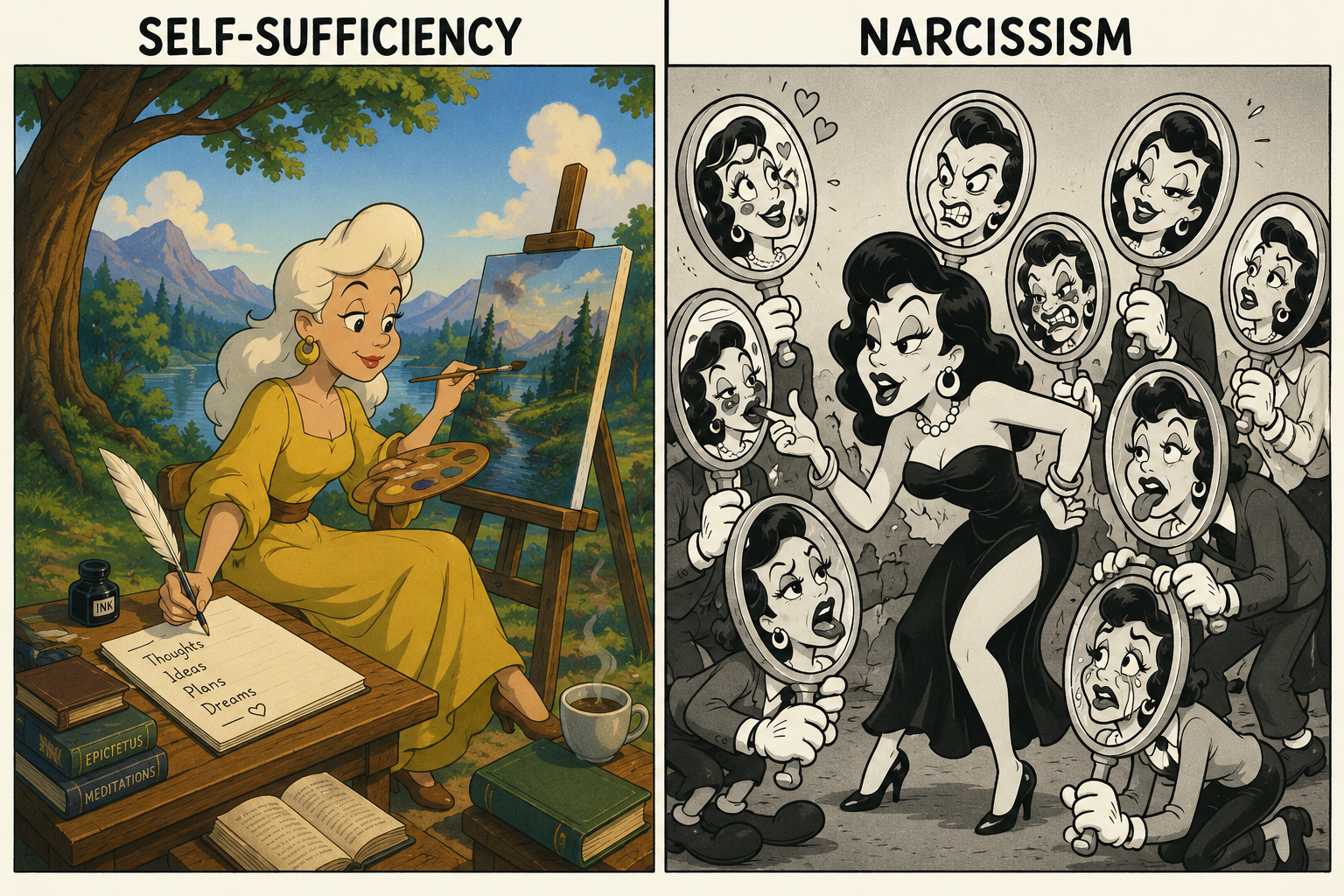
The stoic with the floating palette looks so peaceful.
The narcissist only sees distorted reflections of themselves in others.
Next Week
Monday — Dot Didn't Mooch. Chip Just Can't Count.
Let's talk about Chip. Chip is not an unusual man. He works a regular job, draws a regular paycheck, and moves through a life made navigable by advantages so thoroughly woven into his experience that he's stopped being able to see them—the family that helped him, the people who vouched for him, the infrastructure that caught him every time he stumbled. None of that makes him a bad person. What makes him the subject of this essay is what he did with all that invisible comfort: he looked at Dot—a woman who built her entire life from scratch, without a net, without a family to call, who survived conditions he wouldn't recognize as survivable, who is now producing serious creative work with the support of a patron and gig work—and he called her a moocher. Then he made sure she heard it. This essay is about patronage. It's about what the word patronage has meant across the history of civilization, about Dante and Michelangelo and Baldwin and Woolf and the long, luminous tradition of serious work requiring serious support. It's about why accepting help is not a moral failing and why everyone, including Chip, knows this, or would if they were being honest. And it's about what it means—what it really, specifically, nakedly means—when a man with a floor calls a woman without one by the ugliest word he can find and then makes sure the message is delivered. Chip wanted Dot to feel shame. He should have thought longer about what she does for a living...
Thursday — The Flattery Economy: How Audience-Capture Made Everyone Stupid
The algorithm doesn't need to corrupt you. It just needs to reward you—consistently, invisibly, for the things that keep people coming back. What follows is an autopsy of the feedback loop that's quietly retrained an entire generation of writers and readers: how the essay form got hollowed out and reupholstered with the aesthetic of inquiry, how tribal pattern-matching replaced argument evaluation, and why a piece that no one can safely appropriate to either tribe is probably the one most worth reading. Comments are off. The loop has been declined. Come in anyway.