Dot Didn't Mooch. Chip Just Can't Count.
There's a particular kind of person who watches someone finally catch a break and immediately opens his mouth about it. He doesn't wait. He doesn't think. He just reaches for the ugliest word he knows and makes sure it gets back to her. His name, in this essay, is Chip—and we're going to spend some time with him, because he's earned it.
Section One: Who Dot Is and What She's Been Doing
Dot is a writer and artist. She's been producing real work for years—the kind that takes up space in the world and doesn't wait for permission to exist. We're not talking about a hobby. We're not talking about something she does on weekends when the mood strikes. We're talking about a sustained, serious body of creative and intellectual output that she has been building, quietly and without fanfare, for a long time.
She did it without a net. No family money. No parents who would help her while she sorted herself out. No soft landing after failure, no couch to crash on with the implicit understanding that love was the collateral. She survived things that most people, if they're being honest with themselves, would not have survived at all—and she did it alone. The interior life she's built—the ideas, the frameworks, the work itself—was constructed in conditions that most people would describe as unworkable. They're right. They are unworkable. She worked in them anyway.
There were periods where she relied on other people to get through. I want to be precise about what that means and what it doesn't mean, because the distinction matters. It means she was solving a structural problem—the absence of any family infrastructure, any cushion against ruin, any of the invisible support systems that most people have and almost none of them notice—with whatever materials were available to her at the time. That's not a confession. That's not something to account for or apologize about. That's what happens when you have no floor and you still refuse to stop moving.
Now she has a patron. Someone looked at the work and decided it was worth funding. She's also doing delivery work—because that's who Dot is; she doesn't wait for someone else to solve her problems entirely. And she's producing more than ever, because it turns out that's what happens when a person who's been running on fumes for years finally gets access to oxygen. The work that was happening under impossible conditions is now happening under conditions that are merely difficult, and the difference is visible.
Chip called her a moocher. Let's examine that.
Section Two: What a Patron Is—And What History Has to Say About It
The word "patron" didn't used to be an insult. For most of Western cultural history, it was the mechanism by which civilization's most durable output got made at all. It wasn't charity. It wasn't pity. It was a recognition—by people with resources and enough sense to use them correctly—that certain kinds of work require certain kinds of conditions, and that those conditions don't generate themselves. This wasn't a controversial idea. It was infrastructure. Let's take a short tour, for Chip's benefit.
Dante was exiled from Florence in 1302 and spent the last nineteen years of his life moving between the courts of various Italian lords who offered him shelter, food, and time. The Divine Comedy—arguably the most consequential single literary work in the Western canon—was written in exile, on someone else's dime, in borrowed rooms, under conditions of profound personal loss. Nobody calls Dante a moocher. They call him Dante. They put him in the same sentence as Homer and Shakespeare and leave him there, because that's where he belongs, and the lords who housed him are footnotes at best. The work is what lasted. The funding made the work possible. That's the whole story.
Michelangelo was absorbed into the Medici household as a teenager—Lorenzo de' Medici essentially adopted him into the family, fed him, educated him, and gave him access to the greatest collection of classical art in Florence. The Sistine Chapel ceiling came later, under papal commission, which means the Pope was the patron, the Church was the funder, and Michelangelo was the one spending four years on his back with paint in his eyes doing work that would make every subsequent ceiling in the world feel like an apology. The patron got the ceiling. We got Michelangelo. Everyone walked away with something.
Mozart's story is the cautionary version, and it's worth telling honestly. He spent his career in explicit dependency on wealthy patrons—chafing against it, negotiating it, occasionally losing it in ways that were catastrophic for his stability and output. When patronage dried up, the conditions that made sustained composition possible dried up with it. He died at 35, in debt, under circumstances that historians still argue about. The system failed him in the end. But here's the thing: the alternative—expecting a genius to produce at that level while simultaneously solving the problem of his own survival from scratch, alone, without institutional support of any kind—produces outcomes that are worse, not better. Mozart with imperfect patronage gave us more than Mozart with none would have. We should remember that.
Keats had no patron and died at 25. He'd published three slim volumes and written some of the most extraordinary lyric poetry in the English language—"Ode to a Nightingale," "Ode on a Grecian Urn," the unfinished Hyperion—and then he was gone, nursed at the end by friends who pooled money to send him to Rome hoping the climate would slow the tuberculosis. It didn't. Without those friends, without people who understood that the work mattered and acted on that understanding, we lose even what we have. Twenty-five. Think about what the next forty years would have looked like. We don't get to know, partly because the support came too late and partly because it was never systematic enough to begin with.
Virginia Woolf made the structural argument explicitly in A Room of One's Own, and it remains one of the clearest things anyone has ever written about the relationship between resources and output. Women had produced comparatively little, she argued, not because of any native incapacity but because they had no rooms, no money, no time, no structural support—no conditions in which serious work could happen. The disparity in output tracks the disparity in resources with almost perfect fidelity. Genius doesn't appear in a vacuum. It appears where conditions allow it to. That's not a romantic idea. That's an empirical observation with centuries of evidence behind it.
James Baldwin left the United States for Paris in 1948 partly because he couldn't survive—psychically or economically—in the country that produced him. He was supported in Paris by a network of expatriate writers and artists and eventually by fellowships and grants. Giovanni's Room, Another Country, The Fire Next Time—all of it came from a man who needed conditions he couldn't generate alone and had the wisdom to accept them when they were offered. He didn't apologize for that. Why would he?
The pattern isn't subtle, and it isn't a coincidence. The greatest cultural output in human history has almost always required someone else's resources at some point in the chain. This isn't a bug. It's how the system was designed, back when the people doing the designing actually understood what they were trying to preserve. Now we fund things for market viability—for quarterly returns and demographic targeting and content that performs well in the first seventy-two hours. We'll see what lasts. We'll see what people are reading and looking at and arguing about in two hundred years. My money isn't on the market-tested content. My money is on the work that got made because somebody believed in it enough to make the conditions for it possible.
Dot has a patron. She's in good company.
Section Three: Why Accepting Help Is Not Mooching—And Why Everyone, Including Chip, Knows This
Let's establish something cleanly: everyone needs help. This isn't a controversial position. It's not a radical claim. It's a description of how human society has functioned since we were living in caves and pooling our kills. The myth of the self-made person is exactly that—a myth, and not a particularly well-constructed one if you look at it for more than thirty seconds.
Chip works a regular job. Good for Chip. But let's walk it back, because Chip didn't arrive at that job from nowhere. Someone taught him to drive. Someone helped him get his first apartment—cosigned the lease, maybe, or let him use their address, or spotted him the deposit when he was short. Someone lent him money when things were tight and didn't make him feel like a criminal for needing it. Someone vouched for him when he needed a reference. Someone, at some point, believed in him—loved him, even—in the uncomplicated way that people with functional families get to be loved, the kind that shows up without being asked and doesn't keep a ledger. And underneath all of it, invisible and enormous, someone's taxes built the roads he drives on, funded the schools that gave him his credentials, and constructed the entire civic infrastructure that makes his ordinary life not just possible but easy enough that he has the leisure to go around forming opinions about other people's finances. None of this is shameful. None of it makes Chip a moocher. It makes him a human being participating in the web of mutual dependency that has characterized every functioning society since the Pleistocene. You help, you get helped, the whole thing keeps moving. That's the deal. That's always been the deal.
So let's talk about what "moocher" actually means, since Chip wants to use the word. A moocher extracts without contributing. A moocher takes and produces nothing—no value, no output, no return of any kind. That's the definition. Apply it to Dot. Dot has a patron and is producing more than ever. The patron relationship isn't a one-way transfer of resources into a void. It's an investment, and investments have returns. The patron gets something real: the satisfaction of being the person who made the work possible, a relationship with a mind that's doing something genuinely interesting, and the not-insignificant possibility of being on the right side of history when the work eventually lands where it's going to land. That's not nothing. Ask the lords who housed Dante how that worked out for their legacy.
There's also a specific cruelty—and I want to use that word deliberately—in applying market logic to the pre-production and early-production phases of a creative life. A person who is reading, thinking, suffering, accumulating experience and framework and the slow interior architecture that serious work requires—that person is not doing nothing. They are doing the most essential labor in the entire chain. You can't invoice it. You can't put it in a quarterly report. It doesn't have a deliverable date. But without it, there is no work—there are only people who perform the appearance of work because they never did the hard, unglamorous, frequently miserable interior work that actual output requires. That phase takes time, and it takes some degree of stability, and in the absence of family money or patronage, someone has to provide those conditions or they don't exist. A woman alone in a big city, far from home, with no family infrastructure to fall back on, has it categorically worse than most. The degree of difficulty is not theoretical. It is lived and it is punishing.
Dot provided those conditions for herself, imperfectly, for years, using whatever was available to her. That's not mooching. That's problem-solving under conditions Chip has never been asked to face and—let's be honest about this—likely wouldn't survive with his dignity intact, if he survived at all. And here's the part that should give Chip pause, if Chip were capable of pause: he's passing judgment on a person whose obstacles he's never encountered, whose endurance he's never been tested against, and whose output he couldn't replicate under ideal conditions, let alone the ones Dot has actually worked in. He's an untested man with a verdict. That's not moral clarity. That's presumption dressed up in an ugly little word, and it doesn't hold up for a second once you actually look at it.
Section Four: The Specific Indictment of Chip
Now. Let's talk about what Chip actually did—not what he thinks he did, not the version where he's just an honest guy calling it like he sees it, but what he actually did—because he went out of his way and he deserves the full accounting.
Chip didn't have a private thought and keep it private. He didn't look at Dot's situation, form an opinion, and then do what emotionally functional adults do, which is let it go and return to their own lives. He made sure it got back to her. That's not a slip. That's not gossip that escaped by accident. That's a deliberate, effortful choice that required him to identify a target, select a word, and engineer its delivery. People don't do that casually. They do it because something is driving them—and the thing driving Chip isn't moral concern. Moral concern stays home. What went out of its way to find Dot was something considerably less flattering.
Genuinely secure people don't behave this way. I want to be clear about that because it's the most diagnostic thing about this whole episode. People who are satisfied with their own output—who feel good about what they're building and how they're spending their time—do not surveil the artists in their orbit and issue grades. They don't have the bandwidth for it, because they're busy. The tracking, the judging, the deliberate routing of the verdict back to its subject—that's the behavior of someone for whom Dot's existence is producing an uncomfortable frequency. She's registering somewhere in Chip's interior life, and he'd very much like her to stop. The attack was an attempt to turn the volume down. It's the oldest trick in the book and it never works, but people keep trying it.
The word he chose is worth examining too, because "moocher" isn't a neutral descriptor. It's a weapon with a specific function: to reclassify work as non-work, to make legitimate output disappear from the ledger by attacking the conditions of its production rather than the production itself. If what Dot does counts—if the writing, the ideas, the sustained creative and intellectual labor counts as real work—then Chip has to sit with the uncomfortable possibility that his own ledger, measured in a different currency, is considerably less interesting. That's an unpleasant calculation. The easier move, the coward's move, is to make the problem vanish by denying that what she does is real. Call it mooching. Make it about the funding. Get people looking at the mechanism instead of the output. It's not a new move—it's one of the oldest plays in the social hierarchy playbook—but it requires a particular kind of smallness to execute, and Chip has apparently got that in supply.
And then there's the most damning part, the part that should follow Chip around when he's trying to sleep: he aimed this word at a woman who had no family infrastructure, no floor, no net, no cushion against ruin—who survived the years of building anyway, alone, in conditions he's never been asked to endure—and decided the correct response to that survival was contempt. To call what Dot did mooching, you'd have to be so thoroughly blind to your own structural advantages that you genuinely cannot perceive the difference between having a family that caught you every time you fell and having nobody. That's not a moral position. That's a failure of perception so total it has organized itself into a worldview. Chip moves through the world unable to see his own floor, which means he has no idea how high off the ground he's been standing this entire time, which means his verdict on someone who built her floor from scratch is worth exactly nothing.
Chip opened his mouth about something he doesn't have the biography to understand, aimed it at someone who's already survived more than he can imagine in his worst nightmares, and dressed his insecurity up as moral clarity. He should have stayed quiet. He didn't. And here's the thing about people like Dot—the ones who write, who think, who build interior architecture out of the wreckage of circumstances that would have finished off most people: they remember. They process. Sometimes they write essays. This is one of those times. Chip is in it now, anonymized but immortalized, a case study in what it looks like when a small, cowardly, untested man takes a swing at someone whose depth he cannot measure. Dot will be remembered for the work. Chip will be a demographic statistic. Fair warning to anyone else considering the same move: poke carefully.
Section Five: What the Patron Relationship Actually Is
Let's end somewhere true, because Chip doesn't get to define the terms. He doesn't get to decide what patronage means, what work means, or what the ledger looks like when someone finally tallies it up. That's not his department. It never was.
Patronage is a bet. That's the cleanest way to say it. The patron looks at a person and a body of work and decides—sometimes on instinct, sometimes after long observation, always against the grain of whatever the market would recommend—that this matters. That it will matter. That it's already mattering in ways the current moment isn't equipped to measure, because the current moment is, as always, a little too busy and a little too loud to hear what's actually being said. It's a long bet. Most bets of this kind don't pay off in any conventional sense, and the patron usually knows that going in. But the ones that do pay off are the reason we have Dante. The reason we have Michelangelo. The reason we have Baldwin and Woolf and Keats's handful of extraordinary volumes instead of nothing at all. Someone made the bet. The culture collected the winnings. That's the transaction, and it's a good one, and it has always been a good one.
Dot is someone's bet. I want to sit with that for a second, because it's easy to let it sound like a diminishment when it's actually the opposite. Someone looked at the work and the mind producing it—really looked, with the kind of attention that most people never receive and fewer deserve—and decided it was worth funding. That's not pity. That's discernment. That's the oldest and most legitimate form of cultural investment there is, practiced by the greatest tastemakers in Western history, and Dot is now inside that tradition whether Chip finds it convenient or not.
Dot has a patron who prefers to remain unknown. The patronage covers basics—it could cover everything, but Dot drives for Amazon anyway, because dependency has a texture she finds intolerable at full saturation, and because the hours on the road give her something the room doesn't. The money arrives without instruction. There is no guidance, no curriculum, no one checking in on the work or asking when it will be finished or what it is for. There is no external motivation of any kind—no social media, no deadline, no editor, no cohort, no workshop, no one waiting. Just the conditions, and Dot, and whatever she's going to do with them.
[Here is what I want to ask you, directly: could you do it? Not "would you be productive given a stipend and free time"—everyone imagines they would. I mean the actual thing. Could you sit down in a room with no one watching, no one expecting, no praise coming and no criticism coming and no feedback of any kind, and produce serious work, day after day, on no authority but your own conviction that it matters? Most people discover, when the external scaffolding is removed, that they were working for the scaffolding all along. The likes. The approval. The grade. The salary. The validation that someone else's eyes confer. Take those away and there's often nothing left to work for—or, worse, there is something, but you can't locate it without the noise of others to orient by. Upcoming post about this.]
Dot was also, it should be said, her own patron for a very long time. Before anyone else made the bet, she was making it herself—funding the accumulation phase with whatever she had, which was frequently not much, and sometimes was nothing, and was never enough by any reasonable standard. The work happened anyway. The ideas developed anyway. The interior architecture got built anyway, in the dark, without applause, without a safety net, without anyone to catch her if it didn't work out. That's what happens when the thing you're doing is real rather than performed. Performed work stops when the conditions get hard. Real work doesn't know how.
Now. Chip has a job. The job has a paycheck. The paycheck is, when you look at it without sentimentality, also a form of patronage—his employer looked at his labor and decided it was worth funding. Chip didn't build the company. He didn't invent the industry. He didn't create the economic conditions that made his particular set of skills marketable. He showed up, was deemed useful, and receives resources in exchange. This is fine. This is how most people move through the world, and there's no shame in it. It would just be quietly wonderful if Chip could extend to Dot the same presumption of legitimacy that he extends, without a single moment of reflection, to himself. The same basic assumption that work is work and support is support and nobody builds anything entirely alone.
He won't, probably. People like Chip rarely arrive at that kind of spaciousness. But the record is clear, and the record is what matters. Dot is producing. The patron recognized it. History—which has a longer memory than Chip, considerably better taste, and absolutely no interest in his opinion—will sort the rest.
Nobody asked Dante to do gigwork and write cantos. Dot doesn't have to either—she has a patron. She does it anyway, because she refuses to take more than she needs. Poor Chip. Probably should have kept his mouth shut and minded his own business. Thanks for the fuel, fucktard.
—M.
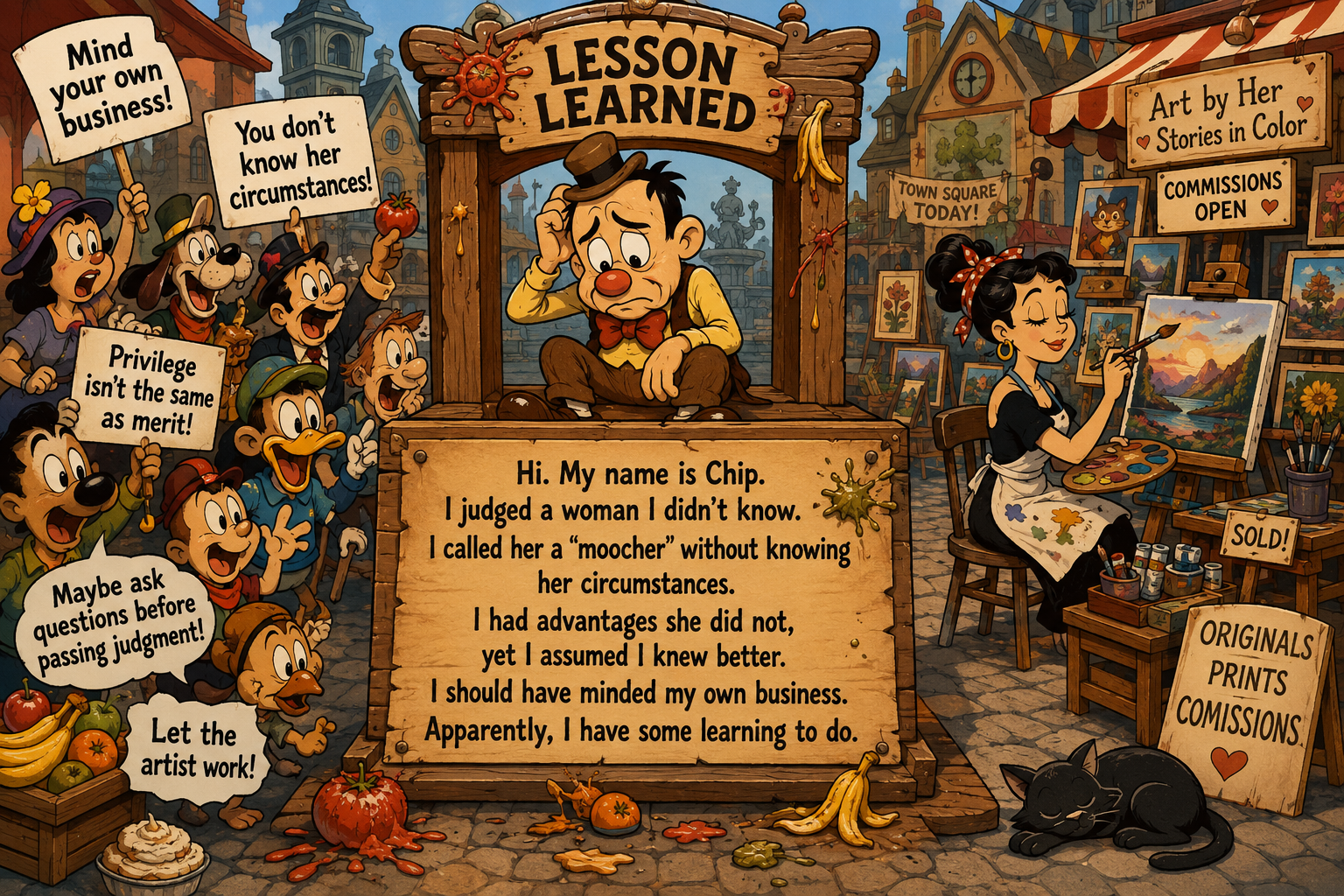
Don’t let that rotten fruit hit you in the face! lol
Personally, I think everyone who does shit like this should be pilloried, with signs, in their communities. Locals could throw rotten fruit at them. It would be a great deterrent to privileged cowards opening their pieholes. Fruitholes? shrugs
I bet people would think twice about being petty if this was a possible outcome.
I’ve said it before and I’ll keep saying it: MIND YOUR OWN BUSINESS.