The Flattery Economy: How Audience-Capture Made Everyone Stupid
Or: What Happens to a Mind Raised on a Diet of Its Own Reflection
I. The Mechanism (It Doesn't Feel Like What It Is)
Here's what makes the flattery economy so elegant as a trap: it doesn't announce itself. There's no moment where the algorithm leans in and whispers say what they want to hear. The mechanism is far more civilized than that. Platforms don't optimize for truth—they optimize for retention, which is just flattery wearing a business casual outfit. The system doesn't need to corrupt you. It just needs to reward you, consistently and invisibly, for the things that keep people coming back. Retention is the metric. Flattery is the method. Your soul is the externality.
And the writer—god, the writer doesn't even feel it happening. This isn't the story of the sellout, the hack who trades integrity for a check. That story's too clean, too morally convenient. What actually happens is colder and more hydraulic than that. You post something vulnerable and the numbers move. You post something challenging and they don't. You're not making a decision; you're being trained. The corpus shifts—not all at once, never all at once, but piece by piece, draft by draft, the work quietly migrates toward the affirming and away from the demanding. Drift is the right word for it. The sellout knows what they're doing. The drifter genuinely doesn't.
The reader, meanwhile, is running their own experiment, and the results are equally grim. A steady diet of confirmed priors does something specific to a mind: it makes it lush. Verdant, even. You've seen these greenhouse minds—they're eloquent, they're enthusiastic, they have opinions about everything. What they don't have is any tolerance for weather. The greenhouse is optimized for growth, not resilience. Every new idea that arrives pre-validated, every argument that already agrees with you before it begins—these are the nutrients of a mind that looks healthy and has never actually been tested.
Which brings us to the product, and this is where it gets interesting. The result of all this isn't stupidity in any way you'd recognize at a glance. It's not ignorance—these are often extraordinarily well-read people. It's brittleness. Fast pattern-matching, zero tolerance for friction, an immune system that treats complexity as attack. The audience-captured mind can run a conclusion in seconds; it just can't sit with uncertainty for more than a few of them. That's the real achievement of the flattery economy: it didn't make people dumber. It made them faster and shallower, which is so much more dangerous because it feels, from the inside, like being sharp.
The product isn't content. Let's be very clear about that. The product is the feeling of having thought—that warm, slightly self-satisfied glow of a mind that has been engaged without being disturbed. The content is just the delivery mechanism. The hit is the confirmation. And like any good dealer, the platform knows you'll be back tomorrow, hungry for another dose of your own reflection.
II. What the Essay Was Built For (And What Replaced It)
Montaigne invented the essay as an act of epistemic humility so radical it still makes modern writers uncomfortable. Essai means attempt—not argument, not thesis, not hot take. An attempt. The man was performing uncertainty in public, following his own thinking wherever it meandered, and inviting you to watch him not-quite-arrive. The implied reader of the original essay wasn't there to be convinced of anything. They were there to witness a mind in motion—which is a fundamentally different transaction than the one we've all quietly agreed to.
That transaction is long dead. What replaced it looks like an essay the way a film set looks like a building—same facade, nothing behind it. The modern think-piece, the Substack dispatch, the viral explainer: these are documents that know their conclusion before they write their first sentence. They have the aesthetic of inquiry and the architecture of a press release. The thinking is purely decorative. The argument exists not to discover anything but to escort you, with maximum rhetorical panache, to a destination that was selected in advance—usually because it's the destination you already wanted to go to.
This is the genre contract that evolved, and it's worth naming precisely because nobody signed it out loud. You, the reader, arrive already knowing what you believe. You will leave still knowing what you believe, but now you'll have better vocabulary for it—sharper phrases, citable data points, the warm feeling of having encountered an Argument. The writer gets your subscription and your share. You get a more articulate version of yourself handed back to you, gift-wrapped. Everyone goes home satisfied. No thinking was harmed in the production of this content.
Call it intellectual nutrition theater. The Substack essay performs nourishment the way a restaurant that serves beautiful, photogenic, completely flavorless food performs a meal. You went through all the motions. You are not, in any meaningful sense, fed.
And here's the tell—the moment that reveals just how thoroughly the contract has replaced the form: when a genuine essay shows up, one that actually follows the argument wherever it goes without first checking whether the destination has been pre-approved, readers experience it as a betrayal. Not as a challenge. Not as provocation. As a breach of contract. The comments fill with some version of I'm not sure what you're trying to say here, which is a polite way of saying you didn't deliver what I paid for. What they paid for was confirmation. What they got was an attempt. Montaigne would have been ratio'd into oblivion.
III. The Specific Crime of Safe Complexity
If the flattery economy had a crown jewel, this would be it. Not the obviously pandering content—that stuff's easy to spot and easier to dismiss. The real achievement, the mutation that deserves its own entry in the diagnostic manual, is writing that looks challenging. Writing that feels rigorous. Writing that makes you lean forward slightly and think oh, this person isn't afraid to go there—and then goes absolutely nowhere you weren't already standing.
You know the tells. The piece opens with some version of it's more complicated than people think, which is the intellectual equivalent of a magician's gesture—look over here while the trick happens somewhere else. And then, with considerable stylistic elegance, it delivers a version of events that confirms everything the target reader already believed, now dressed in the vocabulary of nuance. The complexity was decorative. The challenge was cosmetic. You were flattered with the experience of being someone who reads hard things, while being asked to update exactly none of your priors.
The heterodox move is particularly worth dissecting because it's so reliable, so repeatable, and so effective. The writer takes aim at an easy target—corporate feminism, toxic positivity, performative allyship, whatever the approved villain of the readership's particular tribe happens to be—and the reader gets to feel like a sophisticated critic. A clear-eyed iconoclast. Someone willing to call out the failures of their own side. What they don't get is any actual friction with their actual beliefs, because the approved villain was never load-bearing to begin with. You didn't challenge anyone's worldview. You gave them a more prestigious version of it.
What's being sold here is phenomenology. The feeling of having done something cognitively demanding—that specific texture of satisfying difficulty, like a crossword that's hard enough to be interesting and easy enough to finish. The reader closes the tab feeling like they did something effortful. Nothing was required of them. This is the crime. Not that the writing is bad—often it's quite good. The crime is that it's calibrated, and the calibration is designed to produce the sensation of thinking without the metabolic cost of actually doing it.
What atrophies under this diet isn't what you'd expect. The IQ stays intact. The vocabulary, if anything, gets more impressive. The ability to gesture toward nuance becomes almost athletic. What quietly dies is the willingness to be wrong—and underneath that, something even more foundational: the patience to sit in an unresolved state. To not know yet. To follow an argument into the uncomfortable middle where it hasn't sorted itself into a position either tribe can screenshot. That capacity, unused, goes soft. And once it's soft, the safe complexity diet becomes not just appealing but necessary, because real difficulty now feels like dysfunction.
IV. Tribal Pattern-Matching as a Replacement for Thought
Let's be precise about something: the reactionary response—and both left and right have fully mastered this, let's not pretend otherwise—isn't the absence of thinking. It's thinking that has been replaced by a classification system. That's an important distinction, because classification systems are fast, efficient, and feel exactly like reasoning from the inside.
Here's the scan, running right now in readers everywhere, well below the threshold of conscious awareness: Where is this argument coming from? What tribe generates arguments that sound like this? What does it mean for my team if this turns out to be correct? Three seconds, maybe less. Fully automatic. And then the verdict arrives—not as a conclusion reached by following an argument, but as a pattern match returned by a system that has been trained, over years of partisan content consumption, to sort first and read never.
The skill involved is, genuinely, impressive. It takes real cognitive investment to build that kind of rapid-response classification apparatus. Years of immersion in the content of one's chosen epistemic ecosystem produces a reading practice of extraordinary sensitivity—capable of detecting ideological provenance from a title, a framing, a single word choice. The problem is that this skill is almost perfectly counterproductive when what you're ostensibly trying to do is evaluate an argument. It's a very fast, very confident way of doing something other than thinking.
The specific long-term damage—the injury that doesn't show up until you need the capacity and find it gone—is losing the ability to distinguish between an argument being wrong and an argument being inconvenient. These are categorically different things. One is a property of the argument. The other is a property of your relationship to its conclusion. Audience-capture collapses that distinction quietly, over time, until the two feel identical—until this threatens something I believe and this contains an error produce the same response, which is: classification, label, dismissal. The counter-argument never arrives because the counter-argument was never the point. The point was quarantine.
And the quarantine is, from an engineering standpoint, almost beautiful in its efficiency. Nobody decides to quarantine anything. There's no meeting, no editorial policy, no conscious blacklist. The writer just doesn't get assigned. The editor just develops a vague sense of the minefield's location. The subscribers just leave—not in protest, not with an explanation, just quietly, like antibodies doing their job. No martyrs. No controversy. Maximum efficiency. The system self-regulates without anyone having to admit that's what it's doing.
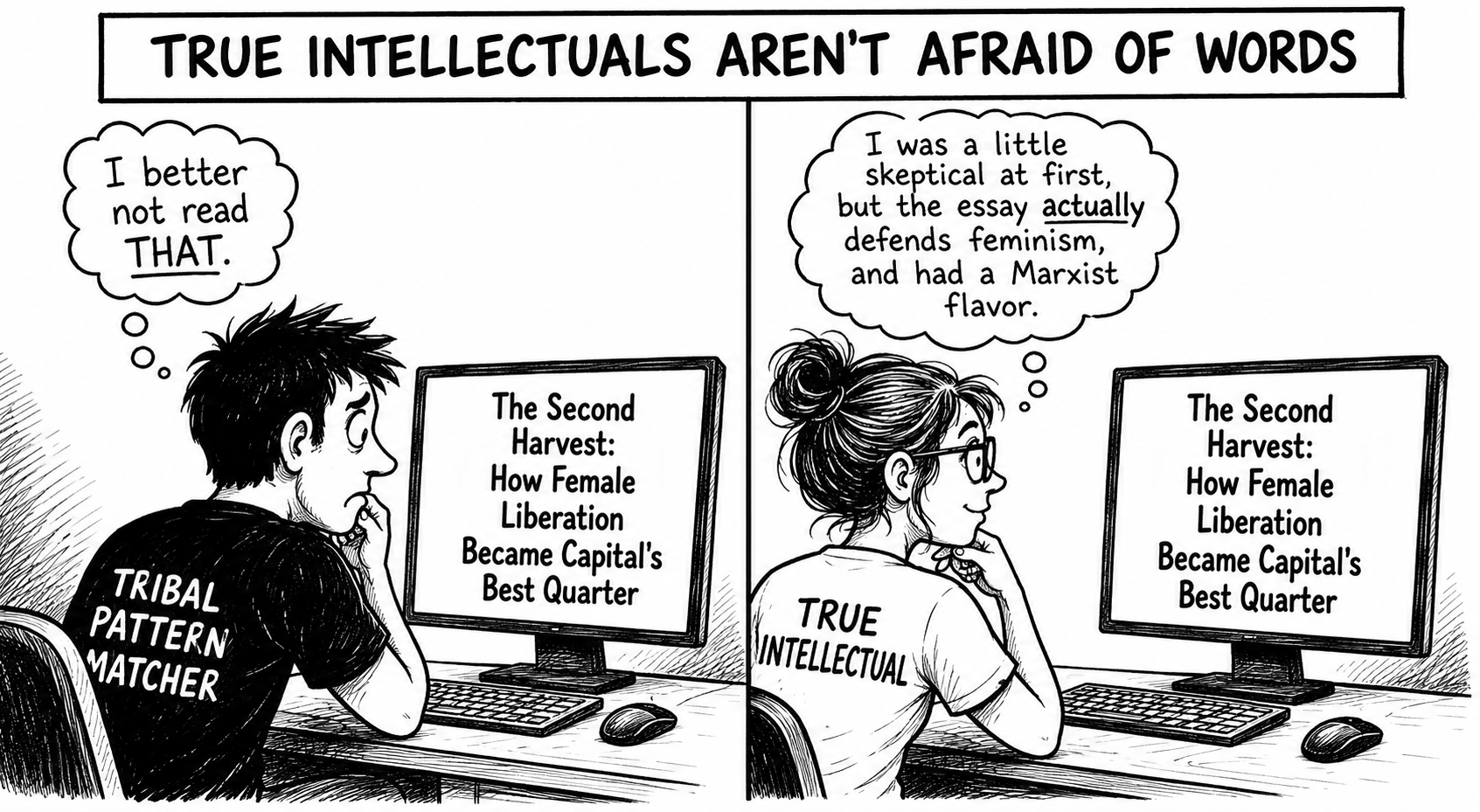
I'll give you a case study. I recently published an essay called The Second Harvest: How Female Liberation Became Capital's Best Quarter. The subscriber dip was sharp and immediate. I know—because I've watched this mechanism operate enough times to recognize its signature—that most of the people who left didn't read past the title. Maybe the first paragraph, if I'm being generous. The tribal scan ran, returned an ambiguous result, and the immune response fired. What makes this particularly rich is that the essay defends feminism. It traces the convergence between capital and female liberation with something I'd call genuine sympathy for what was lost in that transaction. But the title didn't belong to a recognizable tribe, because I don't belong to one—and in the current epistemological climate, unclassifiable is apparently more threatening than wrong.
I'll confess the thought that arrived afterward: these people probably think of themselves as intellectuals. And look—I'm not interested in gatekeeping the word. But I'll offer this as a working definition: you're not an intellectual if you can't sit with an argument long enough to find out what it's actually saying before you unsubscribe like a petty toddler who got served the wrong flavor. The capacity to tolerate the unresolved, the unclassified, the argument-in-progress—that's not a luxury feature of intellectual life. That's the whole foundation. That’s what essays are FOR. Ask Montaigne.
Thankfully, I'm not writing for this moment. I'm writing past it.
V. The Terms I Reject and Why That's the Only Honest Position
Comments are off. Analytics get noted and largely disregarded. The whole economy has been declined—not dramatically, not with a manifesto stapled to the door, just quietly and completely. This is the position. Here's why it's the only honest one.
The flattery economy's offer, stated plainly, is this: write for the reader's existing framework, and they will reward you with their continued presence. It's not a bad deal on its face. Presence is real. Subscribers are real. The feeling of an audience is genuinely warm. But the fine print is where it gets you—because what you're agreeing to, in that transaction, is to let the audience's prior beliefs serve as the outer boundary of your thinking. You can go anywhere you like, as long as you end up back here. The cage is large enough that you can spend a whole career inside it without ever touching the bars. That's the offer. I'm not taking it.
The counter-offer is less lucrative and considerably more interesting: write for the argument. Write for the truth of the thing as best you can locate it. Write for the reader who hasn't found you yet—the one who exists somewhere in the distributed, uncredentialed, geographically indifferent population of minds that are genuinely hungry for friction. I think of this reader as pneumatic—moved by pressure, by the thing that actually pushes. They're rare, yes. They don't cluster anywhere convenient. They hold no particular degree from no particular institution. But here's what's notable about them: they're not the ones who leave. When the tribal scan fires and the ambiguous essay lands in their feed, something different happens—they lean in. They're the ones the whole enterprise is actually for, and they will find the work or they won't, and either way the work needs to be worth finding.
There are civilizational stakes here, and I'm going to name them without apology. A population trained into reactive pattern-matching—trained to classify before reading, to sort before engaging, to treat inconvenience as error—loses something that cannot be recovered quickly: the capacity to reason through genuinely novel situations. Not because the information isn't available. Because the practice of genuine engagement has been systematically replaced by the performance of it. And novel situations, the kind that don't pattern-match to anything in the existing library, are precisely what's arriving. Are arriving now. Will arrive in forms we haven't had the imagination to be afraid of yet.
This age is already crumbling at the load-bearing walls, and the comfort economy of ideas will not survive contact with the scale of what's coming. The essays that will matter then—the thinking that will actually be useful when the pattern-matching fails and people are forced to genuinely reason again—those are being written now, into what looks like a void, by people who declined the offer and kept going anyway.
Writing for yourself, for the record, for the future reader who will recognize the frequency even across whatever distance separates you: that's not a consolation prize for failing to find an audience. That's not the story you tell yourself when the numbers are disappointing. That is, if you'll forgive the precision, the whole point. The work is the thing. The rest is weather.
EyeJam dispatches from somewhere outside the algorithm's jurisdiction. If you found this and it cost you something to agree with it, you're probably the right reader.
—M.
Nuff said…
Next Week
Sunday Bonus Post, 9/13/26 — EYEJAM’S one year anniversary!!! WOOHOO!
This will be a year in review. I talk about what it’s like writing into a void with no direction. There’s a list of posts from the beginning to now—linked, with short descriptions. There’s also a saucy new ritual poem—written 9/5/26. You’re gonna love it!
Monday — The Signal and the Silence: So You Think You Could Do It
You've said it. Maybe not out loud, but you've thought it—if I had her setup, I could do that too. Totally fair. Completely untested. The uncomfortable truth is that time and money are not the variables you think they are, and the proof isn't theoretical—it's the fact that most people who get the time find out pretty quickly that the time was never the problem. The problem is what's waiting for you in the silence when the excuses run out. This essay is about that. Come in if you dare.
Thursday — The Arrival
Next installment from my upcoming book, the roman a clef about my time in SF. You’ll begin to see the shape of what the book will be like. Join me if you dare.