The Overseer Within: How Calvinism Ate the American Soul
I. The Original Surgery
The genius of Calvin wasn't that he made God stricter—plenty of theologians had managed that parlor trick. His real innovation was architectural: he moved the surveillance apparatus inside. Total Depravity didn't just mean you were broken; it meant you couldn't trust a single flicker of your own interiority. Every impulse became evidence in a trial that never adjourned. The doctrine didn't regulate behavior so much as it installed a permanent internal auditor, a meticulous little accountant of the soul who evaluated every desire, every moment of pleasure, every unscheduled thought for signs of worthiness. This was the founding psychic wound—not punishment from without, but the self turned into its own first persecutor.
Under this regime, pleasure became suspect. Rest became suspect. Imagination, desire, the entire interior life—all of it had to be interrogated before it could be trusted, and even then, you probably got it wrong. The self wasn't the location of divine spark or even reliable witness; it was the first site of Calvinist discipline, the original theater of operations. Everything else that followed—the work ethic, the guilt, the bootstraps, the grind—was just the doctrine playing out its logical consequences in a nation that never formally adopted Calvinism but absorbed it like groundwater. We built a country on the premise that your own mind is the enemy, and then we wondered why no one could sit still.
II. Weber Caught the Symptom, Not the Disease
Weber did the world a favor by noticing that Calvinism produced a very particular kind of economic animal—the compulsive accumulator, the man who couldn't sit still, the soul who attached moral weight to visible productivity and experienced idleness as a kind of spiritual hemorrhage. The Protestant Ethic and the Spirit of Capitalism is a masterpiece of symptom-tracking. But Weber was reading the ledger, not examining the patient. He cataloged the economic output without fully diagnosing the anthropological disaster underneath: Calvinism didn't just change how people worked. It redefined what a human being is.
Under the older dispensation—Catholic, pagan, basically anything that hadn't yet turned existence into an audition—a human being was a creature of Eros, contemplation, and sacred absurdity. You were allowed to be. But Calvinism collapsed that ontological permission. Being became insufficient. Worse: it became suspicious. Doing became the only proof of legitimacy, the only evidence you might be worth the carbon you're borrowing. Your existence required perpetual justification through output, and if you weren't producing something legible, measurable, defensible, then you were just dead weight waiting for the trapdoor. This is the deeper pathology Weber couldn't quite name. It's not about capitalism. It's about what happens when an entire civilization rewires the definition of personhood to exclude rest, pleasure, and the interior life—and then calls that progress.
III. Secularization Didn't Cure It — It Laundered It
Here is where it gets insidious. When America lost its explicit Calvinist theology—and it did, mostly, except in pockets where they're still litigating the Elect over coffee hour—the architecture remained. The anxiety didn't dissolve into secularism; it migrated. It found new hosts. God's favor became meritocracy. Election became résumé. Visible sainthood became personal brand. The Puritan congregation that once watched for signs of grace—the slight tremor in your voice during testimony, the quality of your repentance, the visible evidence of an invisible sorting—became the audience, the algorithm, the follower count. We traded the pulpit for the feed, but the logic is identical: you are what you can prove, and the proof must be constant.
Americans who haven't darkened a church door in thirty years are running on entirely Calvinist psychic software. They simply updated the interface while leaving the operating system untouched. The surveillance is still internal. The guilt is still omnipresent. The idea that rest, pleasure, or unmarketable existence might be legitimate—not earned, not justified, not defended, but simply legitimate—remains unthinkable. And this is the truly diabolical part: you don't have to practice religion to be infected by this mindset. It's ingrained. It's in the groundwater. It's the default setting of American selfhood, passed down through cultural inheritance like a blood disease no one bothered to name. The fact that most people couldn't identify Calvinism in a lineup doesn't mean they aren't living inside its logic. They are. They just call it ambition now.
IV. What Got Amputated
A precise inventory of the casualties is in order—the faculties and permissions that couldn't survive the installation of the internal overseer, the ones that had to be amputated to make room for the machinery of perpetual justification.
Otium went first. The classical concept of noble leisure—the understanding that contemplation, friendship, and the production of art required time outside the regime of utility—was recast as sloth. In the older world, otium was the precondition for philosophy, for genuine friendship, for anything worth making. It wasn't laziness; it was the space in which the soul could operate at full capacity. Calvinism looked at that and saw moral contamination. Thinking without producing became suspect. If you weren't generating something legible, measurable, defensible, then you were just indulging yourself, and indulgence was the express lane to damnation.
Carnival consciousness was next. The Catholic liturgical tradition—whatever its other sins—had institutionalized sacred uselessness. It built structured absurdity directly into the calendar. Feast days, saints' days, the entire carnival season before Lent: these were safety valves, cultural technologies that allowed for excess, misrule, the temporary suspension of the rational order. Calvinism read this as decadence, as Vatican corruption, as everything wrong with the old dispensation. What it was actually abolishing was the mechanism that kept the human animal sane—the recognition that you can't live under discipline every hour of every day without eventually going feral in ways far worse than anything carnival ever produced.
Eros as cosmological force was evacuated entirely. I don't mean sexuality, though that got punished too. I mean Eros in the sense Dante understood it: the generative principle, the force that moves the stars, the thing that pulls you toward beauty and knowledge and the transcendent for no reason except that you can't help it. That got replaced with managed appetite and productive partnership. Desire was fine as long as it had a function—procreation, household management, the production of legitimate heirs. But desire as such, the kind that doesn't justify itself, that simply wants because wanting is what it does? Gone. Calvinism couldn't afford it. A cosmological force doesn't submit to auditing.
And then there's children's interiority, which might be the most damaging amputation of all. The Puritan inheritance on childhood is genocidal in slow motion. Imagination wasn't neutral; it was the Devil's workshop. The child wasn't innocent; the child was depraved and requiring correction. Play wasn't development; it was idleness with a future. This is the direct genealogy of the screen crisis, the anxious monitoring, the idea that a child's interior life is a threat that needs to be managed rather than a world that needs to be protected. We're still running that program. We just swapped the rod for the app and called it progress.
V. The American Mutation
Europe, for all its own neuroses, retained countervailing cultural antibodies. The Catholic south kept carnival. The aristocratic classes maintained otium as a legitimate mode of existence—not for everyone, obviously, but the idea survived in institutional form. The bohemian intellectual class had genuine support structures, cafés and salons and patronage systems that allowed for unproductive genius. There were escape valves. There were alternatives to the logic of perpetual justification. America had none of this. The founding settlers were self-selected for the pathology. They didn't bring the full European inheritance; they brought the most fervent Calvinist strain—Puritans, specifically, the people so rigid that the English told them to get the fuck out. Let that sink in. The stiff-upper-lip civilization, the people who turned repression into an art form, looked at the Puritans and said, "You're too uptight even for us. Leave." And they did. And they built a continent around it.
The result is a culture uniquely unable to tolerate unproductive states. Americans can't grieve properly—we're back at work three days after the funeral. We can't feast properly—Thanksgiving has a televised football game scheduled into it like a kidney dialysis appointment. We can't contemplate properly, play properly, rest properly. Even American leisure is industrialized: it must be optimized, quantified, made to perform on social media or it didn't happen. The vacation requires an itinerary. The hobby requires a side hustle. The relaxation requires a guru and a subscription model. There's no permission for anything that doesn't generate content, produce evidence, or improve the portfolio. The psychic software won't allow it. We're running on code written by people who thought dancing was a portal to Hell, and we never bothered to patch it.
VI. The Overseer Has No Off Switch — But There Is a Trapdoor
The conclusion here shouldn't be prescriptive self-help—that would be its own Calvinist capitulation, the overseer rebranded as a wellness coach with a meditation app and a TED talk. The recovery isn't therapeutic; it's ontological. The faculties that Calvinism pathologized—Eros, absurdity, contemplation, the sacred, the carnivalesque—are not hobbies to be reintegrated into a balanced and productive life. They are the life. They're not supplements to the real work of justifying your existence. They're what existence is when it's not being audited.
The species that made Dante, the feast calendar, the White Rabbit, and the flaming heart in the sky was not the species running on the Protestant operating system. That animal—the one that painted caves for no reason except that beauty demanded it, that invented gods for the sheer magnificent excess of it, that structured entire civilizations around the permission to be useless several weeks out of the year—is still in there. There's a trapdoor in the floor of American hyperproductivity, and it leads directly back to that older, stranger thing. The one that knew how to rest. The one that didn't need a productivity hack to justify lying in the grass. The one that understood pleasure as a cosmological fact, not a reward for good behavior.
The Puritans, bless them, tried to kill it. They banned Christmas. Christmas. They looked at a holiday celebrating the birth of their own savior and said, "Too much fun, shut it down." They outlawed theater, dancing, and fancy clothing. They named their children things like Obedience and Humiliation. These people were so committed to joylessness that they made it illegal to enjoy cake. And somehow, we let them win. We built a civilization on the psychological architecture of people who thought cake was a moral failing. It's time to take the country back from the man who banned cake. He's been in charge long enough.
Dancing on the ruins of the old architecture—
Majeye
This one’s worth the watch for the Disney black-and-white video it was paired with:
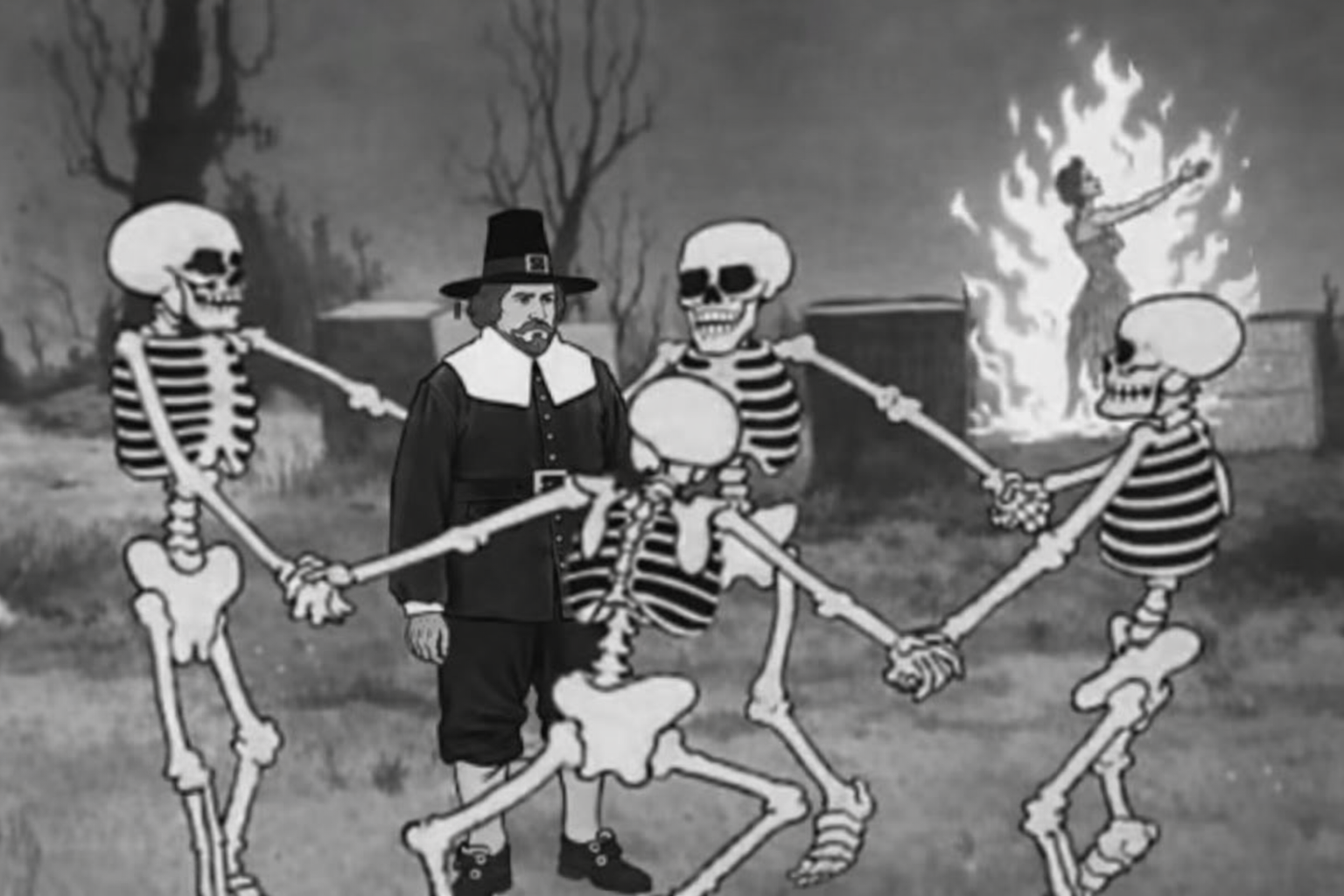
He makes me think of turkey. ;)
Next Week
Sunday, 3/22: A story I call “The Arrangement”—it’s… dear to me.
Thursday: The Field Guide to Mimicus Vulgaris: A Spotter's Manual for the Discerning Observer