I. The Epistemology of Suppression: When You Delete the Data, You Invalidate the Conclusion
There's a move so common in social hierarchies that it's practically load-bearing infrastructure, and almost nobody names it for what it is: epistemic fraud. Not cruelty, not insecurity, not even garden-variety power games—though it's all of those too. It's fraud. Specifically, it's the kind of fraud where you rig the sample and then present the results as if the experiment was real.
Here's how it works. Dominance hierarchies that function through exclusion rather than competition produce, by definition, meaningless results. If you've cleared the field before the race, you haven't won anything—you've just generated the convincing appearance of winning, which is a categorically different achievement and shouldn't be confused with the real one. The difference between being the best in the room and having removed everyone better from the room feels identical from the inside. That's the trap. That's also the fraud.
What makes this epistemically interesting rather than just morally ugly is what it does to the enforcer's self-knowledge. When your methodology is eliminate the inconvenient variables, you never actually find out where you stand. The conclusion—I am superior—precedes and determines the methodology, which is the precise inversion of how legitimate inquiry works. You're not discovering a truth; you're manufacturing a result and then forgetting you manufactured it. The enforcer ends up as blind to their own actual capacities as everyone else is—maybe blinder, because everyone else at least suspects something's off.
What gets destroyed in this process isn't just fairness, though fairness does take a direct hit. What gets destroyed is information. The real hierarchy—whatever it actually was—never gets recorded. The map burns before anyone reads it. And the person holding the match genuinely doesn't know what they've lost, because you can't mourn data you never allowed to exist.
II. What Fair Competition Actually Produces — For Everyone
Fair competition has an underrated side effect that nobody talks about enough: it's the only reliable mechanism for accurate self-knowledge. You cannot know what you are without honest contact with what others are. This sounds obvious until you actually sit with it, at which point it becomes a little vertiginous—because it means that the person who's spent years clearing the field hasn't just cheated their competition. They've cheated themselves out of the only feedback mechanism that could have told them something true.
Here's the paradox that should haunt every enforcer at 3am: losing fairly to someone better is more valuable than winning a rigged contest. Not morally more valuable—informationally more valuable. A clean loss tells you something real about your actual position in the landscape. A rigged win tells you nothing except that you controlled the conditions, which you already knew. One of these is data. The other is noise dressed in a trophy.
What genuine competitors gain from each other goes well beyond the obvious. There's calibration—the constant, uncomfortable, necessary process of finding out where you actually are. There's elevation—the specific upward drag that only happens when you're in contact with someone operating at a higher level. And there's the particular growth that comes from encountering superior capacity directly, which is genuinely not available any other way. You can't read your way into it. You can't simulate it. It requires the real thing.
The distinction worth making here is between threat and teacher. In a fair field, an excellent competitor isn't danger—they're information. They're showing you something about what's possible, which is the most useful thing anyone can show you. Cultures and environments that permit this produce excellence collectively, not just individually. The rising tide is real; it just requires an honest ocean.
The suppressor forfeits all of it. They secure a protected position, which is something—and they lose the only feedback loop that could have actually made them better, which is everything. They get tenure in a department they've quietly gutted, presiding over a measurement they've made permanently impossible, never knowing—and this is the part that should sting—whether they ever actually had it.
III. How Entrenched Social Environments Calcify Into Epistemic Prisons
Here's what happens to a hierarchy that goes uncontested long enough: its internal measurements drift. Slowly at first, then faster, the gap widens between what the environment says it values and what it actually rewards—until the two have so little in common that the official story becomes a kind of institutional folklore, recited by people who'd be genuinely confused if asked to defend it against evidence.
This is the closed system problem, and it's structural. The longer a hierarchy operates without honest external pressure, the more its internal calibration diverges from anything resembling reality. It's not malice, necessarily—it's just what closed systems do. They optimize for internal consistency rather than external accuracy, and eventually internal consistency is all they've got.
The structural enablers are a recognizable type: mid-level positions held for decades, bar owners, nonprofit directors, scene gatekeepers—people whose power depends entirely on controlling access rather than demonstrating capacity. These aren't people who won a fair contest and then held the position. These are people whose position is the contest, and whose primary skill is ensuring it stays that way. Suppress competition, maintain position, use position to suppress further competition—the loop is self-reinforcing and, left uninterrupted, permanent.
What this loop selects for is worth cataloguing carefully: loyalty, compliance, enforcement ability, deference. What it selects against is equally specific: originality, genuine capacity, indifference to approval, unwillingness to perform deference toward people who haven't demonstrated anything worth deferring to, earnestness. The result is an environment that's been systematically purged of the very qualities it claims to value. The most "successful" people in the room are successful specifically because they lack whatever would have threatened the people running the measurement. That's not an accident. That's the product.
The tell—and there's always a tell—is brittleness. Entrenched environments become increasingly parochial over time, and increasingly fragile. They can't absorb genuine novelty because genuine novelty is an existential threat to the measurement system they've spent years constructing. A truly original person doesn't just compete within the hierarchy; they implicitly challenge whether the hierarchy's categories mean anything at all. That can't be tolerated. So it isn't. And the environment gets a little smaller, a little more self-referential, a little more convinced of its own importance—right up until it isn't.
IV. The Gendered Topology of Social Cheating: Different Weapons, Same Cowardice
The mechanism isn't gendered. The implementation absolutely is.
Male and female social suppression run different playbooks toward the same epistemically fraudulent conclusion, and it's worth mapping both—not because one is worse, but because they're invisible in different ways, which is part of what makes them effective.
Male suppression tends toward the institutional and credentialist. It operates at the structural level: gatekeeping access to resources, platforms, credentials, opportunity. The erasure happens before anyone arrives at the room, so by the time the room fills up and someone counts heads, the suppression has already done its work and left no fingerprints. "We just didn't feel she was the right fit" has the credibility of procedure behind it. It sounds like a considered judgment. It sounds, in fact, like exactly the kind of thing a legitimate meritocracy would say.
Female suppression tends toward the reputational and relational. It runs through gossip networks, preemptive character assassination, the loyalty oath economy—the elaborate social architecture of who's trustworthy, who's difficult, who you should probably keep your distance from, delivered not as edict but as concerned whisper. The erasure happens at the social level, which means it also happens in a register that's hard to name without sounding paranoid. There's no paper trail. No evidence is required. And in a particularly elegant piece of engineering, it weaponizes the target's own social needs against her—the hunger for belonging becomes the vector.
Both are forms of cheating. Both produce the same epistemic result: a hierarchy that has no idea what it actually is.
What they share, and where they converge most reliably, is targeting. Both mechanisms deploy fastest and hardest against people whose genuine capacity poses the greatest threat to the existing measurement system. This is useful information. If you want to know who actually had something, look at who got hit first, hit hardest, and hit from multiple directions at once. The intensity of the suppression is, in its own way, a form of involuntary tribute—a tacit acknowledgment, by the people doing the suppressing, that the measurement couldn't be allowed to run.
V. The Confidence Prosthetic: What Borrowed Superiority Actually Looks Like
Genuine confidence can sit quietly in a room with someone more capable without coming apart. This is actually the defining feature—not the swagger, not the track record, not the ease of manner that gets mistaken for it at parties. The real thing has been tested and knows what it found, which means it doesn't need the room to be configured a particular way in order to hold together. It can tolerate the presence of excellence without experiencing it as an emergency.
The prosthetic cannot. The prosthetic requires maintenance—specifically, a steady supply of defeated or suppressed competitors to sustain the underlying fiction. And here's the structural problem with that arrangement: the validation from each suppression depreciates. It doesn't answer the question underneath the question, which is what am I, on my own terms, without the comparison? It only drowns that question out temporarily, which means the volume has to keep going up. More suppressions, louder performance, a rotating cast of targets—not because the strategy is working but because it isn't, and the silence between rounds is getting harder to survive.
The tell, once you know to look for it, is unmistakable: the inability to tolerate genuine competition in any form, the loudness of the confidence performance, the need for the cast to keep rotating. Real confidence is quiet. It can afford to be. The prosthetic is loud because loudness is doing structural work.
The irony—and it's a genuinely exquisite one—is that the prosthetic user is more dependent on the people they suppress than on almost anyone else in their lives. The target isn't the obstacle. The target is the load-bearing structure of the entire self-concept. Remove the target, and you've got a building with no foundation and a very confident facade.
What happens when the target builds anyway and becomes undeniable is that the prosthetic fails catastrophically—not because anyone won an argument, but because the suppression didn't work, which means the fiction it was maintaining is now exposed by the simple, inarguable existence of the work. You can't character-assassinate a body of work. You can't run a whispering campaign against a book. The work just sits there, being what it is, and the fiction quietly collapses around it.
And then there's the damage that was always going to be permanent: having never tested themselves fairly, the prosthetic user arrives at the end not knowing what they actually were. They walked around their whole lives absolutely convinced of a superiority they never gave themselves the chance to actually earn—or discover, or disprove. They never stepped into honest contact with the question. The cheating that protected them also robbed them of the only mechanism that could have told them the truth. They kept the fiction and surrendered the knowledge, and probably never understood what they'd traded. The absurdity is, when you finally see it clearly, almost cosmically funny. Almost.
The rigged sample doesn't just harm the targets. It impoverishes the suppressors permanently. They protected a position. They forfeited a self.
—M.
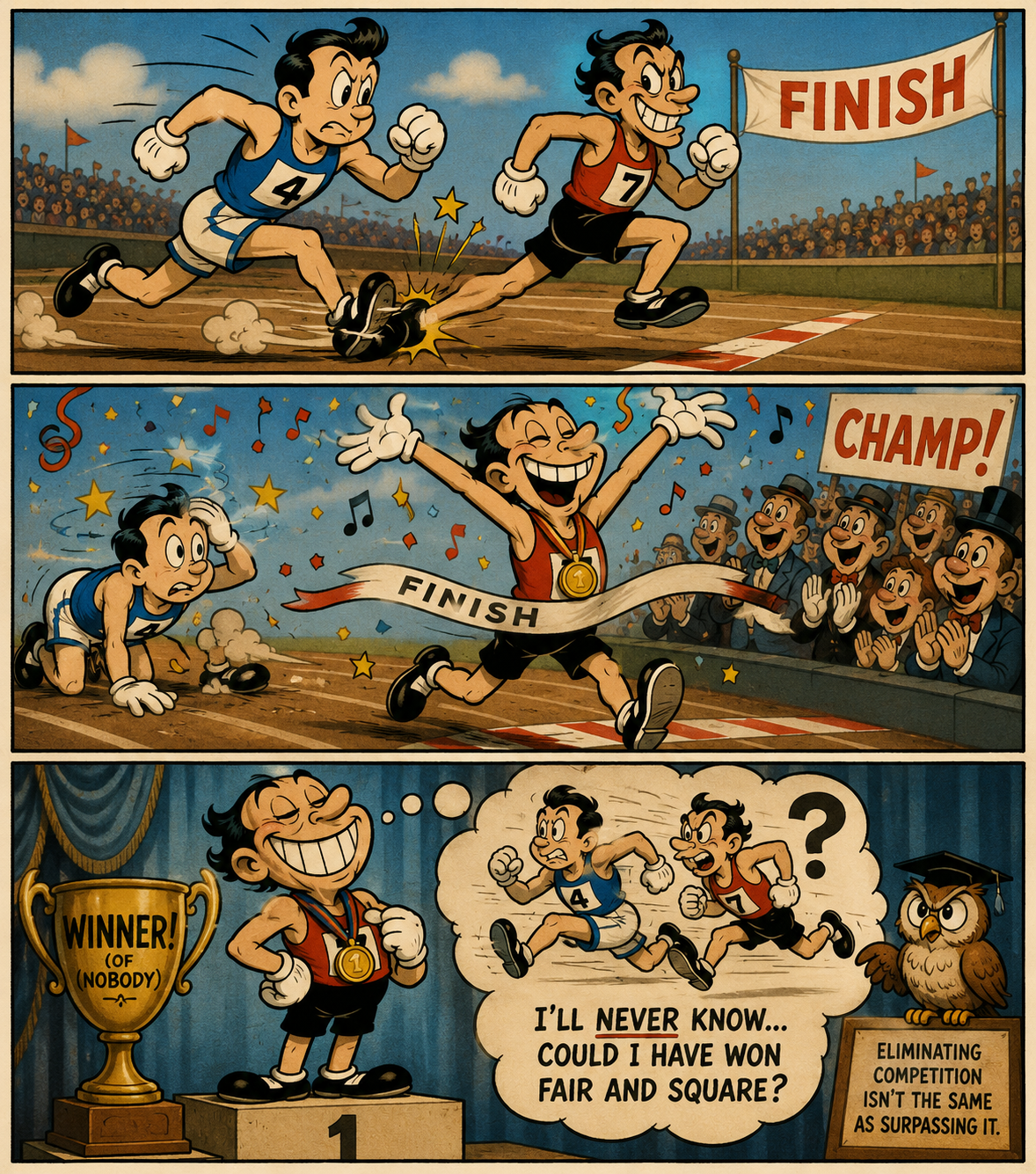
AKA — don’t be a malicious poser fucktard.
Looks like he tripped him with a detachable foot. See: second frame. lol
Next Week
Monday — The Inferno Behind the Gate
Balzac knew a woman who got called cold by every man who couldn't get close. She wasn't cold. She was selective. This post breaks down demisexuality, sapiosexuality, and why the men most certain they understand the gate are always the ones standing outside it. The inferno is real. You just have to be worth the fire.
Thursday — The Con of Legitimacy: or, Who Told You You Were Allowed to Have an Opinion
The rules about who gets to think out loud have always been a hustle. This piece pulls the curtain back on how epistemic gatekeeping actually operates — not as a neutral system for sorting good ideas from bad ones, but as a protection racket for conclusions that were never meant to compete. Twain spotted it in Camelot. It hasn't gotten more subtle since.