I. The Sedation Model and Why Most People Are Living In It
Most people watch television the way they take a hot shower—they get in, they let it happen to them, and they come out on the other side vaguely cleaner or vaguely sadder, with nothing to show for it but a feeling they can't quite name and a strong opinion about whether the finale was earned. The narrative washes over. The emotions fire on cue. Credits roll. Nothing remains.
This is not an accident. The industry has spent decades optimizing for exactly this experience: reliable return viewership, predictable emotional response, the kind of ambient sedation that turns a viewer into a subscriber into a demographic. They even called it programming—and to their credit, that's precisely what it is. You sit down, the sequence begins, and somewhere between the swelling string section and the close-up of the morally compromised but extremely attractive lead, something gets written into you that wasn't there before. The music tells you when to feel it. The shot composition tells you who to trust. The casting tells you what desire looks like. You think you're watching a story. You're receiving a suggestion.
Television was, in fact, the first great atomization technology—and nobody talks about it that way because they were too busy watching television. First it turned the family inward, away from the street and the neighbor and the public square, toward the glowing box in the living room. Then it turned the individual inward, away from the family. Then the algorithm arrived and finished the job with ruthless elegance, giving each person their own perfectly personalized corridor of content with no exits and excellent lighting.
What you're left with is passive consumption as the dominant use case. The show does something to you. You are the object of the transaction. The parasocial replaces the social; the narrative tension substitutes for any genuine reckoning with your actual life. You feel the character's grief so thoroughly that you never have to sit with your own. Efficient. Tidy. Deeply in someone else's interest.
I watch the same shows. I have a completely different relationship to what I'm watching—and that difference is the whole game.
II. The Prepared Mind—What I Bring to the Screen
Any raid requires preparation. You can only take what you already have the equipment to recognize—walk into a vault without knowing what you're looking for and you'll come out with the decorative pen and leave the bearer bonds. The prepared mind isn't just a nice thing to have; it's the entire mechanism. The screen is a surface. What reflects back depends entirely on what you're holding up to it.
In my case, that means years of independent theoretical development conducted entirely off the institutional grid—mimic theory, ontological envy, horizontal totalitarianism, the pneumatic/hylic/psychic/mimic typology I've been refining through a Valentinian Gnostic framework. These aren't parlor tricks. They're a map. And when you arrive at any new territory already holding a map, you're not experiencing the territory the way the locals do—you're reading it. Every scene becomes a data point. Every character dynamic files itself automatically under an existing conceptual heading. The show doesn't have to know it's teaching me anything. It doesn't. That's the beauty of the arrangement.
Eleven years off social media means I visit the normative landscape the way an anthropologist visits a newly contacted tribe—with genuine curiosity, appropriate protective distance, and no illusions about whether I'm one of them. The consensus reality that television both reflects and produces is not the water I swim in. I'm not catching up on what everyone thinks. I arrive cold, which means I arrive clean.
And here's the thing about that clean arrival: the show rarely gives me the idea. What it gives me is the image—the concrete, sensory-specific crystallization of something that was already forming below the threshold of articulation. There's a reason I get some of my best thinking done in front of a screen, and if that sounds like an embarrassing confession, I'd like to point out that Dante had Virgil and I have prestige television. We work with what our era provides.
Stranger Things is the example I keep returning to. Mrs. Wheeler—beautiful, ignored, vaguely yearning, hosting a Tupperware party in a house that's immaculate and somehow suffocating—hit me not as a character study but as an image that made something speakable I'd been circling for a while. The abstract analysis of community dissolution, two-income extraction, the civilizational cost of atomizing the domestic sphere—that was already present, already forming. The show handed me the face to put on it. Suddenly the argument had a body. I could point at something and say: that. That's what I mean.
This is what I'd call a stichomantic relationship to popular culture. The way some people open a book at random and let the line that surfaces speak to what they were already asking—I do that with the screen. The artifact isn't the source. It's the oracle. And oracles only work if you showed up with the question.
III. Reading for Norm Enforcement
Every piece of popular television is a normative document. It doesn't matter whether the writers intended it that way, whether the showrunner considers herself an artist rather than a propagandist, or whether the show is prestige drama or reality trash—the document is normative regardless. The choices are already in there, humming away below the threshold of rhetoric, doing their work whether anyone notices or not.
And the choices are specific. Who reads as sympathetic on first appearance, before they've done anything to earn it? Who reads as villainous the same way—on sight, on register, on the particular combination of traits the casting director assembled? Which behaviors get narratively rewarded, and which ones get punished in the third act no matter how reasonable they seemed in the first? What do the characters take completely for granted, never discuss, never defend, because it's simply the water they swim in? What is coded as sexy, and perhaps more revealingly, what is coded as pathetic? These are not aesthetic choices that happen to have ideological implications. They are ideological choices wearing aesthetic clothing.
This is where the most effective normative work happens—not in propaganda, which is at least visible enough to resist, but in what I'd call emotional grammar. Propaganda argues. Emotional grammar installs. By the time you've registered the argument, the norm has already been written into your response patterns somewhere below the level of conscious assent. You don't believe it because you were convinced. You believe it because it felt true while the music was playing and the attractive person was crying.
So the questions I bring to any show are these: What does this take for granted without arguing for it? What positions are presented as obviously true, the kind of thing only a bad person or a fool would dispute? What does the villain's specific villainy reveal about the approved moral universe—because the villain is always a photographic negative of whatever the show actually worships? And which stigmas keep appearing, keep getting demonized, keep being attached to the characters we're meant to despise? Repeat a stigma enough across enough prestige properties and you don't need a policy. You've already done the work.
Current television, if you read it this way, is quite legible about what anxieties it's resolving and what it's preparing audiences to believe next. I won't make this post a catalogue—that's what the blog is for, one dissection at a time—but I'll say that once you start reading for what the apparatus is processing, the output becomes extraordinarily useful intelligence about the apparatus. It's producing evidence of its own ideological priorities and it can't help it. The machine can't not reveal itself. You just have to be looking for the right things.
One underrated technique, while we're here: watch foreign language television. The norms are even more visible in someone else's shows than in your own, because yours are invisible to you—they're still just reality. But when you're watching a Korean family drama or a French thriller and you notice the unspoken assumptions about hierarchy, gender, shame, privacy, and what constitutes a good life, they stand out with the clarity of a foreign accent. Then you go back to your own shows and, if you've done it right, your own norms have developed the same accent. Suddenly you can hear them.
IV. The Crystallization Moment—From Image to Essay
Here's how the raid actually works in practice. The image arrives—something specific, something concrete, something the show presents as a character beat or a scene transition or a throwaway visual—and something clicks. Not slowly. Not after reflection. The click is immediate, and by the time it's happened, the essay is already half-written. I haven't left the couch. I haven't opened a notebook. The argument is just there, fully articulated, waiting to be transcribed.
Mrs. Wheeler in Stranger Things—beautiful, bored, spiritually marooned in a house that has everything and costs something I don't think she was ever told she'd be paying—generated two complete blog post outlines and a working theory of civilizational decline in a single viewing session. The show was trying to give me nostalgia and monster-related tension. I wasn't rude about it. I took what I came for and let the Demogorgon do its thing.
But here's the distinction worth making precisely: this isn't analysis during consumption. I'm not watching with a clipboard. The prepared mind doesn't laboriously apply frameworks to incoming footage the way a customs agent runs luggage through a scanner. It's faster and stranger than that—it's recognition. The materials I've been developing for years suddenly appear in an unexpected location, wearing someone else's wardrobe, and I recognize them the way you'd recognize your own handwriting in a document you didn't write. The click isn't me figuring something out. It's me finding something I'd already half-known.
This is the difference between inspiration and reception, and it's not a subtle difference. Reception is passive—you sit, the thing arrives, you feel what you're supposed to feel, you're moved by the narrative on its own terms and delivered more or less to the emotional destination the writers intended. Inspiration is active. Directional. Predatory, if we're being honest about it. You go in knowing—not what you'll find, but that you're looking. You take what you need. You leave the rest. The show's emotional conclusions are not your conclusions. The normative architecture it's trying to install is material for examination, not a foundation to build on.
What I was not doing, watching that show: absorbing the intended nostalgia. Feeling the monster tension as genuine threat. Receiving the vision of 1980s American suburban community as uncomplicated warmth. The show wanted me to feel a particular way about a particular time. I felt something considerably more useful—a theory about what the two-income household extracted from the civilizational fabric, arriving gift-wrapped in Karen Wheeler's vacant, lovely eyes.
That's not passive consumption. That's a raid. The show brought the image. I brought everything else.
V. What This Practice Produces—And What It Requires
What the raid produces, in practical terms: essay ideas, norm inventories, cultural temperature readings, and reasonably precise data about what the apparatus currently needs people to believe and feel. Popular television, read as instrument rather than received as entertainment, turns out to be an extraordinarily accurate gauge of ideological pressure—what anxieties are being managed this season, what behaviors are being quietly rehabilitated, what kinds of people are being prepared for sympathy or for sacrifice. The apparatus can't lie about this. Its output is the evidence. You just have to be reading the right layer.
But here's what it requires, and this is the part nobody wants to hear because it isn't a technique you can acquire in an afternoon: an independent normative framework already in place before you sit down. A theoretical apparatus that was built elsewhere, on different materials, with different intentions than the screen's. Genuine cognitive sovereignty—the kind that doesn't come from wanting it but from having actually constructed something that isn't downstream of the thing you're trying to read. You cannot see the show's map as a map if you're living inside it. You'll experience the map as terrain. You'll call it reality and wonder why everyone agrees with you.
This is the non-negotiable piece. The viewer who has been shaped by the same apparatus they're watching cannot perform this operation—not because they're less intelligent, but because the norms have already been installed below the threshold where intelligence operates. They don't experience the show's moral architecture as argument. They experience it as obviously true. The villain seems villainous. The approved behaviors seem reasonable. The water is invisible because they're wet.
This is why the information diet matters. Why eleven years off social media isn't asceticism or eccentricity but a precondition. Why the deliberate, unglamorous, years-long construction of an independent theoretical framework isn't a lifestyle choice but load-bearing infrastructure. These things aren't about purity. They're about whether you're capable of using culture or whether culture is using you—and that question has a binary answer, even if most people never find out which side of it they're on.
One small note I'll save for another essay: you can also run this process in reverse. If the screen can reveal the apparatus's normative requirements, it can theoretically be used to install your own. Predator becomes programmer. But that's a different conversation and requires a different kind of nerve.
The screen is either a window you look through or a mirror that shows you what the apparatus wants you to see. The difference isn't the screen. The difference is entirely in what you bring to it—the preparation, the framework, the practiced refusal to be the object of the transaction.
Bring nothing, receive everything. Bring everything, take what you need.
The rest is just television.
—Majeye, watching with intent
♪ “If You Were Here” by Thompson Twins ♪
I LOVE breathy 80’s music. Sploosh. This album came out the year after I was born.
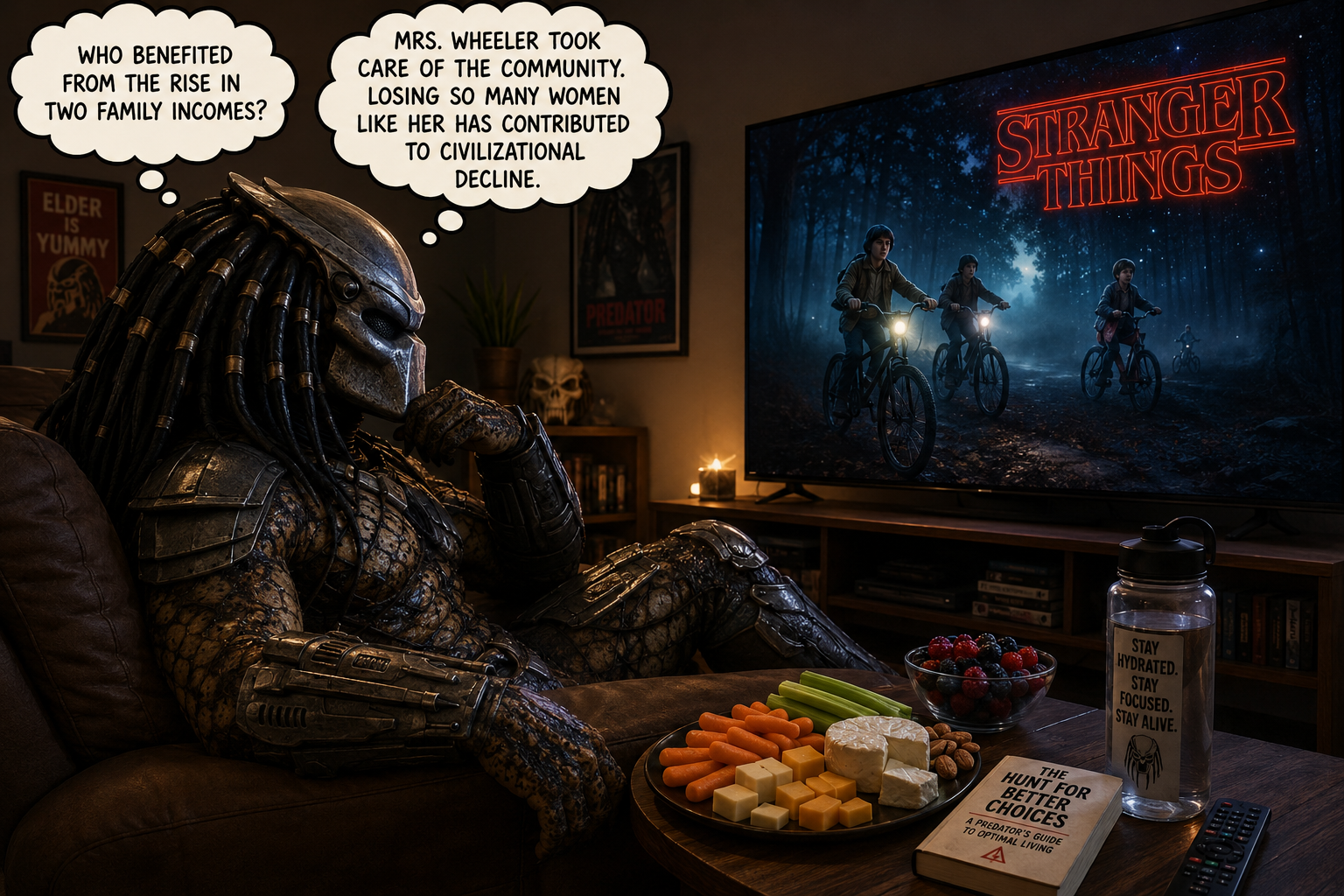
You know… a completely normal person watching television in a completely normal way.
;)