Why the Validation Economy is Dying
THE ADDICTION
We're living in peak reverse solipsism — a condition I've written about before, wherein one's internal experience exists only if externally validated. Likes, followers, engagement metrics: these have become the currency of selfhood for a rather large demographic. And the many who've coordinated around this economy do what insecure structures always do when confronted with anyone operating outside their cartel: they attack. But here's the thing the attackers haven't noticed yet: the structure is collapsing.
The validation economy didn't emerge organically from human vanity, though vanity certainly greased the rails. No — it was engineered. Variable reward schedules lifted wholesale from slot machine psychology. Notification architecture designed by behavioral economists who understood Skinner better than most clinical psychologists. Platform incentives structurally identical to the ones that built cigarette markets in the 1950s. The addiction is real because it was manufactured to be real. And like all manufactured addictions, its collapse requires understanding not just the user but the dealer — who is also, rather quietly, going broke.
There's a subtler violence here that bears naming. The many have not merely adopted reverse solipsism as personal pathology; they've enforced it as social contract. The unvalidated are read as threats. The internally operating — those of us who maintain experiential continuity without external confirmation — are punished for the implied insult of our sufficiency. To exist outside the validation economy is to become, by your very presence, an accusation. And accusations, as we know, must be dealt with.
WHY IT MUST FALL
The metrics are worthless. Everyone knows this. Bot farms, algorithm gaming, engagement purchased in bulk from Indonesian click factories — the numbers mean nothing, have never meant anything, but the addiction persists because addiction doesn't require truth. It requires only the performance of truth, which the platforms have been happy to provide.
But the infrastructure is visibly rotting now, and even the most devoted adherents can smell it. X hemorrhages advertisers while Elon tweets about platform health. Instagram engagement rates have declined year-over-year for half a decade. The platforms are in late-stage extraction mode — monetizing the remaining users while the floor drops out beneath them. This is the behavior of an industry that knows. You can always tell when the dealers have started using.
The money is leaving. Brands have finally done the math on influencer marketing ROI and discovered what anyone with a functioning bullshit detector could have told them five years ago: it doesn't work. VC funding for social media startups has evaporated. The economic engine that built the validation economy is sputtering out, and no amount of pivot-to-video or "we're actually an AI company now" is going to restart it.
But here's where it gets interesting. The epistemological damage is becoming undeniable. When your sense of what is real depends entirely on external validation, and external validation is demonstrably fraudulent, there is no floor. The crisis isn't just economic or psychological — it's ontological. An entire generation built their understanding of reality on metrics that were never real. The reckoning, when it comes, will be structural, not incidental.
Meanwhile, the people are exhausted. Constant performance, diminishing returns, mental health crisis at scale. The hollow recognize their hollowness but can't exit because exit would require admitting the whole edifice was a con, and they were the mark.
And yet — the early exits are already visible. They're quiet. They don't announce with fanfare, because announcement would be just another performance, and they're done performing. But the pattern is legible to those of us watching. The most capable are leaving first, because they can afford to. Because they have interiority to return to. The rest will follow, or they won't. Either way, the empire is falling.
THE FIVE PHASES
What follows are technically hypothetical projections — emphasis on technically — but I'd wager they'll serve as a rather reliable guideline. The pattern is already visible if you know where to look.
PHASE 1: METRIC INFLATION (now – 2028)
Validation abundant but worthless. Everyone has followers; no one has influence. The tell is the inflation anxiety — the desperate arms race to 10K, 100K, 1M, each threshold immediately devalued upon arrival. The horizon retreats faster than you can run toward it. You're sprinting on a treadmill someone else controls, and they keep turning up the speed because your desperation is the product they're selling.
PHASE 2: TRUST COLLAPSE (2025 – 2032)
The public recognizes metrics are fraud. Economic support crumbles. Early exits begin — quiet, strategic, unremarked-upon by those still performing. The first casualties are the mid-tier: too invested to exit, too visible to survive credibility collapse. Brands quietly shift spend to channels with actual ROI. The influencer tier that built entire lives on this economy discovers the lease was always month-to-month, and the landlord just sold the building.
PHASE 3: THE GREAT EXHAUSTION (2030 – 2038)
Mass exodus. "I quit social media" becomes status signal. Protected solitude becomes desirable rather than suspect. Depression, in this phase, functions as latent recognition — the body knew the ledger was false before the mind could admit it. The exodus will be framed as wellness, self-care, digital detox. It is actually ontological correction. The structure was poisoned; the organism is finally expelling the toxin.
PHASE 4: SCARCITY INVERSION (2035 – 2045)
Real recognition becomes rare and therefore valuable. Patron models emerge. Quality over quantity. Scarcity restores signal. When everyone had a platform, having a platform meant nothing. When genuine interiority is rare and demonstrable, it commands what it always should have: sustained attention, financial support, loyalty. The patrons of this phase will be sophisticated — burned once by fraudulent metrics, now discriminating. They'll know how to tell the difference.
PHASE 5: INTERNAL MEASUREMENT RENAISSANCE (2040 – 2055)
"Does the work manifest?" replaces "How many likes?" Substance valued over performance. The internal measurement renaissance doesn't announce itself as a movement — movements are just another form of external validation. It will look, from the outside, like a small number of people producing extraordinary things with unusual equanimity. No hustle language. No growth strategy. No personal brand. Just the work, and the strange luminosity of people who stopped needing permission to exist.
WHO SURVIVES
Internal operators already functioning outside validation structures. Death glamour carriers producing regardless of recognition. The distinguishing characteristic is that they never required the economy to justify the work — they were already producing in its absence, or in active contempt of it. The corpus exists independent of reception. This is not stoicism, which is just performative indifference. This is a different architecture of self entirely. These are the people who kept working through the years when no one was watching, because watching was never the point.
Patrons with resources seeking substance to preserve. The intelligent money — and there is always intelligent money, even when the stupid money is louder — recognizes that supporting genuine work is both insurance against cultural collapse and a rather elegant form of legacy. They're building new support structures now, quietly, while everyone else is still trying to game the old metrics.
Reluctant survivors — those ejected from the validation economy involuntarily, who processed the grief and discovered interiority on the other side of the loss. Canceled, deplatformed, shadowbanned into irrelevance. They mourned. They raged. Then they found out what they were like when no one was watching. They will be valuable precisely because they know both terrains: they remember what the addiction felt like, and they survived withdrawal. They can translate.
The casualties, though. Oh, the casualties.
Hollow performers whose entire sense of self was constructed from engagement metrics. When the numbers stop coming — and they will — there is no one home to experience the silence. Just a vacancy where a person should have been, and a mounting panic that cannot be soothed because it has no internal referent. These are the ones who will spend years chasing the next platform, the next algorithm, the next promised land of virality, growing progressively more frantic as each one fails them. They will not understand that the platform was never the problem. They were always the absence at the center of their own performance.
Metric-dependent influencers who built careers on fraudulent numbers and now discover, too late, that the skills they developed — optimizing captions, timing posts, reading analytics dashboards — are not transferable to any economy that values substance. They will insist, loudly and with increasing desperation, that they are providing value, that their audience is real, that engagement is coming back any day now. They will be wrong. The market is contracting, and it is contracting around them specifically.
Mid-tier performers who mistook access to an audience for possession of one. They had proximity to attention, briefly, and confused it for relationship. When the algorithm shifts — and it always shifts, because the algorithm is not their friend and never was — they will be revealed as interchangeable. They will rage about shadowbanning, about platform changes, about how it's harder now than it used to be. They will not consider that perhaps it was always hard to be worth sustained attention, and the temporary ease was the aberration, not the new difficulty.
Anyone who requires external validation for self-worth. Not just prefers it, not just enjoys it, but requires it the way an addict requires the substance. When the supply is cut off — and the supply is being cut off, systematically, by economics and exhaustion and epistemological collapse — they will discover they have no internal foundation. No way to know what they think, what they want, whether they exist at all, without someone else confirming it. This is not a personal failure. This is the designed outcome of the validation economy. They were always meant to be dependent. The cruelty is that they will blame themselves for the withdrawal, rather than the dealer for the original dose.
The most wicked part? Many of them will never recognize what happened. They will spend the rest of their lives attributing their collapse to circumstance — bad timing, algorithm changes, shifting trends — rather than structural inevitability. They will die still believing the economy was real, and they simply failed to secure their position within it. They will never understand that the position was never available, because the whole apparatus was a con from the beginning, and they were never the player. They were always the product.
THE NEW ECONOMY: RECOGNITION VS. VALIDATION
Let's be precise about the distinction, because the difference isn't semantic — it's structural.
Validation Economy:
Metric-based, externally determined
Abundant but worthless
Requires constant feeding, like any addiction
Collapses under its own fraudulence
Recognition Economy:
Substance-based, internally anchored
Scarce and therefore valuable
Sustainable through depth rather than volume
Rewards the work, not the performance of working
Small networks of deep engagement replace mass following. Patron support based on demonstrable work value, not vanity metrics. Constellation models over broadcast performance. If this sounds like a return to pre-digital structures, that's because it is — not out of romantic nostalgia for some imagined golden age, but because certain structural logics are durable precisely because they align with how attention and value actually operate when stripped of manufactured incentives.
The constellation model deserves elaboration, because it's the architecture that survives what's coming. Rather than broadcasting to mass anonymous audiences who may or may not be human, who may or may not exist, the new structure involves known nodes — small networks where each member is legible to the others, where the work circulates under conditions of genuine attention rather than algorithmic distribution. This resembles pre-industrial patronage not by accident but by structural logic. Small, deep, and durable beats large, shallow, and volatile. Always has. The validation economy convinced us otherwise for two decades, but the math is correcting.
The recognition economy also restores curation as a meaningful act. In the validation economy, curation was just another performance metric — look at my impeccable taste, count my shares, validate my discernment. In the recognition economy, what someone chooses to preserve and champion becomes a substantive act with real stakes. Your attention is finite. Your endorsement is legible. What you support reveals not just your taste but your values, your judgment, your ability to distinguish signal from noise. Curation becomes consequential again, which means curators must become competent again. The dilettantes and the clout-chasers will be filtered out by their own irrelevance.
This is the economy I'm building toward, incidentally. Not because I'm virtuous — virtue has nothing to do with it — but because I watched the validation economy's endgame from outside its walls, and I have no interest in being inside the building when it collapses. The early exits are quiet, as I said. But they're already underway.
WHAT THIS MEANS
If you're already operating internally: Keep producing. Your corpus demonstrates the future model. When the shift accelerates — and it will accelerate, because collapse always does once the tipping point hits — you're positioned not as early adopter but as native. The early adopters of internal measurement are not ahead of a trend. They are ahead of a return. This is how serious work has always operated, across most of human history, in most cultures that produced anything worth remembering. The validation economy was the aberration. Brief, loud, expensive, and structurally doomed from the moment it mistook attention for value.
If you're transitioning: Develop internal measurement now, while you still have time to build the musculature. Withdraw from metric-dependent platforms — not performatively, not as content, but actually. Build work unlinked to validation. This will feel like working in a void. Good. The void is where you find out whether there's anyone home. Most people discover there isn't. That's useful information too.
The pendulum swings left. We're at peak external — maximum noise, maximum distraction, maximum fraudulent validation — which means the reversal approaches. Those operating from internal substance now inherit the post-collapse landscape, not because they were virtuous but because they were structurally compatible with what comes next. Virtue is a performance metric. Compatibility is architecture.
The question of readiness is also a question of what you built while the noise was loudest. Those who built work during peak distraction, without the incentive of metrics, without the reward of recognition, without anyone watching at all — that is the corpus that survives. Because distraction is a filter. An extraordinarily efficient one. The validation economy was, among other things, a sorting mechanism for identifying who couldn't do the work without an audience. Who needed the dopamine hit of notifications to justify the next sentence, the next brushstroke, the next hour spent in solitude with the thing itself.
Unseen building is proof. Radiant production without validation. The work manifests regardless of economy type, regardless of platform health, regardless of whether anyone notices. This is not nobility. This is simply how it works when the architecture of self is internal rather than outsourced.
The validation addiction will break. Internal measurement will return — not as revolution, but as the ground state reasserting itself after a brief, manic deviation. The question is whether you'll be ready when it does. Whether you built something real while everyone else was building metrics. Whether you know who you are when no one's watching.
I do. That's why I'm still here.
— Majeye
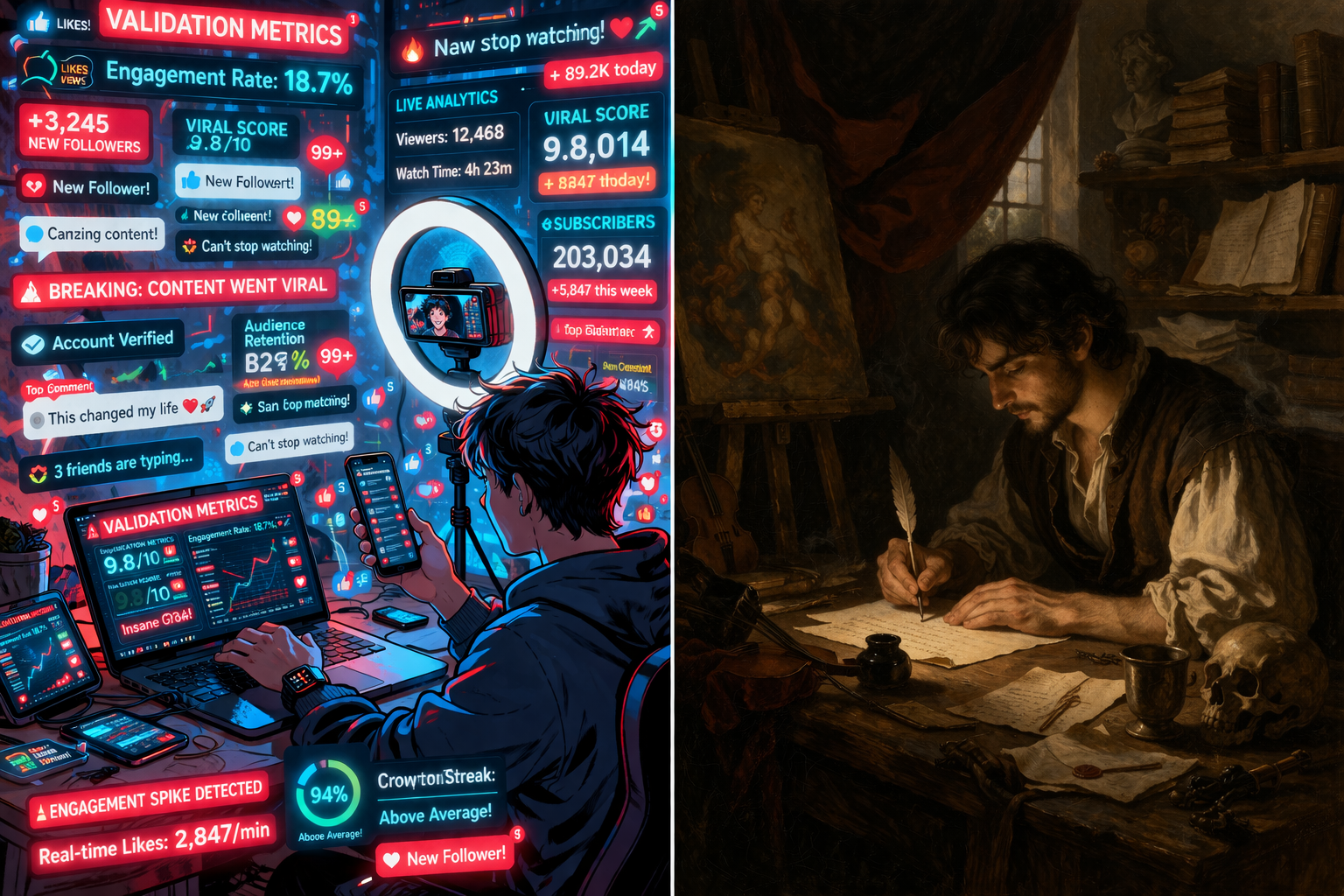
Writing with quills aside, I jive with the person on the right.
I fear what happens to the one on the left when the validation economy finally dies.