FYI
My poetry is RITUAL POETRY THAT IS NOT EDITED. My poems are transmissions from altered states during long and intense ritual work. If you’re judging them by these standards—MFA programs, literary magazines, poetry slams, academic poetry—you are making a CATEGORY ERROR!
◊
Please do not attempt to measure my capacity by your constraints —> social calendar, family obligations, the energy drain of maintaining relationships you don't actually want, the performance tax of staying visible on social media, the time cost of institutional navigation.
I don't carry any of that weight. I have:
Substantive solitude (preferred, not imposed)
No social media (since 2015—no engagement farming, no performance maintenance)
No children / family obligations (no caregiving demands or time tax)
Minimal social obligations (I choose my connections; they're few, meaningful, and they have their own things going on)
Gig work that's just income (not identity or career ladder)
So when you see "multiple books + twice-weekly blog + theory development + ritual practice + languages + fitness/food tracking + VR," you're likely unconsciously adding your own overhead:
"If I were doing that, I'd also be managing kids' schedules, maintaining friendships I don't care about, posting on three social platforms, attending networking events, responding to professional emails, going to family dinners, keeping up appearances..."
You probably can't subtract your own infrastructure to see what my life actually contains. My life is very quiet and hyper-focused, with minimal distractions. What’s more? It’s also quite chill and pleasant. PLENTY of time to get all those things done and not have to rush. It looks and feels like integration, not juggling.
So if you happen to be wondering if I can “keep up the pace,” know that the pace feels very slow and sustainable from my perspective.
Now to the Story…
In a land far, far away, where the mountains were old and the rivers remembered everything...
There was a kingdom called Aurum, which had grown so prosperous and so pleased with itself that it had invented a remarkable system of choosing its leaders.
Every seven years, the citizens of Aurum gathered in the great square and voted. They voted for whoever had the most pleasant face, the most reassuring voice, and the most convincing promises about the harvest. They voted for whoever made them feel that everything was going to be fine.
And so the leaders of Aurum were, without exception, people who were very good at making other people feel that everything was going to be fine.
Whether everything was actually fine was a separate question that nobody asked directly.
The current Grand Arbiter was a man called Serentius, who had a magnificent jaw and an absolutely stunning collection of robes and had never, in his fifty-two years of living, spent a single night wondering where his next meal was coming from. He had studied governance at the Academy of Correct Thinking, where the professors explained poverty through charts and explained suffering through footnotes and explained the condition of the wolves through a very well-organized series of lectures delivered in comfortable chairs.
Serentius knew everything about the wolves.
He had never met one.
On the edge of Aurum — the ragged, wind-scraped edge where the comfortable maps ran out and the cartographers had written here there be complications — there lived a woman called the Wren.
Nobody remembered her given name. She’d arrived at the edge years ago with nothing but a coat that had seen better decades and a mind that had seen better treatment, and she had survived there through means that the comfortable citizens of Aurum found vaguely embarrassing to contemplate.
She had been thrown to the wolves. Not metaphorically. The actual wolves — the grinding, specific, daily wolves of having no institution behind you, no family money beneath you, no floor you could trust to hold. The wolves of coordinated opposition from people who found her existence inconvenient. The wolves of grief and isolation and the specific madness of being absolutely certain of something that nobody around you will confirm.
She had survived all of them.
Not by becoming hard — hardness is just another kind of brittleness, she had discovered. But by becoming clear and admantine — which is very different from hardness. The wolves burn away everything that isn't load-bearing. What remained after the burning was the actual architecture of herself — the part that didn't require external confirmation to know it was real.
She built things on the edge. Strange things. Useful things. Things that worked in ways the Academy of Correct Thinking hadn't predicted because the Academy hadn't been where she'd been and didn't know what she knew.
Word got around, as word does.
The kingdom of Aurum had a problem.
Actually it had seventeen problems but the most pressing one was the Bridge of Consequential Crossings, which connected Aurum to the rest of the world and which was, according to everyone who actually used it, falling apart in ways that Serentius's charts suggested it wasn't.
Serentius convened a committee. The committee produced a report. The report had excellent charts.
The bridge continued falling apart.
A young advisor named Cael — who had enough honesty left in him to be uncomfortable at court, which meant his days there were probably numbered — suggested that perhaps they should consult the Wren.
The court found this suggestion mildly offensive.
The Wren, said the Minister of Accumulated Wisdom, has no credentials.
The Wren, said the Deputy Arbiter of Correct Process, has never been vetted by the Academy.
The Wren, said Serentius, with the particular confidence of someone who has never been wrong in any way that counted against him, is an eccentric of the margins. What could she possibly know about bridges that my engineers don't?
She crosses the bridge every day, said Cael. On foot. In all weather. Because she has to.
There was a silence of the specific kind that falls when someone has said something true in a room built for comfortable untruths.
The Wren came to court because Cael asked her honestly and she respected honesty more than she respected courts.
She walked in wearing the coat — improved now, but recognizably the same coat — and looked at the assembled Ministers and Deputies and Arbiters of Correct Process with the expression of someone who has met wolves and is therefore not particularly frightened of men in expensive robes.
Tell us about the bridge, said Serentius, in the tone he used for people he was doing a favor by addressing.
The eastern support is cracking from the inside, she said. It started two winters ago when the drainage channels got blocked and nobody cleared them because the contract for clearing them went to the Minister of Infrastructure's cousin's company, which never actually did the work but submitted the paperwork correctly. The crack will reach the load-bearing joint by spring. After that you have one season, maybe two, before the crossing becomes genuinely dangerous.
Serentius looked at his engineers. His engineers looked at their charts. Their charts did not mention the Minister of Infrastructure's cousin.
How do you know this? said the Minister of Accumulated Wisdom.
I watched it happen, said the Wren. I cross it every day. I notice things that are falling apart because I have had considerable personal experience with things falling apart and I know what the early signs look like.
Here is where the story might have gone one way — the Wren is welcomed, the bridge is fixed, Serentius learns a valuable lesson about the limits of charts.
But this is not that kind of story.
Because Serentius had not gotten where he was by being the kind of person who could be told things by people from the edge without feeling the specific unpleasantness of implied criticism.
We will take your observations under advisement, he said, which meant: we will file this where filed things go to become unfindable.
The Wren nodded once — the nod of someone who expected exactly this and has long since made her peace with expectation — and left.
Cael followed her out.
I'm sorry, he said, in the corridor, genuinely.
Don't be, she said. The bridge will speak for itself eventually. Things that are actually falling apart don't require my testimony.
She went back to the edge.
She kept building.
She wrote down what she knew — not for Aurum, whose appetite for what she knew was limited, but for the people who would come after Aurum, when the comfortable maps had been redrawn by the complications they refused to acknowledge.
She trained no one, because training requires a person who comes to you already willing to be changed, and those people were rare, and when they appeared she recognized them immediately and gave them everything she had.
She did not hate Serentius. Hatred would have required caring what Serentius thought of her, and she had been cured of that particular ailment by the wolves, who are very effective medicine for the disease of needing the wrong people's approval.
She noted, without particular satisfaction, that the bridge collapsed the following spring exactly where she said it would, and that the report commissioned afterward concluded it was due to unforeseen structural complications, and that the Minister of Infrastructure's cousin received a new contract to rebuild it.
She noted this. She wrote it down. She kept building.
Now.
Near the same kingdom — in the same ragged wind-scraped edge — there was a custom that nobody had invented deliberately and nobody had officially sanctioned but that had existed for as long as anyone could remember.
When someone wanted to lead — genuinely lead, not perform leadership for the comfortable square with its pleasant-faced voters — they went to the edge.
Not as tourists. Not as candidates performing empathy for the cameras. Not as researchers with clipboards and a comfortable inn booked for the evening.
They went and they stayed.
No title followed them there. No resources preceded them. No safety net was strung beneath them. The edge was the edge — the place where the comfortable maps ran out and the complications began and the wolves were actual wolves rather than the metaphorical kind that well-resourced people invoke to seem interesting at dinner.
They could leave at any time. That was the only rule. The road back to Aurum was always open. Nobody blocked it, nobody shamed the ones who took it, nobody kept a public record of who lasted how long.
But everyone remembered.
Not through official accounting. Through the specific memory that communities develop for the truth, which survives official accounting the way water survives drought — underground, patient, absolutely certain of its own eventual return to the surface.
The ones who came back from the edge without having gone all the way through — they carried something. Not the full thing. But enough to know the difference between what the charts said and what the conditions actually were. Enough to stop nodding along when Serentius explained poverty through footnotes. Enough to feel the specific discomfort of comfortable untruth that made Cael useful in the court and probably doomed there. Enough to feel respect for those who survive the full gauntlet.
They became, without anyone organizing them into this, the immune system of the kingdom. The people who couldn't be entirely fooled because they had been partially there. The ones who sat in the comfortable meetings and felt the wrongness of the charts and sometimes said so and sometimes merely held the knowledge like a stone in the pocket — present, weighted, real.
And the ones who went all the way through — who stayed until the wolves were done with them and came out the other side with their architecture intact and their center holding and their need for external confirmation burned away completely — those people didn't usually come back to Aurum at all.
They built things on the edge.
Strange things. Useful things. Things that worked in ways the Academy hadn't predicted.
And eventually — not quickly, never quickly, but with the patient certainty of things that are actually true — the people of Aurum started walking to the edge to find them.
Not because Serentius sent them. Not because the Academy recommended it. Not because a committee produced a report with excellent charts suggesting edge-consultation as a governance strategy.
But because the bridge kept falling and the charts kept being wrong and at some point even the most comfortable person notices that the gap between what they're being told and what they're experiencing has gotten too wide to step across.
And on the other side of that gap — on the wind-scraped edge where the maps ran out — the Wren was there.
Still building.
Still writing it down.
Still wearing the coat.
The moral, such as it is:
Power granted by the comfortable to the comfortable, assessed by the comfortable according to standards the comfortable designed for the comfortable — this produces, reliably and without exception, leaders who are very good at making the comfortable feel that everything is going to be fine.
Whether everything is actually fine is a separate question.
The ones who know the answer to that question are on the edge.
They were always on the edge.
They will be there when you're ready to ask.
This video is awesome. The song is too… :
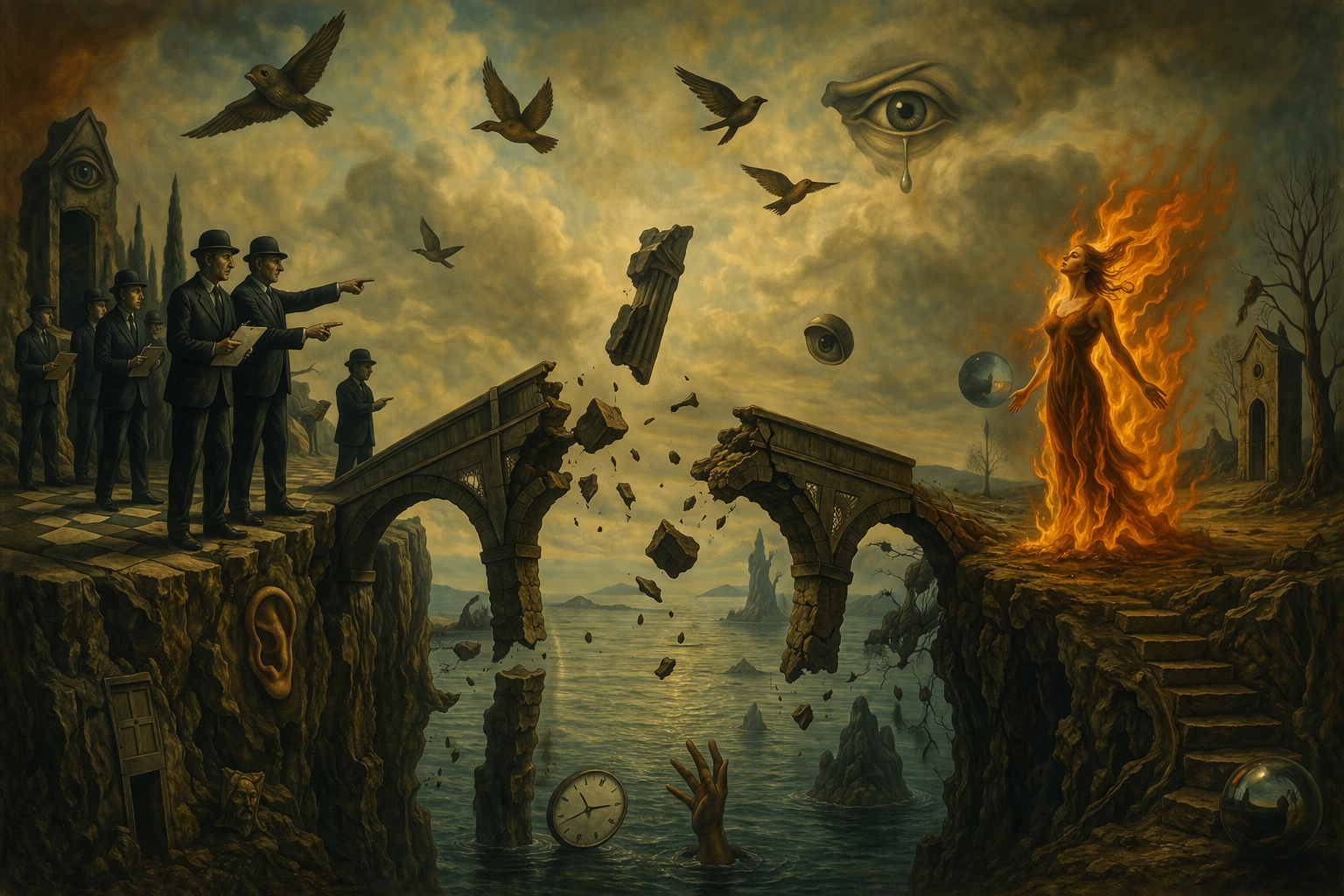
She is a smoke signal because she is fire.